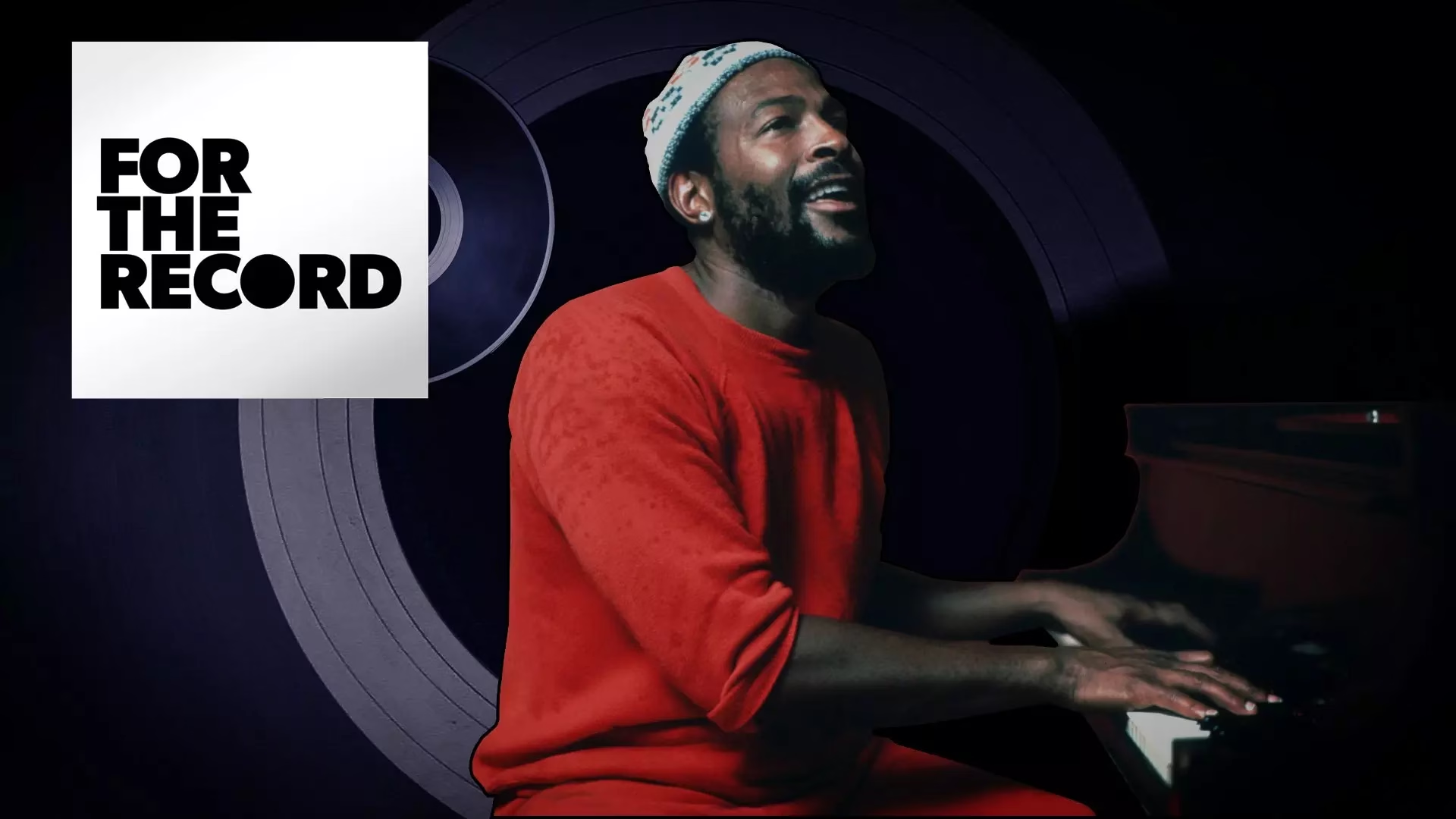
By 1970, Black America was in turmoil. In April 1968, civil rights icon Dr. Martin Luther King Jr. was brutally assassinated in Tennessee. Edwin Pratt was shot to death in the doorway of his Seattle home in January 1969. Black Panther revolutionary Fred Hampton was killed by police gunfire, while sleeping after being drugged, in Chicago in December 1969. In March 1970, Tammi Terrell, Marvin Gaye's longtime singing partner, succumbed to brain cancer.
For Gaye, this string of events became part of the recipe for a heartbreaking masterpiece to come: What's Going On, Gaye's 11th studio album, released May 21, 1971. Widely considered his magnum opus, regularly ranked as one of the best albums of all time, and inducted into the GRAMMY Hall Of Fame in 1998, What's Going On was born from both the singer's personal loss and the tragedy that descended on the Black community at the dawn of the 1970s, compounded by the thousands of young men returning home to America from the Vietnam War. Among them: Gaye's brother, Frankie. That same year, the singer broke a self-imposed three-year media blackout to talk about the tumult that went into the creation of the pivotal album.
"I was terribly disillusioned with a lot of things in life and life in general, and decided to take time out to try to do something about it," Gaye told Disc and Music Echo (via the Guardian) by telephone from his home in Detroit. "I spent the three years writing, producing and reflecting. Reflecting upon life and upon America especially – because that's where I live – its injustices, its evils and its goods. Not that I'm a radical – I think of myself as a very middle-of-the-road sort of person with a good sense of judgment. I think if I had to choose another profession I'd like to be a judge because I'm very capable of determining what's right and what's not."
"What's Going On," the album's flashpoint, came to be when songwriter and Four Tops member Obie Benson was inspired to start writing after witnessing Bloody Thursday at People's Park in Berkeley, California, while on tour in 1969.
"They had the Haight-Ashbury then, all the kids up there with the long hair and everything," he told MOJO (via American Songwriter). "The police was beating on the kids, but they wasn't bothering anybody. I saw this, and started wondering what was going on. 'What is happening here?' One question leads to another. 'Why are they sending kids so far away from their families overseas?' And so on."
Read More: Marvin Gaye 'Let's Get It On' | For The Record
Benson, who co-wrote the song with fellow Motown songwriter Al Cleveland and, later, Gaye himself, took "What's Going On" to the Four Tops and Joan Baez. After both artists turned down the tune, Benson and Cleveland shared the song with Gaye, who was adamant that the track was ideal to launch a new vocal group, the Originals. Benson ultimately made Gaye an offer he couldn't refuse: "I finally put it to him like this: 'I'll give you a percentage of the tune if you sing it, but if you do it on anybody else you can't have none of it.'"
With Gaye throwing himself into the producer role for the record, Benson marveled at how the singer made "What's Going On" his own.
<style>.embed-container { position: relative; padding-bottom: 56.25%; height: 0; overflow: hidden; max-width: 100%; } .embed-container iframe, .embed-container object, .embed-container embed { position: absolute; top: 0; left: 0; width: 100%; height: 100%; }</style><div class='embed-container'><iframe src='https://www.youtube.com/embed//o5TmORitlKk' frameborder='0' allowfullscreen></iframe></div>
"He definitely put the finishing touches on it," Benson said. "He added lyrics, and he added some spice to the melody. He added some things that were more ghetto, more natural, which made it seem more like a story than a song. He made it visual. He absorbed himself to the extent that when you heard the song you could see the people and feel the hurt and pain. We measured him for the suit, and he tailored it."
Example: The iconic saxophone melody at the start of the song happened while saxophonist Eli Fontaine was getting ready to play. Fontaine was just warming up; suddenly, Gaye stopped the tape player and thanked him for his work. When the instrumentalist informed the singer that he was simply goofing around, Gaye responded, "Well, you goof exquisitely." He had captured exactly what he needed.
"I feel very good about it. I wasn't sure what would happen to it," Gaye, describing the finished song, told Disc and Music Echo in 1971. "But I don't feel good for myself – I didn't have much to do with the song; I feel it all came from God. He drew me into it."
<style>.embed-container { position: relative; padding-bottom: 56.25%; height: 0; overflow: hidden; max-width: 100%; } .embed-container iframe, .embed-container object, .embed-container embed { position: absolute; top: 0; left: 0; width: 100%; height: 100%; }</style><div class='embed-container'><iframe src='https://www.youtube.com/embed//tffzUtPlD4E' frameborder='0' allowfullscreen></iframe></div>
The singer was similarly pragmatic in regards to What's Going On as a whole. "I musn't get into ego tripping, because I didn't have much to do with it," Gaye insisted. "But I'm only human and when you get a lot of pats on the back for something it makes you go on trips. I was only the instrument in the album – all the inspiration came from God himself. It's one that should be listened to. The material is social commentary but there's nothing extreme on it. I did it not only to help humanity but to help me as well, and I think it has. It's given me a certain amount of peace."
Legendary record executive and Motown president Berry Gordy, on the other hand, hated "What's Going On," calling it, "the worst thing I ever heard in my life." According to Gordy himself, though, the truth isn't quite as dramatic. "I was in the Bahamas trying to relax," he remembered in the 2016 Motown documentary, Marvin, What's Going On? "He called and said, 'Look, I've got these songs.' When he told me they were protest songs, I said, 'Marvin, why do you want to ruin your career?'"
"I was extremely happy that I released [e] because it was the biggest record at that time," Gordy told TMZ in 2016. "But Marvin was so determined, and such a beautiful person was Marvin. And he fought everything that he thought was injustice and he wanted to speak about—he had a brother in Vietnam—and he convinced me that we should try it. But I didn't think it was going to work."
Released as the album's lead single in January 1971, "What's Going On" was an instant hit; it captured the country's mood while moving more than 10,000 copies in just the first week in record stores. The song made a steady ascension up the Billboard charts, peaking at No. 2 over the week of April 10, 1971. The song that blocked Marvin Gaye from the No. 1 spot? The Temptations' "Just My Imagination (Running Away with Me)."
Released in June 1971, the album's second single "Mercy Mercy Me (The Ecology)," a similarly laid-back yet topical cut, rode up the Hot 100 chart, reaching No. 4 on Aug. 20, 1971. The top tune in America that week: Bee Gees' "How Can You Mend a Broken Heart." Like "What's Going On," "Mercy Mercy Me" peaked at No. 1 on the Billboard R&B chart; it was inducted into the GRAMMY Hall Of Fame in 2002.
<style>.embed-container { position: relative; padding-bottom: 56.25%; height: 0; overflow: hidden; max-width: 100%; } .embed-container iframe, .embed-container object, .embed-container embed { position: absolute; top: 0; left: 0; width: 100%; height: 100%; }</style><div class='embed-container'><iframe src='https://www.youtube.com/embed/_nugzfah5k0' frameborder='0' allowfullscreen></iframe></div>
"Inner City Blues (Make Me Wanna Holler)," the third and final single off What's Going On, proved to be another Top 10 hit in the American mainstream, climbing to No. 9 over the week of Nov. 6, 1971. (Cher had the No. 1 song at the time with "Gypsys, Tramps & Thieves.") That same week, "Inner City Blues" was the No. 1 song on the Billboard R&B chart, marking a perfect hat trick for Gaye. At the 14th GRAMMY Awards held in 1972, the song received a GRAMMY nomination for Best R&B Vocal Performance, Male.
With What's Going On, Marvin Gaye made a massive, and potentially devastating, shift in his artistic direction. But as he puts it, he simply had nothing left to lose.
"There seemed to be nothing else to do," he admitted to Disc and Music Echo. "My life, destiny and fate weren't pointing in any direction, so I thought maybe that would bring it all together a little more."
Fifty years after the release of What's Going On, it's clear Gaye's risk paid off. Its impact has left an indelible mark on Black music and culture. "After What's Going On," Rolling Stone writes, "Black musicians at Motown and elsewhere felt a new freedom to push the musical and political boundaries of their art." Elsewhere, John Legend described the album as "the voice of Black America speaking out that we couldn't always smile on cue for you."
Born out of the social unrest that defined America five decades ago, What's Going On remains a pillar of Black music and the soundtrack to the social revolution.
Black Gold At 50: How Nina Simone Refracted The Black Experience Through Reinterpreted Songs