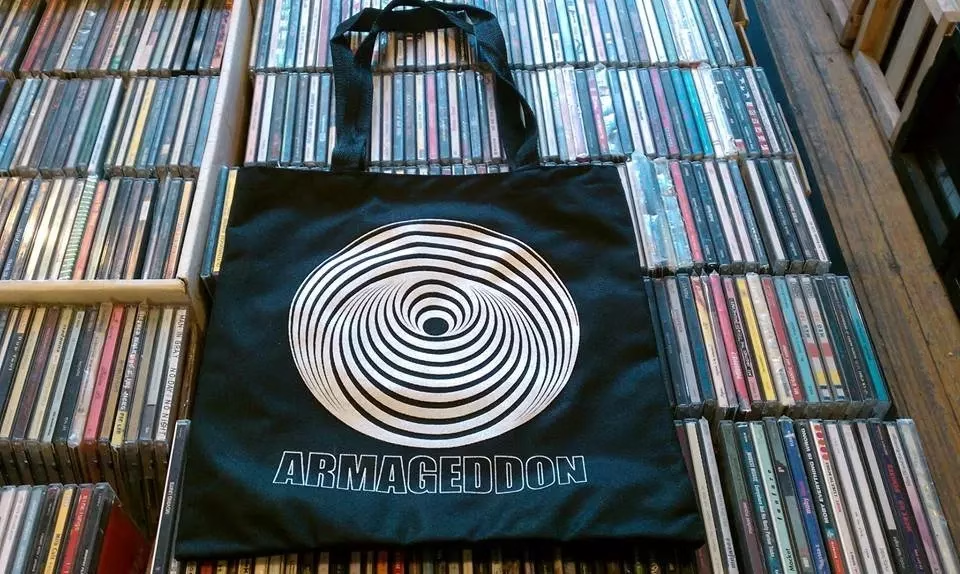
If you weren't looking for it, chances are you would walk right by Armageddon Records in Harvard Square without noticing it was even there. The Boston-based record store is a staple — the kind of place that's recommended by any music junkie living there, particularly to fans of punk and hardcore — and yet its public-facing storefront is modest at best, invisible at worst. It’s burrowed underground in a basement space. Its front entrance, an inconspicuous apartment door jammed between an eyebrow threading service and an eyeglasses shop, reveals a descending stairway and a few Armageddon-labeled records hammered to the sloped ceiling. Occasionally a black sandwich board is propped open on the sidewalk to get your attention.
Perhaps that's why Armageddon feels like a vinyl oasis when you step into the store. It doesn’t get much sunlight underground, so it allows you to lose track of time, almost like hanging out in a friend's cozy den. Rows of new and used vinyl snake around the store, boasting a healthy collection of punk, hardcore and metal alongside a surprisingly well-stocked rock section as well as small electronic and hip-hop sections. All 7"s are organized cleanly, with a massive row solely for local artists. Old hard-to-find band T-shirts hang along a wall. Stacks of magazines, local zines and offshoot papers burst from a bookshelf in a corner. Every inch of wall space is covered with old flyers, basement show signs and iconic memorabilia. And there, behind the counter, are its heavily inked, all-knowing, always friendly staff ready to offer help.
To understand the importance of Armageddon in Boston, you must rewind a few decades and reroute to Providence, Rhode Island. Back in 1991, Ben Barnett and his friends formed the hardcore punk band Dropdead. They were quick to gather fans, playing the type of frenetic powerviolence that gets crowds going, all while repping the do-it-yourself ethic to their very core. When he wasn’t touring, Barnett worked at a local Providence record store called Fast Forward until it closed in 1998. Dropdead toured for the next year, and that’s when he began to notice a trend: local record stores were closing elsewhere too.
Once the band returned home, Barnett began saving money for a new goal. "Nobody was selling punk and metal or crazy weird sh*t anymore," he recalls. "I wanted to open a shop to represent that, because it simply wasn’t being covered." So he teamed up with his then-wife to buy a record store of their own. It opened in 2001. He was 30 years old.
"We had a lot of friends across various scenes who came out that first year," he recalls. "Providence was, more than it is now, a big scene or different bands helping one another. Garage rock people, metal and punk kids, people making weird art — they all came here. They were really supportive of what we were doing.”
In some ways, the store's success was to be expected. Barnett spent his 20s creating fanzines, sharing music, and, eventually, putting out records. He ran a label back then, Crust Records, that was "a product of its time." In 1997, he decided to get a fresh start. He dropped the record label's name, replaced it with Armageddon (a reference to a song by Siege, the prolific ‘80s thrashcore punk band that Dropdead got their moniker from), and started releasing his band's records on the label. By the time he opened his own record store, it made sense to extend the Armageddon name to the physical store itself.
Barnett would go on to release groundbreaking records through Armageddon Label, like The History of Aids by noise act Prurient in 2002 and the self-titled cassette by doom metal duo The Body in 2000. He offered them a platform that few others extended that early on in their careers.
After a few years of steady growth, Barnett needed a new co-owner to fill in the gap his ex-wife left. When word got out in 2004, applications began flooding in. As a local college radio DJ, a loyal customer, and an overly interested applicant, Chris Andries stood out from the bunch. According to Barnett, having Chris buy in to the business as a partner was a no-brainer. Perhaps the biggest testament of such is that the two are still co-owners to this day.
Armageddon's growth continued to shoot upwards. Barnett had been running Armageddon Label for years at that point, but Andries had some ideas of bands to sign, too. So a new label was formed, Armageddon Shop, for the two to co-release records by bands like Brainbombs, Elder, Churchburn. "Sometimes it's more logical to have two ways of doing things," Barnett explains. "I don’t want to spend Armageddon Shop money on a record that may not sell as much as it needs to in order to profit, which is why Shop records must be releases Chris and I both agree on. I don’t want any projects to cause the store any physical distress, you know? But sometimes you just want to help your friends out, and Armageddon Label gives me room to do so."
<iframe width="620" height="349" src="https://www.youtube.com/embed/FvahG2FRdRU" frameborder="0" allow="accelerometer; autoplay; encrypted-media; gyroscope; picture-in-picture" allowfullscreen></iframe>
Every artist who has teamed up with Armageddon in the past not only speaks highly of it to this day, but often credits it as being a major stepping stone in their career. It’s one of the reasons why both the store and the label continue to be successful almost 20 years later.
"Not only was Armageddon a personal gateway to a lot of music for me, but also the owners, Ben and Chris, are active fosters of the local scene who helped Elder a lot in our formative years,” says Nick DiSalvo, the singer-guitarist of Boston stoner metal trio Elder. "What makes Armageddon special is the pure commitment to music for the love of music, and the genuine love that is reflected in their work. Armageddon’s employees and owners are of a dying breed — people who are immersed in their scene but don’t act as gatekeepers, but who really want everyone to enjoy music."
In 2013, they reissued the famous self-titled 7” of Deep Wound, a shotlived hardcore punk band that disbanded when members J Mascis and Lou Barlow left to form Dinosaur Jr. It’s the type of work that Armageddon does: preserving the history of local scenes that deserves to be upheld.
"Dropdead were easily the best post-first-wave hardcore band I had seen or heard, so [working with Ben on the reissue] seemed promising," says Barlow. "A visit to that store would make anyone want to be involved in their mission. You gotta respect the urge to document and disseminate the artifacts of the movement."
Finally, after five years of scouting spots in Boston to open a second record store, Barnett and Andries opened the new Armageddon Records in Harvard Square in 2010. The Boston community was enthusiastic, as many were already familiar with the Providence location. According to Barnett, there are patrons who shopped there the first week it opened who still return to the store regularly. Now music-loving tourists make it a point to stop in to check out records, as do touring bands performing in Boston. "It's a destination record store, definitely" confirms Lee Buford of The Body. The fact it happens to be a social place just adds to its allure.
For others, like Buford, the growth of Armageddon seems logical. Why would a business run by good people achieve the success that goodness merits? "A bunch of us used to live in a warehouse in Providence, like 60 of us, pretty much the entire Providence music scene," he says over the phone. "We were evicted and we had two days to move out. One of my best memories is of Ben and the rest of the Dropdead guys showing up with tools in their hands and saying they would help us break down our rooms. They offered to help shuttle our items in their van to find a new spot. That’s the type of guy Ben is: very community oriented. That's what I think of when I think of the label and the store, too. They’re so focused on the community and want to help with the local scene however they can."
As the Boston location of Armageddon Records nears its 10th anniversary, it feels particularly special to look back at what it has brought to the surrounding areas. For most, it’s easy to remember the early days of the store — and in turn, it’s exciting to see it still going, as successful as ever. "I was probably in my first year of high school when an older friend told me about the shop. It sounded too good to be true — a haven for hardcore punk and metal just about a 30-minute drive from where we lived at the time," recalls DiSalvo. "The first time I actually made it there, I couldn’t have been much older than 16. I remembered immediately feeling overwhelmed by all selection and relieved by the non-threatening, friendly faces at the counter. Funny that years later they would become close friends!"
Barnett himself is similarly baffled by time. He no longer has to work a side job doing construction, nor Andries working at a local venue, to get by. Armageddon is their sole passion and job now — and it happens to include helping fellow artists in the area thrive. "Watching Elder grow up has been really f**king cool. The Body, too, who I saw play in basements to 15 people," he says. "Seeing your friends work hard and succeed with the thing they love doing is pretty cool. You can’t fault that."
As Harvard Square experiences rapid changes, as do many areas of Cambridge and Boston, there's the possible threat of a rent hike or something worse down the line. Barnett and Andries have a good relationship with their landlord, especially after fine-tuning their basement space to stop it from deteriorating. "That said, it seems like it will be harder for stuff like us to hang on there as these buildings all get bought out," Barnett admits. But getting to watch the cities change — both Boston and Providence — is a treat, even if it may eventually feel like a threat.
Armageddon doesn’t plan on leaving Harvard Square anytime soon, and the regularity of business would suggest the locals don’t want them to either. It's an equally rewarding exchange that’s allowed them to outlast other record stores for a reason.
"There’s no debt or financial reaper hanging over us, which feels pretty good should we have to leave quickly or anything," says Barnett. "The things I feel best about are the times I get to see someone come in stoked about a record, someone saying they found out about a band through our store, or a local musician coming in to buy their new record at the store. It’s such a great type of excitement. After all the days of grinding away, things like that make the stress go away. It always makes it worth it. Always."
The Met, "Play It Loud" & New York City's Love Affair With The Electric Guitar