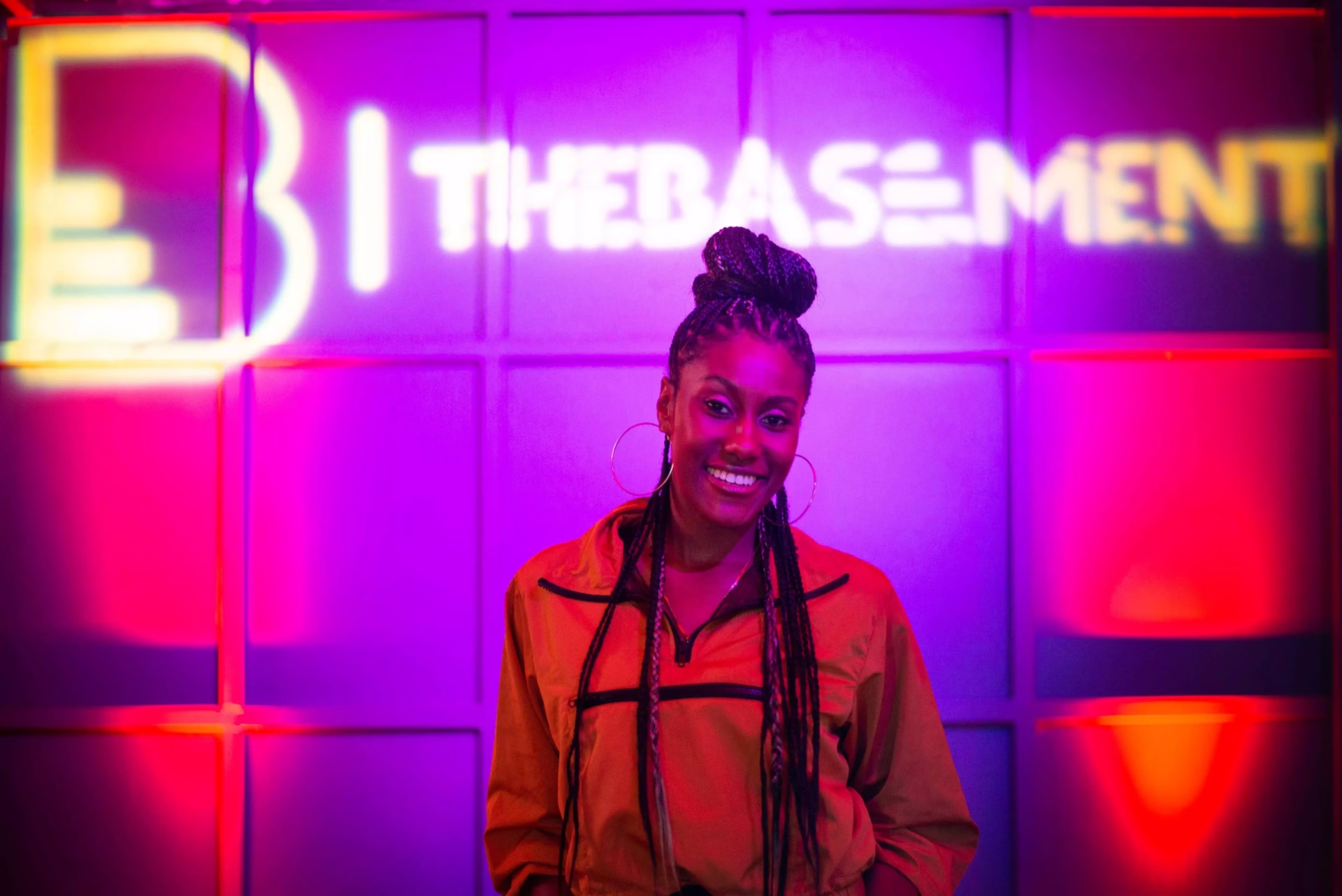
Kansas-born, L.A.-based music executive Ericka Coulter is one of those magical people who connects instantly, makes you feel like a lifelong friend and surrounds herself with an incredible crew. Above all, she is someone who turns visions into reality.
As the Senior VP of A&R at Warner Records, Coulter not only represents big name artists such as Rick Ross, she also highlights rising talent with the event series/industry movement she launched in 2017, TheBasement. Her vision is to help connect emerging talent with what they need to keep growing—excited fans to support them, a label to amplify their work, a manager to rep them, a cool brand to partner with — and to offer them a vibey space to share their music.
Right before the doors opened for the June edition of TheBasement's artist showcase event series, Ericka sat down with the Recording Academy to discuss the spark that started it, how she stays grounded while always moving, her best advice for young artists and music professionals and more.
After the conversation, the doors opened and the exposed-brick space in downtown L.A. quickly became packed and bustling with energy, as the city's hip music creators, professionals and most in-the-know fans waited for the first artist to take the stage. The events take place, popup-style, in different spaces around the city and partner with an exciting mix of music companies and other brands. The June event celebrated Black Music Month and the BET Experience, featuring a stacked lineup of AWAL artists from their new Urban roster.
When did you first discover your calling for working in music?
I'm from Kansas, so I grew up listening to gospel music, and that's really where it started. Like, okay this is what makes me happy. I love to just be around it. But when I came out to L.A., I went to school for fashion and got a degree in fashion merchandising. I loved what I was doing in that, too, but my calling was always that I want to just be in music. I want to put together products. I want to close deals. I want to help people.
At one point I was trying to be an artist and had a couple of sketchy managers, let's say, that weren't the best. If anything, that made me want to go harder to be that person that, if people ever cross my desk, they wouldn't have to go through those things.
But as you get into this, you learn some things are out of your control. It's a process, and not everything works out exactly how you want it to. But if you know that your intentions are good, that's what keeps you sane. And it's like, you know, I know where my heart was. I know why I did it, although it may not have worked.
Did you have any mentors along the way that made you feel like you were on the right path?
Oh, absolutely. I got to work at Interscope during some of the most amazing moments. When Lady Gaga was discovered and Mary J. Blige, Keyshia Cole, Black Eyed Peas and Eminem were all fire. It was just so much all at once, and to see what Jimmy Iovine did, even building Beats.
To see what Beats turned into now, and for Apple Music to be so influential in today's culture, it's incredible. So to see him do that, and when I started I worked for a guy named Step Johnson who was the President of Urban Music. I can honestly say that from him, I learned how to be in this and also know that you can get out at some point, but leave a legacy. And I think that's the most important part, like "what are you doing this for?"
When I was working on Rick Ross' last album, Rather You Than Me, we were in the studio one day and JAY-Z was there, and he was talking about his last project, 4:44. He was playing a couple of records before it dropped and the main thing that he was saying was like, "Yo, you can't be in this if you're not doing it for something." Like as much as we love music because it makes us feel good, what are you doing it for? What are you wanting to leave behind?
And after that, it just made me look at things differently, okay, why am I going so hard? That's what led to TheBasement.
Can you speak a little more to the beginnings of TheBasement and the spark that lead you to starting it?
I wanted to create an environment for people to network, vibe and discover. A room where artist can meet the right people to help them move forward. So maybe you leave TheBasement Series with a record deal out the gate. But maybe you leave with a manager, attorney, producer or writer; something else to help you move further. That's what made me be like, "Okay, there's a need for this."
I found my first sponsor, and then our first venue, a photo gallery. And that's been our thing, to find venues that people wouldn't regularly perform at, something that didn't feel so familiar. Somewhere you can feel inspired, and learn about new artists. Where is it at that you feel like you're discovering something, that you don't feel like it's familiar or that you know what it's going to be. You want to go and feel either inspired or like "I didn't know that person was that dope and I'm going to come back." Or "Now I'm going to go look up that person and start listening to their music." That's what I want you to leave with.
What are some lessons you've learned along the way? I'm sure it's one of those things that keeps going, but could you speak to TheBasement's growth a little bit?
This was literally an idea that has not become a movement that I feel is my responsibility to keep it going.
The one thing that I had to learn is that every conversation is not going to turn into that deal that you wanted it to turn into. But you can't let that stop you. There's been moments where I feel like other people probably would have given up. Where I feel like I'm showing it to you exactly what it is, but you're still not getting it; but I'm a true believer in that whatever is for me is going to be for me. God is going to make sure that happens, and when that door doesn't open that just wasn't the door that was supposed to be there. And no hard feelings, you know what I mean? It is what it is.
I think when you have that mentality, you're going to make it work. Cool, all right, that person, that sponsor didn't come through right now, we're going to get this sponsor, and we're going to put this together. Or you know I've been blessed to have a team of kids that literally we can take $50 and make it look really good. Sometimes too good, but you know that's what makes you be like, okay I'm not doing it for nothing; there's no way that something this good is not going to get where it needs to be.
I use metaphors for a lot of things, but it's like cooking chicken. You cook the chicken, it starts to look really good on the outside, you might open it up just to check on it, and it might be a little pink inside, that means we not ready yet. So we cooking. And we're going to cook until it's time. When that timer hits off, and it's time to go, people will feel it.
So you have two pretty major jobs; how do you stay grounded when you're always moving?
Right. My faith is strong. My parents are in Kansas City and they've built me up to be strong. And you know, you just never look at something like it was a failure. You always look at it like, all right cool, that just wasn't it. So we're going to figure out the next one, but I have a really good team of friends and a foundation around me that even if I wanted to beat myself up, they wouldn't even allow me to do it. And I think that's the thing, and you don't realize that you really have friends. Because you can have a group of people around you. You can throw a party and everyone will be there, but to have people that you actually call your friends. Like who you invite to your house when you have on no makeup and don't feel like putting on clothes. Those are your friends. You know?
They make me feel secure and even when I am down on myself they'll talk to me like, "You're bugging. Like are you serious right now? I'm not going to have this pity party with you. So cry, get your thug tears out for a couple minutes, and then we back at it again."
As cliché as that may sound I think it's just important. Because everyone in L.A. is always from somewhere different so if you don't have that little core team of people, although we may be from different places, that is your family, it's a struggle. Like I'm not going to lie. Like sometimes, you don't have the balance. I still don't know what the balance is even, but I feel like some days when I can just breathe and be like, "All right."
Sitting with you here right now, usually, I'd be like, "Girl, I can't do this because I got to figure out what's going on in there." But I have to trust my team. And I have to trust that they know that I've got them and they got me.
When you are working on a project like this, where it's something you created from the ground up, how do you bring in people that you know are going to work with your vision and keep the vibes positive?
I'm honest with what our vision is. This is no disrespect, but this is not a talent show, and I think you have to look at it in that way to know what type of talent you want in there, what the vibe is supposed to be. That sets the tone, especially in Los Angeles. That'll make you like, "Am I leaving my house?" Because you know people are in their bubbles and I think when I've been honest with my team about that, and then they've seen the results of it, that people need motivation and inspiration as well. For my team, some of the people I don't even get to see until the next Basement, because we're all so busy, but I can count on them. For them it's like, "TheBasement's coming, I have something to look forward to. I have something that I'm a part of that's growing."
I always tell them, "This is not just for me; this is all of us. If you're a part of this team, and you're going into an interview you tell them, I'm a part of TheBasement. I'm your reference. Use me as much as you can so that I can help you or it will be pointless." I think that's why we've been able to form the talent that's coming on the stage, to the team that I'm building or even the sponsors that are coming on now. Because there are brands out there that want to support the emerging artist.
Yes, you need the artists that are already established because that is something that is a part of it as well, but we also got to help these acts that like don't have it yet, that are really, really talented, and they just need their moment. So if they can get their moment on TheBasement stage, I did my job, and that makes me go to sleep at night. Knowing I may not have been able to take over the world, every project might not be perfect, but at least I was able to give somebody some hope, because hope is what keeps us going.
What's your favorite part of your jobs?
Favorite part, I would have to say, from the A&R side of things, is when you get to hear the finished product and everybody else agrees on what you heard. Because sometimes we can move with our hearts and then sometimes you've got to move with your ears. So it's exciting to get the finished products of that part of it. For TheBasement, it's exciting when these artists get off the stage or they hit me up, like, "That was a moment for me, E. Thank you." And some of them have already been performing on stages, but I think it's just such a home kind of feel, like it makes you feel like you're at a party with your friends. And you get to just be free, be yourself, rock out and not overthink it, and that's what this is supposed to be.
Is it important to you to have TheBasement be a safe space, sort of a container for creativity? If so, how do you foster that?
Yeah, it's definitely a safe haven for creatives. And even for the people that work within the industry that come in here. For them, they're like, "Hey, there's a lot of people in there that are from different industries, but I don't feel like I'm at an industry event. I feel like I'm at a kickback." And that's when I was like, how can I make one room feel like Atlanta, New York and L.A. all at one time? I get a vibe every time I go to Atlanta. When I go to New York I feel like I can take over the world and when I'm in L.A., it's like, "All right cool, I'm vibing, I'm chilling." That's what I feel what we're creating. I'm still adding on to it, learning every show. There's always something to be like, Okay, we could have done that better.
What's your biggest hope or vision for TheBasement, in the next six months or year?
To get it on the road, that's been my biggest thing. I want to get this to New York, Atlanta, Toronto. Also, we're working on a lot of content pieces that we're going to be launching very soon and I want to make sure that we get that out too because I don't want people to think that this is just a showcase. It's a movement; I want it to be a creative agency that literally, whatever you need help with we're here to help you, we work with everybody. We're not working against anyone, this is not for us to be the next thing and next that. We want to be that thing that's not there and actually be the glue for a lot of people.
I feel that. I think there's kind of two lines of thought, one is when there's someone at the top, no one else can be up there. That feels counter-intuitive to me, especially if you are living your truth, being honest and helping other people along the way. Do you see that in the music industry, that it's a bit more like, "This is THE person and they're the best"?
I don't want to say it's the music industry. I just think it's industries in a whole. We as people tend to put things into boxes and it's not until you step outside of that box for people to see you. It happens everywhere, not just in entertainment. That's where you have to live your best life and color outside the lines, be humble and be the best you.
I think we all are going to get into coloring outside of the lines. Not only giving people opportunities but also taking risks on ourselves. We get so caught up sometimes in being in one spot and being comfortable, but comfortability is not necessarily going get to the success that we need it to.
What is your biggest hope for the music industry in the near future, the biggest changes you wish to see?
I think it's happening. I see more women being empowered, more women being highlighted. I see different types of artists being signed that usually would be stereotyped. I just love it. You know, I feel like there is no genre, because all genres are all pretty much going together. You got country music and hip-hop doing records together. You have people redefining themselves doing jazz or doing R&B; to see what things are evolving into is exciting. I know about more R&B singers right now than I've ever known in at least the last two years. There's more festivals, which means more visibility for new artists, which is incredible. Yeah, I think everybody just got to start having fun and not taking this sh*t too seriously. We making music, it's supposed to make us happy and free, and that's all I want.
How do you believe women who work in music can help support each other and other less historically represented groups in the industry?
I think for things like that, it's hard to be like, "Oh, we got to all come together and we got to do this." My girlfriends and I struggle to see each other in person because we're all working so much. But we check in on each other and encourage each other. Sometimes, just sending somebody a text to say, "Hey girl, I don't know what you're going through this week, but I want to let you know that you're going to be great. And whatever it is, we're going to get through it."
Those little things, even if it's a stranger. I might want to send you a text one day and be like, "Just letting you know that today is going to be the day and you're going to be great." I think it's about being more encouraging and also being more vocal if we don't know each other, to reach out to each other and just be, "Hey girl, hey!"
Starting TheBasement, I've met some of the most incredible women in this industry, I didn't even know what they did and they didn't really know what I did, but now like I consider that person a friend or a colleague. I've had more women hit me up and be like, "Hey, just checking on you." That goes a long way because sometimes we get so caught up in this and we'll run ourselves down and we don't check on ourselves or each other. I think that that's important, those little words of encouragement, and I think we're going to get there. And yes, you'll see more things of women coming together and doing things, but I think it starts with just a little gesture of "Hello, how you doing, you need help with anything?"
It's really easy to get caught up in the "I'm so busy and don't have enough time." But you never know what the other person is going through, and that little encouragement could be just what they need to hear to do the thing they're afraid of.
I feel like they can do it. I hope seeing this makes somebody be like, "Okay, I don't have to be just one thing. I can be a lot of multiple things."
Pharrell reinvents himself every year! I mean he's the G.O.A.T., but to see this man take it so many different places, that's my motivation to be like, "Oh I don't need to stop, I just need to be like smarter in the moves that I make and just make them make sense." And have fun while I'm doing it.
What's your biggest piece of advice for young women interested in a career on the business side of the music industry? And what about for an up and coming artist, someone that just isn't really sure how to get their name out there or how to meet the right people?
For that young girl, she has to be fearless, and she has to understand that sometimes it's not going to be that full plan on the vision board just in that order, but you will cross out all those dots, know that.
For that new artist, if you are in a little town somewhere in your bedroom making music, and you've graduated from school, it might be time to move. It might be time to take that risk and go to L.A. or New York or Atlanta. That place that you've been like, "Maybe I'm not ready." Well maybe you are ready, and maybe when you get there you might not be, but at least you did it.
I always tell myself this, "I can go back home. If this sh*t don't work out, my mom will gladly be like, "It's okay; we're going to figure this out." I think that's the beauty of it, just knowing that you can go back home. And if you can't go back home, that's going to make you work harder.
And I think it's also being honest with yourself. If you're an okay singer, let's go to being great, let's get the proper training to do that. Don't just settle to be an okay singer. There are artists like H.E.R. who didn't rush the process. She trained herself, so that now, she's on a roll, because she practiced to be great at whatever it is that she needed to do.
Beyoncé practiced to be a beast. So I think you have to use things like that to be like, "Okay, I can't just be mediocre at it, I've got to be great." And that takes time. It goes back to the chicken. We're cooking, so let's just let it bake, let it get all ready and marinated, and then we'll be ready to go.
