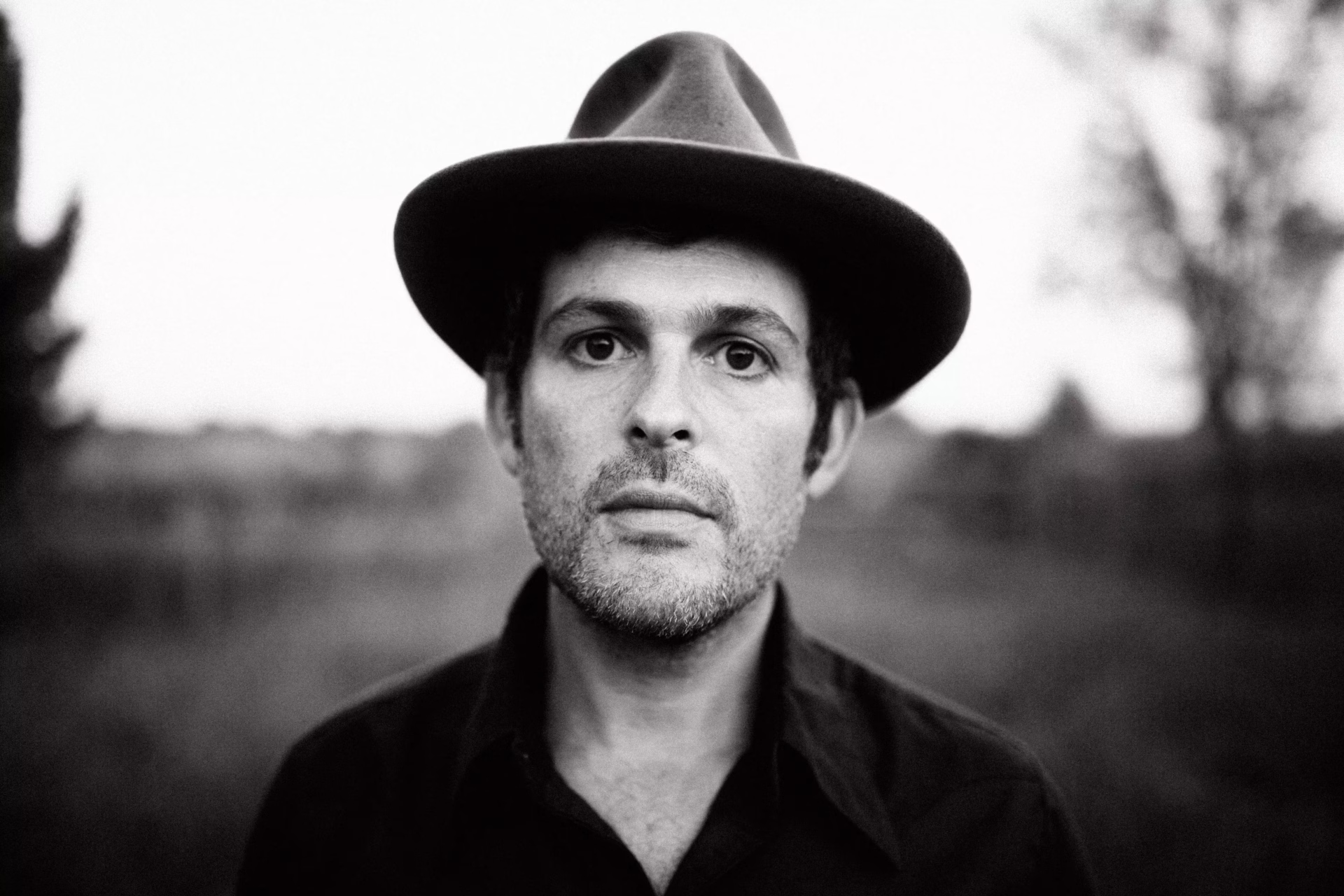
For South African-born, Colorado-based singer/songwriter Gregory Alan Isakov music may have always came second to his primary devotion in life of farming, but just like the rising sun, it came every single day.
"Music was always in my life," he says. "I always play it before work and after work. It was like eating dinner or something. It's just like part of your day. You do it every day. I never thought in a million years I get to do it. Like for a job like this, it's the coolest thing ever."
Isakov has been touring the world with his music while maintaining his farm duties. And with his fifth album, 2019's Evening Machines, his impressive musical career reaches new heights, earning him his first career GRAMMY nomination for Best Folk Album.
<style>.embed-container { position: relative; padding-bottom: 56.25%; height: 0; overflow: hidden; max-width: 100%; } .embed-container iframe, .embed-container object, .embed-container embed { position: absolute; top: 0; left: 0; width: 100%; height: 100%; }</style><div class='embed-container'><iframe src='https://www.youtube.com/embed//7BJ7MDOmLPE' frameborder='0' allowfullscreen></iframe></div>
We caught Isakov on the phone from his farm to talk songwriting, the making of Evening Machines, and learn about the faraway place he was when he found out he'd been nomated for a GRAMMY.
Congrats on the nomination! What was your reaction to being nominated for a GRAMMY for the first time?
I was in Dubai when I found out, I was about to walk on stage because it was a... I forget the time difference. It's pretty big difference. But I was about to walk on stage opening up for a friend of mine at the Dubai Opera House and I was just feeling... It was the first solo show I had played in probably all year. And I was very nervous and I got that news and I just sat in the dressing room and I was all by myself. I didn't have anyone to tell. I just walked down the hallway to like try to tell somebody. And then they're like, "You're on in one minute."
And I was like, "Okay." And then I thought, "Oh I'm not nervous anymore and whatever. I just give you the worst set ever that's going to be okay." And then I remember I cried actual tears of joy by this. I found this abandoned pool like in near a hotel later. And I was like, "Wow, this is so surreal. Like I never dreamed that this like anything like that would ever happen to me."
What a surreal way to find out. I'd love to ask you about the album and making, I understand you did at home on your farm. What were the days like while recording Evening Machines?
You know, this was probably the quickest I've ever made a record, and I did it in about a year, a year and a half, which sounds like a long time. For me. It's pretty fast. I made it mostly at night and I have a studio here at our farm, and it's minimal. And I think all my records had been sort of bedroom records in the sense I've never really loved studios. They've always really intimidated me, I think. And so I've always made records out of my room and then I mix them somewhere else. And for this one I just left all the gear on like all the time and everything was mic'd up during the growing season because I work, my other job, I grow food for a few restaurants. And I always had everything set up.
And Andrew, my engineer would come from Fort Collins three days a week to just help me kind of set up mics. And when I was playing drums he would help me record that. I was always running, running back and forth. But it was a lot of just that that kind of image that you would have like with a mad scientist with a swinging light. Like a lot of nights I spent like that just sort of trying to find these, these noises that I needed and what the songs needed. I recorded about 35 almost 40 songs and then there's just some that just lived together really well. And I remember in the spring I was getting the whole season prepared outside and I was sort of just going through trying to find a playlist. That's really important to me, the order of the songs and it happened pretty naturally.
I wonder if you could go a little deeper on the production of the album, because the sound of this album is full, gorgeous and lush. Where did this sort of vision for the sonic space this album lives in come from?
It's always been a part of my aesthetic in production and arrangements like that I've carried on from my last records. I set out to make like a low-fi rock and roll record. That was when I started out, that's what I thought was going to happen. And then the record sort of just took me into a completely different place. I did a lot of it takes live, just guitar, vocals live. And then I would track around it. I did choose songs with our drummer Max and the rest of the songs I played drums on myself.
I would spend weeks and weeks and weeks in the studio and then I found that was the most valuable for me, it was the time that I would spend away from the songs so I could come back and be like, "Does this still work?" Because I think when you come with an arrangement, like for "Too Far Away." I thought "Okay this is a strong melody, and it really does, it's transporting me. But I don't know if it's real because I'm so close to it". Because a lot of the arrangements on songs that you'll be really stoked on in the moment, you'll come back and be like, "Well I don't really feel anything." And you're attached to how much you worked on it.
But then you'll come back and be like, "Well it doesn't matter." No one cares how long someone spends on anything. Like it just matters. If it makes you feel something and if it does its job, you know?
<style>.embed-container { position: relative; padding-bottom: 56.25%; height: 0; overflow: hidden; max-width: 100%; } .embed-container iframe, .embed-container object, .embed-container embed { position: absolute; top: 0; left: 0; width: 100%; height: 100%; }</style><div class='embed-container'><iframe src='https://www.youtube.com/embed/jeMrXxIud44' frameborder='0' allowfullscreen></iframe></div>
Absolutely. Is there a song on the album that has grown on you in a new way since it's recorded?
Gosh, I haven't listened to the record since it is since it came out. And I got to hear it. I got to hear it once. And I say that I got to hear it because when you engineer and produce your own records, it's like you hear them so many times you don't know anything.
And I finally got a chance to actually hear it. I was in Vancouver. And I had a day off and it just put it on and I listened to it. And then there's the moments that you're like, "I totally see what I was going for. And I almost got there." In one, like a movement of a piece of music or something. But I really loved the record and I felt that feeling of like I've bled into this thing and I'm really glad that I like it.
As a songwriter, I'm curious which school you subscribe to: Is it the sit-down-and-write no matter what school, or do you wait for it to come to you?
A lot of songs don't come easy. I love writing songs because I don't have any clue how it f**king works or how to do it. I don't think it's evolutionary. Like if you've been writing songs for a certain amount of time to get better at it per se. Because every time you start you're at like ground zero again. You're at like trip reset and you'd have all these avenues that you can go down and it's the first time.
"I love writing songs because I don't have any clue how it f**king works or how to do it." -Gregory Alan Isakov
And in my experience, I don't think it has been evolutionary for me, but I have been noticing. I won't let the songs that I know aren't going to live, live as long anymore. I see them like, "Okay, this isn't going to work," and I can already move into a different direction and start something new quicker than I used to be able to do. But you know, I usually have a spark of something and then it sort of feels like this almost ineffable experience between working with this living thing like in the song, and I don't want it said that to sound too bucolic or new age or anything. It's just that it really does feel like a co-creative process for me.
That's a great answer. It's interesting considering that you farm because it almost feels like the same core principle. Was farming your first love?
Yeah, I went to school for horticulture and that's what I mainly did for work forever. And music was always in my life. I always play it before work and after work. It was like eating dinner or something. It's just like part of your day. You do it every day. I never thought in a million years I get to do it. Like for a job like this, it's the coolest thing ever.
And farming is great for me to do still because, In a lot of ways for me, it's the opposite where I'm like, "Okay, I have an hour of time, I can turn over those five beds. I can plant three of them." But with songwriting it's like weeks go by and you have no idea if there's been any progress. Time is the most elusive thing in music. Records take an immeasurable amount of time. I've never made one quicker than this one.
It's an interesting concept because music is a temporal art, and farming is certainly a temporal practice. Do you find any sort of deeper connection between the two or are they truly an escape from each other?
I definitely can. I mean there's definitely this sense of this mystery, this germination that happens with writing. I don't even think people really even know how germination, like botanically, works completely. But it is a certain sense of magic. But that all that information is in that one tiny seed. All their parents, genetic parents everything is right there. And then and I think there is something to that like with music because it's like you get this little spark and it's sort of let's just kind of see where this wants to go and help it as much as I possibly can. But to me a lot of writing is punching in. People ask me, "How do you get inspired?" And I'm like, "Man, if I waited for inspiration, I would not get anything done."
It really is like punching in every morning. Like an old clock. And some days, nothing happens. Some, some days a lot happens, you're not sure if you made progress. But I realized how much more it gets me to slow down and to notice the world. And a lot of the natural world makes it into my writing. But how much I have to slow down. And I love writers like Bruce Springsteen and Leonard Cohen. And they do things I can't do like Springsteen writes stories in a way that I can't. It just doesn't come natural to me. But they both have this way of like that of looking at a story kind of in a different way and making it completely new. And completely relatable. It's funny to talk about songwriting because I find, I don't even know how to do it.
Well, you're not alone in not being able to tell stories like Springsteen. I think we're all kind of chasing that...
Yeah. And I think there's something so beautiful about how there's so many different ways to tell a story. And for me, I sort of use little tiny images, like little pictures. And that's just the natural way for me. But I've found that like you'll listen to like "Ghost of Tom Joad" or something and it'd be like this dude living, crossing the border, making meth with his brother. Iit's these really intense stories. There's a gun, you know. What's bleeding?
And then you realize, then you're on a walk in a city that maybe is unfamiliar and you're by yourself, and there's nothing crazy going on. But there's so much poetry in what's happening every single moment. And it's good for me to remind myself. Like that's why I love like both Leonard Cohen and Springsteen, because they both have such opposites that way. We can have just the way of like something like a shadow or something hangs out on a wall or like. And you could spend a whole verse talking about that and really be saying something really provocative, you know?
Sure. You've toured all over the world. What keeps you sane and happy and mentally healthy on the road? What's your regimen?
Yeah, there's a lot of things. For me it's, it's a funny job to me because I love people. I just have never been that social, especially a lot of people at once. And so for me, I have to take an extra care of finding balance for that, because I really am out of my element. And it really does feel like I'm breaking my boundaries in a cool way. It's actually been really fun for me. But I spent a lot of time like walking by myself. I love photography, so I'll usually like walk around and shoot photos.
Sometimes if I'm in a certain part of the country I'm interested in like a certain farm that I know about. I'll go visit and try to get a tour. I take a lot of classes online. So I'm always like studying, mostly I'm in my bunk or the bus, like with the band like watching videos about turnips and reading about spacing of salad. Like super nerdy stuff like that. And after farming for a long time, I think being on the road is definitely harder on your body and your mind than any manual labor job I've ever had, just because there is, you're waiting around, you're sitting, you're in tight spaces. There's not a lot of alone time. There's alcohol around. There's just like the food's not the healthiest. So it's hard to navigate all that stuff. And when you're outside working 10 hour days, you're like, "Okay, I feel good." You know, everything's working.
One last question. You mentioned that you recorded a bunch of tunes for Evening Machines, but what do you plan a next for your music?
Yeah, so I actually just, I've been rerouting the studio this week and I'm making another record right now, kind of a stripped down record, and I'm trying to record some cover songs, too, with some friends of mine just like for fun, traveling all over the country and asking friends to sing songs. Just songs I love. Me and Leif Vollebekk are going to do one. And I'm asking Brandi Carlile to do one with me. Just a couple, just for fun, like finding old songs that I just love and just putting them out there,
But beyond that, I'm making another record. Hope should be some of the songs that didn't make it on Evening Machines, I'm reworking a few of those. But I've kind of out wrote myself. And so now I have some newer material that I'm more interested in, that I've been getting down, and so that's my main work right now.