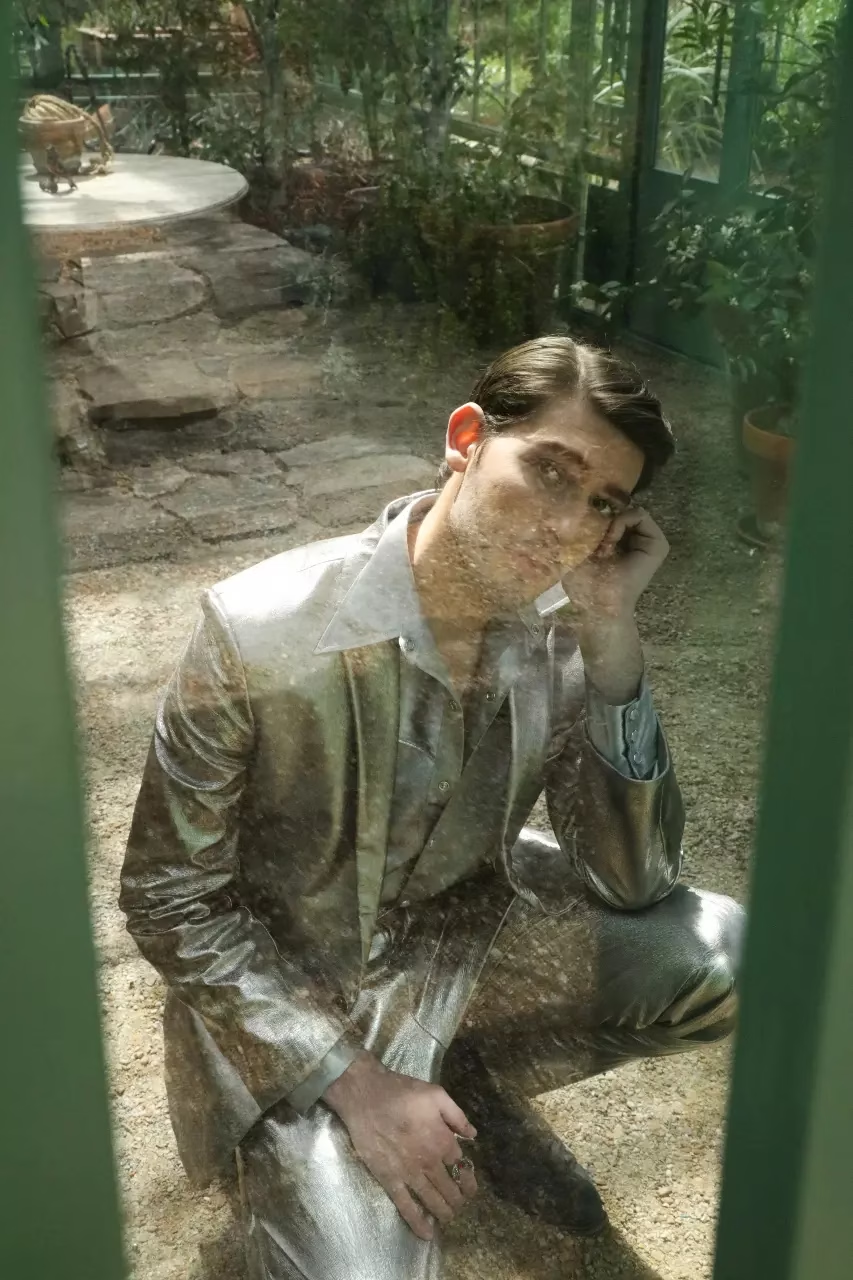
People make a big deal out of "authenticity" in country music, as if acoustic guitars and washtub basses were a crafted aesthetic and not simply the tools artists had at their disposal mid-century. But if Hank Williams showed up today, perhaps he'd be in a hoodie, making beats on Logic. His grandson, Sam Williams, knows he's probably bumming people out by embracing modern sounds and not wearing a 10-gallon hat. Still, he's clearly doing something right: He was just on Colbert.
"My grandfather passed away on the last day of 1952. This is pre-Elvis," Williams tells GRAMMY.com over Zoom from his parked vehicle. "I think that if he hadn't passed away so tragically, he would have been reinventing his sound and bringing rock elements into music that were spreading across America, you know what I'm saying? So it's not really fair to place those trappings."
Granted, he still makes music with Americana leanings, but Williams is influenced by music from all over the place, including hip-hop and R&B. Still, his debut album, Glasshouse Children, which will be released August 20, ultimately just sounds like him—while preserving country's ability to throw a stark reality at your feet like a frying pan on tile. "I'd say I was forever changed after the fall of '99," he admits in the startling title track. "I got exposed at two years old to demons in my mama's eyes."
Sam Williams is a fresh signee to Universal Nashville and leaps into the music biz with boundless possibilities—far more, he says, than his father, Hank Jr., had when he got into the game. GRAMMY.com spoke with him about sloughing off the limitations of traditional country, Nashville's baby steps toward inclusivity and the artists he believes are pushing the envelope in the 2020s.
This interview has been lightly edited and condensed for clarity.
With debut albums, there's often a lot of deliberation about what side of themselves the artist wants to present. What do you hope Glasshouse Children relays to the listener?
I try not to spend so much time thinking, "This is going to be so many people's first impression of me. What do I want to say? What do I want them to think?" and just try and go with my gut and be natural and write the songs that were coming to me and felt the most authentic to me, regardless of subject matter. With that being said, I wanted the first impression that this is really human and not industry-crafted. That these songs come from a really heartfelt and human place.
It's very richly recorded and listenable, but I don't get the sense you're trying to please everyone at once.
Thank you. A lot of the album was produced by Jaren Johnston. He's in a country-rock band called the Cadillac Three. It was really cool to do that because it helped bring some great musicality to it. There's a Nashville producer named Paul Moak who did "Glasshouse Children" and the interlude song, "Bulleit Blues." It was really awesome to bring in a live string section to bring the drama and the theatrics to the opener and bring the listener in.
I imagine you've written songs that reflect various parts of your psyche. What sides of you do these songs particularly contain?
Kind of a coming of age. A lot of contradiction and juxtaposition of loss and gain of heartbreak and healing. Of insecurity and stability. There are many songs that talk about trauma and upbringing and finding yourself.
The reality is that country music to the core is writing songs from the heart and telling your story and projecting your voice and hearing everyone else's voice and different perspectives.
Was there any trepidation about your surname being front-of-mind for people? Perhaps that it would be the horse leading the cart?
I think that with my last name, it's said a lot that it's a blessing and a curse. I think that the music does speak for itself. It's not too similar to any music that's been released in my family or in country music in general. But that being said, I know there's a tremendous amount of people who would like to see me just dressing in suits like my grandfather and forcing an accent that doesn't reflect where or how I grew up.
They're probably a bit thrown off when they see me wearing an earring or doing something that doesn't feel "country music" to the core to them. But the reality is that country music to the core is writing songs from the heart and telling your story and projecting your voice and hearing everyone else's voice and different perspectives.
Trying to play dress-up with the trappings of the '40s and '50s is pretty silly. Buck Owens was a cutting-edge musician. If your granddad were around today, perhaps he'd play an electric guitar or a synthesizer.
Exactly. I always think that because my grandfather passed away on the last day of 1952. This is pre-Elvis. I think that if he hadn't passed away so tragically, he would have been reinventing his sound and bringing rock elements into music that were spreading across America, you know what I'm saying? So it's not really fair to place those trappings.
What, exactly, is the thesis of country music to you? The cliché is that it's all about the stories, but perhaps it's also a vehicle to deal with some of the roughest parts of being a human.
I studied the entertainment industry at Beaumont in Nashville for a few years, and I remember having a course about the Irish and Scottish songs that you can trace country music back to. They're talking about people getting killed and buried alive. Crazy, crazy songs. One of my dad's songs is called "Knoxville Courthouse Blues" and it's gruesome.
It's just a lot more than what it's been watered down to by Nashville standards nowadays. I just try to kind of keep that out because it would just dampen me as an artist, trying to do something that I didn't feel really connected to.
I wouldn't say this is country music to me. But as an artist, I like to sing about things that make the listener a little uncomfortable in their head and bring up things they don't typically think about because that's the kind of music I enjoy listening to.
Sam Williams. Photo: Alexa King
What were you pursuing as far as a production aesthetic?
I wanted some of the songs to have the country sound of just acoustic guitars and some live piano in the background and things like that. But a lot of artists that I admire and respect in country have pushed the boundaries of what you can bring into songs. I'm a big Jason Isbell fan.
I think if you took the songs to their core of the songwriting, they'd be country, but when you add all these different [elements] and production, it's just a whole new world of possibilities. It's also important to me to try and experiment a little bit and do a little bit more pop production.
Like, "Hopeless Romanticism" and "The World: Alone" are definitely influenced by younger artists that I listen to. It goes without saying that I'm from a generation that primarily grew up listening to Top 40 radio and [remembers] hip-hop becoming the biggest genre. I'm very R&B-influenced.
I like to take little pieces of each genre of music and artist I listen to and see what I can craft and come up with. There's a lot of music you can listen to where you may really enjoy it, but you don't feel as connected to the artist. That's something I wanted to make sure can be done.
There's a lot of talk about Nashville's incremental steps toward diversity and inclusion. But on the main, is it still this conservative Iron Man you have to face off?
[Knowing laugh.] It definitely can feel like that.
I just signed a record deal with Universal a few weeks ago. What is kind of interesting about that situation is that my record was done prior to entering talks with or signing with Universal, and that's not typically how it goes at all. Usually, a major label is very involved in the writing process and production and who's going to be on it and what the cover's going to look like.
I would say it definitely can feel like that and that's the norm, but Cyndi Mabe and Mike Dungan at Universal Nashville have really opened up and taken a risk by embracing me. It's definitely slowly changing. You may not see it every day. It comes down to support, but there are a lot of artists out there now pushing the envelope than there have been in the past 10, 15 years.
Yola is someone I think of off the top of my head. She's truly amazing, and a few years ago, she may not have been able to enter the scene like she has. Even queer artists like Brandi Carlile that have been in the industry for a long time are able to do more and be more [included] and seen in this landscape is telling that it's heading in the right direction, even if it's not as fast as we would like it to be.
Is there anything we didn't touch on about Glasshouse Children that you'd like to express?
[Long pause.] I would just like to convey that I wasn't really trying to put anything across that wasn't me while making this record. It's a melting pot of traditional country songwriting and storytelling that's in the DNA.
My dad was really forced into the music industry and started to make his own sound of music and do his own thing later in his career, after standing in his father's shadow for a long time. I'm grateful I got to do something that was uniquely me from the get-go instead of being "Hank, Jr. Jr." for however many years and then switching it up. I'm grateful for that and I hope it just surprises the ear of the average country listener and that people are pleasantly surprised by it.
