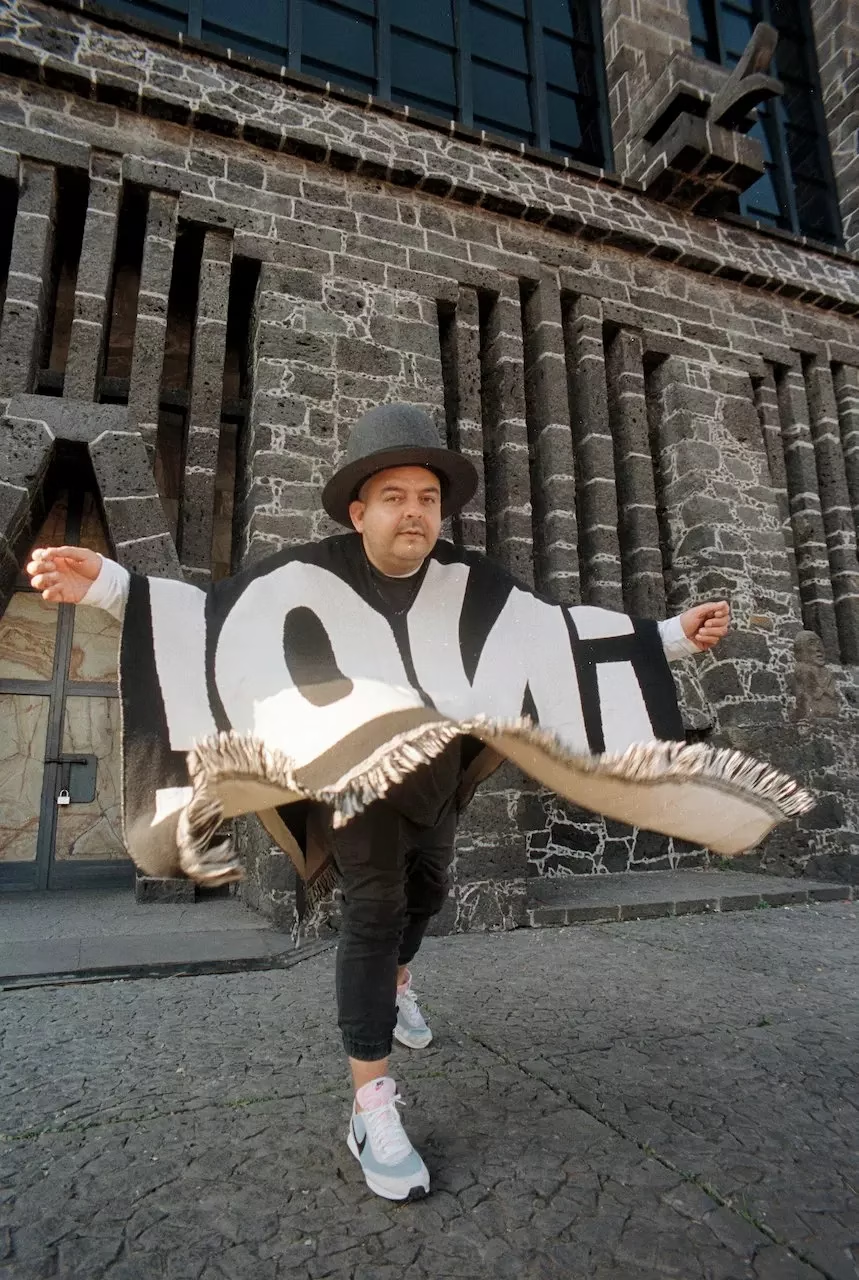
Although Mexico City may have rebranded itself as CDMX a few years ago, the city will be forever immortalized as Distrito Federal on Camilo Lara’s latest album under his electronic music-making moniker Mexican Institute of Sound (MIS). Named after the city as it was known before the name change in 2016, Distrito Federal is Lara’s homage to the sight and sounds that he remembers and are etched in his identity—from the blare of sonideros to mouthwatering lyrics featuring some of Mexico’s most irresistible street foods.
<style>.embed-container { position: relative; padding-bottom: 56.25%; height: 0; overflow: hidden; max-width: 100%; } .embed-container iframe, .embed-container object, .embed-container embed { position: absolute; top: 0; left: 0; width: 100%; height: 100%; }</style><div class='embed-container'><iframe src='https://www.youtube.com/embed/n768i9tfFOs' frameborder='0' allowfullscreen></iframe></div>
The GRAMMY-nominated DJ, producer and artist has spent years carving a path for electronic sounds in Mexico while simultaneously taking Mexico’s traditional sounds to global stages, television shows like "Californication" and films, including on Coco and Tu Mamá También. On his sixth studio album, he clashes Mexico’s past and future as regional musical treasures like cumbia, banda and mariachi mesh with urban, futuristic electronic sounds combining some of Lara’s most beloved sounds. But the album encapsulates more than nostalgia for Lara, it also embodies his uplifting spirit and his belief that music can be a tool for change. On the album, you’ll find antidotes for your woes, humorous songwriting, pro-immigrant political anthems, and straight-up bangers.
With a name like Mexican Institute of Sound, Lara has had a lot to live up to, but the musical ambassador has not disappointed. While he’s released his latest album, he’s also created incidental music for "Narcos: México" and most recently launched his first clothing line with Mexico’s Pay’s clothing store inspired by Distrito Federal’s album artwork.
Last week, Lara sat down with GRAMMY.com via Zoom from Mexico City to talk about his projects, including Distrito Federal, nuances between Mexican and Mexican-American culture, differences in creating music for the dancefloor and television.
You released your latest album, Distrito Federal, your homage to Mexico City, earlier this year. How is the city looking like now?
I think it's a city that keeps changing. The only thing that is constant is that the city keeps destroying and constructing itself. Mexico City is not the same city as it was for my parents. When I was growing up, it was a city that is [now] completely different from what it is now. And that's very exciting. I mean, it speaks [to the fact] that it's a city that is alive. And it doesn't have a lot of nostalgia. I think it's just keep reinventing itself.
What do you want people to know about Mexico City today that they may not know?
That's a very tough question. I think across all these years that I've been doing music, one constant thing that I have done is have feet in my community. Every record I have done, every album I have produced or every movie I've been involved with is from the point of view of the music that is near to where I live.
I've been involved with Mexican Institute of Sound, or with Mexrrissey or in Coco or [working with] Flor de Toloache. So I feel Mexican culture very near, it's not the only thing that I like. But I do think showcasing that to the world is a way to help my community have a positive change [in perception.] All the news that you hear outside Mexico, about Mexico, is heartbreaking. It's about violence. It's about narcos. And where I live is not about that. It's about culture and it's a city that is so exciting and so many artists doing stuff at the same time. That's what I want to show. And I believe culture can change perception. You can change the culture, you can change so many things. So for me, music is a weapon of transformation.
You really do showcase a lot of different types of Mexican music, you have cumbia and you have banda. Do you feel like electronic music is that glue that makes mixing all those sounds together sound good?
I do think it's embedded on me. I love Mexican music. I love mambo and cumbia and danzon and cha-cha-cha. But I grew up listening to electronic music, hip hop, punk rock, and that is part of me and that's part of my nature. So I think I always try to push this rhythm and to have the spirit of punk rock in all of [rhythms I do]. Like, what if you like, for example, mariachi music? I think we have the perception that mariachi music is for old people and it's [far] from the youth. I do think the original mariachi was very punk rock. And so I'd like to capture that spirit of rebellion in Mexican music. Sometimes it's more electronic, sometimes it's more acoustic, but I have this other side that is a big thing on me. Modern music, in general.
<style>.embed-container { position: relative; padding-bottom: 56.25%; height: 0; overflow: hidden; max-width: 100%; } .embed-container iframe, .embed-container object, .embed-container embed { position: absolute; top: 0; left: 0; width: 100%; height: 100%; }</style><div class='embed-container'><iframe src='https://www.youtube.com/embed/twsHcfR23E0' frameborder='0' allowfullscreen></iframe></div>
I find it so curious how banda is perceived in places like Los Angeles versus Mexico. Do you think there's a difference in how the communities embrace this specific genre?
Yes. I think that's where the future is. I think banda—I mean they always have been very progressive genre. And I think now, it's a very exciting moment because you'll have all the corridos tumbados and people like Natanael Cano just reinventing something that in paper seems like there was not a lot of room [for change], but [there] is. And so it is very exciting. And I think Banda is part of us. It's the same thing as mariachi [music]. It would be a shame that it [remains] for [old] people. It's an alive thing and it deserves to be young and cool and hip, and have swag.
On your album, you have a lot of amazing features. You have Duckwrth, and then you have Cuco. What do you think about the relationship between Mexicans and Mexican-Americans and how was it for you to work with a Chicano like Cuco?
It's super important. I feel I'm like a double agent. I live in Mexico City, but I also go back and forth between Mexico and L.A. It's completely two different [worlds], and I think if you don't experience that, you don't understand the cultural differences. It's very exciting to see someone that speaks your language and has some kind of points of reference but from a completely different point of view. So it was fun. With Cuco especially, we were friends. And I think I'm way older than Cuco. Like he's 20 years old, so he's a kid and our cultural reference was what our parents listen at home so we had a lot in common, like a love for boleros. I grew up listening to boleros, but also Morrissey and The Smiths, and he grew up listening to boleros, but also all modern stuff … so we share that thing, and we decided to [do a bolero.] And that's what [happened], and it was exciting. He’s such a talented person. And I think he's an old soul.
You brought up L.A. Cinco de Mayo is huge here in Los Angeles. What do you think about Cinco de Mayo?
Well, it doesn't have any meaning in Mexico [other than] if you're only in Puebla. But I think it has a different meaning outside Mexico. At least it's a good excuse to put the spotlight in
Back to your music. Your cover art by Urbano Mata is amazing. Who came up with the idea for the artwork? And why focus on that part of Mexico's history?
The whole album was thought as a codex. Each song, instead of telling a story, is just an idea. So I wanted to create that codex, but bringing it to today. And so each codex on the artwork tells a story. And it is something that I had very clear just to tell the whole narrative of the album through that language. The artwork is divided on air, water, ground, and space. So, it was exciting to do that. I came up with it with Urbano Mata who is a guy who does modern ideas of codexes And yeah, with another artist Oscar Reyes we created this mini-universe of what Mexico city would look in aquatic style today.
You have a clothing line with Pay's, inspired by it. When you made the album, did you know you wanted to make a clothing line inspired by it?
Yes and no. It was a dream. I've been a fan of Pay’s for a long time. They are in the same neighborhood that I live in [in Mexico City], in Roma. And so they have always been that exciting, new thing that is going on. And so when we teamed up and they came up with all these beautiful designs, it was fantastic. I mean, it made sense. I would wear that in a heartbeat.
You also wrote the incidental music for "Narcos." How was your approach to that?
I work with musical supervisor Liza Richardson. I've been a fan of the series for a long time. And I enjoy focusing on a certain period of time in Mexico a lot, and [also enjoy] doing research on what was happening [with] radio and media. What were the bands that were having airplay? So it was exciting to go back into Mexican history and try to do that, and create music that could fit into that period of time.
That's amazing. What does making music for film and television give you that making music to perform live doesn't?
Oh, it's two very different experiences. When you do music for film, you help create a vision [for] the filmmaker. And that's teamwork … And the goal is to create this scene that is perfect. Music is one piece of the whole puzzle.
[With] performing live for me, [it] is more of a therapeutic experience. My whole theory when I perform live is that the only democratic place on earth is a dance floor. Every time there's a dancefloor, doesn't matter if you're tall or short, or fat or skinny, or rich or poor, you dance and you connect to music. It’s just like an energy that makes the dancer [have a] place that is just a free space for everything.
<style>.embed-container { position: relative; padding-bottom: 56.25%; height: 0; overflow: hidden; max-width: 100%; } .embed-container iframe, .embed-container object, .embed-container embed { position: absolute; top: 0; left: 0; width: 100%; height: 100%; }</style><div class='embed-container'><iframe src='https://www.youtube.com/embed/LsR0Bh_Q4AA' frameborder='0' allowfullscreen></iframe></div>
Speaking of the dancefloor, you recently remixed "Ooh La La" off the Run the Jewels record. How was it working on a song and how do you give new life to a song that may already be great?
That's a tough job as a remixer. That song is amazing. If someone tells me, "Would you improve it?" I would always say "No, it's perfect. I love that song." So it was a big challenge. So instead of competing to improve the song, I just erased everything that they sent me and just left the vocals and a few things and started from scratch. So I did the different music and everything. I kind of took a piece of that and made it on my own. And it was fun. And definitely the original is better, but I had a lot of fun doing my version. And they like it so I'm very happy.
So, as we were all going through a pandemic, it seems like it really hasn't stopped you. It seems like you've been keeping busy. Have you gotten any downtime at all? Just to do nothing?
No, because in a way, my studio was my hamster wheel. It was the only place that I didn't have a T.V., I didn't have the news. It was a free space [free] of everything that was happening outside. So I did it, I used my studio as my happy place. And that's why I've been non-stop working on projects. I think it was a very exciting moment because many people, including myself, found, in music, this place that could be a place to feel better. To have peace. So, I don't know. Many people decided to do music at this time. It helped me to keep my mental sanity.
Zoé Continue To Build On Their Indie Synth Rock Legacy With 'Sonidos De Kármatica Resonancia'
