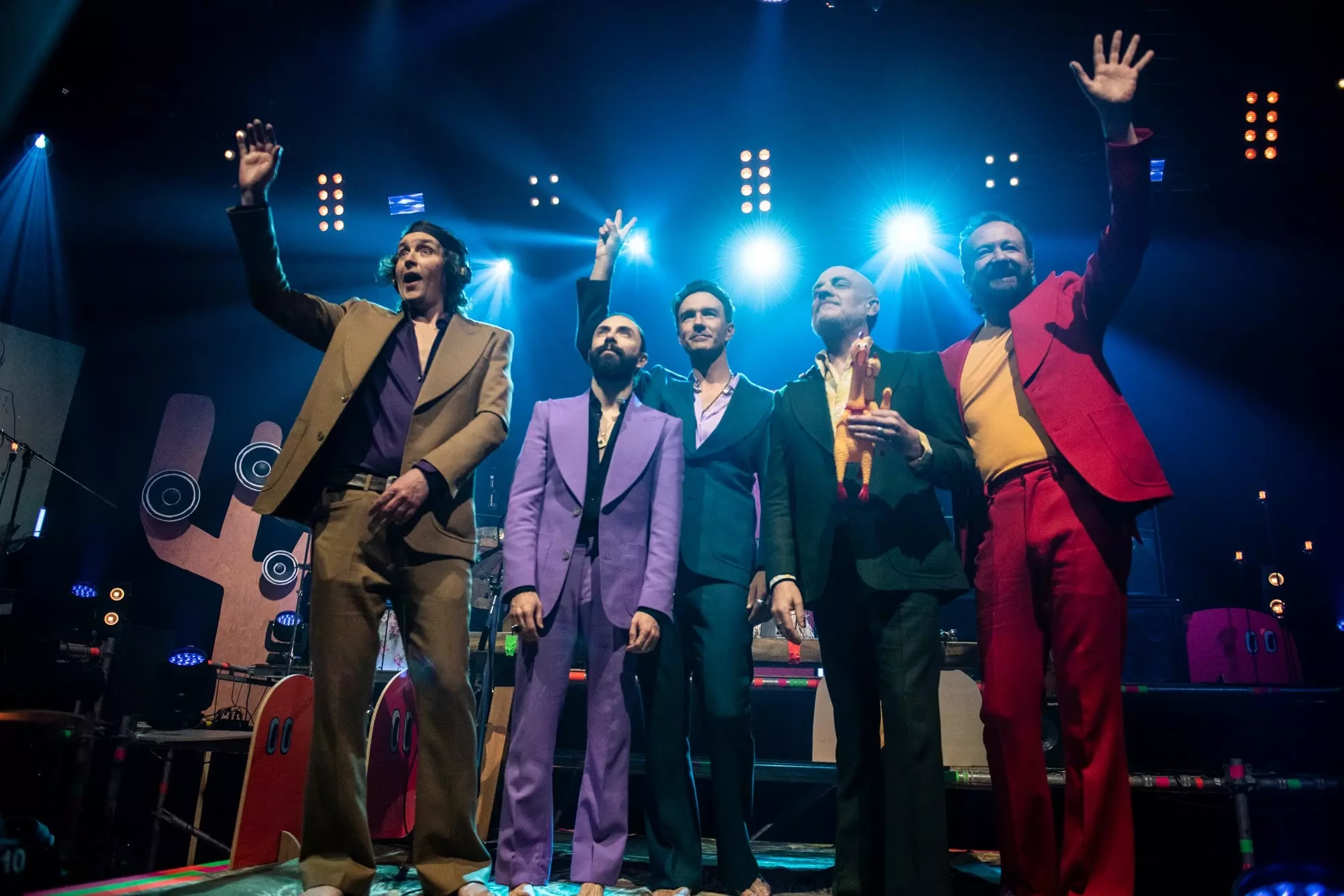
Fobia, the trailblazing Mexican rock band whose career spans roughly three decades, open their long-awaited “MTV Unplugged” performance with a song that hits a little too close to home.
Lead vocalist Leonardo de Lozanne launches into “Pesadilla,” which means “nightmare,” from their 2012 album, Destruye Hogares. In that song, he sings of trying to save the world from devastation—and ultimately proving unsuccessful. But something is conspicuously missing on this edition of the long-running franchise: an audience.
<style>.embed-container { position: relative; padding-bottom: 56.25%; height: 0; overflow: hidden; max-width: 100%; } .embed-container iframe, .embed-container object, .embed-container embed { position: absolute; top: 0; left: 0; width: 100%; height: 100%; }</style><div class='embed-container'><iframe src='https://www.youtube.com/embed/vLYsEB0aFvM' frameborder='0' allowfullscreen></iframe></div>
Originally, the band had plans to record their performances in early 2020, but filming was rescheduled to October due to COVID-19. Their new circumstances meant no audience and called for the band to get creative: They went with a circular set instead of a traditional one facing a crowd and had guest guitarist Joe Gore, who could not physically join them, perform with them virtually from San Francisco. Aware of these unprecedented circumstances, bassist Javier “Chá!” Ramirez, who helped design the stage, wanted the set to radiate hope. On the stage are messages of encouragement meant “For all of us who have been locked up for so long, who have lost friends, who have lost family members,” he shares.
But the pandemic didn’t dissuade Fobia from the "Unplugged" format; instead, they leaned into it. Using toys and assorted useless objects—rubber chickens among them—as their percussion, they give new life to some of their biggest hits, including “Hoy Tengo Miedo” and “El Microbito” with a playful approach. The band—comprised of Lozanne, Ramirez, guitarist Paco Huidobro, drummer/multi-instrumentalist Jay de la Cueva, and keyboardist Iñaki Vázquez—are joined by other guest musicians: percussionist Pipe Ceballos; pianist Eric Deutsch; percussionist/keyboardist Kevon Bradford; drummer Sebastián Farrugia; and percussionist Matias Majewski.
Beyond aiming to bring joy to fans, the "Unplugged" has even more personal meaning to the band. The Mexican rockers, who in the 1980s were integral in bringing attention to rock music en Español in Latin America, as documented in the Netflix series Break It All, have had their ups and downs—they disbanded in 1997 and reunited in 2004. They took another break in 2012 but regrouped and in 2019 released a live album featuring their hits, Pastel (En Vivo), and toured in celebration of their 30 years together. The "Unplugged" session provided them the opportunity to continue their legacy and perform "Pesadilla," released during a time when some of the original members weren't a part of the band, for the first time together.
GRAMMY.com spoke with what performing “Pesadilla” meant to them, the state of rock during the back-half of a global pandemic, and their future as a band.
This interview has been translated into English and edited and condensed for clarity.
We have seen great rock performances on this series, including legendary Mexican band El Tri, Nirvana, and now you have one. What does it mean for Fobia to have an “Unplugged”?
Ramirez: We had wanted to do it [for a while], and the fans wanted it as well, but for one reason or another, it hadn't happened. So, as you said, being [a part of this] with all these great artists from all over the world fills us with a lot of emotion. It is also interesting because we had to do it in the middle of the pandemic. The conditions were different; there was no audience. It was very curious. We tried to look for the best during this terrible situation that we are going through—especially creatively speaking.
The audience is a big part of the series, but I think not having it made it a little more intimate. Like you are singing to those of us watching the video. What do you think?
Lozanne: Yes, I agree. The truth is that worried us at the beginning because we thought that a little of what “Unplugged” was about is also having an audience there, doing something intimate with [them]. Still, when we started playing, we realized that it could also be an advantage because it did not limit us in any way.
We were able to arrange the stage how we wanted. We filmed in 360 degrees. The stage was free for us. Our guests [Pipe Ceballos, Eric Deutsch, Kevon Bradford, Sebastián Farrugia, Matias Majewski, and Joe Gore], who did an incredible job with the inflatables that are Cabo San Roque’s musical installation. Everything made it more meaningful. The truth is, we were also surprised by the process.
Chá!, I imagine it is different performing with a view of each other. Who had that idea of being in a circle?
Ramirez: Since it was no longer the traditional stage arrangement where you see people and people are watching you, we said, "Let’s look for another way.” It was an idea our production people and MTV had. We thought it was a very good idea and that it even had a certain meaning.
These months that we’ve been locked up, that we thought we were going to leave and that we did not leave and we are still here, we’ve had a lot of opportunities to look inside. The circular stage, this stage where we are all seeing each other, as Leo says, in 360 degrees, somehow represents this.
When I listen to "Unplugged," I imagine things very handmade. All the platforms are hand-painted by a signmaker named Carlos Andrade, who is a genius. The platforms also have certain messages of encouragement for all of us who have been locked up for so long, who have lost friends, who have lost family members. We wanted that to be there too. As Leo says, it was to turn [things] around completely.
Photo: Toni Franćois
For a moment while I was watching, I forgot everything that is happening in the world. I even noticed a little dog that I have to ask about.
Ramirez: [laughs]
Lozanne: It’s Jay’s. [That's] Arepa.
This is a gift for your fans you can’t see right now. You also approached collaborations very differently this time around, because there aren't any vocal collaborations. You bring musicians as special guests. Why these musicians?
Lozanne: We had to think very hard about who we were going to invite and we just focused on people who would join in, who could make this a little more artisanal, who would add both a musical presence and personal presence, because they are also good friends that we admire a lot. Some of them have already participated in Fobia before and others came to contribute a lot to the group, the sound and the environment in particular, as was the case with Joe, who accompanied us virtually from San Francisco.
The truth is, we needed friends to help us fill those gaps and unite us, to bring new energy and good vibes. It greatly alleviates the relationship that we have had for so many years, it refreshes many aspects, both musically and personally, each one of them was very important.
The truth is that they completely changed the history of this “Unplugged,” including, of course, Cabo San Roque, who is another special guest, because these incredible inflatables that you see there are actually doing all the percussion work. They are practically our drummer and percussionist and the others are doing what humans have to do, but those little machines are the backbone of all the “Unplugged.”
All of them gave another dimension to our “Unplugged.” We are really very happy and grateful to them, especially for all the love, patience and affection they gave it.
The songs “Pesadilla” and “Hoy Tengo Miedo” hit differently now in pandemic times. Did you choose the setlist to reflect the times, or had you already planned to play them?
Ramirez: I think it is a coincidence. I also thought about that the other day while I was watching it. I thought, "How interesting that the songs have precisely those themes.”
Obviously, songs like “Hoy Tengo Miedo” had to be played. They are the songs that people expect us to play. “Pesadilla” is interesting because it's a song that was made at a time when the five of us weren’t together. It's a record that Leonardo and Paco made at a time when three of us were not there. That was Paco's idea. When he told us that we “Pesadilla” seemed like a great, great idea so that somehow the five of us could play that song for reasons of fate, life, etc.
[It was also nice to] put it out as a single because I think that's a great album and it's a great song. It is very symbolic, and representative in many ways of us, for the people. I'm very excited to be able to do it.
Speaking of the setlist, there are songs that we have to play. "Hipnotízame," "El Diablo," "Veneno Vil," "Hoy Tengo Miedo." We have many songs within our discography that we had not even played even on this 30-year tour that we did here in Mexico City…
You’ve sung these songs many times over the years in various forms. For the “Unplugged,” what was the intention of the sound this time?
Lozanne: I think the intention was mainly to have fun with the songs again and to have fun you have to play. That’s what was achieved more efficiently in this “Unplugged” and what we are most satisfied with is that we managed to play with the songs again because we are interpreting them with knickknacks and toys.
Something that is also very cool is that we are not playing the typical instruments that we would be playing at a live Fobia concert. For example, Jay is playing piano and guitar, never played drums. Some of us are also playing knickknacks. Iñaki is squeezing toy chickens as instruments. We are having fun with the songs—playing with them, taking them apart a little, but [putting them back together in] another way and playing.
Songs like “Caminitos Hacia el Cosmos” and “Mi Pequeno Corazon,” are very pleasant to listen to again. It's kind of a private joke between us and the true Fobia fans. Then there are people who already know these songs massively, which have been singles, so we try to level it but also play even with all the songs.
<style>.embed-container { position: relative; padding-bottom: 56.25%; height: 0; overflow: hidden; max-width: 100%; } .embed-container iframe, .embed-container object, .embed-container embed { position: absolute; top: 0; left: 0; width: 100%; height: 100%; }</style><div class='embed-container'><iframe src='https://www.youtube.com/embed/OEt7YyBffa8' frameborder='0' allowfullscreen></iframe></div>
Netflix’s series Break It All recognizes you for helping to expand rock in Latin America. It covers how “El Microbito,” a song you also play on the “Unplugged,” was censored. Has censorship changed in Mexico since then?
Ramirez: Yes, a lot. I personally feel that it is another Mexico, it is another world. We are talking about “El Microbito” coming out at the beginning of the ‘90s. Back then, things were very different in the media, in politics, in society. I feel like it's different now because we also have a lot of new technology at our fingertips that allow us to communicate in other ways. [Now,] if there was that kind of censorship somewhere, you can always output your ideas, your music, your art, through other channels.
I feel that it is a very different world. The censorship was very silly. “Microbito” is a very innocent song [which was reflective of] another world. On this album, there is another song called “El Crucifijo” that was also censored, particularly in Monterrey and here in Mexico City. It happened to many bands. Molotov, early in their career, was also censored.
Lozanne: During those times, they really censored you. For example, you were no longer on the radio, and in those days, radio was everything. If you weren't on the radio, you didn't exist. It wasn't like now that we have a lot of media and a lot of independence to promote ourselves.
That was what really affected [artists] ... Also, another thing there was a lot of abuse of power. There were very few people making huge decisions that affected the lives and careers of millions or thousands of people. Fortunately, I think we also no longer have that so much in Mexico.
Maybe there is still abuse of power, obviously, but it is not affected as much. There is much more independence and many more ways to move as artists and as professionals in general. We had to break some very big barriers. Fortunately, today, they sound archaic, but it was not that long ago.
Do you have faith that rock will continue to thrive in Mexico?
Lozanne: That’s a good question. You know, now that I saw the documentary I did like it, by the way. Nobody has asked me! [laughs] I did really like it.
I understand that, obviously, it can’t please everyone. We all see the stories from a different perspective—as Mexicans, Argentines, Chileans or Peruvians. "They didn't mention this or that!" But, in general, I like it because it's done super-well.
Watching the documentary, I also realized that rock comes and goes a bit. It is never completely absent, but it has major waves. I don't feel that at this moment, for example, I am at a very high point. There are no great standards in the rock world. I believe that in Latin America there are always band, [but] today, there is so much diffusion that it is diluted. You can’t get attention and follow a career [because] things are too fast.
Everyone is there but you have too much to choose from, and I feel like everything is a whirlwind of events, singles and careers. You have to be very aware of artists’ [careers] because one has three bands, the other is already a DJ and it is difficult to have a career, to follow someone, to be a fan.
Personally, I feel, because obviously, this is a personal thing, I feel that thanks to rock, I have realized there are other alternatives in life, which is not what my parents, television, politicians, or doctors told me. It's like, “I want to live this way and I want to say things like this.” Not just for being a rebel and for being a rebellious force or whatever, but I think rock has that.
When you think things are established someone comes out and breaks the schemes. [Rock], to me, is the best. As [Andres] Calamaro says in the documentary, “It's milk.”
<style>.embed-container { position: relative; padding-bottom: 56.25%; height: 0; overflow: hidden; max-width: 100%; } .embed-container iframe, .embed-container object, .embed-container embed { position: absolute; top: 0; left: 0; width: 100%; height: 100%; }</style><div class='embed-container'><iframe src='https://www.youtube.com/embed/u_f71XkVpNo' frameborder='0' allowfullscreen></iframe></div>
I found an interview on YouTube with you at Vive Latino years ago. Leo, you said that you’ll disband the moment you stop enjoying it. Are you still enjoying it?
Lozanne: That's one thing we set out to do from the beginning. As Chá says, from the beginning we didn't even know we were going to record or have a career. When we stop enjoying it, we put it on pause. When it turns us back on, we do it again.
We have had the great blessing of being able to continue having a career despite the breaks, despite the comebacks, despite having other projects despite everything. I believe that this is the greatest blessing we have had. It just happened to us [with this “Unplugged” session].
We finished an amazing tour, celebrating 30 years with an extraordinary box set designed by Chá!, which also made us very proud, we were very excited. We finished that long period tired, bored and already wanting to close the chapter and just when we thought we were going to be unemployed for years, suddenly the “MTV Unplugged” proposal came and we said, "Wow." We weren't expecting it.
Now, when the end of pandemic happens, hopefully this year or, if not, the next, we can do concerts. If they make us a good offer to go to incredible countries and do a good tour of the United States and Mexico with “Unplugged” and we are excited, well come on! Let’s do it! ut if we are no longer excited, we no longer do it. It's that easy.
Should fans be on the lookout for a new album?
Ramirez: Not for now. As we were telling you, we are doing this in parts. We had already planned to take another break ending the 30-year tour and [then] this “Unplugged” arrived. We had not contemplated it at all.
As Leo said, hopefully we can go out and tour this year or next year. We really, really want to be able to bring [“Unplugged”] to live concerts, to live shows. For now, we have no plans to make a new album with original music, but you never know, right?