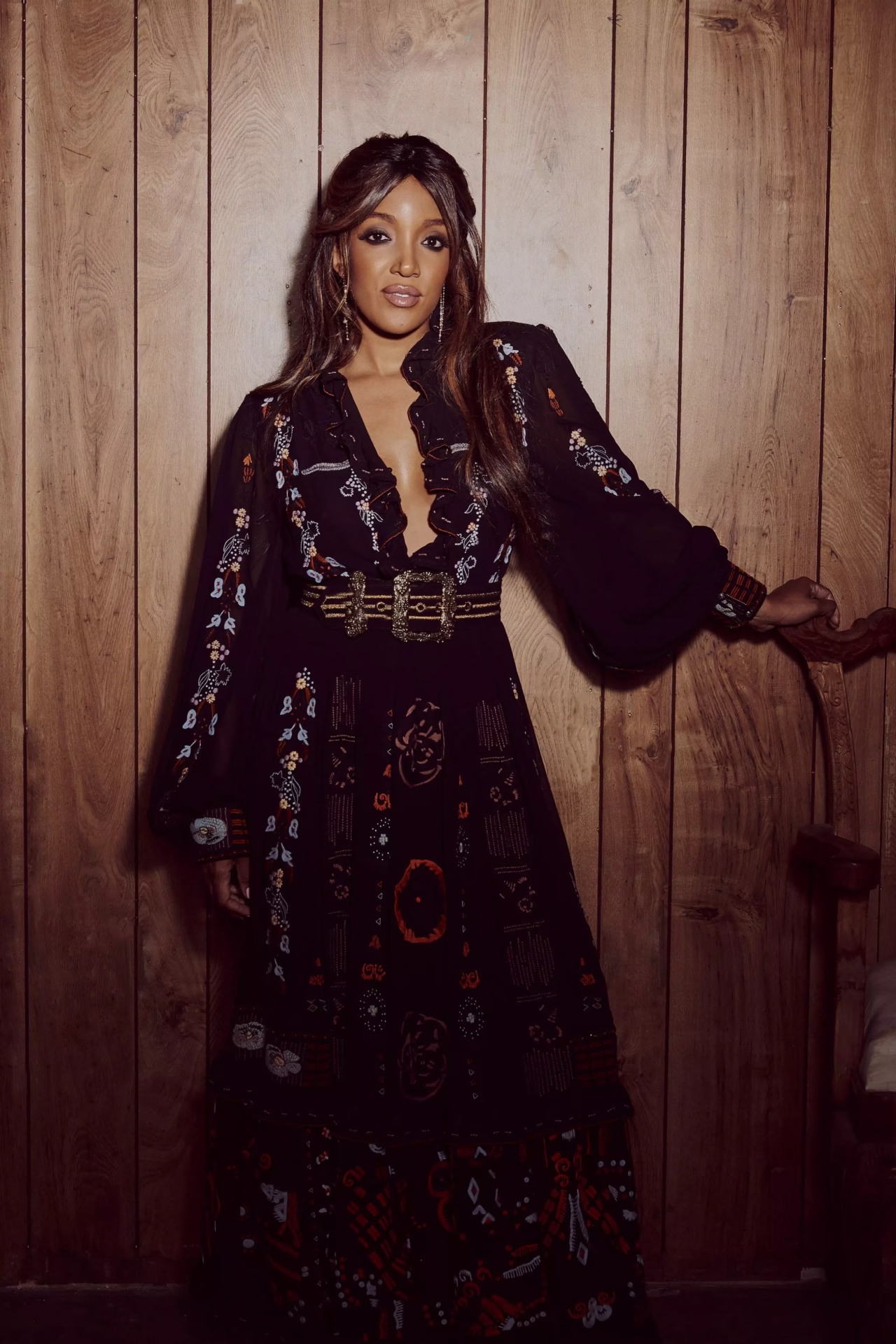
At 38 years old, Mickey Guyton is feeling on top of the world. In 2021 alone, she had her first child, hosted the ACM Awards alongside Keith Urban, and was nominated for a GRAMMY for her poignant stunner "Black Like Me," making her the first Black female solo artist to be nominated in a country category.
On Sept. 24, the country singer added her debut album, Remember Her Name, to her already stellar year. One listen of the sparkling set will have fans realizing two things: Guyton is more confident than ever, but it hasn't come easy.
As a Black woman in a predominately white-washed genre, Guyton has faced several hardships and setbacks since signing with Capitol Records in 2011. She found herself driving four hours to Atlanta to get her hair done for red carpets because there was no one in Nashville who knew how to style her hair. She received hateful messages that led her to drinking too much and into intensive therapy. And though she was signed to a record label, Guyton mostly fell under the radar, hardly getting recognition by country radio or industry players—at least not in the way she'd hoped.
"[Industry people] would always describe me as the 'girl next door,'" Guyton remembers. "I'm like, 'What if the girl next door is Black? Does that make her any less 'girl next door'?'"
<style>.embed-container { position: relative; padding-bottom: 56.25%; height: 0; overflow: hidden; max-width: 100%; } .embed-container iframe, .embed-container object, .embed-container embed { position: absolute; top: 0; left: 0; width: 100%; height: 100%; }</style><div class='embed-container'><iframe src='https://www.youtube.com/embed/zPH9hgKSai8' frameborder='0' allowfullscreen></iframe></div>
After Guyton's husband (Los Angeles-based attorney Grant Savoy) advised her to speak about those experiences in her songs, things started to look up. Soon, she had impactful and super-personal songs like "Black Like Me," "Love My Hair," and "Words." Most importantly, she had the confidence to be herself.
Guyton takes listeners through her journey to happiness on Remember Her Name, which both addresses the oppression she's faced in poetic anthems such as "All American," and also reminds fans that, like she has, you can conquer any adversity you face.
Overall, the 16-track LP presents a slew of important sentiments—from the confidence-boosting title track to the thought-provoking ballad "What Are You Gonna Tell Her?" It's sprinkled with upbeat moments of positivity (a drinking song for the girls titled "Rosé"; a hip-shaking ode to uniqueness called "Different") and stamped with the ultimate statement at the album's finish: a dynamic re-recording of her debut single, "Better Than You Left Me."
Below, Guyton chats with GRAMMY.com about her road to Remember Her Name, and how finding peace with her differences led to the music she's been wanting to make from the start.
I've heard the story about how LeAnn Rimes' rendition of the national anthem made you realize you wanted to sing country music. What was it about that performance that was so inspirational for you?
I was completely blown away. I was in the nosebleed section, but I even remember what she was wearing. It wasn't that it was even about the twang, it was more about the voice. I just loved the voice.
When I was in junior high, I went to cheerleading camp. I got up there and sang [LeAnn Rimes'] "Blue." Like, yodeling "Blue." You would think people were going to be singing Mariah Carey.
Yeah, you're probably the only person in the world who can say you yodeled at cheerleading camp.
At the time when everybody was playing Spice Girls, I was listening to Shania Twain. I think it was the diva facade of country singers that I loved—and, granted, there was also the diva side of Mariah Carey and Whitney Houston. But Shania was so much larger than life. I also loved The Chicks, like when they covered "Landslide" by Fleetwood Mac, there was just something beautiful about it. I didn't think about it as a genre thing, I just liked it.
It was genreless before the idea of genreless really became a thing.
Exactly! I would watch BET, and I would learn to do the dances in front of the TV. I listened to Aaliyah and all of that, but where I saw myself being able to be myself and be comfortable with that was in country music. That felt the most like me.
I also heard the story about how a hip-hop producer ended up introducing you to Nashville producer Julian Raymond.
I was on an episode of Wild 'N Out, just in the audience, and I became friends with this DJ [DJ D-Wrek]. At that time, I was really frustrated in my career. I wanted to sing country music, but I had no ties or any way to get [to Nashville]. I ran into the DJ at a mall, and he was like, "You sing don't you? I know a producer, and he's been looking for a Black female country singer." I'm like, "Well, I'm your girl."
I wish I had some more glamorous, hard-working story. I mean, there was a lot of work that went into that time—having three jobs, going to school, [being] broke, trying to figure out how to get to Nashville and having no ties. To meet a hip-hop DJ who had a connection with a producer that produces country, it's crazy. That just really goes to show that, whatever your destiny, it's going to happen.
<style>.embed-container { position: relative; padding-bottom: 56.25%; height: 0; overflow: hidden; max-width: 100%; } .embed-container iframe, .embed-container object, .embed-container embed { position: absolute; top: 0; left: 0; width: 100%; height: 100%; }</style><div class='embed-container'><iframe src='https://www.youtube.com/embed/gOrMnLoZWm0' frameborder='0' allowfullscreen></iframe></div>
So Julian was sort of your ticket to Nashville then?
Yeah, we wrote a couple of songs together, and one of them was good enough to get me a record deal. He also introduced me to my management, who managed Keith Urban, and the next thing I know I'm in Capitol Records, sitting in front of them, singing my songs and a cover of Patty Loveless' "Blame It On Your Heart."
By the time I left that meeting and got to the Riverfront Stage at CMA Fest in 2010, I was offered a record deal. [Universal Music Group Nashville Chairman and CEO] Mike Dungan called me, and he said, "Just so you know, it is really, really, really hard for women." He didn't even say Black women. He just said, "It's really hard for women. But with hard work, we can make this happen." And I thought, "Man, I got a record deal, this is going to happen for me tomorrow!" And it didn't go that way at all. Not even close. It was very hard, if not harder than Mike Dungan said.
You've talked about the conversation you had with your husband a few years ago where he suggested that you write from your perspective as a Black woman. Where do you think you'd be if that conversation hadn't happened?
I would not be here if that conversation had never happened, I can tell you that much. I would've packed up my stuff and moved back to California with my husband and figured out a job there.
Once you had that conversation with him, did it feel like these songs just started pouring out of you and things started changing? Or was it not necessarily an instant switch?
It was an instant switch. We had that conversation in 2018, and maybe two weeks later, I wrote "Black Like Me" and "Love My Hair."
It completely changed my perspective. I was like, "Wow, I can write country music based on what I've gone through. I don't have to write a song about someone's blue eyes." And that would happen—I'd be in songwriting sessions, and they would throw out blue eyes and I'm like, "Well, the person I'm dating doesn't have blue eyes, he's got brown eyes."
"I found everything wrong with myself because I didn't fit in this box. The box is imaginary, by the way."
When you announced Remember Her Name on Instagram, you wrote "I set out to create music that would make people feel self-empowered, loved, and comfortable with being themselves." Do you feel like part of the initial struggle with your music stemmed from the fact that you weren't feeling empowered yourself?
Oh, 1,000 percent. I was definitely not self-empowered. If anything, I wanted to change everything about myself. I found everything wrong with myself because I didn't fit in this box. The box is imaginary, by the way. There is no box you can put yourself in, because it doesn't even exist. But I allowed it, and it caused me to hate myself.
Once I had the realization that I was running away from everything that makes me different, I started looking at my social media. It was, like, floppy hats and [this image that] everything is awesome. And it wasn't. It was embarrassing. I cleansed my social media page of anything that reminded me remotely of that person.
Was "Black Like Me" the sonic turning point for you in writing your truth?
Yeah. I wrote "Black Like Me" at a writer's retreat. I'd never met two of these writers before, and I said, "Y'all, I have a crazy idea. I'm even scared to even say it out loud. I want to write a song called 'Black Like Me.'" Everybody's ears perked up and eyes widened. They were so excited to write something different.
When we finished recording it, I'll never forget [co-writer/producer] Nathan Chapman saying, "I think we wrote the most powerful song of your career." And he was right.
It was such a genuine moment. We wrote that song in 2018, so none of this [current] social unrest was even happening. After we wrote it, I sent it around to people in the industry and nobody really gave it any attention.
Do you think you maybe would have never put it out if the Black Lives Matter movement hadn't reignited last year?
Well, before the shutdown in 2020, I had a meeting with directors for music videos—we were going to do a sort of music video movie with "Black Like Me" and "What Are You Gonna Tell Her?" The thing kind of derailed itself. But [once we did release the song], I 100 percent believe that people heard it differently.
I feel like a lot of the features I've read have focused on the oppression you've faced in the industry. I don't want to overlook that, but I did want to give you the chance to talk about the positive things you've seen come out of being so honest and really standing for something in your music.
Ah, yes, thank you! Of course, you get the negative horrific fans that say such terrible f—ing things. But I think the industry as a whole has really appreciated the change that is happening. I truly believe the industry has wanted this for a long time. I just think that we were in a hamster wheel that you just kind of go with what works.
I truly believe that this is giving people, not only hope for equality, but hope in the freedom that they can be themselves and still be accepted. That they can still push the envelope and still be accepted. I get messages like that all the time from songwriter and artist friends of mine.
I also have the support from Black female artists that are getting their shots. They constantly send me messages saying thank you. And I'm not saying it to get thanks, but it does make me happy to see them getting their much-deserved opportunities to sing country music.
The reality of it is, the only way we're going to see change is by us all walking through the door together. We've been complaining about country radio and how they don't support women. Okay, we know that now, but how do we create opportunities for ourselves, and keep pushing the needle forward?
Whether some radio station wants to support us or not, we will continue moving forward. And that's the positive spin on all of this, is that we're all moving forward. These conversations have forced all of us to look within ourselves, and to see where we're not being our authentic selves and knowing that our authentic selves are enough. We are enough.
<style>.embed-container { position: relative; padding-bottom: 56.25%; height: 0; overflow: hidden; max-width: 100%; } .embed-container iframe, .embed-container object, .embed-container embed { position: absolute; top: 0; left: 0; width: 100%; height: 100%; }</style><div class='embed-container'><iframe src='https://www.youtube.com/embed/QHYQQtVDhWU' frameborder='0' allowfullscreen></iframe></div>
The line "I'll never justify my skin again" in "Love My Hair" is so powerful. Since you released that song before the album came out, what kind of reaction did you receive to its message?
I've actually been trying to stay off social media. I'll go on there a little bit, but I'm trying not to look at comments, because they have been negative in the past, and that has been really bad for my mental health.
I saw that Selena Gomez said she doesn't really go on her social media and does not have it on her phone. And I'm like, "Does she miss anything? She probably doesn't miss a single thing." After reading that, I was just like, "I'm a grown-ass woman, I have sh** to do. I've got a baby. I don't need to be on here."
You've called this album "the closing of a chapter." What makes you feel that way?
At the very end of the album, I put "Better Than You Left Me," the song that started it all for me. I re-recorded it, because it means something completely different to me [now]. I'm talking about the industry, I'm talking about myself and self-rediscovery, and I'm closing that chapter. I've talked about race, I've talked about things that I felt were wrong in this world and this industry. I put them in songs, and I'm putting that to bed.
I will still continue my advocacy behind closed doors, because I absolutely walk the walk, I don't just talk about it. I actually actively help artists, whether it's with mental health, or whatever, I do that. But I'm closing the chapter to this part of my life.
Do you feel like the next chapter has already started?
Absolutely, that next chapter has started. I already have a concept for the next album, and I have a lot of the songs, honestly. I've been writing these songs for years. It's just cool to finally be heard.
<style>.embed-container { position: relative; padding-bottom: 56.25%; height: 0; overflow: hidden; max-width: 100%; } .embed-container iframe, .embed-container object, .embed-container embed { position: absolute; top: 0; left: 0; width: 100%; height: 100%; }</style><div class='embed-container'><iframe src='https://www.youtube.com/embed/HLrUEztFdsM' frameborder='0' allowfullscreen></iframe></div>
Now that you have a child of your own, has that changed the way that you think about your career and what you stand for?
It changes everything. There's so many amazing things happening in my career right now, but nothing tops my son. Nothing. I could win six GRAMMYs, and it still wouldn't even touch my son.
I saw that Carrie Underwood bought your son a piano. Is he a musician in the making already?
Oh my God, he is. He loves music. He was there through every recording I did for this album, so he really notices. It's so cool to watch. He was with me the whole time!
Even though it's been a long road with lots of hardships, and you're just now releasing your debut album despite being an artist for 10 years, do you feel like everything sort of worked out the way it was supposed to?
I do. Obviously I wish it would have happened sooner, but everything is God's timing. I don't regret any lessons, and I'm extremely grateful for how things are going.
The last 10 years, me getting to this point of putting this album out, I have arrived now. I am here. And now I can be free to be an artist.