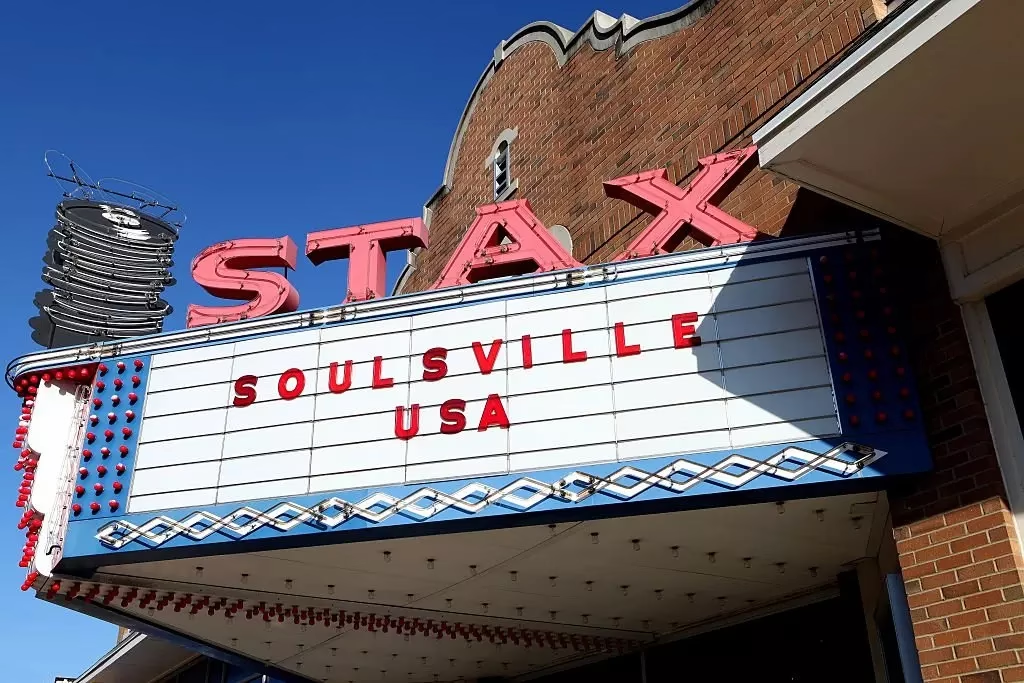
Most museums have paintings, statues, dusty garments and a disintegrating document or two. Most museums are not the Stax Museum of American Soul Music, which has a tricked out peacock blue Cadillac Eldorado spinning on a turntable so visitors can savor every glamorous detail on Isaac Hayes' gold-plated ride.
The Cadillac—which was customized for Hayes as a contract negotiation perk in 1972—is the centerpiece of the Memphis institution, and arguably the main attraction of a treasure trove of instruments, outfits, posters, records and other memorabilia of the storied soul label and its artists. Otis Redding, the Staple Singers, Booker T and the MGs, Carla Thomas, Hayes and other talents cemented Stax’s legendary status as a foundational soul label back in the ‘60s and ‘70s, and its place in pop culture has only grown more precious thanks to the timeless appeal of its greatest hits.
But down the hall from the Cadillac stand two modest wooden bookcases, and those contain slim, white cardboard boxes with the names of various Stax artists written on the front and sides—William Bell, Rufus Thomas, Redding, Hayes. The boxes are less flashy than the Caddy, but they are perhaps the most important pieces in the museum: These hold the “brain” of Stax records, as these are the masters that the staff hastily grabbed and brought to a safe location when Memphis erupted into unrest following the assassination of Martin Luther King, Jr. in 1968. (Though much of the neighborhood surrounding the Stax studio was destroyed, the original site—where the museum stands today—was left untouched.)
The history of Stax is entwined with the Civil Rights Movement, and these artists not only gave voice to some of the most powerful protest anthems of the 20th century, but to the time and place that informed their art. This through-line is a crucial one for the Stax Museum, which operates under the umbrella of the nonprofit Soulsville Foundation, as do local music education initiatives through the Stax Music Academy and Soulsville Charter School—and one that strikes a poignant chord in 2020 as thousands of people across the country take to the streets in the wake of senselessly lost Black lives, just as they did in 1968, in 1971 and far too many times since.
For Jeff Kollath, the executive director of the Stax Museum, he and his colleagues are listening to the needs of their community and taking this slower-than-usual season to reflect on their important mission: to share the music of Stax, but highlight the people, causes and communities that brought that music into being.
I’m so struck by the parallels between this moment and the struggles that shaped the early days of Stax. In the Stax Museum, we literally walk through the history of the label, and the curation of it is anchored in a broader conversation about what was happening in the country, and popular culture, at the time.
Jeff Kollath: Stax as a record label didn’t have this social, political awakening—at least one that was publicly evident—until 1968. It didn’t start to take hold until after the death of Dr. King in Memphis, just a few miles from the Stax studios, at [the Lorraine Motel], a place that was sacred to Stax Records in so many ways. It was one of the few places where Black and white [Stax] employees and musicians could hang out. They would record in the morning, take a break in the early afternoon when it got hot because the studio didn’t have air conditioning, hang out by the pool, eat some lunch, write.
The artists and the employees were certainly aware of everything—they just had more freedom to express it, and the company was more willing to put it on a vinyl record. You start to see that with the rise of Isaac Hayes, the signing of the Staple Singers, and the establishment of new artists and new sounds, and you especially start to see that after 1969 with Hot Buttered Soul, which marked a new era for Stax n terms of the music it was going to put out. The artists [became] much more socially, politically active.
How have the last few months changed, or deepened, the mission of the Stax Museum and the Soulsville Foundation?
For us, it’s been this moment of a lot of listening, seeing what’s going on in our city around us and the world around us—much like Stax did—and also finding good places where we can draw parallels. In October 1971, a 17-year-old by the name of Elton Hayes was joy-riding in a pick-up truck with some friends. They got pulled over by Shelby County sheriff officers, and there was an incident. Elton was beaten and eventually succumbed to the injuries at the hand of a number of Shelby County sheriff's officers. And so the city responded to that, and eventually there were protests in the streets, protests in the neighborhood, which is northeast of where Stax is.
Isaac Hayes was a key part of those protests. He was already involved in the community, but he was asked by Mayor [Henry] Loeb to sort of help keep the peace, to talk to the young people, because there’s rioting and widespread unrest. Isaac goes out and tries to be the voice of reason, the voice of calm. He's planning a large benefit concert around that same time, and Loeb and the city had imposed a curfew. In order for that concert to happen, the curfew needed to be lifted. Isaac learns through the machinations of Mayor Loeb and the city council that he’s basically just being used by the city to calm this predominantly Black neighborhood. He goes out on a limb for them, and then the curfew doesn’t get lifted until the last minute. They hold this concert, it doesn’t go the way that it’s supposed to, they don’t raise as much money as they wanted for a charitable cause, and Isaac basically throws up his hands at that point and realizes that it’s almost impossible to work with the city.
Photo By Raymond Boyd/Getty Images
At the same time, there’s a trial by which the officers were acquitted of any wrongdoing in the Elton Hayes case. This is something that happened almost 50 years ago, and that’s been at the forefront of my mind, and Stax’s role in that. What Stax tried to do was provide a voice for the Black community and try to [support it] in so many ways, and try to maintain a positive role and image—not just for the company, but for the Black community in general. You see that with the Wattstax Festival in 1972: They pulled off something that nobody thought could happen, which was a concert in the L.A. Coliseum that cost $2 [to attend]. 110,000 overwhelmingly African-American attendees, and the concert goes off without a hitch—there’s no violence, no unrest, no protests, no nothin'. It’s just this beautiful moment for the company, especially coming after the Civil Rights Movement and the Black Power movement. For us, it’s what we can contribute, and we’re trying our best to figure out how to do that when so much of the ways we’ve been able to do it—through the museum, through 30-40 free programs a year, providing a venue for Shelby County public schools to tour our museum at a free or discounted rate—all of that stuff is on hold right now. A lot of these museums, it's planning for the future, but it's also figuring out how to respond in this moment, too, in a genuine and meaningful way.
The altruism at the heart of Stax made it a hotbed of creativity, and it was such a welcoming label—one that was integrated from inception. It isn't lost on me that Stax provided much of the soundtrack to the Civil Rights Movement.
The threads, for us, that run through past to present are opportunity and empowerment. What Stax did in the past is what Soulsville Foundation and the charter school and music academy are doing today, which is to provide young people with an opportunity to learn, create, to work, and then empowering them to forge their own path. The path that was school of hard knocks, learning on the job, learning in the studio and mailroom or publicity office at Stax Records, now it’s in the classroom, orchestra suite and choir suite, and providing these young people with the tools they need for lifelong success. Stax did the same thing. It sounds cliche and trite, but it’s legitimate: Everybody had an opportunity at Stax records. If they thought you could contribute in some way, you got the opportunity to contribute. The Bar-Kays were being groomed to be the next rhythm section at Stax when the majority of them were killed in the plane crash with Otis Redding in 1967. All of those kids were from the neighborhood; they all lived within walking distance of the studio.
That’s one of the parts of [Stax] that we love so much, why we’re so protective of it and why we think it has so much resonance: it’s hyper-local. This is what really drives us going forward, and something we need to recalibrate during the time of the pandemic. We’ve been so tourist-driven, and sharing the story with people outside of Memphis, that it’s really important that people in this city know it, too… Everybody knows Elvis; everybody knows Sun Records and Johnny Cash, and people know Otis and Isaac and so on, but to me it’s these stories of young people getting an opportunity, getting a chance, that are really powerful. Those are the stories we can really share with young people and help them understand that what we’re providing has roots in the past. It isn’t some new thing.
Are there any pieces of memorabilia in the Stax exhibits that’s all the more precious to you or relevant because of the context of our current moment?
It’s a William Bell fan club card. Nobody notices this thing, but I noticed it pretty much when I interviewed for the job. It has an acronym for SOUL, and the acronym is Strength Opportunity Unity and Leadership. Those are four words that are very important right now, and four words that you could argue are lacking in a lot of ways. For us, it’s using those four words as an inspiration for doing what we can for our community. I think that if we could all find a bit more of that, maybe we could get out of this situation.
Read More: Houston Rappers Talk George Floyd's Musical & Community Legacy
What about the label’s place in protest music, and the artists who have had the freedom to say these things? I’m curious about some of the more prominent voices of protest that were championed at Stax, and how they’re represented in the museum.
Artists can write a protest song, certainly: they can sit down and respond to a moment; they can respond to George Floyd, to anything that’s happening in the world around them. [The music of Stax] is still so relevant and impactful today. These songs took on lives of their own a lot of times after they left the studio. They could be inspired by things that are happening in the everyday world, but as soon as it gets out into a 45 and a jukebox and radio and an LP at home, whatever it is, and the listener juxtaposes that music to the moment that they’re in, that’s when it takes on a new meaning.
That’s one of the things about Stax that makes our place so powerful: People are coming from all over the world and these songs mean something to them. It’s sacred ground in so many ways. I think of songs like "Soul Man," which was not an explicit protest song: it was one of the first times that Stax actually used the word "soul" in a title, and was inspired by the spray painting of SOUL on black-owned businesses in Detroit during the 1967 riots. That’s what inspired Isaac Hayes and David Porter to write that song. But if you read the lyrics, straight, and don’t know the moment in which it was recorded, it’s not going to read like this overt protest song. When it hits and it starts to gain some steam and more people are listening to it, it becomes an anthem of Black pride in so many ways: I’m a soul man, this is me. It becomes so much more in that moment because of everything that was going on in the world. It becomes this anthem of Black pride. "Respect" by Aretha is the same way. These two songs, which were not written as overt protest songs, become two of the most powerful songs of that moment for Black Americans in the late ‘60s, and they still have resonance today.
<style>.embed-container { position: relative; padding-bottom: 56.25%; height: 0; overflow: hidden; max-width: 100%; } .embed-container iframe, .embed-container object, .embed-container embed { position: absolute; top: 0; left: 0; width: 100%; height: 100%; }</style><div class='embed-container'><iframe src='https://www.youtube.com/embed/1cSyZY1dBpI' frameborder='0' allowfullscreen></iframe></div>
I think that’s the moment where it really begins, 1967 with "Soul Man," and then when the Staples come to town in '68, and they would do Soul Folk In Action... You start to see those records, and that’s what gets you "Respect Yourself," "I'll Take You There" and so on. Even a song like "The Weight," which was on Music from Big Pink by the Band, an anthem, really, it’s a legendary song, it’s been covered a bajillion times—but listen to the Band’s version, and then listen to the Staple Singers' version, and then tell me what you feel… That’s one of the things I think Stax was particularly good at: the talent of their artists, vocally, certainly, but the songwriting talent, and just the company understanding the moment they were in. They got it. Deanie Parker is our founding CEO and she was the director of publicity there, and she’s modest about things, but Stax didn’t put out a full-on company newsletter until 1969. If you go to Staxarchives.com, you can see all of these issues, because we have them scanned. The first time that Stax explicitly is juxtaposing their company’s politics with stories or anti-war stories, about racism in the recording industry, stories about abortion, next to adds for Johnnie Taylor records. It’s a brilliant, brilliant thing that they did that, and of course it’s just a treasure trove for scholars and researchers.
One of the things it did—you talk about shut up and sing—they did get some backlash from people who thought they were just subscribing to the Stax newsletter and all of a sudden they’re getting stories about current events along with their stories about Johnnie Taylor and Albert King. Stax was in that moment too, a little over 50 years ago, where they had to sort of work hard to justify why they did that. I think that’s really what set the company on the course it had heading up to Wattstax. That’s the company understanding that there’s this moment here, this is our time to step up, this is our time to make our voice heard, because this is what our buying public, our customers, the people that are keeping us in business, and the people in this community that we are serving, this is what they’re saying. Al Bell's thought was, we’re going to take care of the people that take care of us. The record-buying public that takes care of us, we’re going to take care of them, and that’s why Stax invested so heavily in charities and causes: they felt it fulfilled their value and mission in Memphis and all over the country.
<style>.embed-container { position: relative; padding-bottom: 56.25%; height: 0; overflow: hidden; max-width: 100%; } .embed-container iframe, .embed-container object, .embed-container embed { position: absolute; top: 0; left: 0; width: 100%; height: 100%; }</style><div class='embed-container'><iframe src='https://www.youtube.com/embed/JV0_RvpPoG8' frameborder='0' allowfullscreen></iframe></div>
Is there a particular song that’s offered comfort or been a rallying cry that people have been responding to from Stax lately that feels on the nose for you right now?
When you go into Studio A, there’s the loop of stuff from outtakes, and there’s Otis that sings, and there’s a "Dock Of The Bay" thing,” and a Bar-Kays thing, but then there’s a Rufus Thomas thing, and it’s Rufus singing "starting all over again," which is the Mel and Tim song. For me, when you’re in the studio, and you turn it on, and you’re doing work, and you hear that loop over and over again, to me, that’s the thing that always sticks in my head. When we had decided on our opening date on June 18 and we were all working remotely and doing Zoom calls like everybody, and we were trying to think of some pithy things to put on the marquee to make good social media, the only one I could think of was "Starting all over again on June 18." We put that on the marquee and we used that to announce our return to the world. I think that song has really resonated with me, because I’ve had to share it with staff, too—we closed on March 17, and I’ve told them multiple times, the museum you left on March 17 is not the museum you’re coming back to. It’s different. There are obvious things that are going to be different—acrylic shields, our guests will have to wear masks, there are hand sanitizing stations everywhere, decals that say don’t get near each other, and any number of things. But our mission is still the same. Our story is still the same. What we want people to get out of a visit to the museum. Starting all over again is going to be rough, so rough, but we’re gonna make it: that’s the line from the song. To me, this has just been hard, and it’s been hard for so many businesses and so many people. I think, for us, it’s like, it’s going to be rough, but we’re going to make it, because our story, our legacy, our history is what carries us through. As long as that’s around, we’ll be around.
Fire In Little Africa: Tulsa’s Journey Of Prosperity, Loss & Redemption Told Through Hip-Hop
