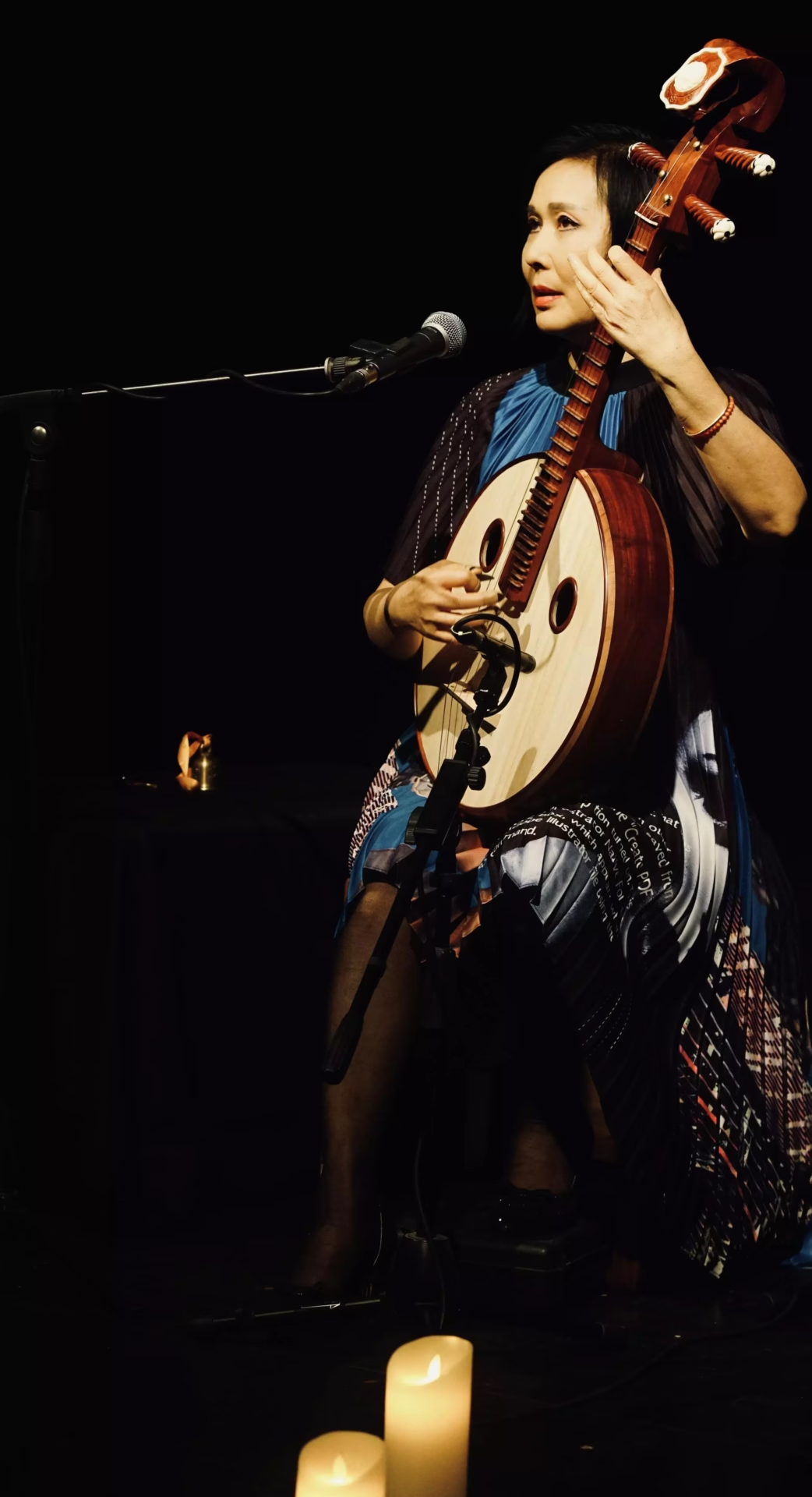
To hear Min Xiao-Fen's "Annica," named after a Buddhist term meaning "impermanence," is to feel pulled between the earth and the ether. She plays the pipa, which, in America, is typically thought of as a Chinese lute. The tonality of the strings may evoke something close to an acoustic guitar, but the harmonies have depth and darkness beyond description—to say nothing of her droning, rasping vocal over the top.
But after a minute or two, gravity sets in. The tune, premiering exclusively on GRAMMY.com, from her new album White Lotus, out June 25, reveals ancient dimensions of harmony and order. (The pipa's been around for more than 2,000 years, after all.) What initially may have come off as strange and different becomes incontrovertibly human—something from the heart or the guts. In conversation, Xiao-Fen is kind, bubbly and informative, and she's quick to note that American sounds aren't so different from those ringing from China.
<style>.embed-container { position: relative; padding-bottom: 56.25%; height: 0; overflow: hidden; max-width: 100%; } .embed-container iframe, .embed-container object, .embed-container embed { position: absolute; top: 0; left: 0; width: 100%; height: 100%; }</style><div class='embed-container'><iframe src='https://www.youtube.com/embed//EzKHa3gVjUM' frameborder='0' allowfullscreen></iframe></div>
"Blues and bluegrass reminds me of what I studied in China!" she says with a dash of mirth. "Talking blues reminds me of a Chinese [form] called pingtan. It's music from the Southeast that I grew up with."
Speaking of transdisciplinary connections without borders, here's another: The relationship between music and cinema. White Lotus is Xiao-Fen's original score to the long-lost 1934 Chinese silent film, The Goddess. The music isn't just played on pipa, but on a variety of other plucked instruments—plus, eerie loops mixed with Buddhist chanting. The results sound far more familiar than alien thanks to Xiao-Fen's mastery and deep connections to American improvisational music.
GRAMMY.com caught up with Min Xiao-Fen to talk about her roots in traditional Chinese music, how she came to score The Goddess, and how music can explode cultural barriers between the East and the West.
This interview has been edited and condensed for clarity from two conversations.
Tell me about the pipa's history and significance in China.
The pipa developed during the Qin Dynasty between 220 and 270 B.C. Of course, it's a plucked instrument. Western people say it's a Chinese lute. It's a pear-shaped wooden body. The name "pipa" comes from Chinese syllables: pi and pa. The maker of the instrument played it and heard sounds like "Pi-pa, pi-pa," so he kept the name. The most common technique is to use your first finger, strike down, and with your thumb, strike back, so it sounds like "pi-pa."
The pipa has four strings. The tonality is A-D-E-A. During the Tang Dynasty from 618 to 907 A.D., a pear-shaped wooden body pipa was introduced to China from Central Asia. At that time, the pipa only had three or five frets, was held horizontally and they used a plectrum. During the Tang Dynasty, the pipa became a principal musical instrument in the imperial court, and it was played solo or with an orchestra.
Right now, I'm playing the modern, reformed pipa, so it's chromatic-scaled and has six large frets and 24 bamboo frets. It's been around so long that it has a large repertoire; [it can be] played lyrical-style, martial-style. It's a wonderful instrument, especially for solo.
What feelings is it meant to convey? Is it meant to capture the entire spectrum of emotions? Or does it have a specific role in that regard?
Chinese music is always associated with nature and seeking that harmony and balance. When we play traditional music, which is very hard because you have to use your inner energy, we always emphasize strong but not aggressive, soft but not weak. This is how I was trained as a traditional Chinese musician. You have to be very careful how you play, with your energy. Just don't show too much! Always the balance.
<style>.embed-container { position: relative; padding-bottom: 56.25%; height: 0; overflow: hidden; max-width: 100%; } .embed-container iframe, .embed-container object, .embed-container embed { position: absolute; top: 0; left: 0; width: 100%; height: 100%; }</style><div class='embed-container'><iframe src='https://www.youtube.com/embed//iuDE7qnFQRk' frameborder='0' allowfullscreen></iframe></div>
How did you come to this instrument?
I grew up in a musical family. My father—he passed away—was an educator and pipa master. He taught at Nanjing University for 60 years! My sister was a well-known erhu player; that's a Chinese two-string fiddle. She passed away, too. I'm the youngest. My brother is an orchestra conductor.
When I was young, I just wanted to play. I didn't want to study music. My father always encouraged me to study a Chinese instrument, but I was just not into it. One day, I remember my father, after university, came back home and said, "Hey, your classmate wants to study pipa with me!" I lent her the pipa and immediately got jealous. So I told my father, "I want to learn!" I was 10 years old.
Is the pipa the only traditional instrument you play on White Lotus?
I played several other plucking instruments. Actually, it's a whole family of instruments. One is the ruan. It's also a plucked instrument, four strings. It's kind of a lower tone, like a viola, a little bit. Also, I play the sanxian. It's also in the Chinese plucked-instrument family. The sanxian has three strings and no frets with a long handle. Also, the guqin, one of the ancient seven-stringed instruments. We're going back 3,000 years.
Tell me about scoring The Goddess.
I had to compose a musical theme for each character in the film. For the single young mother forced to work as a prostitute, struggling to support her young son, I used Buddhist chanting and voice with electronic loops to surround her and to show her lotus-like purity.
For her young son, I created some simple notes to emphasize his innocence. The sounds for the thug, or gangster, who was stealing money from a woman trying to save money for her son's education, are dark, ugly and irregular. The climax of the film occurs when the young mother grabs a bottle and smashes the thug on his head. That moment is so strong, so I decided to simply use silence and let the action speak.
Min Xiao-Fen. Photo: Jiang Yu
Where do traditional Chinese music and American improvisational music connect for you?
I was a pure traditional musician, and I have a lot of stories I could tell you about how I went in this direction. Basically, I learned all kinds of genres and styles of jazz on stage, because I work with so many great musicians. I started composing my music in 2012 with my Dim Sum CD. I was thinking, "I want to do something for myself." Just spontaneous. I thought I would start to improvise on swing notes and see how it goes.
Is there a way that understanding the ancient musical heritage of Asian-Americans can help combat xenophobia?
That's what I want to do. I feel like it's my duty. I want to introduce not only my instrument, but all kinds of things, arts and film. America's a great place for all kinds of races and cultures.
First of all, I feel very lucky because I never thought I could go that far. I was totally trained as a traditional musician, not changing the notes, just following what the master taught me. Coming to America, I felt very lucky. I met so many musicians that influenced me. I could become myself. Before, I was so stiff! When I came to America, everyone just said, "Hey, do what you want to do! Be yourself!" I fundamentally changed.
It's not only films. I also worked with dancers and opera singers. Also, visual arts. I learned so much from different kinds of formats and arts. It's good to share your experience and share your culture—to tell people what a great history China has.
I feel like when one views another fearfully as an interloper, understanding that they have their own rich traditions and inner lives just like them can help soothe those pains. I mean, China is an ancient place; America is only about 250 years old.
You know, there are a lot of similarities. Blues and bluegrass remind me of what I studied in China! Talking blues reminds me of a Chinese [form] called pingtan. It's music from the Southeast that I grew up with. It's a form of singing and talking and making jokes and playing and acting. It's very similar to the blues. This world is small, you know? People should be open-minded.
We think these lands are so far-flung, but they're not. The East and the West aren't on different planets.
You don't know this instrument, but music is a universal language. You don't need to say something. You just play it and make them happy.
Tomoko Omura On The Universality Of Japanese Folktales & Her New Album, Branches Vol. 2