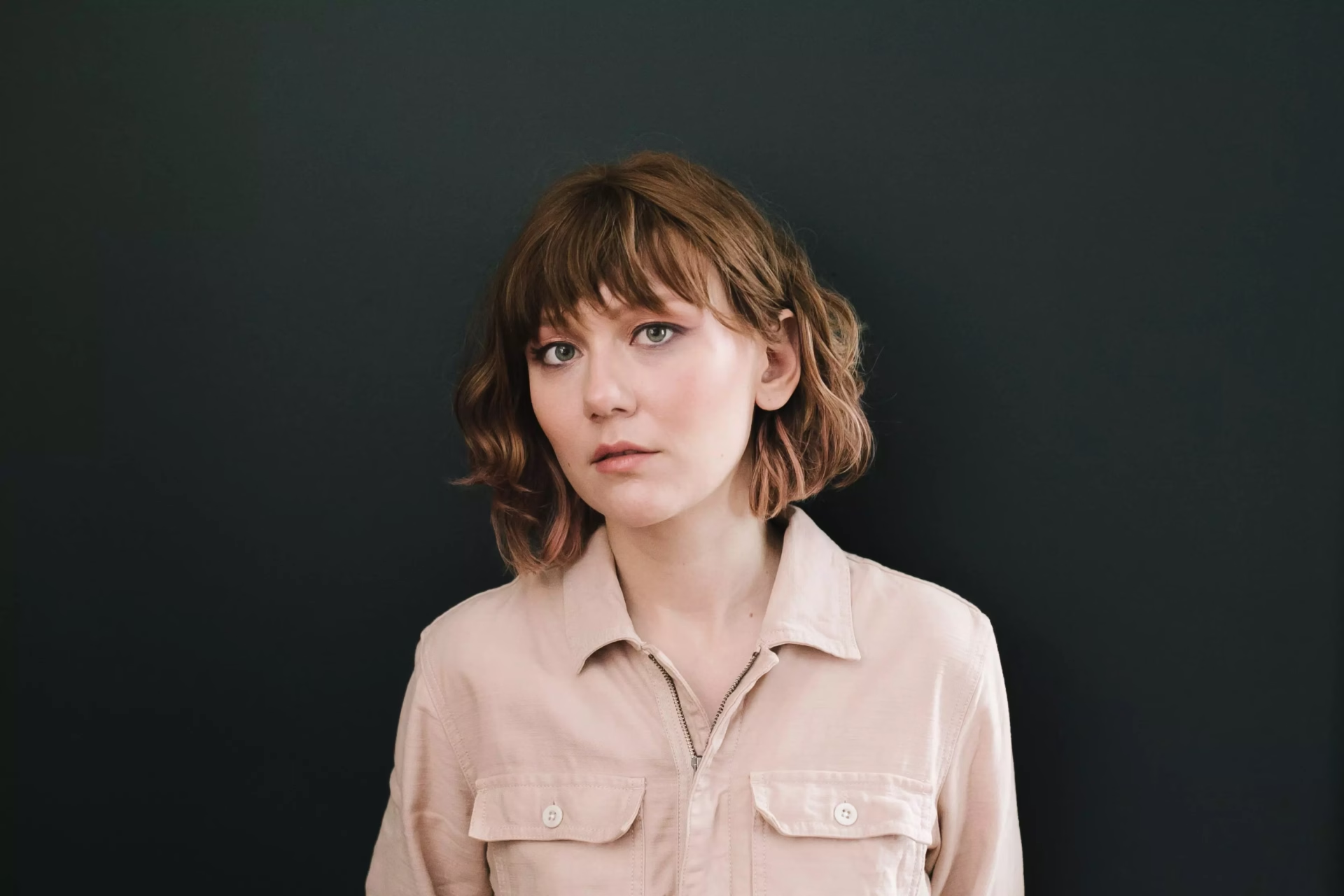
At the beginning of 2020, when it looked like the year would be as normal as any can be, Molly Tuttle met with producer Tony Berg to discuss working on a new album of original songs. Then the pandemic hit, forcing the 27-year-old singer, songwriter, and guitarist to stay home alone in Nashville with no access to a proper studio, putting plans to develop her next LP on hold.
But Tuttle didn’t just wallow in isolation or pass the time making a sourdough starter. She kept in touch with Berg, whose most recent production credit was Phoebe Bridgers’ 2020 standout Punisher, and they figured out a new project: an album where Tuttle would home-record cover songs that had special meaning to her at various points in her life. Inspired, she taught herself to use Pro Tools and got to arranging and tracking, then sending her work to Berg, who was sequestered in Los Angeles.
<style>.embed-container { position: relative; padding-bottom: 56.25%; height: 0; overflow: hidden; max-width: 100%; } .embed-container iframe, .embed-container object, .embed-container embed { position: absolute; top: 0; left: 0; width: 100%; height: 100%; }</style><div class='embed-container'><iframe src='https://www.youtube.com/embed//io3hvuzlfxg' frameborder='0' allowfullscreen></iframe></div>
That collection became …but i'd rather be with you, which was released by Compass in August. The 10-track LP features renditions of songs by artists including The National, FKA Twigs, Rancid, Harry Styles, Cat Stevens, and the Rolling Stones, all anchored by Tuttle’s powerfully shimmering vocals and virtuosic guitar playing. It’s a departure from the bluegrass and Americana that won her acclaim, but as she explains, 2020 felt like the right time to explore something new while returning to the songs that brought her so much joy. We recently caught up with Tuttle and Berg — who are still separated by thousands of miles — to discuss how the album came to be.
How did the process for recording this album start?
Tuttle: Tony and I had been talking about making a record and then once quarantine started, we had this idea to do it remotely and choose these cover songs. We both wanted a creative project to work on and these songs kind of stood out to me as ones that I wanted to put my own voice to. They were some of my favorite songs. It was kind of an unconventional way to make an album, but we both thought it would be a fun and interesting new project to work on remotely.
Berg: Yeah, we had a plan and then the world got in the way.
Tuttle: It gave me something to look forward to when I wasn't like screaming at my computer because Pro Tools was crashing. That certainly wasn't good for my mental health, but overall, I loved working on it. It was really gratifying to be able to share something with people during this time that hopefully helps people who are struggling.
How did you narrow down the list of songs?
Tuttle: That maybe took the longest out of the whole process. We went back and forth sending each other playlists and different songs. I think we decided early on that we had to only choose songs we both felt really strongly about and both really loved.
Berg: Well, I would send Molly songs by [Karlheinz] Stockhausen and John Cage and she would say, "Oh no, that's not going to go." [Laughs] It was, I'm not going to say effortless, but in the relative scheme of things, it was surprising how quickly and easily we agreed upon repertoire.
<style>.embed-container { position: relative; padding-bottom: 56.25%; height: 0; overflow: hidden; max-width: 100%; } .embed-container iframe, .embed-container object, .embed-container embed { position: absolute; top: 0; left: 0; width: 100%; height: 100%; }</style><div class='embed-container'><iframe src='https://www.youtube.com/embed//_ObwYBYJEqc' frameborder='0' allowfullscreen></iframe></div>
Tuttle: That's true. It was funny — I feel like we were looking for the same qualities in the songs and we ended up with such a diverse array of different genres that we were pulling from, but we wanted the same qualities: great lyrics, great melodies, interesting chords, and stuff that I could really put my own spin on. We were gravitating towards songs that sounded really different from what I do.
Berg: It's as if we met and then eloped. It was like this instant wedding.
Molly, you mentioned your misadventures with Pro Tools. What was that process like?
Tuttle: It was just that I'd never run Pro Tools before and I still don't have a great setup for it. I was going off my six-year-old MacBook, which I don't even think is supposed to run Pro Tools. My little house, all my electricity and stuff, was interfering but Will [Maclellan], who mixed the album, and Tony would walk me through stuff. There were hiccups along the way, but overall that felt pretty smooth. I wasn't doing anything crazy with plugins or like anything super advanced — just basically trying to get it to run.
Berg: What was interesting about that was, I think we both approached it with an unspoken dread because making a record is a social exercise. It's the interaction of players and the discussion of ideas and contacts and to be denied face-to-face, in-the-room experience, I found it a little daunting initially. By the second day, it was second nature.
What was it like putting the songs together with the backing musicians without being able to work in person?
Tuttle: I really trusted Tony and I trusted all the musicians because the people he asked to play on it were so wonderful. They were people I'd never played with before, but I was familiar with most of them. I just had to let go. I realized it was better if I didn't listen to stuff a lot until it was more fleshed out because there was a temptation to get really nitpicky with each piece along the way. My biggest concern was my own parts and that it would gel with everyone since we weren't playing altogether.
Berg: There's the great luxury of, as Molly was alluding to, if you're going to call Matt Chamberlain, Rich Hinman, Taylor Goldsmith, Gabe Nolan, Patrick Warren, basically, it's hard to f*** up. These are great musicians with a real history of sensitivity to song and to the artist.
Tuttle: There was the slight anxiety of, “I'm probably not going to hear these until they're all done. I hope I like it,” but again, I wanted to make this record with Tony because I knew he would choose great people. Then when he sent me the list of players and I was like, "There's not really a way that that's going to not sound awesome."
Did any track make you nervous to record, with the worry that the original artist would disapprove?
Berg: No, we were lucky, weren't we, Molly?
Tuttle: Yeah, no.
Berg: We heard wonderful things back from [The National’s] Matt Berninger, whom I know pretty well and I have huge respect for, so that was a relief.
Tuttle: That broke the ice because you sent it to him and he was the first one who heard the cover of one of his songs [“Fake Empire”]. Then the guys from Rancid have reached out to me and said they really loved the cover [“Olympia, WA”]. One of them got the vinyl and posted a video of him listening to it. I was like, "Oh, my God." Then Harry Styles, he started following me online and I messaged him and he said he had heard the cover [of “Sunflower, Vol. 6”] and loved it. He was the one I thought for sure would never hear the cover.
<style>.embed-container { position: relative; padding-bottom: 56.25%; height: 0; overflow: hidden; max-width: 100%; } .embed-container iframe, .embed-container object, .embed-container embed { position: absolute; top: 0; left: 0; width: 100%; height: 100%; }</style><div class='embed-container'><iframe src='https://www.youtube.com/embed//dZ5hWXLpjxQ' frameborder='0' allowfullscreen></iframe></div>
Berg: Of course, Mick and Keith haven't said a thing.
Tuttle: Yeah. We're still waiting on that one.
Berg: The nerve.
How much did working on this project help you both in terms of mental health during this overwhelming year?
Tuttle: It definitely made me reflect on what these songs have meant to me. I felt I was struggling being creative and feeling like I had purpose. It was comforting to come back to these songs and just revisit how I felt when I first heard them and what they mean to me now, then also have something that would hopefully bring other people joy. It really gave me a sense of purpose. And it was fun making the videos for them and having that connection with people still.
Berg: In what is perhaps inarguably the worst year in our history since World War II, the community that has stood up, in my opinion, has been the musician community. By that, I mean the quality of material we've been exposed to, whether it's Fiona Apple, Bob Dylan, Phoebe Bridgers, or Molly Tuttle, I think speaks to artists acknowledging their responsibility to do their best work in the face of adversity. Maybe it is collectively about hope that the orange imbecile will no longer be part of our lives in 45 days.
<style>.embed-container { position: relative; padding-bottom: 56.25%; height: 0; overflow: hidden; max-width: 100%; } .embed-container iframe, .embed-container object, .embed-container embed { position: absolute; top: 0; left: 0; width: 100%; height: 100%; }</style><div class='embed-container'><iframe src='https://www.youtube.com/embed//YMnopVR3x04' frameborder='0' allowfullscreen></iframe></div>
Tuttle: Yeah, it's overwhelming how much incredible music has been coming out. I've been listening to more music than I have in years.
Berg: On a personal note, when I was first introduced to Molly, I was aware of her as a guitarist. I'd watched some videos, but spending time with her, getting to hear her, I realized that as much focus should be placed on her singing and on the intelligence of what she brings to a record, because that shows the breadth of her as an artist. The fact that she's a world-class player, it's almost a given, but to learn that she sings as beautifully and intelligently as she does is something I'd like an audience to really be aware of. Her next album, I would like for her writing to be the focus of all of it, because that's where she really would excel.
Some of the videos you’ve put out touch on some weighty topics. What was the decision behind that?
Tuttle: Yeah, the “Fake Empire” video was the first one. We decided to put that out because we thought it was relevant to the moment we're in. That song, to me, feels like a wakeup call [to] people who have the privilege to ignore these things happening in our country. That was during the time that I was going to Black Lives Matter protests in Nashville and trying to get more engaged in the community, as I still am. We took a lot of protest footage from the ‘50s and ‘60s and put it with that song to kind of contrast the message of the song, the dreamlike quality with these really powerful images from American history.
How is Nashville these days? You had the tornado in March and then the pandemic hit right after, and there still seems to be a lot of fighting over safety precautions from the virus.
Tuttle: It's really bizarre. We had the tornado a couple of weeks before quarantine started. It's like people almost have forgotten about that. Now it's COVID, but people are still trying to rebuild from the tornado. A lot of businesses have just been closed this whole time because their buildings were destroyed and they couldn't reopen because of COVID. It's bizarre to see people packed into bars and restaurants. I drove by downtown and you feel like half the people aren't wearing masks. It seems really chaotic. A lot of people are frustrated. I'm frustrated that people aren't being safe. Then people on the other side are mad that they haven't let bars open to full capacity yet. I've seen pictures of bars completely packed with people not wearing masks and it's freaky.
Yeah, many musicians have said they won’t tour until there’s a vaccine or some sort of indication that things are safer. How do you feel about getting back on the road?
Tuttle: I don't know. I thought of the vaccine as the thing that hopefully people will be able to get and want to take. I don't know what's going to happen, but I feel like until there's a vaccine, I just don't want people getting sick at my shows.
But whenever it happens, like you said, musicians might be able to be the ones who can get back out there and maybe make us feel normal again.
Tuttle: Yeah. No matter what, there's still the music. It’s all really heartbreaking but it makes you realize what's actually important about playing music.