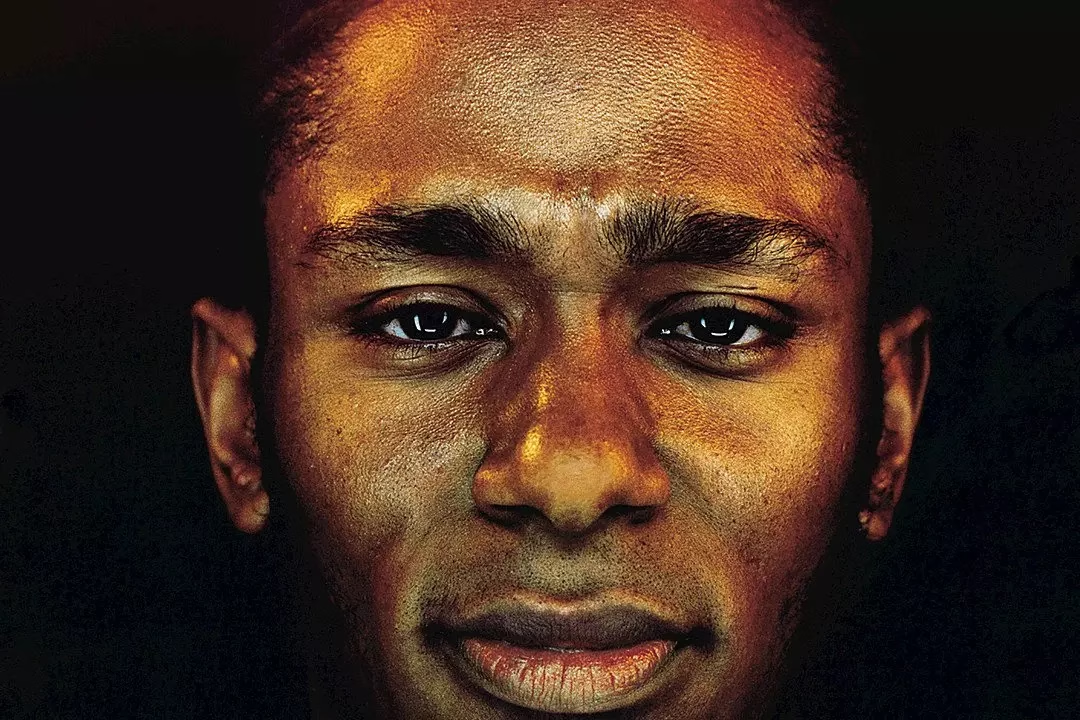
When Dante Smith titled his solo debut Black On Both Sides two decades ago this week, he may not have been thinking about time. But those two sides might be "past" and "future," with who else but the man currently known as Yasiin Bey adjoining them. The Bed-Stuy polymath came to the world’s attention in 1998 with his fellow wordsmith Talib Kweli for just one album as Black Star, appropriately titled Mos Def &Talib Kweli Are Black Star. And redefining both "blackness" and hip-hop was present in their work from the git. The duo's explanatory "Astronomy (8th Light)" spends the entire song doing just that: "Blacker than the seed in the blackberry pie / Blacker than the middle of my eye," "Black like the perception of who on welfare," et cetera. But where Kweli has always adhered strictly to the boom-bap, Mos Def indeed showed another side of himself just a year later.
One of rap's most enigmatic figures then and now, think of Smith like Jack White, an artist who loves history so much he has to mess with it. But where White channels his ideas into paradoxical analog gadgetry, Mos Def sang the praises of Nina Simone on a song that turns into barreling hardcore punk. This was 20 years ago, long before Lil Peep sampled emo songs or Travis Barker grafted drums onto XXXTentacion tracks. "Rock N Roll" didn't really make a show of itself either; the late '90s were so self-consciously eclectic that it was just a matter of fact that Lauryn Hill, Missy Elliott and Andre 3000 were beginning to cut their rhymes with straight-up singing. That's the environment Black On Both Sides was born into, and it was the most nonchalant of all, partly because when Mos Def sang, it didn't sound like he was doing it for a hit.
<iframe width="620" height="349" src="https://www.youtube.com/embed/GCuTYVulOzY" frameborder="0" allow="accelerometer; autoplay; encrypted-media; gyroscope; picture-in-picture" allowfullscreen></iframe>
The meditative, nearly free-associative "Umi Says" was released as a single anyway, with live drumming beneath electric Miles Davis atmospherics for five minutes, while Mos singsongs about "trying to do the best I can" and ultimately climaxing, "I want black people to be free, to be free, to be free." On the neighborhood anthem "Brooklyn," he sings a bit of Red Hot Chili Peppers' "Under The Bridge," which was neither something people were expecting from a moderately mainstream rapper in 1999 outside of maybe an MTV awards show, nor something listeners were expecting from someone who just a few tracks earlier was proclaiming Afrocentric preferences for Fishbone and Albert King over Korn and even the Stones. You could almost say that he was so demure about shifting from a rapped setting to a sung one that Mos got a raw deal compared to Andre or Cee Lo Green, who were seen as innovators by the time "Hey Ya!" and "Crazy" became worldwide smashes.
Hosted by one of the calmest rap voices you'll ever hear, Mos' debut was appropriately soothing, rhythmically hard, vocally liquid, full of melting-pot soul-jazz sonics as his loose cavalcade of compadres like Questlove, Common, and D'Angelo developed their awe-inspiring studio aesthetics. If you can remember which songs he speaks (the opener "Fear Not Of Man"), sings and raps by merely from skimming the tracklist, you’re probably not being honest. It's only now cherry-picking for research two decades on that it's actually apparent he doesn't start rapping until five minutes into his first album. Flow was his thing; for all of Sides' genre-splicing, its trick was that it never felt like it was doing something new (even though it beat OutKast and Gnarls Barkley to the punch by years.
<iframe width="620" height="349" src="https://www.youtube.com/embed/zbjhH1AQYTE" frameborder="0" allow="accelerometer; autoplay; encrypted-media; gyroscope; picture-in-picture" allowfullscreen></iframe>
But then there's the rapping. It’s not quite right to call "Speed Law," "Do It Now!" and the flute-flecked "Habitat" bangers in any traditional sense. But they're clever, wordy, spaciously produced and catchy the way jamming in a room gets catchy when all the players lock in. Even "New World Water" is catchy, and you've definitely never heard another rap song fretting about the world's water supply. In the wake of California's droughts and the threat of melted ice caps, it takes on all different layers of apocalyptic new meaning.
It won't surprise you that the most marketable tune from Black On Both Sides was "Ms. Fat Booty," an instant classic that sampled Aretha Franklin's early "One Step Ahead" and wasn't nearly as simple as its title; nothing was simple with this guy. A conversational noir of vivid storytelling, "Ms. Fat Booty" is one of the most cinematic rap songs of the '90s and absolutely the least dramatic entry in that crowded subgenre. Not a lot of hip-hop from any era resembles a smart rom-com, and Mos gives the woman of his pursuit just as clever dialogue as he gets.
<iframe width="620" height="349" src="https://www.youtube.com/embed/01yUzXQctcM" frameborder="0" allow="accelerometer; autoplay; encrypted-media; gyroscope; picture-in-picture" allowfullscreen></iframe>
Mos would become more adventurous on The New Danger, an underrated half-rock album with his supergroup Black Jack Johnson that no one in 2004 knew what to do with, and he even topped his debut with 2009's exotically gorgeous The Ecstatic before changing his name and all but disappearing from release schedules. But Black On Both Sides helped hint at what the next millennium's vision of hip-hop would be like, an impressionistic painting that honored not just his rap elders but many other genres as well. The great achievement of Mos Def's debut is that it made rap feel more comfortable in its skin, being whatever it wanted to be. That's still an ongoing process for too many black Americans, and too many are still not free.
OutKast Examine Their Southern Experience On 'Southernplayalisticadillacmuzik'