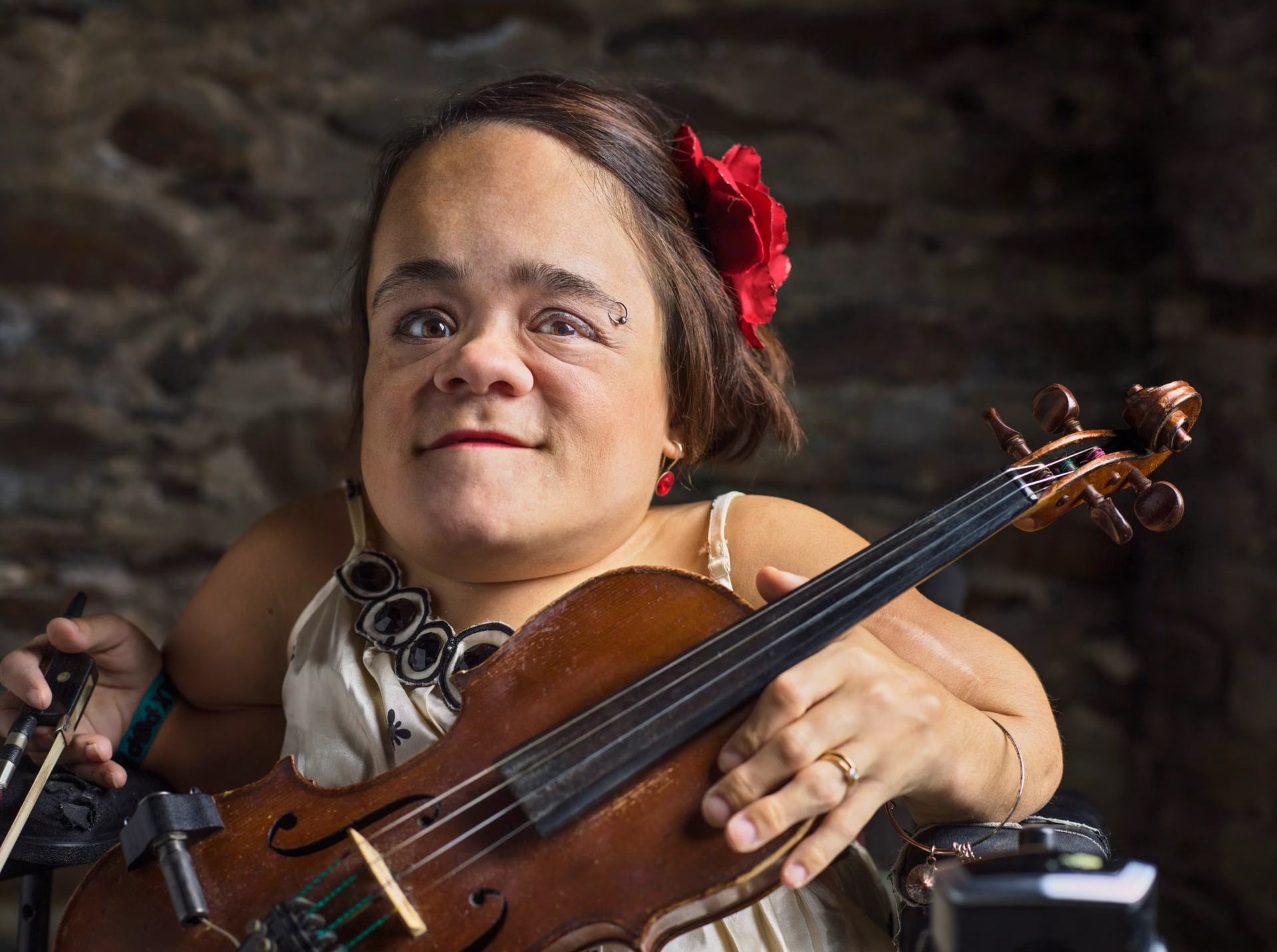
Gaelynn Lea is a violinist and folk singer hailing from Minnesota who has become a mighty voice in the fight for accessibility in the music industry through her advocacy and public speaking. Born with a genetic condition that complicated bone development, she uses a wheelchair full time. She began playing violin in grade school after an astute teacher saw her passion and talent for music and helped her adapt a unique playing style to fit her needs.
Lea is an international touring artist, having supported bands like The Decemberists and Wilco, and gaining national recognition from her Ted Talk about Disability Culture. GRAMMY.com sat down with her to learn about her latest endeavors and discuss her goals for a more inclusive and accessible music industry for all.
What have you been up to over the last year and a half during the ongoing pandemic?
I started a weekly concert series called Sunday Sessions, literally the first week we were all home. I did over 80 concerts. This week is my last weekly one, but I'm going to do it once a month from now on.
I invited a different guest artist every week, musicians I’ve met from all over the world touring. It was a fun way to stay connected with not just my music fans but also the people that I’ve met on the road. I perform at the end of every show.
<style>.embed-container { position: relative; padding-bottom: 56.25%; height: 0; overflow: hidden; max-width: 100%; } .embed-container iframe, .embed-container object, .embed-container embed { position: absolute; top: 0; left: 0; width: 100%; height: 100%; }</style><div class='embed-container'><iframe src='https://www.youtube.com/embed/Vc0Tel9IPLg' frameborder='0' allowfullscreen></iframe></div>
I released the live album [The Living Room Sessions: Gaelynn Lea Live] in September 2020, taken from those concerts. Most of it was improvisational music, instrumental with my looping pedal and violin. But there were a couple of newer songs on there that hadn't been released yet. A lot of the improvising I did in the beginning was reworking traditional fiddle tunes with the looping pedal, creating the sonic landscapes underneath them and then playing the tune on top. But this year I've been straight improvising.
I had never done it solo at live shows; I had always felt nervous to try it because people are paying money to see you and I'm not a big jam band person, I don't want to be jamming if [the audience is] bored.
Online, I'm doing a show every week, I don’t have that many weeks of brand-new material. So, I had to improvise. But people really enjoyed it. I was excited to find out that's something that people got a lot out of. I think I'm going to incorporate that in my live sets now.
I also began working with Recording Artists and Music Professionals with Disabilities (RAMPD). It was founded by Lachi and she asked me to be the vice president. That has been amazing because we are bringing in people who do what we do, music for a living, and are facing different barriers in the industry. We're hoping to partner with companies like the Recording Academy, NIVA and SONA on awareness-building campaigns.
The big new things that I'm working on creatively are writing a memoir and composing original music for Broadway’s “Macbeth,” which will star Daniel Craig and Ruth Negga and is directed by Sam Gold, and that is very exciting.
That’s amazing, congratulations! Have you felt like being isolated has helped or hurt your creative process?
I will be honest, creatively it has been very hard, but improvising has been a good way to stay connected with my creativity. I haven't written any new songs since the pandemic, which kind of freaks me out because they [used to] always come to me kind of downloaded. But this year I feel really drained. Pivoting to the concert series and RAMPD have allowed me to express myself without being put under the pressure of, “You have to write a song.”
And that's why I'm so excited about the play coming up because that's going to be my first completely, really, totally creative project in a while. And the book is a good way to connect with my career while using a different part of my brain that seems to be more active.
We're all analyzing everything all the time right now. It's weird where we're all at, at least where I've been. It's weird but it's not bad. I think artists, a lot of us found creative ways to keep going in a different format that made it more bearable than it would have been without.
<style>.embed-container { position: relative; padding-bottom: 56.25%; height: 0; overflow: hidden; max-width: 100%; } .embed-container iframe, .embed-container object, .embed-container embed { position: absolute; top: 0; left: 0; width: 100%; height: 100%; }</style><div class='embed-container'><iframe src='https://www.youtube.com/embed//Pk9lgimztD4' frameborder='0' allowfullscreen></iframe></div>
You recently penned an open letter to the music industry about accessibility issues. Despite the Americans with Disabilities Act passing 30-plus years ago, there are still venues across the U.S. that are not in compliance with this law. Why do you think that is and what can be done to change that?
There is still a big barrier in the music industry with people not understanding accessibility issues. People are afraid to talk about it. It's like other forms of oppression; if we admit that it's a problem, then we're going to have to do something about it. For example, what if SXSW came out and said, “We’re not going to book any of our official showcases at inaccessible venues.” That would change a lot for them.
And that's why I don't think it ever happens. But it's not a burden forever, it's a burden for a while as we figure it out. But people haven't been interested in doing that, even though it is illegal [discrimination]. That's the hard part for disabled people. That’s one reason why we started RAMPD. We need to have an official way to address this because right now individual artists are carrying all the burden to educate the world.
There's not a very robust system for enforcement. There's a lot of misinformation about a grandfather clause [in the ADA], which everybody always references when I bring up that their venue is not accessible. Or they’ll tell me that they can’t afford to build a ramp or install door openers. But these are usually only a few thousand dollars, these are not million dollar [improvements]. Most businesses cannot tell me that for 30 years they never had to invest $2,000 in their venue for [nondisabled] customers to be able to access their space. So, it’s just not being enforced enough, and people are miseducated.
That's why I want to work with RAMPD to bring this to a bigger discussion point because there are creative ways to fund things. There's nothing saying you can't fundraise for it, or part of the ticket sales goes to an access fund, there're a lot of creative ways to do it. We haven't been talking enough about those options or DIY. Building a ramp is not actually that hard of a project. A lot of venues have built ramps for me since I made the decision not to play in inaccessible spaces. It's just plywood and two by fours, it’s not rocket science.
I think the way to solve this problem is to better educate the venues and make them see accessibility as a priority. And we must put people in place, whether it's at a federal or a local level, to hold the venues accountable. There are more than just physical access issues, but I think the physical ones are so easy to fix that it's ridiculous that some venues haven’t addressed them yet.
I also think venues need to be held accountable through the industry itself. If a venue couldn’t get agents to book their room due to inaccessibility, they would become accessible because otherwise nobody would play there, and they'd be out of business. There are ways that we can formally put on the pressure to make everybody just realize, “Wow, we've been straight up discriminating for three decades.”
Another thing you address in the letter is the need for booking and management agencies to diversify their rosters. Share a little more about what you’ve gone up against there and what you think companies can do to fight that inequality.
I can only go on my own experience, but I won the [NPR Tiny Desk] contest [competing] with over 6,000 people from all over the country. After that I only got one offer from a tiny booking agency in Minnesota, which I took but he wasn't prepared to book accessible venues. There I was doing [accessibility communication with the venues] on top of his work. I eventually left after 18 months. When looking for a record label, manager or agent and everyone says, “They’re too busy,” or “I’m not the right fit,” or whatever.
It's tough, because you know what you're putting out is authentically actually very good and the response is overwhelming from people, but then to be still ignored by the music industry. There's just a disconnect that I can't explain in any other way. Maybe there's another reason, but I find that very hard to believe.
<style>.embed-container { position: relative; padding-bottom: 56.25%; height: 0; overflow: hidden; max-width: 100%; } .embed-container iframe, .embed-container object, .embed-container embed { position: absolute; top: 0; left: 0; width: 100%; height: 100%; }</style><div class='embed-container'><iframe src='https://www.youtube.com/embed/n6oSeODGmoQ' frameborder='0' allowfullscreen></iframe></div>
You don't see disabled artists that are visibly disabled. Not on rosters, you just don't see that. They're leaving disabled people out and not being held accountable. I think what it would take to change is raising the bar of the entire industry. Instead of asking record labels to be more diverse, let's say, “Hey, the music industry needs to be more diverse [overall].” And for the labels who do not diversify, it’s going to be noticed.
When it comes to booking agencies, they should stop booking at inaccessible venues because they’re discriminating against artists and their audience. Finding accessible venues needs to become a priority. I'm not going to lie to you, it is more work. There's so much sorting through inaccessibility to find accessibility and then advocating, “Your venue is pretty good, but you still don't have a ramp, can you get a ramp? Here's the link that you need and here's a video on how to build one,” etcetera.
If that became industry practice it would be extra work for a little while but eventually it would just be the new music industry. That's when it would be more of an equal playing field.
What can nondisabled individuals and the music industry at large do to help normalize Disability Culture?
The more you write about disability in the music industry, the less niche it seems. There was a stat in New York City that 70 percent of people are close to someone with a disability. It’s not a known issue. We are the largest minority in America, 26 percent. We need to normalize talking about it. I think the music industry has a powerful voice for change. If you normalize it, suddenly, people who wouldn't necessarily care about certain ways of life realize that's not fair, and then they start to care about it.
I think collecting data in the U.S. would be helpful. England did a [disability and accessibility] music industry survey and found that a lot of people put themselves at risk to play shows, or can't play shows because they're not accessible, or they don't attend because they're afraid they won't be able to get into the venue in the first place.
America just did a huge survey on minorities in the music industry, but they didn't include disability, which shows you how much of an unseen area it still is. Disability represents approximately one in four people in the U.S. Not all those disabilities are visible, but they can be when people share their experiences and we talk about it.
There are also educational barriers for disabled people to become musicians. We need to educate teachers about the possibilities. I was lucky to have an orchestra teacher who said, “Let's try to adapt the way you play. I've never tried this before but let's just experiment and see if we can figure something out.” But a lot of people I've met have said they had the opposite experience growing up and never played even though they wanted to because of that.
What’s next for you? Any artists you’re hoping to work with in the future?
Right now, I’m focusing on writing my book and composing music for the play, so it probably won’t be until 2023 until I record a new album. I want to get back to performing live regularly again. It would be a dream come true to collaborate with Yo-Yo Ma and Itzhak Perlman someday.
The best thing I have found for myself is to not actually set too many expectations because I’ve always been very pleasantly surprised by just saying yes to things. I wasn't planning to be a professional musician; I was teaching fiddle full-time and performing a lot in my hometown, but I had never imagined a national or international career. But when I won the Tiny Desk contest, I thought, well, it would be silly not to try, it's such a big opportunity. So that's sort of how my whole career has unfolded. It’s been fun so far, so I’m just going to keep with my M.O. of saying yes and going through the doors and seeing what happens.
Jason Becker On Making Music With ALS: "Accessibility Is Much More Than Ramps And Wide Doorways"
