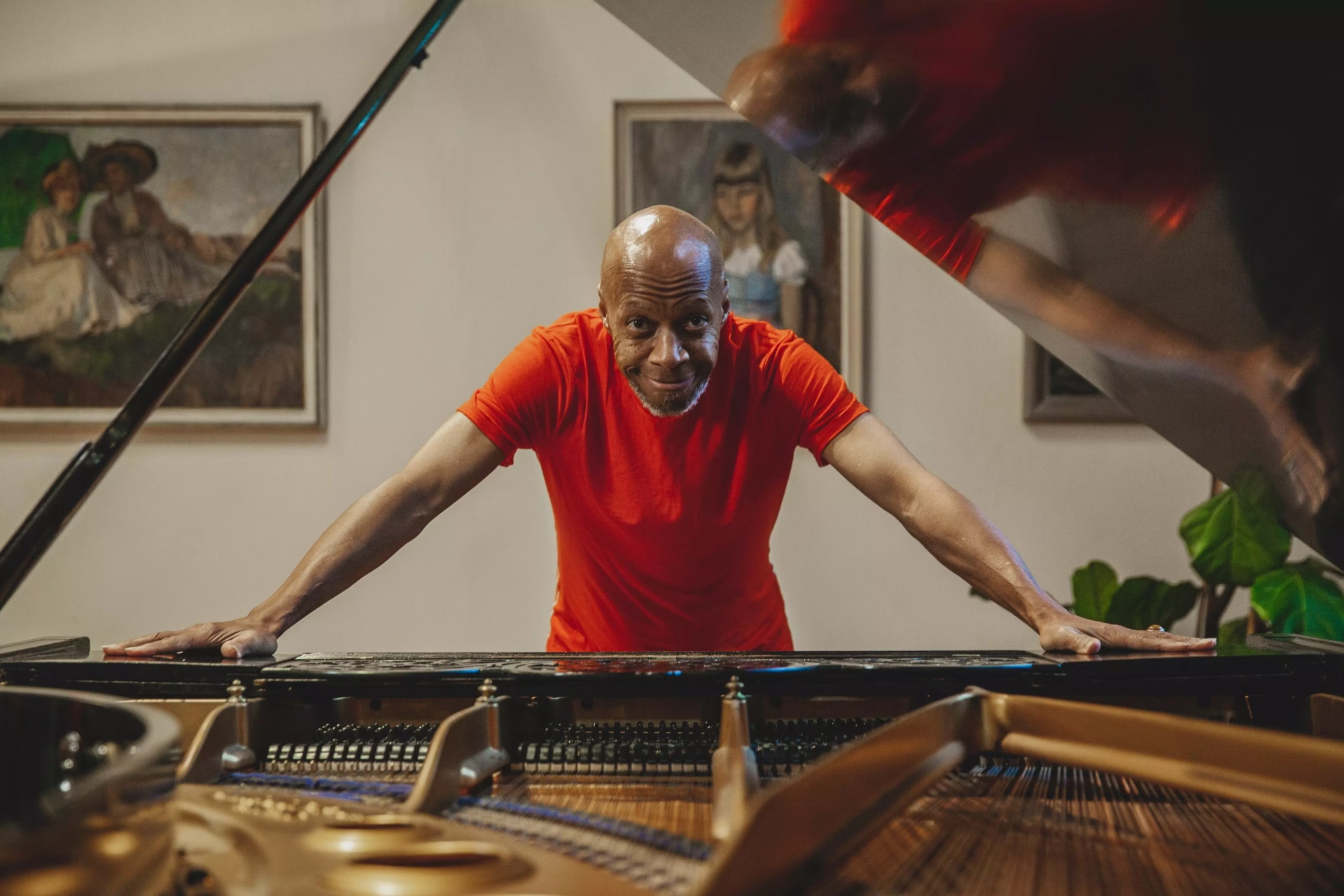
It’s clear that Edward Gordon's laugh is a healing tonic even before learning that he's a practitioner of laughter therapy. The lush, resonant "ha's" are as strong and warm as a heartbeat coming through loud and clear over the phone from his Harlem, New York, home. Not only a spiritual guide in therapeutic practices, Gordon has built a long, legendary career in music. The first major splash in public awareness came via Brian Eno, who worked with Gordon for the third record in his ambient series in 1980. However, Gordon has produced countless meditative albums under the name Laraaji since the late ‘70s. Gordon has focused in recent years on the power of the zither to bring listeners to another plane.
In an appropriately reality-bending conception, his latest LP, Sun Piano, takes a step forward and a look back at the same time. The record is the first in a trilogy focused on piano as primary instrument, and the resonant chords and walking bass lines perfectly fit a new transcendent phase of Laraaji. However, the album also captures the mystic spirituality of the piano's place in Gordon's upbringing in the Baptist church.
Though Sun Piano was recorded well before the world was hit by pandemic, before the prominence of marches for racial justice, Laraaji was already focused on helping listeners reach a place of peace. Playful piano stairsteps open album highlight "This Too Shall Pass," the right hand pinging out lustrous counterpoints to the left’s cheery bass bounce. In a world where we are all bombarded by information and message, Sun Piano offers a respite for the imagination, a moment of peaceful self-exploration and beauty.
The pioneering Afro-Transcendentalist Laraaji spoke with GRAMMY.com about mystic coincidences, imagining other existences through improvisation and the healing potential of Sun Piano.
<style>.embed-container { position: relative; padding-bottom: 56.25%; height: 0; overflow: hidden; max-width: 100%; } .embed-container iframe, .embed-container object, .embed-container embed { position: absolute; top: 0; left: 0; width: 100%; height: 100%; }</style><div class='embed-container'><iframe src='https://www.youtube.com/embed/GR5CDUJpFGU' frameborder='0' allowfullscreen></iframe></div>
Do you see yourself as Laraaji, or is that a name that more encompasses what you represent to other people in your music?
It's both. It's a name that for me addresses my appreciation and respect for the power and the presence of the sun. And it serves me in my attitude about myself as a serving through sound and through my lifestyle, constant service, constant radiation. Although I sign my checks as Edward Gordon. [Laughs.]
When you release an album, do you have a plan or a hope for what that specific release can bring for people? Do albums differ greatly in that regard for you?
I am peacefully excited with the sense that this album will address the psychological and emotional comfort side for people. Also it will address any desire to feel the piano in a new way. This piano is a very grand classical concert piano being handled in a way that grand pianos aren't normally handled. [Laughs.] A little rock, jazz, flowing, ambient, celestial, very free flow, free-spirited approach to the improvisation with the piano. And I feel that that spirit could support people around the planet at this time, those who choose to listen to it, to keep the spirit free and light and flowing.
Do you see the mission of your music differently when the world surrounding you feels in relative chaos?
The recording session took place December 2018, and at that point I had no conscious inkling that it would be released during a time of a pandemic or a racial intensity. But I feel spiritually guided by unseen forces that this album should be released at this time. My life has been guided in ways that might seem mystical and my activity has been synchronized with so many things that go on in my environment.
So you're saying that while it is a coincidence, you aren't so shocked by the timing?
No, I'm not. I kind of laugh at it. I'm constantly reminded how the spirit or the higher intelligence works. There's a unity I feel in the way that I'm guided to be at the right place at the right time doing the right thing for the right reasons. [Laughs.]
That definitely resonates. Do you feel that mystic connection when you perform live as well?
Yes, I do. My practice is to get into as fine an alignment with a universal sense of mission or a universal sense of purpose as possible so that my music is not just for this location, not just for this audience, but it's an embrace of the entire unified field of the cosmos. Years of meditation have allowed my imagination to go to that place, to have my own inner imagery, a universal space time. So when I am performing, those who come up to me after the show will mention something about how a headache had disappeared or an ailment in the body had subsided, or the music had lifted them out of an emotional trying time in their life, and I'll get the feeling, "Ah, so this is one of the reasons I was here tonight."
I was fascinated by the fact that you and Donny Hathaway were classmates at Howard University. His music touches something deeper in one's soul as well, but in a different methodology.
Very much so. I grew up in the Baptist church and around a lot of gospel music. Donny Hathaway I believe had a strong background similar to that and his music reflected a spiritual influence. And I feel it in the music that I'm doing now. It’s a continuation of that Baptist Christian do-good, look out for your neighbor, bring good vibes world.
That must've been an incredible experience for you to think back on all the people that you have met along the way. How important are those kinds of connections for you?
It’s like one big party. You meet the family members one at a time along the way. It's very reassuring, very uplifting. If I hadn't met those individuals, I would imagine my zest for doing what I'm doing might be on a different level. Jessye Norman was another person I was connected to. She was an opera singer and was also at Howard at the same time—but I think she's moved beyond this life form.
<style>.embed-container { position: relative; padding-bottom: 56.25%; height: 0; overflow: hidden; max-width: 100%; } .embed-container iframe, .embed-container object, .embed-container embed { position: absolute; top: 0; left: 0; width: 100%; height: 100%; }</style><div class='embed-container'><iframe src='https://www.youtube.com/embed/KizpwXBZPTM' frameborder='0' allowfullscreen></iframe></div>
It’s so important to see connections and collaborations not only as uplifting, but also as a point of reassuring you that you're on the right path, which is really tricky for an artist. Sometimes you don't really know if you're on the right path until you're faced with somebody telling you to come along.
Yes! During periods when I was doing early experimentation, before even the zither came into view, I remember writing lots of music and sending it off to be copyrighted. That was a period where I didn't get much reassurance that the music I was doing then was benefiting people emotionally. So when I opened up to more of a service attitude in my music, I allowed my music to support people in moving into deeper silence, or music that would help to harmonize deep subconscious stress patterns, or music that would help the imagination of a creative writer or a painter or a dancer to open up on new levels of their ability to create. This later period I'm around dancers, choreographers, composers, recording artists and musicians who have all given me reassurance that now I'm doing something that means a lot to more than just myself.
What drew you to the piano for this particular album in this moment?
I've always liked the piano. Whenever I've found one, I'd play it. Even when I was on tour the last 15 or 20 years, if there was a piano backstage, I would play it during downtime. I didn't want to become dependent on it because as I moved around, I was able with the zither to go into places and do concerts where there was no piano.
But a year or so ago Matthew Jones at Warp Records suggested I should do a solo piano album. He heard a recording of a piano performance I did in San Francisco. I was there to do a zither concert, but there was a piano on stage. And I said, "Why not leave it there? And I'll somehow incorporate my concert." Matthew suggested that we do a piano album and call it Sun Piano in sequence with the Sun Zither and the Sun Gong music that I've been doing.
The record immediately calls these clear visions into the listener's mind. Do you have images in your own head while you improvise?
Images come to mind, dancers especially. They serve as my sheet music. I do a lot of dancing. The dance feeling is always in my body and it translates to the way I interact with the piano a lot. I also have images of people in deep trance, people going inward and being still. My lifestyle puts me in touch with meditation circles and energy communities, so I often have images of people using my music that way, people that I know would enjoy moving to this music or tapping their foot, as well as the people who would use it to go to sleep by, or as a backdrop for creative writing.
A favorite image of mine is the image of civilizations, either known or unknown, doing dance celebrations. Another is angels moving at a very light vibratory altitude. Another is imagery of body functions, like blood moving through veins, or the breath being coaxed to slow down.
How would you describe an energy community for those who aren't familiar?
Like a drum circle or people getting together to chant or to heal. People come together to do things like Reiki or massage, to share energy in a way that uplifts people. It's not always about sharing words or talking, but sometimes touching, laying on of hands, massage, or chanting. People come together with musical instruments and just hang out for the joy and the healing.
Even those that don't think of music as a healing form will feel that from this album. How did you utilize sequencing on this album to make that trajectory clear?
It was very easy: I gave that assignment to Matthew Jones. [Laughs.] He worked out sequences and he would run them by me. He gave it some very strong time and energy to work out the sequence, and I'm quite impressed and pleased with the way the sequences unfold.
Can you tell me a bit about how this album fits with the rest of your planned piano trilogy?
Sun Piano is the more vibrant mixing of what happened in the recordings sessions. The next one is Moon Piano, which is more of a feminine, soft, quiet energy. And then the third is called Through Luminous Eyes, which is piano with zither in the same framework.
I was lucky enough to see you play at the Bohemian National Cemetery here in Chicago two years ago. It always seems that location impacts the way that you make music.
Yes. The environment and the people who are assembled contribute to the alchemy or to the chemical act of the way I perform, or I let music happen. The architecture, no doubt whether it's indoors or outdoors, amphitheater or nightclub stage, also plays a big role. I tend to honor the space so much that you can say I play the space too. I don't just play the musical instrument.
You've worked with a wide range of artists, from Pharaoh Sanders to Blues Control. How do you know whether a collaborator will be a good fit for your expression?
With Blues Control, we went into the studio without me hearing their music. I went through a period in the ‘70s of jam sessioning in coffee houses and late-night recording studios, just on the fly, being with musicians and creating on the spot. Learning how to free associate and how to find an enjoyable function within a musical collaboration has been a gift of mine, to be able to sit in with anything and find a meaning. However, it might not always be interesting to the ears of someone else.
Is there a particular time or space in which you feel people should absorb this album?
I find myself pleasantly looking forward to this music either late at night or waking up in the morning. I haven't had the opportunity to, but I would imagine listening in a car on a nice scenic car ride.
<style>.embed-container { position: relative; padding-bottom: 56.25%; height: 0; overflow: hidden; max-width: 100%; } .embed-container iframe, .embed-container object, .embed-container embed { position: absolute; top: 0; left: 0; width: 100%; height: 100%; }</style><div class='embed-container'><iframe src='https://www.youtube.com/embed/apUE3nAeszw' frameborder='0' allowfullscreen></iframe></div>
Going into these next few weeks before the album's release, you're not able to tour. What are you going to use that time for?
I've regarded this as a blessing of unlimited relaxation. I've been doing lots of interviews and lots of home collaborations, sending music out to other artists and producers. I get to walk in Central Park a lot still during this time, but as for performing and touring, nothing's on the table until probably September or even 2021. We'll just see, because venues around the world have not really opened up to include large audiences. I also did a laughter workshop on-camera for Nike. A camera crew came here the other day and did a short introduction to my laughter meditation work.
If I were doing a laughter meditation workshop, either alone or with my partner, we would open up with call and response chanting. People would be sitting in a circle and they would be invited to sing along. Then we would talk about the health benefits of laughter and get into what I call the play zone—to get people into a childlike, playful nature. Then we would explore six or seven different ways of using laughter to work on our inner self. There's a laughter for the head to get endorphins and hormones to flow. There's a laughter for the throat, laughter for the heart, for the abdominal organs, for the immune system, for the lungs. People get to interact with one another during the laughter exercises, which causes a lot of hilarity. Then the participants are invited to lie down on a yoga mat or pillows and use these exercises to create a laughter release as a practice for how they might want to wake up in the morning. I advise people to try this for seven days to explore their laughter for 15 minutes in the morning.
After the laughter release, the participants are allowed to just lie still. The lights come down low and they're in a state close to the corpse pose in yoga, Shavasana, a deep meditative place. And then live music, whether it's a gong or Tibetan bowls or zither or voice, moves around the space to help support and compliment a deep state of relaxation and meditation. Then we would close with all the participants coming back into the body with a very happy interactive sing-along song called "The Happy Foot Song." People get into the body from the feet all the way up to the top of their head. We dance every part of the body. And then we'd close with optional sharing of experiences. We close with a hum or an om sound, or if it's in a very close-knit community, we close with some hugging so people get to let the softer energy of their laughter experience transfer into warm hugs.
Have you ever connected a laugh workshop and your music in concert?
Once in Japan I included the laughter work in a concert. It was tricky for Japan. They were so reserved. But in other parts of the tour, the laughter was a segment unto itself. Usually it's in the afternoon and the music is at night. Something that I'm now doing more of is called a sound bath, where the entire time people are coming in and lying down with masks on to be immersed in a sound bath with gongs and musical instruments. To get people into a deep, relaxed place, we'll introduce laughter as a very brief component of the experience upfront.
Beginnings And Endings With Rufus Wainwright