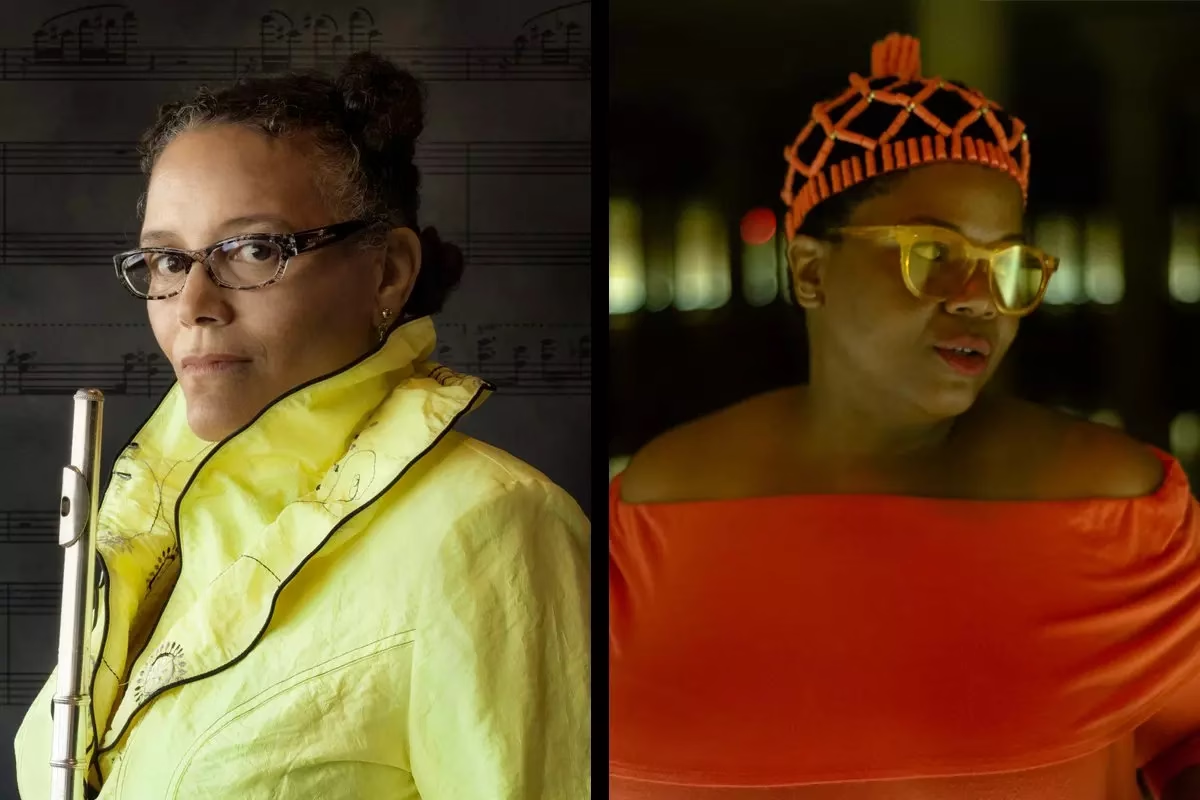
In the '90s, the late science-fiction author Octavia E. Butler predicted a future America rife with greed, chaos and violence, at the hands of a tyrannical ruler, with her Parable novels. However bleak (and eerily echoing of 2020), the story offers hope in the form a wise young Black woman named Lauren Oya Olamina and her spiritual teachings, Earthseed.
As explained in the liner notes for the powerful new album EarthSeed—inspired by Butler and composed and performed by avant-jazz flautist Nicole Mitchell and classically trained vocalist Lisa E. Harris—this woman "helps to rebuild her community through offering Earthseed, an egalitarian philosophy and spiritual practice which honors inquiry, independent thinking, and realistic acceptance of constant change."
"Our vision designs our experience. Our words comingle into elements of our future," Harris proclaims on "Biotic Seeds." "Your enemies and your saviors are within," she repeats later on the track, her words dancing with those of Julian Otis and the haunting winds of Mitchell's flute.
Released on Chicago's FPE Records on June 26, the experimental, improvisational project was recorded during the live performance of the piece in 2017 at the Art Institute of Chicago. It also features Mitchell's band Black Earth Ensemble and experimental jazz artist Ben LaMar Gay on trumpet and electronics.
Ahead of the release, we caught up with Mitchell and Harris over Zoom to learn more about how they sonically embodied the concept of Earthseed, the collaborative co-creation and how Butler's messages apply to this moment. We also discuss making art and music for social change and how that is its real purpose.
I just wanted to start by checking in and see how each of you are feeling.
Mitchell: I'll defer to Lisa. Lately, I haven't been answering that question.
Harris: I am doing not so great today. I found out that a Black man was hanged in Houston where I live. I just found out 20 minutes ago. I didn't want to reschedule, it's important to be here. But that's the space that I'm in and it is really disturbing.
Mitchell: Wow. Maybe we should reschedule.
Harris: It is urgent and emergent. There's nothing I can do about that particular situation, but that's what's happening and I don't know if that colors the interview too much, but it's real.
Mitchell: Yeah. I didn't know about that. I was just trying to take in Atlanta today.
Harris: Same, Nikki. But I still think it's important that we talk about this music. It's one of the things that we have.
Read: Amid Black Lives Matter Conversations, Black Latinx Artists Urge Non-Black Latinx To Do Better
The timing of your new album EarthSeed, which you recorded back in 2017, feels very urgent right now. What message do you hope it brings into the world with everything that's going on right now in 2020?
Harris: I hope that it brings a listening and a focus on contemplation of the self, a self-awareness that I think will benefit all of humanity right now. I think that's central in the kind of the meditation or philosophical, spiritual approach that we attempted to create with EarthSeed. The reflection of the self and then how that self operates within a community and within a larger biosphere, within a larger system, how it all comes from one idea. I hope that is a point of reflection that can be offered to people right now, as it seems like we're going to be going deeply within for a while now.
"In the Parables, both books, the Sower and the Talents, one thing that's really special is that Olamina, the main character, she's delivering a spiritual text to help people to navigate the moment that they're in. It's very similar to the moment that we're in now. And if you think about it, every major religion has a text, but every text is written by men. So, for that text to be delivered by a Black woman, and for us to create our own text with this music, I think there's something wrapped in it that will hopefully be uplifting." – Nicole Mitchell
And I would love to hear a bit more about how Octavia E. Butler and her concept of Earthseed.
Mitchell: Well, we can talk about how Lisa and I met in New Orleans on a residency. That was the first thing we learned about each other. Lisa was sharing her music with me and we were talking and we realized this really strong connection in terms of both of our inspirations, aesthetically expressing some of the messages and, I would say, the vibrations that Octavia Butler has left us with.
Octavia Butler has had an impact on my life for a long time because my mother read her books, so I grew up reading them. This was something that really fell into place in a special way, because we met and said let's do an Octavia Butler project together. We had a real alignment, not only with the text, but with the musical aesthetics. And then the opportunity came from the Art Institute [of Chicago] to do a commission.
In the Parables, both books, the Sower and the Talents, one thing that's really special is that Olamina, the main character, she's delivering a spiritual text to help people to navigate the moment that they're in. It's very similar to the moment that we're in now. And if you think about it, every major religion has a text, but every text is written by men. So, for that text to be delivered by a Black woman, and for us to create our own text with this music, I think there's something wrapped in it that will hopefully be uplifting and also help people, like Lisa was saying, to center in themselves, to get to know themselves, to reflect and to transform.
Watch: Jessie Woo Brings The Haitian "Vacation" Vibes For Press Play At Home
That's really beautiful. I was reading a recent essay on BBC about how Butler's work essentially predicted where we are now. What do you think her response or message would be for 2020?
Harris: I think it would probably the same message that she has in her books—to lean into change, that God is change. She was quoted, I don't want to misquote so I'll paraphrase, about being careful of following fools and how that could be perilous and foolish. I think she would point back to those things that she articulated so well, that resonate as a truth. A friend of mine says, "truth has a certain frequency." You hear it and know when something is true.
Octavia also wrote a lot about sustainable food sourcing, collaborating and stewardship with the land. She gave us those tools and I think she would point back to them.
Revisit: I Met Her in Philly: D'Angelo's 'Brown Sugar' Turns 25
Going back to the album, I'd love to learn more about the journey of the 11 tracks, looking at where things end with "Purify Me With the Power to Self Transform" and the flow to that point.
Harris: Sonically, and also texturally, we were really interested in conveying a life cycle. And, throughout the course of the album, really defining what exactly is an Earthseed. We started with a birthing of an idea, of creation before language. Then language comes into place and we're actually defining seed when we get to "Biotic Seed," kind of a definition of form. It unfolds in a way of the journey of the seed, that's one way to look at it. All the way, eventually to a transformation, a purification that leads to a desire for transformation is really the end, and then some journeying and traveling through space in between. Would you say so, Nicole?
Mitchell: Oh, definitely. Especially the idea of the life of the seed itself. And there's a lot of breath in it, especially with the way you and Julian [Otis] voice the words. There's playfulness and there's also depth.
Harris: And breath and movement too. At the beginning, the first sounds you hear are Nicole on the flute, creating this atmosphere that's like, every time I hear it, it feels and it sounds like gases and different temperatures, like a place I have never been before, or a feeling I've never felt before. But definitely a feeling that also has to do with hearing breath and hearing air move and what that means to us in our memory.
What was the collaborative and creative process like for this project—how did that first seed of a concept grow into the final product?
Harris: I think the seed was planted, like Nicole said, when we first met and shared our obvious mutual connection to Octavia Butler and her work, and we decided we need to do this. That desire created the life, and that was a while ago, in 2016. Then we premiered the piece in 2017, but germination was happening that whole time. We get this question because of collaboration, and people want to know the mechanics and timeline of different things, but it's so interesting because we're in this space where time is very fluid and we're working with fluidity of time in the piece. I think that we find that in composition a lot, there's definitely a beginning and a lot of space and then the end. So, we began at the beginning.
Mitchell: We worked on those words for all a while together. We always met in the mornings, didn't we?
Harris: We did. We had great morning time in the kitchen.
"What was so beautiful is we all were conducting, but if we really had a conductor, I would say it was Nicole, not with a baton in her hand, but with her flute she was conducting freedom for the others." - Lisa E. Harris.
You're right. I'm always interested in the creative process because, when we see a finished product, we can imagine the space and energy with which it was created, but we don't really know. And I'm always super interested in collaboration.
Mitchell: I definitely appreciate you asking, because I think people have trouble understanding collaboration. They always want to have one person as the creator and it's a completely different process. I think it's really important for people to be more familiar with collaboration and to try it, because it's really an expansive type of activity, it's going to open you up. You're going to be inspired.
It's a transformational experience. And especially in jazz, well really in any music, there's always a focus on one person creating. And in this case, we did it together. It was a co-creation process. It's really important to us that's clear when people write about it, and that we emphasize it because people aren't used to it. I think people understand it in visual art and in interdisciplinary art. Well, this [project] is interdisciplinary because it has words and music and the performance had our physical embodiment, which people take for granted in music.
Harris: It's a huge part that people take for granted. It's definitely interactive with the audience for them to listen, but then for them to also see things happening, kind of physical things and a performance happening, then their body starts to react in a different way. That can be unique and not as practiced as the act of just passively listening or hearing. They might be thinking about something else or on their phone or something, but if you see someone turn a backflip onstage, which neither one of us are doing, but if you see it or someone jumps off the stage or something, in the witnessing of it, something happens in your body that inspires those mirror neurons that are kind of like, "Oh, I can do that too."
So, like Nicole was saying, it's expansive. It's different even than orchestra, and I love orchestral and chamber music. But visually, in a traditional or classical setting, you see the conductor and then you see all the people sitting a bit lower than them, and those systems are set up to sustain a certain system. During our live performance of EarthSeed, people were standing and sitting all around the stage, it was more of a forum. What was so beautiful is we all were conducting, but if we really had a conductor, I would say it was Nicole, not with a baton in her hand, but with her flute she was conducting freedom for the others.
I'm a very visual person and I was trying to imagine what the performance would look like by listening to it. And that's something I've been thinking about during quarantine, is how much I miss the energy of being at a show.
Harris: That's what I like about the recording too, you hear the space we were in. We were in a hall and there's a lot of room for that air, as Nicole mentioned earlier, to move around. It frees your mind a bit to listen to it. It frees my mind a lot to listen to it.
"We need truth. So, that's shifting the usefulness, the facility, of art and music right now, which artists and musicians have always had access and agency and faculty over that facility. But with industry and capitalism and white supremacy, colonialism, and all of the -isms that have been oppressive in this world, it's been optional. It's been optional at best and intentional at other times. But now it is essential." - Lisa E. Harris
More: Baby Rose On The Struggle To Make Protest Music
What role do you see art and music playing in social change and in creating a place upward from where we are right now?
Harris: That's a tough one. I definitely think we are at a crossroads, which is powerful because right now we need more than to be entertained. We're over-entertained.
Mitchell: Yes.
Harris: We need truth. So, that's shifting the usefulness, the facility, of art and music right now, which artists and musicians have always had access and agency and faculty over that facility. But with industry and capitalism and white supremacy, colonialism, and all of the -isms that have been oppressive in this world, it's been optional. It's been optional at best and intentional at other times. But now it is essential.
Now it just is, or it isn't. It's basic. It's elemental. That's the thing, it's so crazy, because it's like our track "Elemental Crux." [Both laugh.] That's actually where we are. We are at that elemental crossroad. I'm not trying to quote our album, but putting that onus and that weight, that gravity back into the tools that art and music really are here for us to use. They're part of our humanity, they're built in that way.
For a long time, we've been really wedged away from that elemental quality that it's set up to be for us. I think we're coming back to that. It's very creative, very musical and artistic to figure out how to purify your water, which we're going to have to do. We live on a planet, our food doesn't come in a graphic construction. Our food comes from the ground.
Mitchell: And it takes time. It's not instant. I completely agree with what Lisa said. We hope that the music can offer a space within. [Both laugh.] I'm quoting from "Elemental Crux."