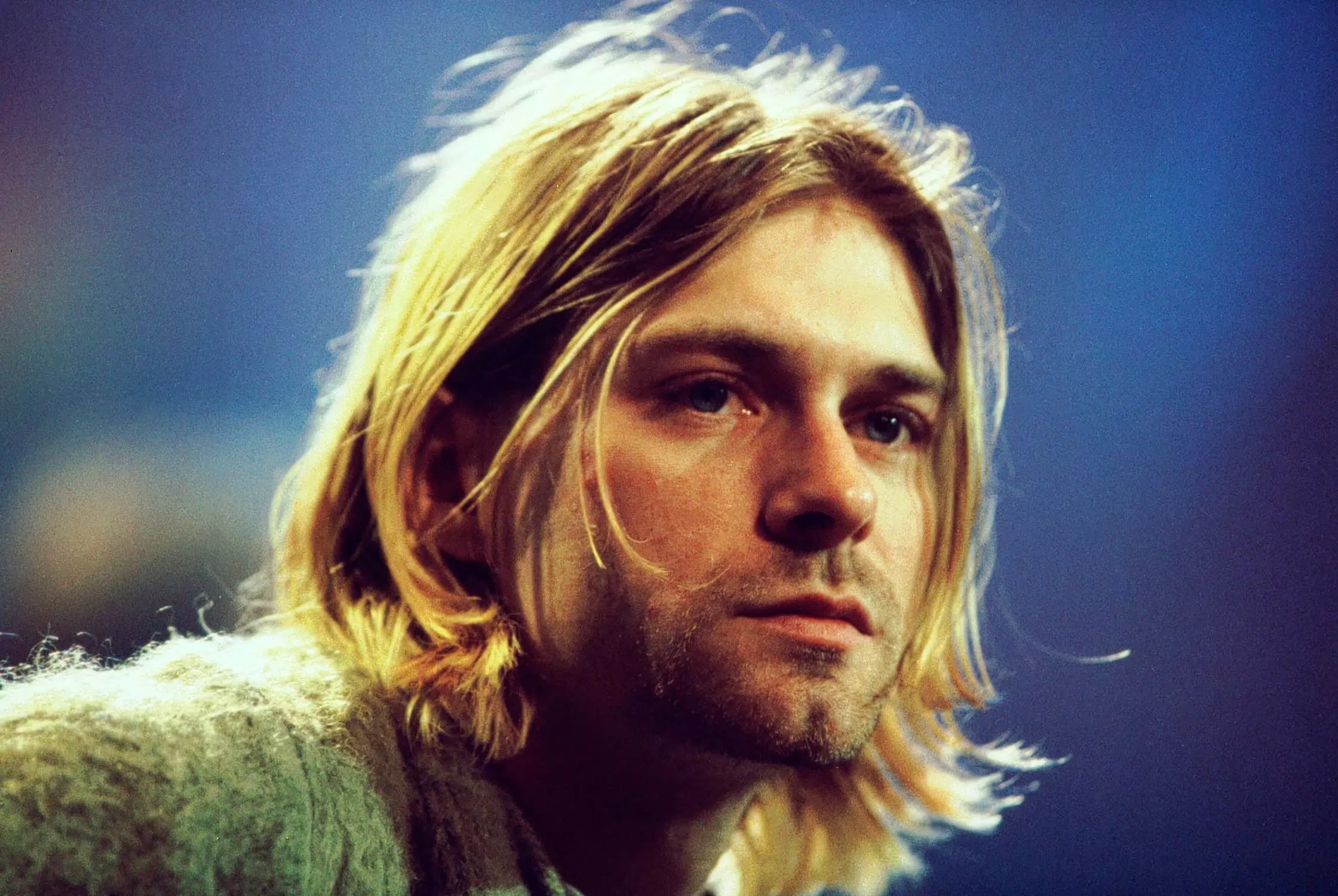
"Good evening. This is off our first record. Most people don’t own it."
With this unassuming and charmingly self-deprecating kick-off from frontman Kurt Cobain, Nirvana launched into their feverishly anticipated episode of "MTV Unplugged"—a crystallizing performance that quickly became one of, if not the most, beloved and iconic gigs of their all-too-short career. Often celebrated for showcasing both the band and the "Unplugged" format at each of their respective creative heights, the stunningly intimate episode spawned the MTV Unplugged In New York album that was released on Nov. 1, 1994. For the 25th anniversary of the GRAMMY-winning, Billboard-topping, multi-platinum album, MTV Unplugged In New York is getting an impressive expanded vinyl reissue that drops 25 years to the day after the album’s original release.
In addition to the enhanced aesthetic upgrades of an exclusive gatefold layout with celebratory silver-foiled front and back artwork, this MTV Unplugged in New York vinyl reissue finds the album making its double-disc debut with the addition of five extra rehearsal tracks—"Come As You Are," "Polly," "Plateau," "Pennyroyal Tea" and their revered cover of David Bowie's "The Man Who Sold The World"—that were previously only available in video form on the 2007 DVD release. This reissue is pressed on heavyweight 180-gram black vinyl and the band's website is offering a limited-edition multi-color variant as well.
<iframe width="620" height="349" src="https://www.youtube.com/embed/fregObNcHC8" frameborder="0" allow="accelerometer; autoplay; encrypted-media; gyroscope; picture-in-picture" allowfullscreen></iframe>
With both MTV Unplugged In New York and the show itself celebrating milestones this month (the album turns 25 on Nov. 1 and the very first episode of "Unplugged" aired 30 years ago on Nov. 26, 1989), the Recording Academy spoke to former Nirvana manager Danny Goldberg about the lead-up, taping and lasting legacy of Nirvana's landmark acoustic performance.
Danny Goldberg: As a music fan, I really liked the idea of "Unplugged." For the band, creatively, it provided an opportunity to experiment with acoustic music, which Kurt really liked. As much as he loved punk music, he was also a really big fan of acoustic singer-songwriters like Jad Fair. Also, the timing of it was perfect because it allowed the band to continue their presence on MTV without them having to be involved with making another music video.
The opportunity to record their own episode of "Unplugged" presented itself at an interesting time in the band's career. After two years of tumultuously navigating the cultural tide change spearheaded by their sophomore album Nevermind, Cobain, bassist Krist Novoselic and drummer Dave Grohl released the raucously powerful (and famously unpolished) In Utero in late September of 1993. The album’s lead single, "Heart-Shaped Box," hit number one on the Billboard Modern Rock chart and was accompanied by a stunningly surreal music video that was intricately created by Cobain and directed by photographer Anton Corbijn. The video quickly became an MTV mainstay and went on to win two MTV Video Music Awards at the following year’s VMAs.
Danny Goldberg: The music video for "Heart-Shaped Box" was an extremely elaborate production and Kurt didn’t really have an idea for a follow-up video that was going to live up to that impact. However, he didn't want to stop the connection between the band and MTV on the In Utero cycle prematurely. The relationship between Nirvana and MTV was really important to Kurt from the very beginning. From his point of view, MTV was the number one connector between Nirvana and their fans in the United States.
As "Unplugged" rose to become a legitimate pop cultural force in the early-to-mid 1990s with episodes by Eric Clapton, Mariah Carey, Rod Stewart, and 10,000 Maniacs making major impacts on radio, singles charts and album sales, there became a bit of a creative formula that continually proved successful and held up well to repetition: imaginatively rework your hits on acoustic instrumentation, invite a well-known special guest, and sprinkle in a familiar cover song or two. While those ingredients would still end up being present throughout Nirvana's "Unplugged" performance, the band's creative variations on them were not exactly what MTV was initially envisioning.
Danny Goldberg: MTV had made their requests for guests and song selections that were more in line with the typical "Unplugged" format. They raised the possibility of having guests like Eddie Vedder or Tori Amos—artists who would be well-known to the MTV audience—but I don’t think those suggestions were even passed along to Kurt. He was a real-life artistic genius and complete control freak, so he knew exactly what he was going to do. It wasn't a marketing moment for Kurt, it was a creative moment. He didn't take any creative suggestions about art and to him, Nirvana's "Unplugged" was going to be art.
<iframe width="620" height="349" src="https://www.youtube.com/embed/aWmkuH1k7uA" frameborder="0" allow="accelerometer; autoplay; encrypted-media; gyroscope; picture-in-picture" allowfullscreen></iframe>
For their "Unplugged" set, the band was augmented by cellist Lori Goldstein and second guitarist Pat Smear, who had just been invited to tour with the band a few months prior. When it came to the setlist, the band was well aware that the raw, livewire power of their biggest hits—"Smells Like Teen Spirit," "Lithium," "In Bloom"—wouldn’t translate properly into an acoustic format. Instead, they crafted an imagenitively special set around some of the more down-tempo deep cuts from Bleach and Nevermind, as well as three tracks from their recently released In Utero album. The song selection was rounded out by a trio of unexpected (yet wildly successful) covers of The Vaselines, David Bowie, and blues legend Lead Belly, plus three songs accompanied by their special guests, brothers Cris and Curt Kirkwood of The Meat Puppets—a band Cobain had become a fan of after seeing them open for Black Flag in the 1980s.
Danny Goldberg: The Meat Puppets were actually touring with Nirvana at the time. It was Kurt's idea to have them on board and he was very much driving the car as far as creative decisions. My assumption is that he knew he could do what he wanted to do on "Unplugged." Whatever misgivings MTV may have had as far as their normal way of measuring commerciality and programming, they weren’t going to piss off Nirvana. And Kurt was right, they totally pulled it off.
Earlier this year, Goldberg released the book "Serving The Servant: Remembering Kurt Cobain," in which he devotes a whole chapter to Nirvana's "Unplugged" show. In it, he points to Cobain’s solo performance of "Pennyroyal Tea" as his favorite moment of the episode. However, there were some pre-show uncertainties as to whether it would be a full band version, what key it would be in, or if it would even be played at all. When the song came up on the setlist during the actual taping, it’s fate was still to be determined—a fact evidenced by Cobain turning to ask his bandmates, "Am I going to do this by myself?"
<iframe width="620" height="349" src="https://www.youtube.com/embed/ayanerhcJu8" frameborder="0" allow="accelerometer; autoplay; encrypted-media; gyroscope; picture-in-picture" allowfullscreen></iframe>
Danny Goldberg: I always liked "Pennyroyal Tea" a lot because I think it's some of his best writing. So, hearing him play it by himself on "Unplugged," I was just so proud of him for pulling it off and so moved by the way he sang it. He had so many different talents—as a songwriter, as an image-maker, as an extremely good guitarist—to me he also had one of the greatest voices ever. I loved the intimacy of his vocal on that performance, especially combined with some of his best lyrics.
After Nirvana's "Unplugged" taping had concluded, Cobain had some mixed feelings about the performance. By the next morning, however, he eventually settled into a clearer picture of the uniquely meaningful moment his band had created together. "At first, Kurt was freaked out about it," attests Goldberg, "but when I talked to him the next day, he had already realized that they had done something special and he was really proud of it."
Nirvana's "Unplugged" episode aired on Dec. 16, 1993, and less than four months later Cobain was found dead in his Seattle home. In the days following his death, MTV played a plethora of Nirvana material, with their "Unplugged" episode serving both artistically and aesthetically as somewhat of a self-made eulogy. MTV Unplugged In New York would be released that following November and it would go on to win a GRAMMY for Best Alternative Music Album and be certified 5x platinum.
Danny Goldberg: I think the Unplugged record is equally important to every other record that they made. That's not always the case for a live record, especially an acoustic one. There's so much creativity in it and there are songs that the band had never recorded before. There was also the intense drama of it being recorded just a few months before Kurt's death. Mainly though, it all comes down to the sheer emotional power and excellence of it. When people talk to me about Nirvana, as many people cite Unplugged as their favorite album as will mention Nevermind or In Utero. The band left such a legacy in such a short amount of time and its deeply affected people. A day rarely goes by that I don't see somebody wearing a Nirvana T-shirt and often it’s people that may not have even been born when Kurt was alive. It speaks to the power and beauty of his art, and "Unplugged" was certainly one of the performances that really showcased that. It’s an incredibly significant part of the band's legacy.