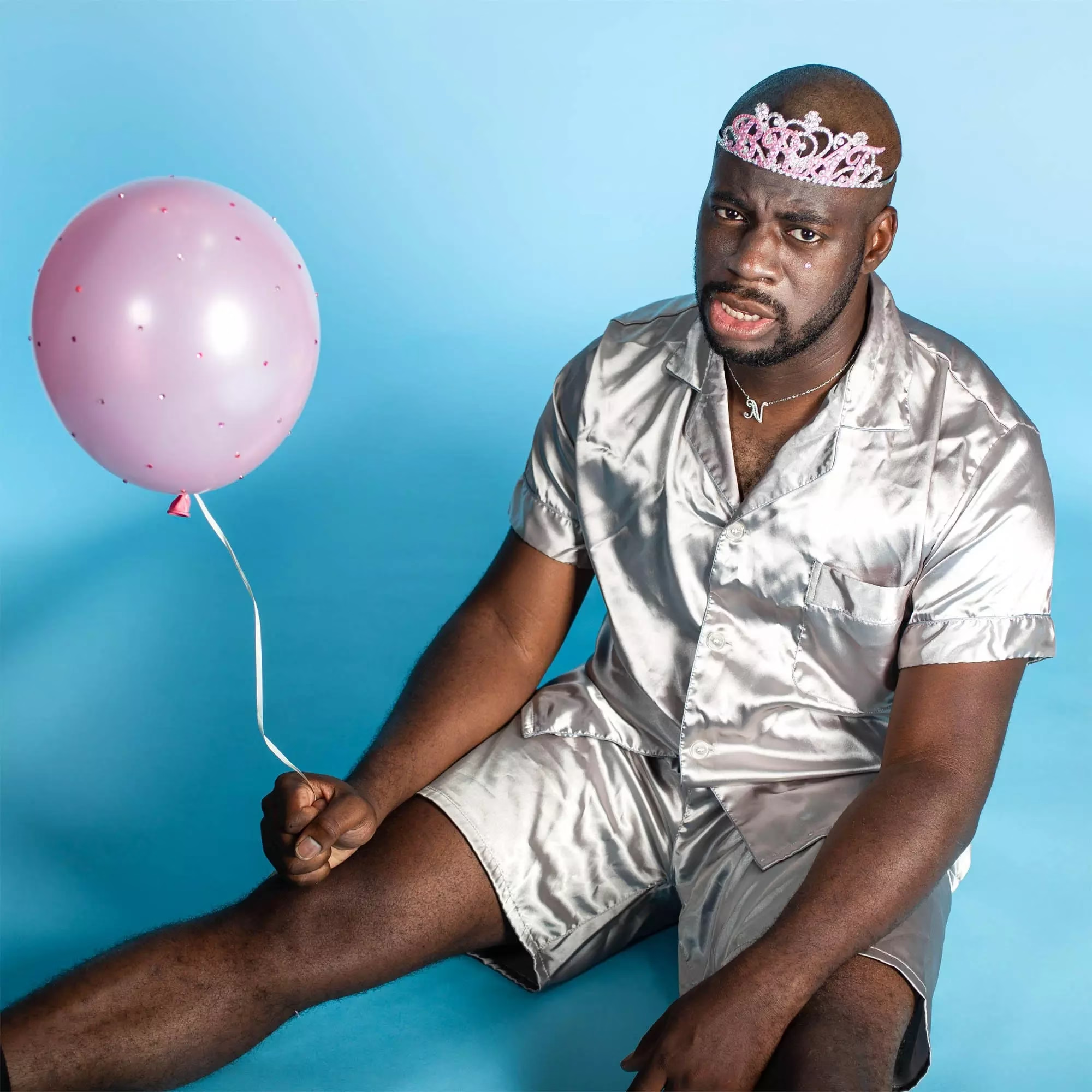
We used to think of isolation as a linen-clad monk in prayer position, rolling beads between their bare fingers, and reaching a higher state of being. Needless to say, we’re all self-isolating alright, but that zen we all assumed we would find is consistently interrupted, our minds trailing off, focusing on the details of the world. Achieving anything outside of panic is possible, it's just that the creative spark we need is at the top shelf (along with the emergency kit)—we just have to build an existential step stool to reach it. Nnamdi Ogbonnaya knows isolation—he channels the feeling into his new album, BRAT. "My thought is just to make as much art as possible and make it fun," he explains. "Making it fun comes before making it good. Good is an opinion."
It’s that awareness and intentionality that ensures the genre-defying experimental Chicago artist, now recording as NNAMDÏ, can tap into dizzying ethereal planes. By focusing on the creation instead of the chaos, NNAMDÏ weaves together elements of hip-hop, indie rock, R&B, West African guitar, dream pop and more into his own musical language.
The record takes its name not from the Chicagoan’s refusal to be tied to any genre or influence, but rather a self-deprecating joke at the very concept of chasing a career in art. "It feels a little bit selfish at times, even though I know ultimately music is very powerful and helpful for a lot of people," he explains. That balanced take—informed by his traditional upbringing with Nigerian immigrant parents who are both ministers—reflects in the music of BRAT as well. At times the record is wild and self-assured, at others tender and contemplative. Swaying through its many moods, NNAMDÏ unites the record in a mantric, explorative cohesion about growth, balance, and recognizing what you need in life.
Opening track "Flowers To My Demons" starts the conversation, circular, staccato guitar and vocal arrangements lead the listener through indecision, narcissism and shame. On the woozy twist of "Wasted," synths and clipped falsetto harmonies linger at the back of the track like lightsticks just pulled out of the freezer.
NNAMDÏ spoke with the Recording Academy about the importance of isolation and inspiration, the value of creating community, and the interconnected higher state of BRAT.
<style>.embed-container { position: relative; padding-bottom: 56.25%; height: 0; overflow: hidden; max-width: 100%; } .embed-container iframe, .embed-container object, .embed-container embed { position: absolute; top: 0; left: 0; width: 100%; height: 100%; }</style><div class='embed-container'><iframe src='https://www.youtube.com/embed/G2lKOu8JlXU' frameborder='0' allowfullscreen></iframe></div>
Is it even all right to ask how one is right now? I’d love to hit automatic and say “I'm good” but every second is shifting.
It's wild. The world is crumbling. It's on fire outside. I’ll be living life and carrying on with normal tasks, and then every 20 minutes it’s like, "Oh yeah, everything is horrible." I feel like a flayed pig at a Filipino barbecue.
I need to run across a bed of hot coals just to coax the creativity out right now. How does it feel to be releasing your new album, BRAT, in the midst of it all?
Every preconception, every feeling I had before, and all my plans are thrown out the window. I was very excited to put out this album before, but now I need to put this out. Knowing that this is coming out is literally one of a few things bringing me joy. A lot of these songs deal with isolation already. Isolation is not a new thing for a lot of artists, but it's different when everyone is going through it at the same time.
Right! A solitary science that for some is so challenging to grasp. Do you feel like a lot of artists share that sense of isolation?
When I record there's no one else in the studio. I set up the mic, I hit record, I play. It's literally just me by myself. Being an artist and trying to work on your art is a very isolated process for a lot of people. If you want to get better, you have to practice and you can't really practice if there are outside distractions. Recording this album, I was isolating 90% of the time, even when I didn't need to. I would just spend way too much time working on music or music videos, stuff that no one will ever hear or see. I obsessively work on things sometimes.
It's not that you don't want other people's perspective, it's that your focus has to be 100% on the work, otherwise you'll just float somewhere else.
Yeah. It just frees me up to not have any outside influence. Even if someone is in the room being like, "I like that," I don't want that either. I don't want any sort of opinion when I'm working. Recording by myself lets me open up to do whatever comes to mind. Relinquishing any of that control is difficult for me. I played everything besides the horns and the strings, and my roommate played a keyboard line on one song and helped me mix everything. Even that was difficult for me to let go of. Ultimately it's better because if you just do sh*t by yourself all the time, it gets old and boring. You can only do so much by yourself.
<style>.embed-container { position: relative; padding-bottom: 56.25%; height: 0; overflow: hidden; max-width: 100%; } .embed-container iframe, .embed-container object, .embed-container embed { position: absolute; top: 0; left: 0; width: 100%; height: 100%; }</style><div class='embed-container'><iframe src='https://www.youtube.com/embed/Fas2lVNRdSI' frameborder='0' allowfullscreen></iframe></div>
How did music enter into your life to begin with?
My mom would sing, and my dad would write songs on guitar and sing, just for fun around the house. I'm the youngest of four, and all of my siblings started in fifth grade in concert and symphonic band through high school. My brother played bass and guitar, my oldest sister played saxophone, and my other sister played clarinet. I was in band in middle school and high school, and started writing my own songs in middle school.
The more bands I started, I realized how much I loved it. It was something that I always wanted to do, but it didn't seem like it was a tangible career choice. My folks always said I needed to become a doctor or an engineer. That's a very Nigerian or immigrant parents thing in general. "We came to this place, so we want you to do these things that are 100% sustainable and will guarantee that you're set in life." Music just isn’t a thing that will guarantee you a job. It wasn't until pretty recently where I made the jump to doing it full-time, less than five years ago.
What were you doing whilst you were making music?
I went to school for electrical engineering, which seemed like a good idea at the time. I enjoyed the things that I learned, and a lot of it can still be useful for things that I will be doing. But the underlying thing looming over me the whole time was music. Even while I was at school, I dropped out twice to go on two different tours. I didn't really need any convincing.
When did your parents move from Nigeria?
My oldest brother is the only one of my siblings who was born in Nigeria. I was born in California.
The Nigerian music scene and industry is gigantic. As a kid, we’d often get music from Ghana and Nigeria before we would get music from anywhere else. But I suppose that still doesn’t necessarily equate to a solid career path.
They need to be like, "Oh, you're on TV performing. Okay. I get it! Then you can continue doing that."
What did they think of your music?
They...think it's fine. [Laughs.] They like some songs. They don't really like it when I swear. My dad will always be like, "I like the beat, but all this F this and F that!" I'm just like, "I said 'sh*t' maybe like once in the course of four tracks and you're still dwelling on that." He really liked "Wasted," the first song I released off BRAT. That was the first time he called me and said, "Oh my goodness, Nnamdi, this song. Old people can listen to it. Young people can listen to it!" It’s a more accessible song than a lot of things that I've done.
<style>.embed-container { position: relative; padding-bottom: 56.25%; height: 0; overflow: hidden; max-width: 100%; } .embed-container iframe, .embed-container object, .embed-container embed { position: absolute; top: 0; left: 0; width: 100%; height: 100%; }</style><div class='embed-container'><iframe src='https://www.youtube.com/embed/1fofQt6UpP8' frameborder='0' allowfullscreen></iframe></div>
The whole record is, in a way. Your music always builds its own language. How do you patch together so many different ideas?
A lot can happen in a couple of years. The way that I make most records is I'll just write and record a little something almost every day. I'm never like, "I'm going to write an album right now." I'm just always working on music. I'll slowly compile songs, and over that course, I'll notice a theme that connects some of the songs. I'll put the songs that go together in a folder. So it starts off slow, but then when it seems like it could be an album, I'll write more songs toward that feeling that I got from those specific songs. I’ll follow it.
A lot of the influence comes from my surroundings and noticing particular habits that I've formed. That's something that comes a lot especially if you're in isolation. I have a lot of time to be in my own brain, plenty of time to nitpick and overthink.
And we know what kind of winding road self-evaluation and over-analyzing can be. What sort of habits did you notice?
When I write music, sometimes I feel a need to disorient people. I still do it on the record, but not in a jarring way. These songs are easier to digest, but I don't want them to be boring or simple, necessarily. I like making some of the lyrics a puzzle that you don't really understand unless you dig deep. That's a cool habit, but it doesn't need to be like that all the time. On previous recordings, I would just write whatever I was feeling, not taking into mind whether people will feel exactly what I'm feeling from this. I would just trust that that would happen, but that's not always the case. Things are misinterpreted a lot.
My thought is just to make as much art as possible and make it fun. Making it fun comes before making it good. Good is an opinion. And then I focus on making art that's interesting and makes people think, even if it's not super technical or super verbose. I'm okay with people not getting it. But what is there to get? It's just music. Just listen to it and if you feel something, then that's good. The people that are open to it will get something out of it. A lot of people who will listen to this record and just be like, "Ah, I don't know." Maybe they'll just shrug it off as weird or just not get it, so they'll move on to something that's more comfortable for them.
Before this record, you adjusted your stage name to all caps and stopped using your last name. What prompted the change?
I have a great name, but the separation has to do with privacy and separating family from the art I make. I've had situations where things I've done have come back and affected my parents. That's another reason why they're concerned with the swearing. Both of my parents are ministers. Sometimes people will see what I'm doing and be like, "Did you see what your son did?" Changing to just the first name and having it be all caps allows me to internally at least be a little freer without worrying about those things. It's not like people will be able to Google my full name anyway.
[Laughs.] Gosh, this world. Have you played them "Salute"? That one's very spiritual.
Nah, they can hear it when it comes out. But you’re right, it's definitely religious. It's about battling with spirituality, which a lot of people that grew up in the church have to deal with at one point or another. It's also about not putting all of your faith in a higher power and not putting people on a pedestal. People let people down. People are gonna make mistakes, and the song is about recognizing that—which can be a sad thing to recognize.
<style>.embed-container { position: relative; padding-bottom: 56.25%; height: 0; overflow: hidden; max-width: 100%; } .embed-container iframe, .embed-container object, .embed-container embed { position: absolute; top: 0; left: 0; width: 100%; height: 100%; }</style><div class='embed-container'><iframe src='https://www.youtube.com/embed/ylO1huhwQzA' frameborder='0' allowfullscreen></iframe></div>
How did BRAT take shape?
Drool my last album was all made in a very small room in my apartment, which is why there's not a lot of acoustic instruments. I couldn't really be that loud, so it's mostly digital, MIDI keyboard, and direct input stuff. After finishing that record, I moved into this house with some friends. I'm in this band called Monobody, and a couple of the folks in that band had a studio in the house they share, and I'd come here to practice all the time. So when a room opened up in the house, I was like, "I get to be in this nice house and there's a free studio in the basement? Absolutely." Being able to wake up, go in the studio, and learn at my own pace was very helpful and refreshing.
I love that connection between sound and space. You've developed quite a clear and powerful community in Chicago around Sooper Records. How did the label materialize?
This was actually my third attempt at starting a label. I grew up mostly in the suburbs, 40 minutes South of the city. The first label was when I was still living in the burbs. There were a lot of very cool bands there and I would have shows at my parents' house, and I would call it Nnamdi's Pancake House. Eventually it just became way too convoluted and hard to control. The second time around it was a little more grownup. It was called Swerp Records. I moved to Chicago and had a venue called Swerp Mansion with a handful of people. That didn't work out because I was in school and didn't know how to balance my time at all.
But then I met Glenn Curran, who was in this band called New Diet at the time. I met him outside of a show and we hit it off. He talked me into trying a label again. I made it very apparent that I had tried to do it before and wasn't super eager to jump back into it unless we did everything we could do to make this work. I was at a point where I couldn't afford another failure, which has been my attitude since then. [Laughs] But the more we talked about the people we knew in bands, the more excited we got about trying to share our friends' art. Plus, I was working on music and he was like, "If you own this label and have an outlet to put your music out, it makes it a lot easier and it makes people pay attention." It took a little convincing, but there's literally no one else I would have started a record label with.
With Sooper Records, we’ve built that community by finding individuals that are very passionate about what they do, and then looking at their surrounding situation. Usually every person that is super zealous has folks around them that are also boosting them and helping them. People like Sen Morimoto and Kaina are powerful individuals, but it’s nice to get to know their little communities and to bring all these different pockets together.
Do you feel like you could carve out that community in Chicago in a way you wouldn't be able to in other cities?
I really do feel like I would have been on a similar path to where I am now if I was planted in any place on earth. I don't know if I believe in destiny, but that's just something I think about often. Chicago does definitely make it easier to meet people. There are so many shows, so many different pockets of people. You could live here for a year and not know about a whole scene of things happening.
I love how interlocking the very different pieces of the album are. There are lines and sounds that repeat and echo, even when the songs are almost completely different environments. How far into the process did you decide to utilize that world-building?
"Wasted" and "Perfect In My Mind" both have a mantra that intertwines throughout the album and helps glue things together. Those two songs totally encompass the vibe of the whole album, just because you have your electronic, mellow section and then the real instrumentation, live drums and full guitar, that gets heavy and distorted at the end. They're both about growth, balance and recognizing what you need out of life—which is where the title BRAT comes from. It's the selfishness you can feel when you pursue anything—especially pursuing a career in art when there's so much sh*t happening. I can finally pay my rent, but it goes back to parents wanting you to pick a field where you'll be set and comfortable. I'm pursuing this thing where I’m just now reaching a point of comfort after 10 years of touring. And even now I can’t just rest easy. It feels a little bit selfish at times, even though I know ultimately music is very powerful and helpful for a lot of people. In the past, it would feel selfish to be pursuing these things while meanwhile there’s family in need or one of your friends getting sick and needing help with hospital bills, and you can't do anything. You think, "What if I had a different career path? I would have the funds but I would feel horrible. I would hate my life."
Thinking of art as selfish is reductive, right? Speaking of pursuing something in the context of darkness surrounding, is the Wilco and Sleater-Kinney tour canceled or postponed?
It’s not meant to start until August, so I guess we'll see what's happening in the world then. I have relinquished all control of everything. If it gets canceled, it gets canceled. If it gets postponed, it gets postponed. Everything's so uncertain right now. COVID-19 can't stop me from what I was meant to do. It can only postpone it.
Thundercat’s New Album Is A Balm For Troubled Times