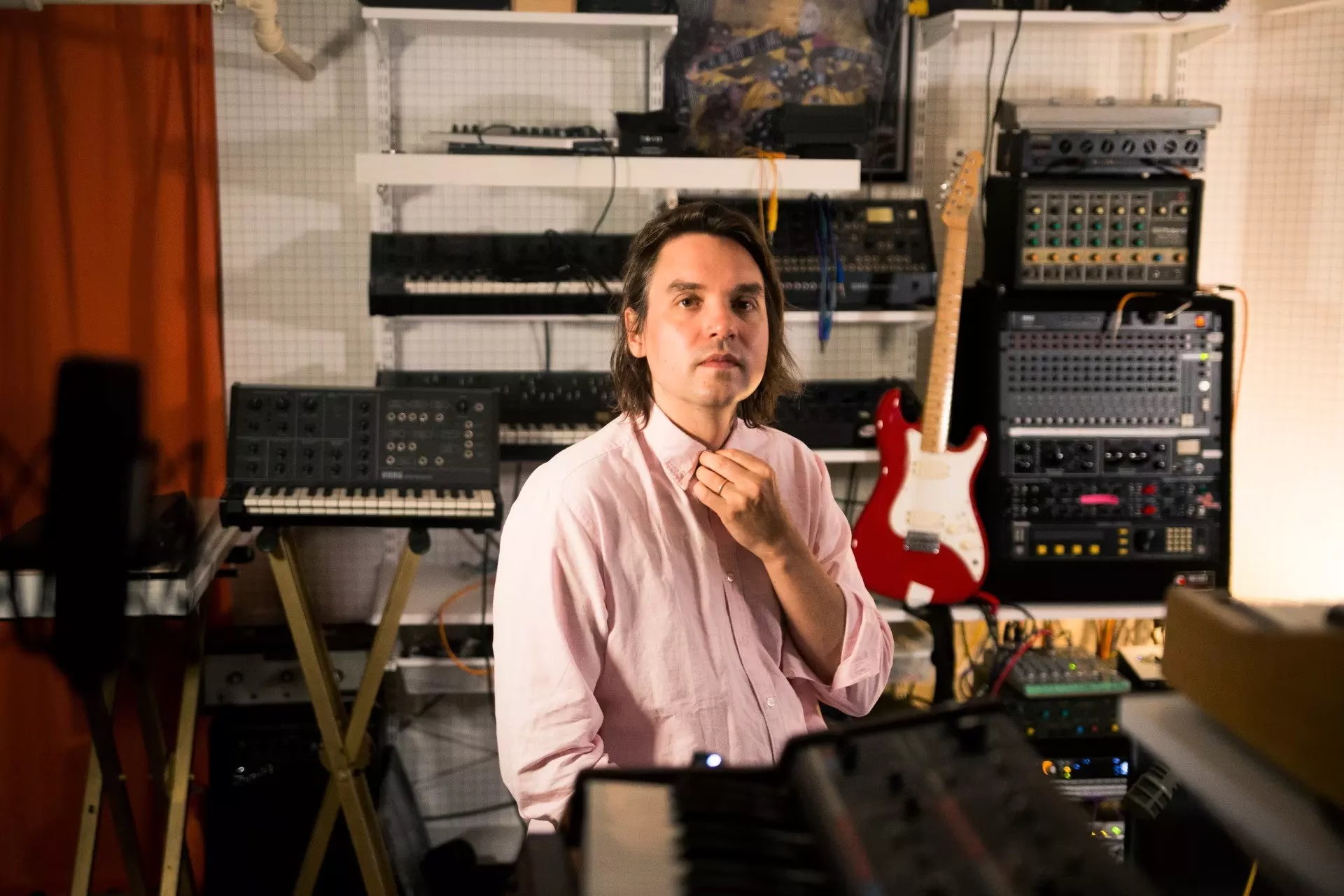
When Arcade Fire released their very first single, it came with a B-side that hit very close to home to brothers Win and Will Butler: a recording of a song called "My Buddy," credited to their grandfather, Alvino Rey. In fact, several generations of musicians line their family tree. While those historic echoes provide joy and solace for younger brother Will, the world tipping into pandemic and protests over racial injustice reinforced life’s darker cycles. On Butler’s second solo album, Generations (due Sept. 25 via Merge), he explores the ways in which we come together in community both because of and in spite of those ripples.
The video for early single "Surrender" represents that duality perfectly. The clip opens with studio footage of Butler’s band recording the jangly anthem, complete with call-and-response vocals and gospel falsetto. But much like 2020, things devolve quickly, with closed captioning-style subtitles mourning the deaths of Black men and women killed by police, calling for sweeping political change, and insisting on prison reform. Though written long ago, the album holds a special ability to tap into something boundless and timeless while simultaneously feeling entrenched in the tragic pain of the present.
Butler spoke with GRAMMY.com about the album’s similarities to Fyodor Dostoevsky, the ways in which songs take on new meaning over time, how Generations fits in with an upcoming Arcade Fire album and the healing power of community.
<style>.embed-container { position: relative; padding-bottom: 56.25%; height: 0; overflow: hidden; max-width: 100%; } .embed-container iframe, .embed-container object, .embed-container embed { position: absolute; top: 0; left: 0; width: 100%; height: 100%; }</style><div class='embed-container'><iframe src='https://www.youtube.com/embed/HOZKKuKaXV8' frameborder='0' allowfullscreen></iframe></div>
Did you have any hesitation about releasing the album in the midst of the pandemic?
I'm sad to not tour it. If I could wait four weeks and then tour the record... but that's not going to happen. It's actually kind of a good time to put out music. It feels morally good! People want music, so let's put out music. I've experienced that, where people put things out and it feels generous.
It truly does. You've compared this album to a novel and your debut before this to a collection of short stories. Is there a particular novelist that you feel would be in tune with your work? Do you take inspiration from fiction in that way?
It's not Dostoevsky. [Laughs.] But it is weirdly more inspired by Dostoevsky than it ought to be. It's the tumult of the 19th century, the next stage of the industrial revolution and the gearing up of socialism and anarchism. It feels related to the pre-revolutionary thing happening in Russia. [Laughs.] It's not a one-to-one comparison by any means, but it’s just the deeply human things happening in a context of the whirlwind.
Was there an experience that led you to the feeling that it was the right time to deliver such a politically driven album?
Partly, I went to grad school for public policy. I explicitly went as an artist wanting to know what's happening and why it's happening. I started the fall of 2016, which was a very bizarre time to be at a policy school. But I had a course with a professor named Leah Wright Rigueur, a young-ish professor, a Black woman, a historian. The course was essentially about race and riot in America. And since it was a policy school, the second-to-last week on the syllabus was talking about Hillary Clinton and the last week was talking about Donald Trump. It was a history class, but in an applied technical school, so it's like, "What are we doing with this history?"
We read the post-riot reports of Chicago in 1919 and the post-riot reports of the '60s, the Kerner Commission and after the Watts riots, and we read the DOJ reports after Ferguson and after Baltimore and Freddie Gray. And then Donald Trump got elected at the end of the semester. This course really trained my eyes at this moment of time, just being in that state of thinking about what's going on and why it's happening.
Right, and the album's title feels like it encapsulates not only the history that you were learning at the time but also your personal and familial ancestry.
Yes, very much so. My mom's a musician, and her parents were musicians. My grandmother grew up in a family band driving across the American West with her parents before there were even roads in the desert. Her dad got arrested a bunch of times for vagrancy or for not paying off loans. There's something very beautiful about being in the tradition of generations of musicians. That's a positive thing in this world. It's no coincidence that I'm a musician. There are, however, many more poisonous things that are also not coincidental that are rooted in both personal and political history. All of political history in America has been geared towards making each generation of my family's life better insofar as they're white men. It's been very good to my family, but that is as much of an undeniable generational heritage as music, which is this beautiful and faultless and glorious thing.
Do you see that musical tradition in your family as storytelling?
It's never been explicitly storytelling, though that is part of it. It's more about building community or building a society through entertainment. Entertainment is almost too light a word. My grandfather and grandmother did all these broadcasts during World War II, and some of it's jingoistic, some of it's incredibly moving, some of it's just dance music for people who don't want to think about the war for a minute. It's all these emotions, but still with this aim of trying to get us all in it together–which in a war context is fraught. But there's that element of always trying to make a family, make a community, learning how to bind us all together.
That reminds me of the call and response vocals you've got throughout the record. It has an especially gospel-y feeling on "Close My Eyes," which is such a clever way to paint a song about surrendering to something bigger than yourself, that communal feeling. What was the impetus for that narrative voice?
Part of it is just rooted in Smokey Robinson and the Miracles. [Laughs.] Years ago, someone mailed us the complete Motown singles on CD, just every single starting from day one. Even though there’s some garbage mixed in there, it just feels so human with those gang vocals and great singers that sometimes they just pulled off the street. You get the sense of humanity. Having backing vocals be so integral instead of just having my voice layered feels like having a community and feels very natural. It's hard for me to not just rely on that every third or fourth song. [Laughs.] It just feels like that's how it should be.
<style>.embed-container { position: relative; padding-bottom: 56.25%; height: 0; overflow: hidden; max-width: 100%; } .embed-container iframe, .embed-container object, .embed-container embed { position: absolute; top: 0; left: 0; width: 100%; height: 100%; }</style><div class='embed-container'><iframe src='https://www.youtube.com/embed/0Cp8Cs-dWa0' frameborder='0' allowfullscreen></iframe></div>
Those multi-part harmonies must be especially potent live in a room. Do you write in a way where you’re already picturing these songs live?
We played almost every one of these songs live before we recorded them. My solo band played "Surrender" live on the Policy tour for years. But even before we went into the studio last summer, I booked a weekend of shows. We did the Merge 30th Anniversary festival just to have us feel it live and have that communication. And then we went down to the basement to try to iron it out.
Speaking of "Surrender," that song took on an entire new life in the video. It starts out with videos of your band in the studio, but then quickly and powerfully gets replaced with messages mourning the deaths of George Floyd and Breanna Taylor and emphasizing the need for prison reform. You never know what life a song will have when you’re writing it.
That song is very nostalgic in a certain way. It’s looking towards the past, but not wishing to be in the past. It's wishing that we were in a different present because we had already chosen a different past. So when I was editing the video, I started it as a "making of" video. But the footage is from January of this year—five, six months old. There's this feeling of nostalgia, but also 2019 was not good enough to look back at. [Laughs.] 2019 was also horrible.
It's not like I want to go back to 2019. I want to play music with people. I want to be having fun with my friends. I want to be making a record. But I don't want it to be 2019. I'm nostalgic for a different future. And as I'm editing the video, there have been six weeks of protests of people trying to build something, and it just felt crazy to not acknowledge that. It was what people were focused on, at least the people around me.
Do you feel like you'll be infusing more overt social and political commentary into your music going ahead?
I think so. It's important that it's organic. It's part of the world I live in, part of my family and my friendships. Before the coronavirus hit, I was very much looking forward to touring and had vague plans to do town hall meetings and discussions. It felt like a rich time to do that around America, and around the world. I'm sad to not get to do that, but I think it will happen someday.
You produced the album yourself in your basement, so were you writing with the production choices already in mind or were you writing while in the studio?
I had the band come down and record for a week. And at the end of that first week, we had seven or eight songs that could be real. Some of them were clear. Some of them are simpler, like "Surrender." Others were trying to figure out where they would go. "I Don't Know What I Don’t Know" was more trial and error, trying something crazy. We'd turn everything off for two days and then come back to it and try something else. You try to be surprised by it.
I love revision. Well, I don't love it. I hate it. [Laughs.] I love the process of editing, of making a version of something and then finding something that's either better or worse. It's fun when you work with an editor that you trust, but when you're just doing it yourself, you drive yourself batty after some time. But I still love versioning it until it makes sense.
<style>.embed-container { position: relative; padding-bottom: 56.25%; height: 0; overflow: hidden; max-width: 100%; } .embed-container iframe, .embed-container object, .embed-container embed { position: absolute; top: 0; left: 0; width: 100%; height: 100%; }</style><div class='embed-container'><iframe src='https://www.youtube.com/embed/eWpvB8xtJkQ' frameborder='0' allowfullscreen></iframe></div>
It feels like you're not too precious. You just want to service the song at the end of the day.
Yeah. I try to not be precious. I feel like the songs mostly came out with a fresh spirit. I didn't massage any of them too much. I'm very conversational in how I think of the world. Nothing is the final statement. You say something and then someone says something else and then you say something. And you have to finish what you're saying in order to hear what the other person says. So if that means putting it out into the world without rounding everything off, to me that feels right.
The record begins and ends on the same burning synth tone, like history ready to go around the loop again. What does that synth tone represent for you?
Not to get too mystical, but there's something about the bass that is so embodied. There's something about a really powerful bass that is fundamental, something that just gets to the core. I wanted that core to feel a little uneasy. It's not like the hit at the end of "A Day in the Life" where it’s this clear conclusion. It's a little bit gnarly. It's a little bit not in the right key for the song. It’s something disturbing at the very core of everything.
What has writing and producing this record taught you about yourself?
I found that while I still prize quickness and thoughtfulness and conversational life, this record took longer and took more effort than Policy. It was way less casual. It was not casual in a very good way. I realized this shouldn't be a casual undertaking—even though it can have lightness and humor and breezy elements. Even then, the whole undertaking can still be serious and grounded. It can even be quick without being casual. In the past, I've fallen into thinking, "Just do something first before you think about it too hard." But this was a reminder that you can do something more thoroughly.
Were you writing these songs while working on the next Arcade Fire album? Speaking about intention, how do you compartmentalize those two sides of your creativity?
Yeah, Arcade Fire is always very cyclical. We record for a year and a half, we tour for a year and a half, and then we're off for a year and a half. I was very conscious to do this in a moment when I wasn't distracted by something else. I wanted to focus on this.
I'm still figuring it all out. Right now I'm making a video for the song "Close My Eyes." I have children, two-year-old twins and an eight-year-old, so the spring was just complete family time—net positive, but total chaos. [Laughs.]
On 'Transmissions,' Beverly Glenn-Copeland Looks Back On A Long And Varied Musical Life