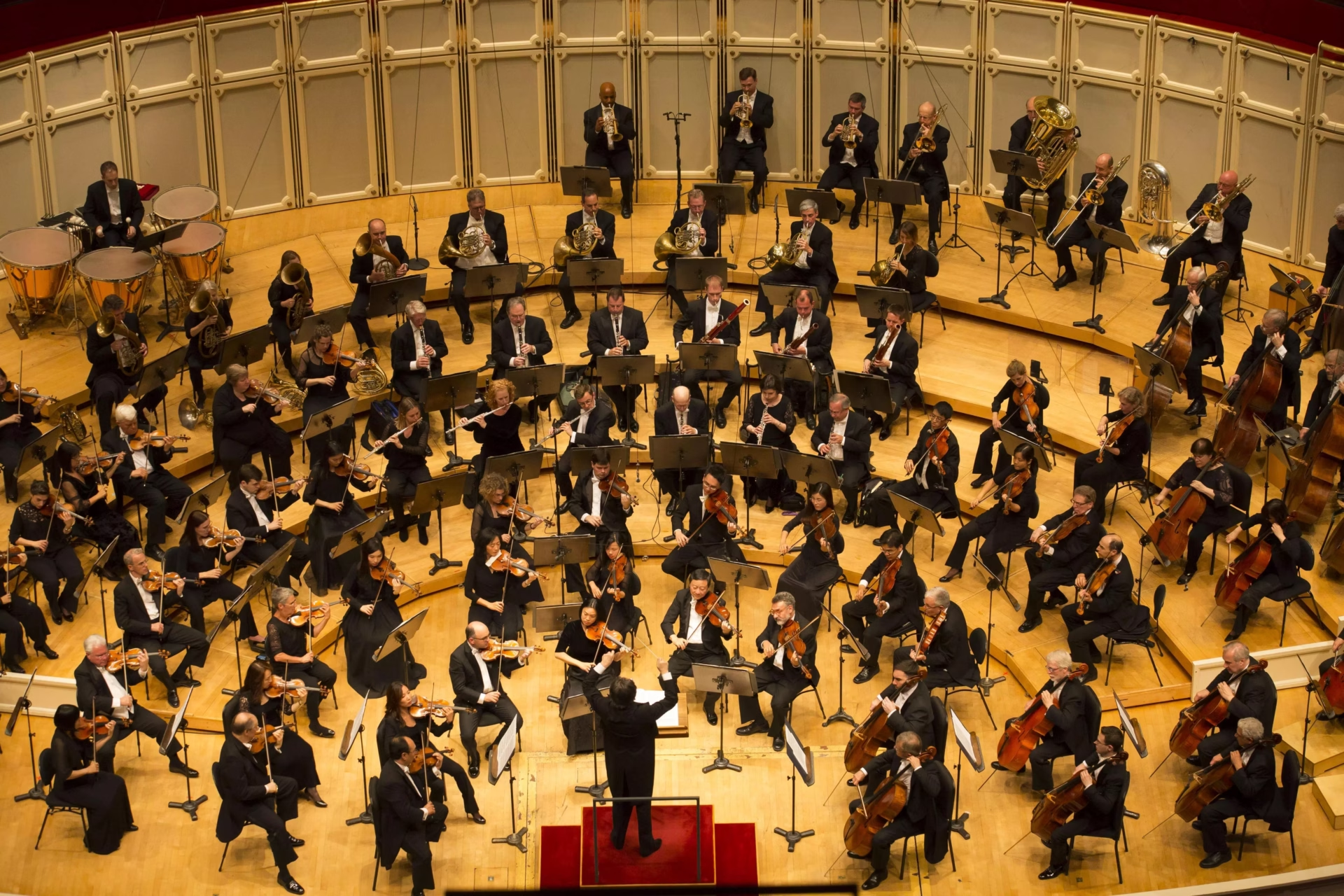
Beginning in March of 2020, as the COVID-19 pandemic placed the U.S. in lockdown, the lives of musicians all around the world drastically changed. International tours were postponed, longstanding music festivals were canceled, and the era of the virtual concert began as indie and Top 40 artists alike took to Instagram Live and YouTube to continue bringing live music to the ears of their beloved fans. But what about the musicians whose careers revolve around being a part of something much larger than themselves, and whose voices ring purest when surrounded by an ensemble of 100 or more players?
Orchestra musicians all across the country have had their lives upended in drastic ways, many of which the music community is unaware. The Recording Academy reached out to three of the nation’s most influential orchestras in order to get a closer look at how the musicians themselves are fairing during this challenging time. Members of the Chicago Symphony Orchestra (CSO), New York Philharmonic (NY Phil), and Los Angeles Philharmonic (LA Phil) opened up to us about the experiences, fears, coping mechanisms and hidden gems surrounding the unprecedented shutdown that forced them out of the concert hall indefinitely.
Shocked By Lockdown
When the lockdown began, Stephen Williamson, principal Clarinet player for CSO, was on his way to a concert when he learned the news. "I was [driving] to CSO for a performance of Rhapsody in Blue when I got a call that the concert was canceled," he shares. CSO's Associate Concertmaster Stephanie Jeong, the youngest member of the orchestra ever to hold this prestigious title, was in Kansas City visiting her boyfriend when she learned of the Shelter in Place order going into effect in Chicago. "I ended up staying in Kansas City, and I’m still here."
What was hoped to be a temporary shutdown soon turned into a stay-at-home order with no end in sight, and the shattered economy that accompanied it was something many musicians didn’t anticipate in the United States. "In my almost 30-year tenure with the orchestra, nothing like this has ever happened," explains CSO bass player Robert Kassinger. "Maybe once every 10 years a concert had to be canceled because of weather conditions, sure, but nothing like this."
Chicago Symphony Orchestra Associate Concertmaster Stephanie Jeong
Photo by Todd Rosenberg
Rebecca Reale, violinist for LA Phil, had a similar reaction. "I think I just convinced myself that it wouldn't happen over here like it happened in China and Europe," she recalls. "But then it very quickly turned into reality that we will be off work for the foreseeable future."
The entire concert season was canceled for all three of these renowned orchestras. Forced out of the job indefinitely, the ensembles' more than 300 musicians have collectively been coping with both job insecurity and musical deprivation. "I [needed to] regroup and recover from the shock of all concerts being canceled," shares Anthony McGill, Principal Clarinetist for NY Phil, adding that the orchestra is used to playing four concerts per week. "It's tough for any musician who's used to [making] music together, in a group." Kassinger explains. "We communicate with each other and we communicate with the audience. When you take that away, it's very hard to know how to proceed." Furthermore, Kassinger has the added challenge of being a bass player. "The bass is a very social instrument, you know. It works best when combined with others."
For full-time orchestra musicians, listening and feeling are just as important as playing, regardless of which instrument they play. Relying on the conductor and the community of instrumentalists around them, orchestra players are a unique breed of musician in that they do not rely on a spotlight to feel fulfilled as an artist. Quite the contrary, the one common thread that ran through each of the interviews was the shared longing to be a part of an ensemble once again. "It’s always better to be a part of something much bigger than myself, and that’s why we are orchestral musicians. We want to share our gift, not only with our fellow musicians on stage but with an audience," Williamson points out. Wesley Sumpter, percussionist for LA Phil, expresses the same sense of longing. "I miss it. Way too much. More than I thought I would," he says with a sad chuckle. "You practice differently when you’re getting ready to perform for an audience. Right now, we are all trying to…find the motivation and inspiration to continue to play music."
"When we’re on stage we feel the presence of the audience. Missing that is definitely a big part of this. It plays a big part in how we feel." — Wesley Sumpter, LA Philharmonic
The country has lost over 20 million jobs since the pandemic hit in mid-March, bringing about a record unemployment rate of 14.7% not seen since the Great Depression. Fortunately, endowments are keeping these musicians afloat for now, though at a lesser rate. "We are lucky to be getting paid at all, but it’s scary not knowing how long they’ll be able to afford to keep it up," one orchestra musician pointed out.
Making The Most Of It
Thankfully, there are hidden gems to be found amidst every misfortune if we make a point to look for them, and these musicians are an excellent testament to that. For CSO's Stephen Williamson, this happened almost immediately with the help of his family. "My family is very musical. We’re really lucky. There’s five of us, and each is a musician," Williamson shares of his brass-playing wife and three sons, one who attends Julliard for French Horn Performance. When Williamson called up his family to inform them that the Rhapsody in Blue concert was canceled, his son went online and found a Brass Quintet arrangement of the Gershwin masterpiece for them to record as a family. The video went viral on Facebook, instilling in Williamson a sense of hope that he would in fact be able to find fulfillment during the quarantine.
<style>.embed-container { position: relative; padding-bottom: 56.25%; height: 0; overflow: hidden; max-width: 100%; } .embed-container iframe, .embed-container object, .embed-container embed { position: absolute; top: 0; left: 0; width: 100%; height: 100%; }</style><div class='embed-container'><iframe src='https://www.youtube.com/embed/Xtw0yafICiE' frameborder='0' allowfullscreen></iframe></div>
For book-loving Wesley Sumpter of LA Phil, there is no such thing as boredom—especially when the books you choose teach adaptability. "Right now I’m reading Thinking Fast And Slow by Daniel Kahneman. It’s about how we think in two systems… System 1 being our innate response to anything, and System 2 being our more deliberate, slow process." Sumpter goes on to explain how your System 2 ultimately informs your System 1. "It’s a wonderful book. It’s allowed me to really think about how to use this time to practice, and what I’m practicing for. How to map out goals based off of being able to have this time to use my System 2 and… slowly do things."
During her extended visit to Kansas City, CSO's Stephanie Jeong and her boyfriend ended up getting a new dog named Jasper. LA Phil's Rebecca Reale began participating in neighborhood chamber concerts in Pasadena, and CSO’s Robert Kassinger poured his energy into teaching and watched as his DePaul University students thrived. As for NY Phil’s Anthony McGill, he sparked a movement on Instagram three weeks ago that swept through the classical community in an unforgettable way.
NY Phil Clarinetist Anthony McGill
Photo by Chris Lee
As the U.S. copes with national protests in response to the death of George Floyd at the hands of a Minneapolis police officer, McGill found himself in a unique position. As the first African American to serve as a principal instrumentalist in the New York Philharmonic—and the third African American ever to join the ensemble—McGill saw it as his responsibility to encourage the classical community to participate in the protests in their own unique ways. "It’s almost like a protest challenge for musicians, and artists, and anyone else who wants to participate, and it’s called #taketwoknees," McGill explains. The decision to take two knees was inspired by the fact that taking one knee didn’t go over so well, as society seemed to miss the point of what a peaceful protest means. "As a musician whose voice has been silenced the past few months, I wanted to do my part to continue to talk about this problem."
The problem McGill speaks of is not only police brutality and racial injustice, but also the stigma surrounding peaceful protests. In order to articulate this, McGill wrote a statement about the different ways people protest and why. Then, he got on two knees as he played "America The Beautiful," going into a minor key and eliminating the final note, sending the message that America is beautiful but broken and in need of mending. "It’s important as musicians, [and] as people, that you engage in peaceful protests however you feel you can without reservations," he tells us. For McGill, that happens to be with his clarinet. "This is my only voice in the world that I can touch people with," he shares.
If you wish to donate to these non-profit orchestras as they combat the new challenges brought on by the COVID-19 pandemic, the New York Philharmonic, LA Philharmonic, and Chicago Symphony Orchestra, have provided these links to their donation pages for your consideration.
Marching Six Feet Apart: How High School Marching Bands Are Coping With The Pandemic