Music and musical expression can often communicate the depth and emotion that words can’t fully articulate. That’s a given when it comes to important ceremonies, be it weddings or funerals, but the power of the medium can be harnessed in infinite ways. For Dr. Regina N. Bradley, an assistant professor of English and African Diaspora Studies at Kennesaw State University in Georgia, these are powerful tools to have in an educational setting.
"In my literature courses, music is considered a critical text," she says. In one class, students delve into Black protest songs. So much of the message in Black music, she explains, is nonverbal. For this reason, students in her class wrote about the content of the song as well as their accompaniments and how the music made them feel. "It [was a] powerful exercise," she recalls.
An alumna of the Nasir Jones HipHop Fellowship at Harvard University, one of her current classes hones in on Southern rap: a genre that was birthed in the Southern United States and is one of present-day hip-hop’s most influential sounds. The South, home to the civil rights movement and a large African-American population (the 2010 Census reported that 55 percent of Black Americans lived in the South), holds many connections to Black identity and Southern rap naturally embodies the Black experience. Its lyricism provides an easy entryway into conversations on economic status, intergenerational trauma, rage, and more. As Bradley puts it, "Southern rap embraces the messy, the illegitimized, and the marginalized."
<style>.embed-container { position: relative; padding-bottom: 56.25%; height: 0; overflow: hidden; max-width: 100%; } .embed-container iframe, .embed-container object, .embed-container embed { position: absolute; top: 0; left: 0; width: 100%; height: 100%; }</style><div class='embed-container'><iframe src='https://www.youtube.com/embed/bsNsd9MDWOI' frameborder='0' allowfullscreen></iframe></div>
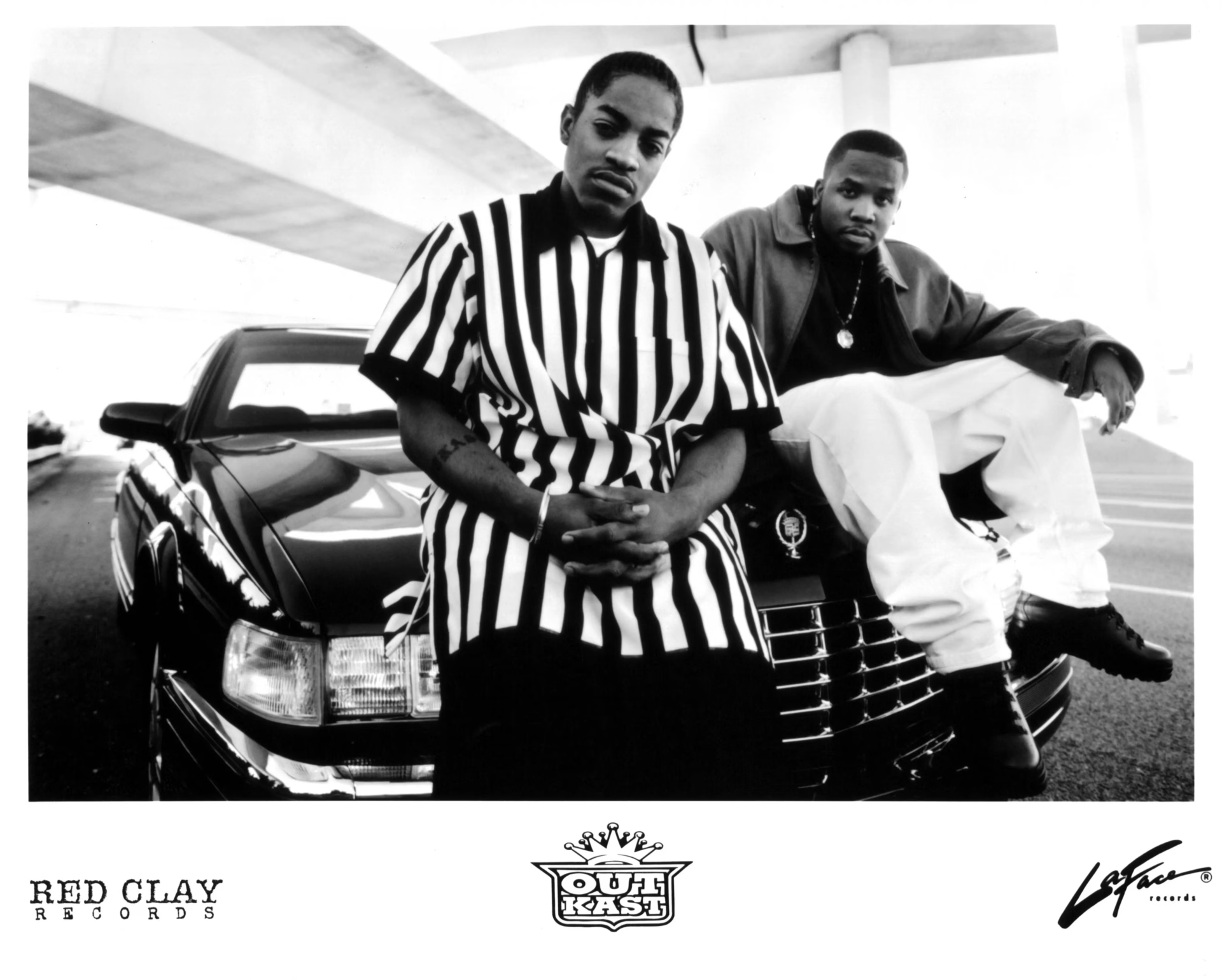
Each semester, she particularly focuses on OutKast, the legendary hip-hop duo from Georgia composed of André 3000 (André Benjamin) and Big Boi (Antwan Patton). The duo came up in the scene with strong lyricism ("These boys were so metaphoric," Producer Rico Wade says of the two on Netflix’s "Hip-Hop Evolution.") Their introductory track, "Myintrotoletuknow," off their 1994 debut Southernplayalisticadillacmuzik was a view into the minds of two Black teens in the '90s who grew up in the South.
"Back in the days when we was slaves I bet we was some cool ass n*****/ But now we vultures, slam my n**** back out/ To make his ass black out, or even pull your fucking heater," Big Boi delivers sharply.
In her course, Bradley emphasizes that "Southern rap does not subscribe to scripts of respectability in order to present Black people's humanity." Something doesn’t have to be clean or pretty to offer a strong message. Rap gives honest insight into the psychological impact of Black life and makes sense of emotions in a raw and unapologetic way.
And OutKast continued to use rap as their vehicle of expression beyond their debut. They were a leading force in what Bradley describes as the "Hip-Hop South" that arose in the generation that followed the civil rights movement. The rappers explicitly reference the movement itself in songs such as "Rosa Parks" off their 1998 Aquemini album.
The popular Kennesaw State course uses the group as a test case for exploring how race and identity are recognized generations after the movement. Outkast don’t just implicitly touch on Black identity politics in Afrofuturist musings such as their 1996 album ATLiens, but rap about Southern Black identity and its relation to Blackness in other parts of the country—Bradley discussed how the duo made space for Southern Blackness in hip-hop in the ‘90s for the African American Intellectual History Society in 2016.
A fan of the duo since she was 14 years old, Bradley is an expert on the Southern duo and their message. She recently wrote and released the nonfiction book Chronicling Stankonia: The Rise of the Hip-Hop South (The University of North Carolina Press) and serves as the editor of the forthcoming An OutKast Reader: Essays on Race, Gender, and the Postmodern South (The University of Georgia Press). As she writes in Chronicling Stankonia, Bradley became an OutKast fan when she moved from Virginia to Albany, Georgia, a city of just over 73,000 people that’s located about 180 miles south of Atlanta.
Dr. Regina N. Bradley. Photo: Pableaux Johnson.
Most of her students, who tend to average between 18 and 22 years old, were introduced to OutKast thanks to older family members and friends or via Speakerboxxx/The Love Below—the supernova 2003 double album that was certified diamond by the RIAA for sales above 10 million. (The success of that release put the duo in a rarefied sales club next to groups like the Beatles, the Eagles and Led Zeppelin.)
To explore OutKast’s messages, the class listens to five of the group’s studio albums: Southernplayalisticadillacmuzik, ATLiens, Aquemini, Stankonia, and Speakerboxx/The Love Below. They also read novels influenced by the group as a requirement.
Bradley firmly believes that the rappers’ music will teach her students about what it is like to be Black in the U.S. because music is the foundation of the Black American experience.
"Music is pedagogy. It's an archive and so real," Bradley says. "Whatever our parents played when the family and friends gathered for the cookout, we remember. Whatever they played on the weekends to denote cleaning up or chilling around the house, we remember. Whatever you listened to in the car, we remember."
And in her class, the professor asks her students to really listen. Students are expected to submit critical listening journals that include documenting what state of mind a song or album puts them in if it’s the first time they’re hearing it. If they have listened before, they’re asked to note what has changed or caught their attention since the last time they cranked it up. This exercise is part of the course that aims "To challenge students to engage with unfamiliar texts, cultural expressions and language in order to learn how to be socially and culturally sensitive and aware of modes of expression outside their own experiences," as stated in the class syllabus.
<style>.embed-container { position: relative; padding-bottom: 56.25%; height: 0; overflow: hidden; max-width: 100%; } .embed-container iframe, .embed-container object, .embed-container embed { position: absolute; top: 0; left: 0; width: 100%; height: 100%; }</style><div class='embed-container'><iframe src='https://www.youtube.com/embed/drsQLEU0N1Y' frameborder='0' allowfullscreen></iframe></div>
The listening days connect the students to the professor more and lead to a more engaged form of learning. "I share my memories and they share their memories," she says.
Bradley has observed her students connecting with civil rights history and current events in a more meaningful way thanks to her use of music, something they deeply invest in outside of class. But the class doesn’t just look back at history. In a nod to what’s happening right now with race relations, a portion of Bradley’s listening homework includes current songs from rappers Tobe Nwigwe from Texas, Mississippi’s Big K.R.I.T. and Atlanta’s Spillage Village collective—acts that are arguably descendants of the OutKast lineage.
"When you can show and prove to students that the history of civil rights for Black folks is not linear but cyclical, they understand and value that their experiences and what they are witnessing on a daily basis are reflections of the past in the present," she shares. "History lives in the music; it lives in the culture. When we say Black Lives Matter, people have been saying that for generations prior to this most recent cycle of activists."
She continues: "As a professor, it is my job to show students the dots, connect them a little bit and set them on their own journeys of discovery."
Because music is a highly consumed art by the masses, Bradley believes understanding how artists share real experiences related to race, economic class and beyond can be a strong tool to educate anyone.
"If folks would treat music as a multi-layered cultural experience that speaks to things other than just popular culture," she says, "The academy and the world would be so much better off."