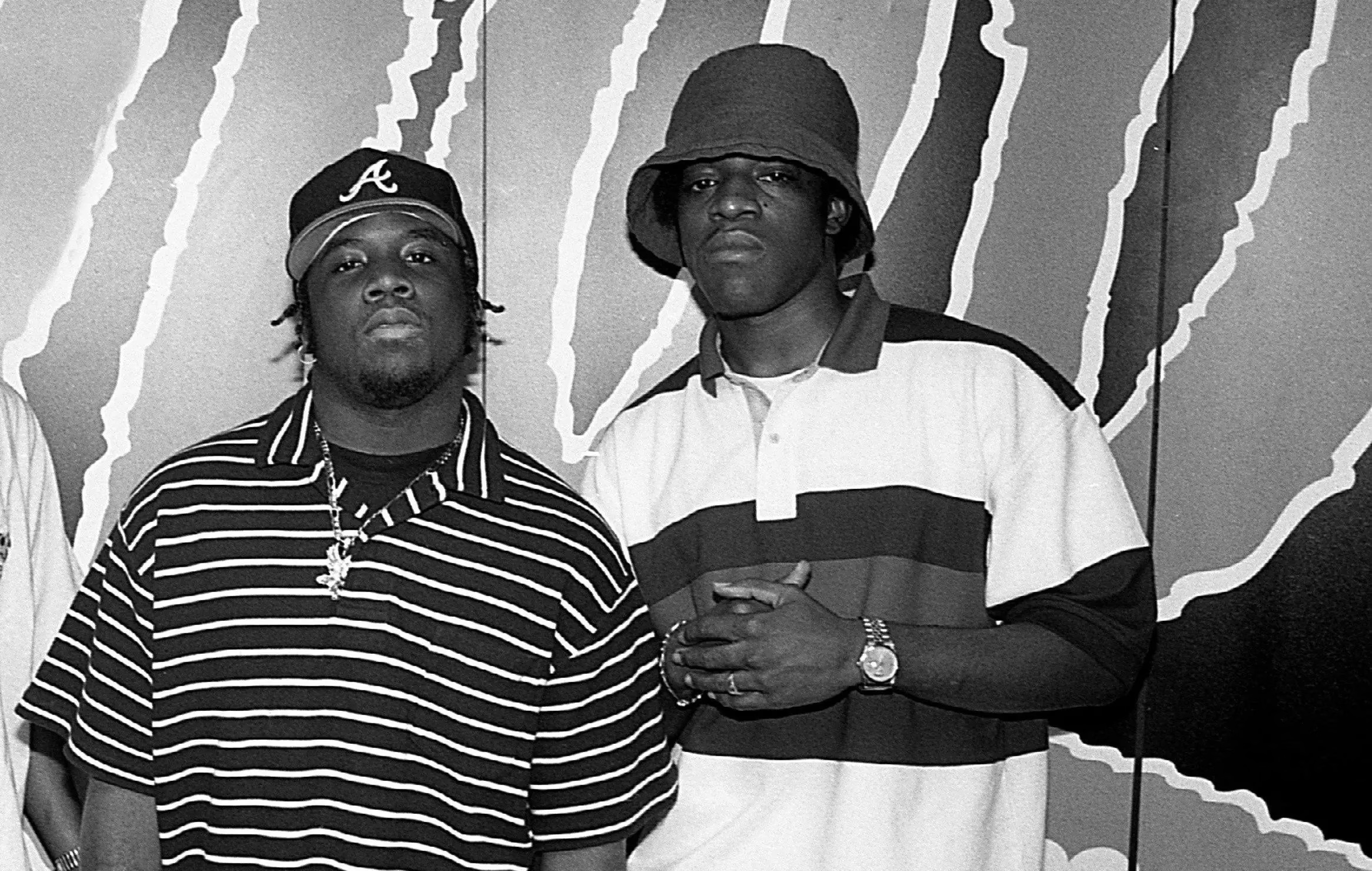
Long before they amassed six GRAMMY awards, sold millions of records, and toured to sold-out crowds around the world, the duo of Antwan "Big Boi" Patton and André "André 3000" Benjamin were just a couple of teenagers in Atlanta, sharing their experience through freestyling. And when they released their first album as OutKast in the midst of the East Coast-West Coast hip-hop rivalry, nothing else in the world sounded quite like it. It's been 25 years since the 1994 release of Southernplayalisticadillacmuzik, and there's still nothing like it. "Big Boi and I were just fans of the music of the time and enjoyed rhyming," Benjamin tells the Recording Academy over the phone. "I'm from the South. I lived it, saw it, and just spit it back out."
Benjamin and Patton met at a shopping mall as 16 year olds, which quickly led to rapping in the cafeteria at school. Not long after, they and schoolmates Goodie Mob caught the attention of hometown production trio Sleepy Brown, Rico Wade, and Ray Murray, collectively known as Organized Noize, and the whole group came together in a fluid collaborative troupe eventually known as the Dungeon Family. "When we were working on the OutKast vibe, even though there were two members in the group, we all considered ourselves OutKast at the time—including all of Organized Noize and the Goodie Mob members who appeared on the album," Murray says over the phone.
Benjamin remembers being immediately entranced by Organized Noize's style. "Rico Wade brought us to his house studio, where I heard the most interesting music production I'd ever heard from Atlanta," he says. "It was Rico, Ray, and Sleepy's vision to make sure [OutKast would put] Southern lifestyle first. I was just playing my part the best I could."
Despite that modesty, it's clear from the earliest OutKast recordings that Patton and Benjamin had an irrepressible charisma. While still in high school, the duo signed with LaFace Records, the Arista imprint run by L.A. Reid and Babyface. Before their first record, OutKast made waves with an appearance on a remix of fellow LaFace artists TLC’s "What About Your Friends" and the magnetic single "Player’s Ball," which was released as a Christmas single.
"It was the first rap act we signed to LaFace, and it was my idea to release a Christmas single. Nothing about that was supposed to work, but it was the beginning of what turned out to be one of the most incredible careers," Reid tells the Recording Academy.
Reid had been focused largely on pop and R&B, and propelled his career into one of the most prominent producers and record executives across decades—eventually turning Epic records into a hip-hop hub. After leaving Epic in 2017 (Editor's note: Reid's transition out of Epic is tied to allegations of sexual harassment), Reid has since formed his own organization, HitCo Entertainment, where Big Boi is currently signed. "All I knew was that I loved Big Boi, I loved André, and I loved Organized Noize, and the record sounded incredible," Reid says. "I've since learned every lyric to every one of their songs, and can rap along word for word. They became my favorite artists that I’ve ever worked with."
That captivating sound comes in large part from the ways in which Organized Noize and the rest of the Family took inspiration from music spanning much farther and deeper than the monolithic "East" and "West" hip-hop sounds presented to mass audiences at face value. Per Murray, the production draws inspiration from New York to Oakland, from pop appeal to intense musicality.
"There were two ends of the spectrum—Jermaine [Dupri] was a hometown guy, and he discovered Kris Kross, and that was a major thing. And then on the other side of the coin, you had [Dr. Dre's] The Chronic, which laid down the blueprint of craftsmanship and symmetry," Murray says. "Kris Kross were as big as you could be; they went around the world being from Atlanta without being [in] Atlanta. And then The Chronic was about being as impactful as possible. Somewhere in between, you've got New York sh*t, Hit Squad, Redman, and Das EFX, and then all the way out to Oakland. You have all of these different kinds of ways to maintain your integrity, which is the culture of hip-hop, but you can then still try to express it in terms of your neighborhood. As we put all that stuff together and stirred it up, that's what clicked for us.”
Those elements came to the surface in Southernplayalisticadillacmuzik, an album that reached number 20 on the Billboard 200 and garnered rave reviews, but also left some confused. OutKast weren’t afraid of leaning into local slang and had no interest in catering to the expectations of radio rap. In fact, it seems they weren’t even considering that reality.
"We had our own lifestyle and lingo and confidence from the inside, so it really didn’t matter what everyone else thought," Benjamin says. "I didn't really think it was so left field at the time. I just thought it sounded good and because we were all in The Dungeon making it, as a whole. People would stop by The Dungeon, or later on by the studio, and it was like a listening party damn near every night. People smoked, partied, and conversed to what we were making—so that was the proof to us. The Atlanta pride was there, because we believed it."
While he would end up producing tracks for OutKast beginning with 1998's "Aquemini," Benjamin started writing while listening to other music rather than creating himself. "I actually wrote a lot of the verses that ended up on the first album to R&B songs. like Janet Jackson's "Let’s Wait a While" and '"Funny How Time Flies," "Loose Ends," "You Can’t Stop the Rain," and Tony Toni Toné’s "Anniversary," he says. "I always felt more deeply, wrote more deeply with chords involved. They color the mood. Bass-lines, too. The beat was just the time keeper for me."
For Murray, the Atlanta-ness of the record extended always to a place of civic pride and activism. "Atlanta is the home of Dr. Martin Luther King and Andrew Young, as well as the first black mayor, Maynard Jackson. We were rooted in mobility and progressiveness as black people in America," he says. "And that translated into not wanting to identify with New York or L.A., but to personify Atlanta and its thought process. It's a great confluence of what we believe in, what we were raised in, and we wanted to show that to the world."
From a production standpoint, Organized Noize first cut their teeth professionally on Parental Advisory's Ghetto Street Funk, released on Pebbles' Savvy Records imprint. Though they'd been developing their musical influences prior to that record, Ghetto Street Funk taught them much more about communicating with their fanbase. "On the Parental Advisory record, we were trying to talk to people we didn't know. But for Southernplayalisticadillacmuzik, we decided to talk to everybody we know," Murray says. "We tried using New York terminology, trying to reach them with a dialogue we didn't have. But it's amazing that the culture of Atlanta is a barometer for what's really going on. If it works in Atlanta, it works in Detroit, it works in Chicago, it works wherever you have urban centers."
By focusing on what they knew, Organized Noize and OutKast found the world coming to them, rather than needing to push for attention. The record sold half a million copies in the first few months, and was certified platinum within a year. Critics lauded the fusion of p-funk influences, live instrumentation, and bold coming-of-age tales of life in the modern South. Organized Noize's writing and production were injected with the electric personality of André 3000 and Big Boi, while the young rappers found a frenetic footing for their burgeoning talents. "I can't explain the gravity, attraction, or soundscape of that record. We were merely hired young guns that only rapped on the record, which [Organized Noize] produced in its entirety," Benjamin says.
Beyond the traditional critical acclaim, the record had people within the entertainment world buzzing as well. Legendary director John Singleton had been a big enough fan of Southernplayalisticadillacmuzik that he reached out to Organized Noize when he began production on Higher Learning. "John Singleton said that a lot of the movie was based on Big Rube's interludes on this album," Murray says. "In essence, Ice Cube is playing Big Rube off of Southernplayalistic in that movie."
Now, 25 years later, the record has only grown more beloved, garnered more of a following and inspired more growing artists and enlivened more lives. But for the men involved in the record's creation, listening back to Southernplayalisticadillacmuzik is more of a complex proposition. "I actually cringe now when listening to it because I hear how I was still trying to find who I was as a young man with many influences—good and bad," Benjamin says. "I was only about three years away from living a pretty strict life with just my mom and I, so I was essentially still a momma's boy that got sent to live with my dad and that's when I met Big Boi. Then we met Rico, Ray, Sleepy, Gipp and what would later become The Dungeon Family."
Murray, meanwhile, listens to the record from time to time as a reminder of the fire of that moment. "We just had the competitive spirit of young lions looking at old lions," he laughs. "I have all faith in God, I put it all on the record, and faith is rewarded because people are saved by it. We’re still talking about Southernplayalisticadillacmuzik 25 years later."
But, perhaps most important, both in propelling their growth as artists and a tight-knit group that would go on to produce more mind-blowing records, Benjamin looks back to the debut as a family affair, an experience of discovering a whole new life.
"Rico, Ray, Sleepy, Gipp, and what would later become The Dungeon Family—I watched and learned from them like big brothers. I'm an only child so this was great for me," he says. "Another world opened up for me then and it came fast. The characters I met, the experiences, the odd trying to fit in, trying to belong to something is all heard on that record. I cringe at my rhyming because I could barely even pronounce my words clearly. And I can hear all of my influences. As time went on, I heard more and more confidence in myself and that inspired more freedom to explore. I've found some creative freedom and have developed a little more in areas. I’m always concerned with the discovery or newness of things, which keeps me invested. Otherwise, I'm dead."