
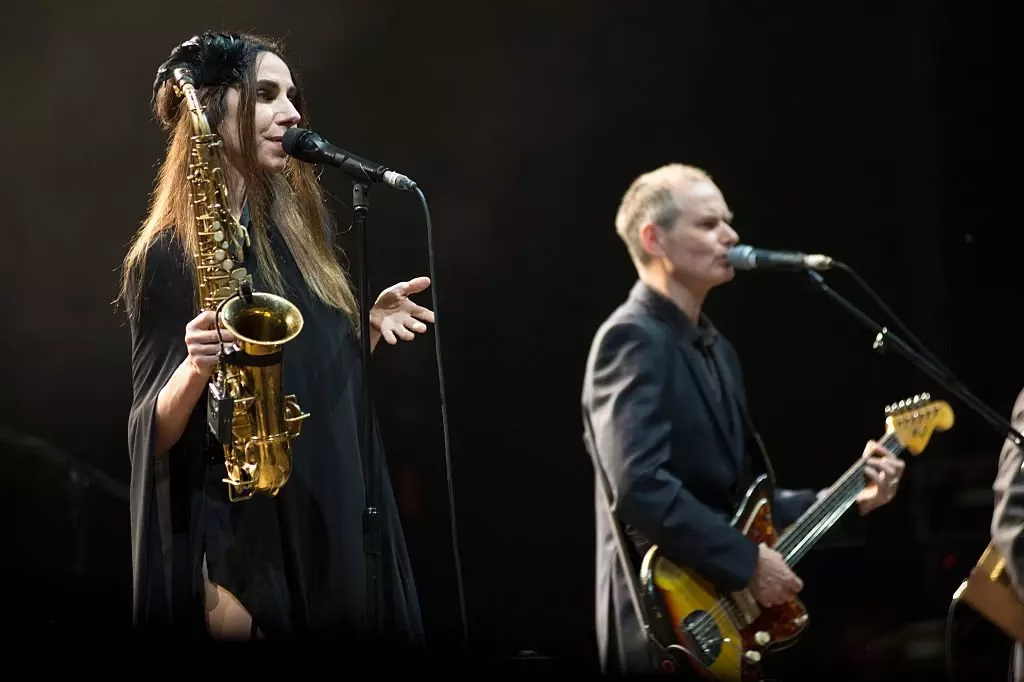
PJ Harvey rarely looks back. The songwriter’s career has been defined by a restless sense of reinvention, each album cycle accompanied by a fresh persona—the blues roar of To Bring You My Love, or the glossy alt-rock romance of Stories From The City, Stories From The Sea—ready to be discarded at the next creative whim.
But 2020 has been an exception. Harvey has spent much of the year rolling out a vinyl reissue series of her back catalog, along with some accompanying demo albums. The latest vinyl reissue is something of an outlier: Dance Hall At Louse Point, Harvey’s abrasive 1996 collaboration with ex-bandmate John Parish. Harvey and Parish had first met in the late 1980s, when she joined his band Automatic Dlamini. In 1996, they combined Parish’s musical demos and Harvey’s lyrics on an album that would plunge the singer-songwriter into an avant-garde realm of disturbing monologues and banshee-wail vocals.
Credited to John Parish & Polly Jean Harvey, Dance Hall was largely overshadowed at the time by the immense success of To Bring You My Love. In retrospect, it’s an underrated gem and something of a lost album in Harvey’s catalog; as Harvey herself later acknowledged, "People don't even count that, yet that's the record I'm really proud of."
On the occasion of the album’s recent reissue, I tracked down John Parish to talk about the album’s unusual backstory and his earliest memories of meeting Harvey as an ambitious teenager. Since then, Parish has co-produced most of the singer’s solo albums, and in 2009, the pair reunited for a second collaborative record. This interview has been lightly edited and condensed.
<style>.embed-container { position: relative; padding-bottom: 56.25%; height: 0; overflow: hidden; max-width: 100%; } .embed-container iframe, .embed-container object, .embed-container embed { position: absolute; top: 0; left: 0; width: 100%; height: 100%; }</style><div class='embed-container'><iframe src='https://www.youtube.com/embed/EYhy5pLqRaM' frameborder='0' allowfullscreen></iframe></div>
At the time you made Dance Hall At Louse Point, you had already known Polly for a number of years. What was your first impression when you first met her in the '80s?
She was like 17 when I first met her. She was coming to see my band, Automatic Dlamini, whenever we played in her local area. We all got to chatting after a gig. A mutual friend introduced us, and then she gave me a couple of cassettes of some of her early songs she’d been writing. They were kind of like folk songs at that time, really. But her voice—it was already there. It was fully formed at that age.
I just thought, "That girl’s got a really good voice, I’m gonna see if she wants to join the band." So I just asked her. When she finished school, she came and joined the band and she played with us for the next three years, before she formed the first PJ Harvey trio.
Was there a moment when you first realized, "This person is extraordinarily talented, oh my God."
I mean, I obviously saw something that was really good there; otherwise I wouldn’t have asked her to join the band. You can’t possibly predict how somebody’s going to develop as an artist. I could see that she had the potential to be great. If I said, "Oh, I knew she was going to be a star"—obviously nobody can know those kinds of things.
Do you have any favorite memories of working with Polly in Automatic Dlamini?
She came in at a point when the original lineup was kind of falling apart. I was rebuilding a lineup, and she was an absolutely fundamental part of that. She’s always had an old head on young shoulders. She was somebody that you could talk to and discuss pretty serious issues. As a teenager, she was very serious. And was quite capable of being able to offer good advice. We started relying on each other.
<style>.embed-container { position: relative; padding-bottom: 56.25%; height: 0; overflow: hidden; max-width: 100%; } .embed-container iframe, .embed-container object, .embed-container embed { position: absolute; top: 0; left: 0; width: 100%; height: 100%; }</style><div class='embed-container'><iframe src='https://www.youtube.com/embed/DumDNDl-bgU' frameborder='0' allowfullscreen></iframe></div>
Was she nervous performing onstage with the band when she first joined?
The first couple of shows, yeah, really nervous. As you would be. But no, she got used to it pretty fast.
Tell me about the origin story for Dance Hall At Louse Point. My understanding is that you wrote those songs while on tour with Polly for To Bring You My Love?
That’s semi-right. It was Polly’s idea. It was after Rid Of Me, before she had started To Bring You My Love. I was teaching a performing arts course at a local college. I’d written some music for a theater production, and Polly came along to see it. She absolutely loved the music, and said afterwards, "Would you write me some music in that kind of vein? That I could try writing words to?" I said, "OK, that would be great."
That’s how we had the idea for the album. I was writing the music for Dance Hall At Louse Point at the same time she was writing the music for To Bring You My Love. I then became involved with [To Bring You My Love], which was obviously a big record. And it involved a big tour as well. Took 18 months of our time. While we were on tour for To Bring You My Love, that’s when Polly wrote all the words. She already had a cassette of the music for the Dance Hall record, which she carried around with her on the tour and then wrote lyrics in different cities. Which is why those cities are referenced on the album sleeve.
Were you hearing her lyrics while she was writing them? Or were you both working in your own separate worlds?
She would sort of drop a cassette into my hotel room and say, "I've got some lyrics for this song." I'd hear them as they were coming in. It was always kind of, "Here you go, here's the lyrics." And it would always be completely done. It was very exciting.
I was reading some old interviews with Polly. There’s one where she describes that record as being a huge turning point for her. What do you think she meant by that?
It’s always difficult to talk about how that is for somebody else. My take on that is—and I know this from myself when I’m writing in collaboration with somebody else—it’s a certain freedom you have that you don’t give yourself if you're writing entirely individually, because you have the weight of the whole thing. When you can share the weight, it eases you up to do things you might be nervous about doing yourself, because you’re not sure whether you’ve gone off a stupid tangent and you’re not seeing it.
You can try those things that might seem kind of wayward. And you have another person that you rely on say, "Oh yeah, that’s great. Push it a bit further." Like I said before, she approaches most things very seriously. Writing particularly so. So I think it probably enabled her to be a bit more wayward than she might have been. When I first heard her vocal idea for "Taut," I mean—the entire delivery of the song was kind of extreme.
<style>.embed-container { position: relative; padding-bottom: 56.25%; height: 0; overflow: hidden; max-width: 100%; } .embed-container iframe, .embed-container object, .embed-container embed { position: absolute; top: 0; left: 0; width: 100%; height: 100%; }</style><div class='embed-container'><iframe src='https://www.youtube.com/embed/5Va1GWtjExc' frameborder='0' allowfullscreen></iframe></div>
Which song are you referring to?
I’m referring to "Taut." Which is quite an extreme performance. A lot of the songs, I would give her a title. So I gave her the title "Taut." She didn’t have to use it if she didn’t want to. Some of the titles she used; some she didn’t. But I think it was also quite freeing to suddenly have a word or a line and say, "What are you gonna come up with for that?"
I’m assuming Polly thinks the same. She might have a totally different reason for saying that was a turning point. It could also be that, up until that point, the lyrics she had been writing—you know, Rid Of Me and Dry—were very personal lyrics. Or they could be read in a personal way, couldn’t they? Louse Point was very much stories and scenarios. You weren’t imagining that Polly was talking about herself in the bulk of those songs.
The vocal performance on "City Of No Sun" is also quite extreme and very jarring. Were you taken aback by her approach to singing this material?
I was a bit surprised. In a good way. I thought it was really exciting. I remember the performance of "City Of No Sun" when we were in the studio. She said, "OK, I’ll record the quiet bits first, then I’ll do the loud bits." So she had the engineer set the levels, doing the quiet bits. It’s quite strange timing in that song, to get everything to line up. She hit the chorus; she had two or three go’s and she kept getting it wrong.
At one point, she got it wrong again and she was so annoyed that she just went straight into the loud bit anyway. We had the mic set to be recording this really quiet vocal, so all the needles shot way into the red. It was on tape, which can really compress those kinds of things.
Is that the performance that is actually on the record? You can hear how it sounds a bit distorted.
Yeah. Because it’s absolutely pushing everything. She didn't mean to record it like that, but it just sounded so great. Of course we kept it.
Whose idea was it to cover "Is That All There Is?" by Peggy Lee?
It was initially done because they needed it for this film [Basquiat]. We really liked the way it came out, so we thought, "Oh, it kind of fits on the record." The recording that’s on the album is actually the first time we’d ever played that song. There were no rehearsals. We didn’t really know what we were going to do. Mick Harvey played the organ, I played drums, and Polly sang.
Obviously, most of her albums are credited to PJ Harvey. On this album, she's Polly Jean Harvey. What do you think is the significance of her changing her billing?
That was absolutely her call. I think she was quite protective of me. She very much said, "I want it to be called John Parish and Polly Jean Harvey, not the other way around." It’s difficult, isn’t it, if you’re an established artist and you suddenly work with someone who’s unknown, or de facto unknown. It’s like, "Oh, PJ Harvey and some bloke" kind of thing. I think she was trying to find the best way of making people realize that it wasn’t another PJ Harvey album. I know that later on, when we did the second collaboration, it was PJ Harvey and John Parish. It in some ways made more sense, but you’re never quite sure how you should go about those things when you’re doing them.
<style>.embed-container { position: relative; padding-bottom: 56.25%; height: 0; overflow: hidden; max-width: 100%; } .embed-container iframe, .embed-container object, .embed-container embed { position: absolute; top: 0; left: 0; width: 100%; height: 100%; }</style><div class='embed-container'><iframe src='https://www.youtube.com/embed/PLnOokXvJjw' frameborder='0' allowfullscreen></iframe></div>
Some articles I’ve read state that the record label, Island, was uncomfortable with the album and believed it to be "commercial suicide." Is there any truth to that?
I’m sure there were people at Island who were a little bit unnerved by it. And by the fact that it was coming out not as a PJ Harvey record, but under a different name, when To Bring You My Love had just been such a relatively commercial success for PJ Harvey. Probably somebody said it was commercial suicide. If they really thought that, I doubt they would have put it out. I think they didn’t really know what it was.
I have to give quite a lot of credit to Polly’s manager, Paul McGuinness. I think if he hadn’t been behind it, perhaps Island Records wouldn’t have gone for it. But Paul heard it and he was like, "This is a really good record." Obviously he had a lot of clout and a lot of credibility with Island.
During this period, Polly was also becoming successful very quickly. Perhaps she was overwhelmed by the expectations from the record label or the degree of media scrutiny. Do you think those factors contributed to her desire to separate herself from the PJ Harvey that people knew?
You’d probably have to ask her. My take would be that it’s not quite as thought-through as that. She doesn’t like to repeat herself. The last thing she would have wanted to do at that time would have been To Bring You My Love 2. Her gut reaction is to try and do something different each time. Which is why I think she’s had such a long, successful career. I think there was a lot of pressure after the first album, Dry—the record company didn’t like Rid Of Me. They didn’t want to have this Steve Albini-recorded, very hard-hitting album. They were hoping for something more commercial, like I would have said Dry was.
If you are able to reinvent yourself each time—which, obviously a lot of artists just don’t have that facility—if you can, it sets you up for a much longer, more interesting career.
The album title refers to a painting. How did the title present itself to you or to Polly?
I was, and I still am, a very big fan of the painting Rosy-Fingered Dawn At Louse Point by [William] de Kooning. I told you I was giving Polly some of the songs I gave her with titles. One of them, which she ended up not writing any lyrics to—the title track from the album—is an instrumental. That was just a title I gave it. There was something about a place called "Louse Point" that sounded sort of desolate and rather unappealing, and I just thought a dance hall—I just liked the atmosphere that the title [suggested].
How would you describe this album’s long-term legacy in Polly’s career? Do you think it’s overdue for more attention?
I mean, I know it’s seemed like there’s a hardcore group of fans that like it very much. In the U.K. and Europe, there were a lot of people [who] liked it pretty much straight away. Perhaps in America it took a little bit longer to find its home. Obviously we never came over, played any shows, did anything in the U.S. at the time of its release. A lot of people talk to me about it 23, 24 years after its release and say they love it very much. I guess it has its fans for sure.
<style>.embed-container { position: relative; padding-bottom: 56.25%; height: 0; overflow: hidden; max-width: 100%; } .embed-container iframe, .embed-container object, .embed-container embed { position: absolute; top: 0; left: 0; width: 100%; height: 100%; }</style><div class='embed-container'><iframe src='https://www.youtube.com/embed/_MTeq7QWw4k' frameborder='0' allowfullscreen></iframe></div>
Once this reissue campaign is over, do you think we can expect a new album from Polly next year?
Umm… I don’t know. I can’t really answer that.
Are there any more previously unreleased demos, like the Dry demos, that fans can look forward to as part of this reissue campaign?
Nearly all the albums will come with accompanying demos. Probably the only ones that won’t are our two collaborative albums—the demos would all be instrumental versions of the album, because that’s how we went about it.
What can you tell me about the demos for Is This Desire?
Well, there’s a demo version of "The Garden," which I really, really love. Had it been down to me, I would have said "Put the demo version on the album" when the record came out. Because I just think it’s one of Polly’s greatest demos. Generally, I like the demos for Is This Desire? a lot.
And the b-sides from that record as well—"Sweeter Than Anything," "Nina in Ecstasy." I think there are some really extraordinary songs that didn’t make it onto the proper album.
You and me both. I think "Nina In Ecstasy" should have been on the record. That was my favorite track of the whole set of demos. So I was very disappointed that that didn't make it onto the album.
I’m glad I’m not the only one who thought that track should have been on there. Will those b-sides be included with the reissue package?
Not the initial reissue package, because it’s literally the album plus demos of the album. I might be wrong, but I think there might be some kind of b-sides and rarities thing to come out as another package at some point down the line.
Will you also be reissuing the more recent albums, like Let England Shake and The Hope Six Demolition Project?
I think Hope Six is still available anyway. So I don’t think there’s any point in reissuing that. But I think everything that was unavailable is being made available.
Has Polly herself been very involved in preparing these reissues and overseeing everything?
No, I think she’s delegated to people like me or Head. And she’s delegated the artwork; it’s all the people that did it originally who are working on it again. She’s very good at [delegating].
I’ve always gotten the sense she doesn’t like to dwell on her past work. She’s more interested in doing something new.
As all creative artists should be, I think.
Ruth Bader Ginsburg, The Honorable Music Lover
