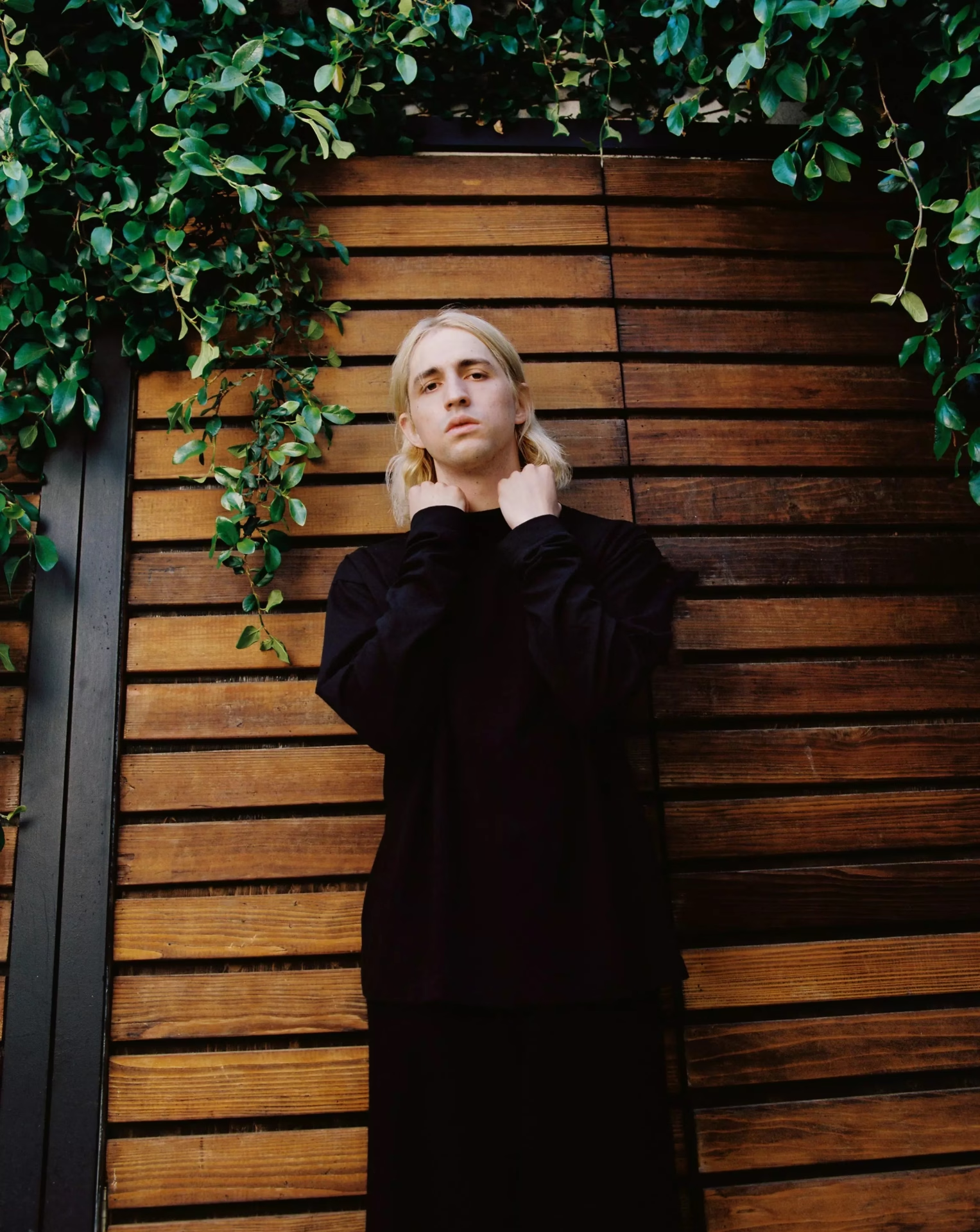
Porter Robinson is finally giving himself permission to be human, though this road to acceptance was not without bouts of darkness.
It’s been nearly a decade since the GRAMMY-nominated DJ/producer’s 2011 debut project, the Spitfire EP, helped ignite North America’s explosive fascination with EDM—its instantly recognizable synth stabs and pulsing electro beats brought him to EDC that year, when he was just 18 years old. Then in 2014, his first album, Worlds, left its transformative mark on the genre, igniting a trend among electronic tastemakers to experiment with new sounds, many shifting focus away from festival bangers to create bodies of work packed with bona fide passion.
The years surrounding these divergent releases were defined by tireless tour schedules and the constant question: “What’s next for the wunderkind from Chapel Hill, North Carolina?” When one spends every waking moment poring over work, burnout is the only reasonable outcome. For Robinson, that realization came after years of battling depression and his own crippling fear that he’d never produce worthwhile art again. (Though fans of his trance-leaning alias Virtual Self or his powerhouse Shelter (LIVE) Tour in which he shared the stage with Madeon surely have rebuttals.)
“Self-compassion and being kind to myself, those are all things that don't come naturally to me,” Robinson shares candidly. “But when I'm able to get there, it's so good.”
Let's Dance: ZHU Talks New Rave-Ready Album 'DREAMLAND 2021,' Being Inspired By Hyphy Music & Asian Americans Finally Being Heard
His newest LP is a testament to that fact. An exploration of his deeply personal journey in regaining his confidence, Nurture is a welcome collection of sunny productions, mellifluous piano chords and nature-laced soundscapes which offer ears exactly what its namesake promises. A foil to the dreamy, far-away sounds of Worlds, Nurture is (as Porter calls it) “intimate” and “up-close,” its instrumental elements and crackling lo-fi aesthetic a clear departure from past styles, yet distinctly Porter at the same time.
Fans recently had the chance to experience Nurture (LIVE) during Secret Sky, an online music festival created during the pandemic as a virtual alternative to his in-person gathering Second Sky, which will return to Berkeley, California for it’s second installment on September 17 and 18. Robinson sat down with the Recording Academy to discuss the album’s three-year metamorphosis, how he creates his multifaceted live performances, and what he hopes fans will take away from this musical lesson in perseverance and finding peace.
Was there a definitive moment where you shifted from feeling unable to create music to recognizing that you had something solid in the works?
For a project of this scale, those breakthroughs tend to happen over time, and little by little. One of the first moments where I could say things started to seem like they were getting better was in, I think, 2017. I had really not left my studio for some time, and my manager and my girlfriend were both like, “It's time to leave.” To my mind at that time it made no sense at all. I thought, “How am I going to do the only thing that I'm trying to do—make music again—if I'm not in my studio?” It felt like anything besides working was a waste of time. And that was one of the truly pathological beliefs I had to work through.
I ended up going to Japan with my girlfriend for a few months, and I had a studio rented just in case I wanted to try to make music. That was where I had one of my first breakthroughs and it wasn't visible to me at the time but what was happening was that I was basically running on empty in terms of inspiration and staring at a blank canvas and expecting something to spring out. It was a really kind of egocentric way of thinking about creativity, because I think for me, creativity is actually more like I find something new that I love, or something new that I haven't tried before, and it gets filtered through my senses and experiences and habits and it comes out the other side as something novel.
I started forcing myself to do new things and forcing myself to spend time not working. When I was there, that was when I wrote the chorus of “Look at the Sky,” which ended up being the lead single.
The lyrics to “Look at the Sky” and “Musician” obviously speak very much to this transformation, from the burnout to the breakthrough. Did the words or the beats come first?
Every song begins with the instrumental for me. That's how I've always worked, and I think maybe it has to do with coming from an electronic music background. I've actually thought about it—maybe I should try just writing a song first and then producing it second?
The only song on the album that I can say was written in that way would maybe be the song “Blossom,” because it's really stripped down. It's a ballad and it's a love song. It's just me and a piano over which I'm playing an acoustic guitar sound.
I can't move on until I have something in the instrumental that makes me want to bathe in the music, like live there. I'm looking for a sound that just feels like it fills the hole in my heart. And with “Musician” I definitely had that.
Whenever I have that breakthrough, I always do this thing where I walk back and forth in my studio and just listen to it super loud over and over and over and I'm like, “Wow, this is it, this is the best feeling ever.” I remember writing the beat instruments in the beginning and just being so excited and [thinking] I have to do this song right and ended up taking a year from that point to actually finish the song.
More Ambiance: 5 New Age/Ambient Albums To Soundtrack Your Zen
“Wind Tempos,” on the other hand, has no words. What inspired you to include ambient productions on Nurture?
I've mentioned before how one of the first inspirations for Nurture was this artist Takagi Masakatsu who made the soundtrack for this movie called Wolf Children which hit me at a really pivotal point in my life.
I'm always trying to make music that feels beautiful. For whatever reason, that's what calls to me. And the things that I found really beautiful in the past were these really big, epic, wide sounds that felt far away, and sort of dreamlike and imaginary. And when I heard the soundtrack for Wolf Children—everything feels so close. It’s almost like ASMR piano music.
I remember feeling so inspired writing “Wind Tempos” and thinking, you know, there's no chorus, there's no drop, are people gonna think this is an interlude? But I feel so grateful that a good chunk of my audience [are] treating it as the main course.
What steps were involved in creating the Nurture (LIVE) audio-visual experience?
In the case of Nurture (LIVE), it began with commissioning visuals. I needed a whole lot of video content to put on the screens, you know? And so, I'll typically put together some references and boards and inspiration and some descriptions and we'll put out these feelers to various visual artists. I’ll pay them and commission little 15-second clips of video content, and then I'll do that throughout the year.
As soon as I turned in the album, I started thinking about how I wanted to arrange a live show. The initial plan was to leave the music really untouched and before I knew it I had re-edited all the songs and made little adjustments. I'll produce the live versions of the songs. The next step from there is making it so that I can perform them live, so pulling out certain pieces so I can play them on the piano or on Ableton Push or on the keyboard, and pulling out vocals so that I can sing and recreate all my vocal effects that I use, because I prominently, on this album, use this [effect] where I pitch the vocals up, and making sure I was able to do that live.
The instruments that we have on stage are curated based on what's really needed for the set, and I knew there was going to be a lot of piano for this one so I wanted to have a big piano set piece that would be like a central part of the stage. And then the next step after that is, is taking all the visuals that we've commissioned and editing them to the music that I created for these live versions. And then I just rehearse and rehearse, and we troubleshoot.
So it takes a village to bring this performance to life?
It’s a big collaboration with a bunch of really talented artists. Some of the people who are working on this live show with me, like for example Ben Coker my Lighting Director, or Ryan Sciaino a.k.a. Ghost Dad, who's my VJ, I've been working with them for like 10 years, since my first EP, Spitfire.
You’ve come to the realization that constant work can stifle creativity. So, what activities will you always make room for in your life?
It is easy for me to lapse into being a bit of a workaholic and putting pressure on myself. Things that I think I have to make room for are being a present partner and doing things with Rika. That's of really high value to me and I always make room for the two of us to spend time together and that's just so important to me, and having time with family.
And forcing myself to experience media! This is so random, but ever since I was a teenager I’ve had a weird anxiety around the idea of watching movies. When someone asks, “Do you want to watch this movie?” I get this gut wrenching anxiety [because I feel like] I don't have an hour and a half to do this, like, I need to be working. So I'm trying to force myself to watch stuff, and listen to new albums and go to places I haven't been before, whenever that is safe.
A big thing for me I think is actively pursuing new things to love. I think it's a big part of being an artist that can fall by the wayside. I've always been a scientifically-minded type, but once I started actually coming to understand mindfulness and meditation—it's genuinely life changing stuff! And so I have to add, that is something I always try to make space for too.
Read: Justin Michael Williams Talks "I Am Enough," Teaching Kids Meditation & Pivoting Towards His Truth
“All we need is already here” is the motto of the album. It’s also been something we’ve had to remind ourselves of during the pandemic. What do you want people to do with this message now?
I think gratitude is a huge thing that I feel coming out of the pandemic and that I want people to feel when they listen to Nurture. And what I mean by that is [having] an appreciation for the extreme beauty and magic that there is all around us, in reality. I was so preoccupied with the idea of escapism and of going to this imaginary world that I think I sort of lost sight of how magical and mystifying our [real] world is.
Food is a place of comfort for many, so, of all the bites you munched on in the studio, what would you say was the “official snack food” of Nurture?
I'm gonna pare it down to three things. It would be these Quest Protein Chips, seaweed snacks, and then Oreos. Oreos are for the moment of weakness, and the other two are for the moments of strength.
