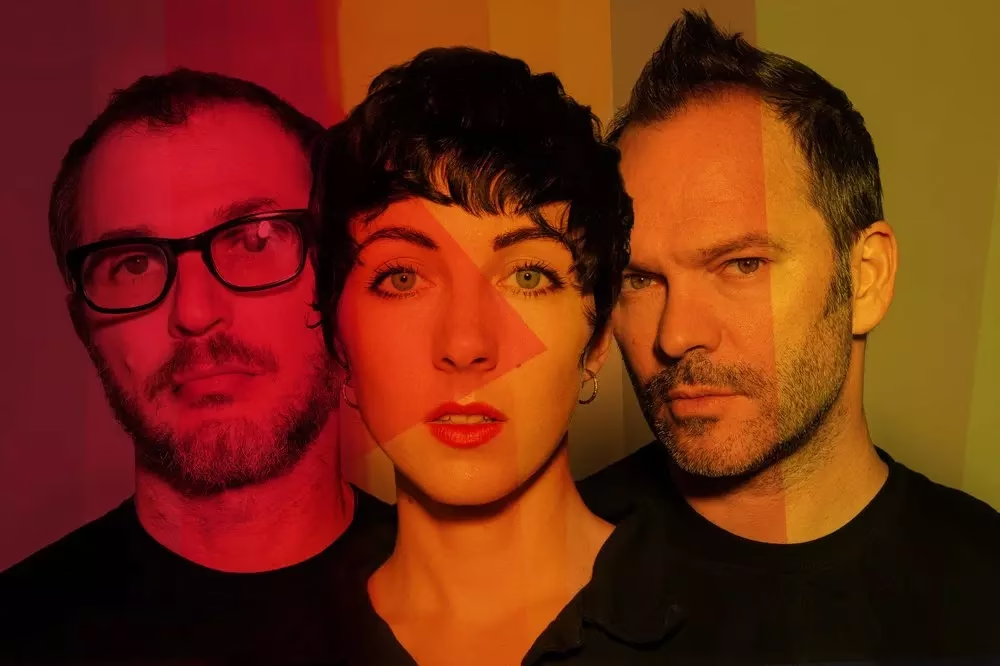
Nigel Godrich likes to make music that sounds like you can see it. “Everything is very visual to me," he says in a recent interview with the Recording Academy.
The GRAMMY-winning producer from London has produced for iconic names in music including Beck, Paul McCartney, Roger Waters and Radiohead, whom he's essentially served as a non-touring sixth member since the mid-'90s. When it comes to working with artists, Godrich comes in with his own plans.
"I don't set out to [leave a fingerprint], but I also have my own agenda on what I want from something," he says. "I regard all projects as collaborations really. I'm not trying to get what somebody else wants at all."
With Sister, the second album from his band Ultraísta out today, March 13, Godrich, who plays bass, continues to place his hallmarks: immaculate hi-fi production, experimental arrangement techniques, a delicate balance of programmed and played; of song and soundscape. It does, indeed, sound like you can see it—a painting made with bold brush strokes.
<style>.embed-container { position: relative; padding-bottom: 56.25%; height: 0; overflow: hidden; max-width: 100%; } .embed-container iframe, .embed-container object, .embed-container embed { position: absolute; top: 0; left: 0; width: 100%; height: 100%; }</style><div class='embed-container'><iframe src='https://www.youtube.com/embed/gYSbrX74M80' frameborder='0' allowfullscreen></iframe></div>
As Godrich notes, with both fascination and mild shame, the record took over six years to gestate—nearly the equivalent of the Beatles' entire studio career. And that's partly due to the project's piecemeal construction. After touring behind their self-titled 2012 debut, the producer regrouped with singer Laura Bettinson and drummer Joey Waronker for sporadic jam sessions he patiently whittled down into finished tunes. Each musician was busy in their respective careers: Bettinson as a solo artist, Waronker as a session player, Godrich's stage and studio work with Radiohead's Thom Yorke. But every so often, the producer would dig into the recordings and sculpt them like Play-Doh—building tracks from surgically extracted drum beats or looped basslines.
Bettinson and Waronker carried on with their lives with no expectation of when an album might emerge. But Godrich’s jigsaw slowly fell into place around 2018. "All the things that have happened in the process of making this record," he says, "it's quite absurd really."
The producer spoke with the Recording Academy about more on the six-year journey to Sister, the exhilaration of transforming jams into actual songs, his evolution as an instrumentalist and Radiohead's upcoming 20th-anniversary package of Kid A.
You sculpted much of this material through improvisations, a technique you've used in the past, like with Atoms For Peace's 2013 LP. Can you walk me through that process? Did everyone bring in grooves that you jammed on, or did you walk into the room with a completely blank canvas?
You're right in that it's a technique that's quite recurring in a lot of stuff I've done, with Thom [Yorke] too and even Radiohead or whatever. That was the foundation of The King Of Limbs, all that kinda weird [stuff]. It's like a home studio mentality, where you create loads of stuff, go back to it later and find a piece that works. It's something I'm used to doing and it's the easiest way of making tracks, really, because you can create a lot of stuff and you don't have to think too hard in order to make a big noise.
Ultraista only toured once, around 2012. Did some of the ideas originate around then?
We found, doing more and more shows, there were little gaps between songs and extended bits of songs that we kept playing. The way we had our equipment set up, we could just make music in the air. We just went into my little basement studio in L.A. and just played for nothing, with no ideas. No sort of basis for anything. It's easy for me to build a loop and a keyboard sound and Laura to build a vocal loop and Joey to play along—to create these little soundscape things that are used as building blocks. But they did sort of sit around for quite a while.
They also didn't function exactly how they were designed. There are a few things like that. I might hear one element and think it's good, but it didn't work that way, so [we'd] replay it or create it in a sequence and start again. But as a kind of seeding workshop, it's a great way of working. It's sort of leisurely, the way we've made this record. We had the luxury of taking some distance and looking at some things we made and going away and writing lyrics over things. It happened a lot of different ways, but the core of the intention was to do exactly what you said.
The challenge, though, is to take those little sequences and turn them into songs.
It's very easy to make cyclical things, but then you have to somehow hang music on them, which means going away and thinking about changes and chords. That exercise is done in a different kind of setting, and that's the bit that takes ages: forming them into coherent songs that are gonna hold your attention—which we never tried to do before. That was the big difference between the two records. The first one was supposed to be cyclical; It was intentionally dumbed-down in that way. Just to do something else, we thought it would be nice to make more conventional song structures.
Unlike most of the projects you've worked on, you weren't working with a deadline or any real sense of expectation. At what point do you put that internal deadline on yourself? Did you at some point say, "OK, we have 75 percent of an album at this point, so let's finish off this thing"?
It's a very, very good question. You're hitting on a very good point, which is that you can only sit around in the bath, picking out the fluff from your navel, for so long. And then you're like, "Uh, if we're gonna do this, I guess we've gotta get on and do it." That moment was relatively recent, probably a year and a half ago. It's like, "OK, let's finish this. It's really unfair for everybody to keep saying, 'Oh yeah, this track we did is really good. Let's nail it down and get it all done. Let's get this music out.'" We're very lucky to be able to sit around not finishing things. That's a privilege to sit around on music that's not finished. That did happen. It was like, "OK, if I've this time. I'm going to focus on all these strings and little bits and bobs I've got. I'm in the same country as Laura." We got the songs down, and then we got Joey back and did some more work with him. That's it. That's how we did it. It was a lot of navel-staring for like six years. [Laughs.] Not due to a lack of activity. Jesus Christ, it was such a busy time for all of us and we were doing lots of other things. It was a pleasure to go back and finish this stuff. And now that we've got it, it's really fun to talk to you about it and go promote it and play some songs and play some shows. It's a happy place.
You were in a unique position as a producer. You're the gatekeeper to this music in a way. How did the other two handle that? Were they checking in every so often, like, "Hey Nigel, what's the status of these songs? Any progress?"
No, not at all. We'd see each other socially anyway, so we're all in each other's lives. In all honesty, it was more like me trying to sell a second-hand car: "Guys, you know what, this song is actually good. I swear!" It's that up until a point, and then it's like, "Let's do this." We're quite content people. [Some artists are] signed to a major label where you have high-powered people pushing you to finish your album to a deadline, but nowadays there are musicians who can make music at home or in their own studios and make a living if they can manage that. There is no imperative; it's your own pace. It's a strange phenomenon that's not really existed before. In the '60s, people didn't sit around with songs they've written for five years, did they? They had entire careers. In fact, the Beatles had their entire career in the space it's taken us to produce another record. That's not a very good commendation, is it?
<style>.embed-container { position: relative; padding-bottom: 56.25%; height: 0; overflow: hidden; max-width: 100%; } .embed-container iframe, .embed-container object, .embed-container embed { position: absolute; top: 0; left: 0; width: 100%; height: 100%; }</style><div class='embed-container'><iframe src='https://www.youtube.com/embed//wN8_e8Bma3I' frameborder='0' allowfullscreen></iframe></div>
It's easy to forget how much artistic ground the Beatles covered in such a short span.
That's a marker I use: I measure things against the Beatles' entire career. It's only six or seven years, really, of the recordings.
Since the last album, you've performed live with Atoms For Peace and alongside Thom Yorke in Tomorrow's Modern Boxes. I assume that's changed you as a musician—you have to be a bit more practiced up on your instruments and that could also give you a different view of yourself as a musician.
I was a player when I was a teenager and then I didn't really pick up a guitar for a long time. But I remember thinking and feeling, after all that time in the studio working with other musicians, that I was a better musician when I picked up the guitar again. I was a better player. It was quite odd. I don't know why. I'd just watched and been around so many great people, great players. On the first Ultraista tour, it was a new thing to be on stage and play this stuff. Since then, you're right, playing with Atoms and even stuff with Thom now—I'm a different person than I was 10 years ago, but I'm more certainly more confident as a performer in front of people. I think I probably was a better player when I was 17, to be honest because I was playing all the time. But mentally, I'm certainly more confident now. We change over time. I think we're able to learn skills later in life too—I think I can do things I couldn't do 10 years ago. You think about things differently. So much about performance is about feeling and feel. I don't know—I feel like I focus on that more now.
I'd like to dig into the creative process behind Sister. "Tin King" is built around a hypnotic bass that runs through most of it. Did you just pluck out that riff from your pile of jams and start building from there?
The very basics of that were from the original jam for the first album but very, very skeletal. The only thing that actually survived is the bassline. And the idea was to write a song that's one-note. It's an exercise, a word game; three people contributing different lyrics and then choosing the note and taking it from there. I picked it up and said, "OK, something has to happen. There has to be a B section." So you write a refrain and it somehow solidifies some meaning in what's going on. The abstract imagery—it's all just words. It's something about an internal dialogue: "Am I in the right hands? Am I in the right hands?" It's funny how one injects one's own premise into a pile of things and it sorts them all into rows. The other thing was to make some sort of arrangement so the second half of the song could just blossom. So, I wrote the chords and extrapolated them from the middle onwards and then it reaches a sort of climax through Laura's performance at the end. Suddenly you have this arc and it makes sense. It's a track.
I love that concept of building a vocal around one note. Laura's performance, like the bass, has a kind of trance-like effect.
It's actually a really, really well-used and overused technique in songwriting. It's better to change the chords than the melody sometimes. It's funny how that works and it's funny how compelling it is. You wouldn't think that one note would hold your focus, but it depends on what's going on around it.
There are some lovely strings at different points in the album and the most definitive example is the surging, repetitive part on "Anybody."
That is from one of the jams in my basement. Joey and Laura making the vocal loop "I could be your anybody; I could be your nobody," that's the jam that went with the drums. The bassline is part of that jam too. That thing kind of existed and was arranged and knocked around and it had this amazing instrumental section from the middle part where it goes off into a sort of dreamscape. That's essentially the shape of the jam. When you do something and you're like, "Something really cool happened there," you fight to preserve the moment by building the song around it. Then Laura came up with the lyrics and the strings were the very last thing to go on because it felt very skeletal.
How did you end up recording those?
Actually, it's a good story: My friend Xavier Veilhan, a French artist who was representing France in the Venice Biennale, built an installation that was a recording studio. And I helped by basically giving him all the equipment. I sort of set up my studio as part of his exhibit. So there was this studio in Venice for like six months and they had artists coming through like every few days—from very esoteric electronic people to more well-known people. As a part of the deal, I had a few days to record some things. We decided to record our strings at the Venice Biennale in front of people walking in and out.
People would come in halfway through, watch, look confused and walk out. We somehow managed to do it without interfering with the recordings. [Laughs.] It's an overlooked story. It's pretty cool. It was just an opportunity to record the strings on our own. With the string line on [“Anybody"], I wanted something driving to push it along, some kind of Steve Reich-ian, Phillip Glass-type repetition. It's played. It sounds impossible to play, but it's played. It's just mathematical. But it's not a synthetic thing. It's ten people playing that part.
Yeah, it sounds like it could be a looped sample or something because it's so precise.
It's a weird story. It just goes to show—you reminded me, like, "Oh yeah, another thing: We recorded that at the Venice Biennale."
<style>.embed-container { position: relative; padding-bottom: 56.25%; height: 0; overflow: hidden; max-width: 100%; } .embed-container iframe, .embed-container object, .embed-container embed { position: absolute; top: 0; left: 0; width: 100%; height: 100%; }</style><div class='embed-container'><iframe src='https://www.youtube.com/embed/9vRtx8cICvs' frameborder='0' allowfullscreen></iframe></div>
Blurring the line between organic and synthetic is a signature of your work. One of my favorite moments on the album is Joey's drum part on "Bumblebees," where the groove sort of flips over on itself. It's disorienting but also super funky.
The reason [for that] is because he's actually playing to something else. The track is constructed around him and, basically, it's backwards. Sometimes it's a really good place to start—move the downbeat of the drums by a beat or a 16th early. What happens is that, rhythmically, things shake up and interesting things happen. You're quite right—it is backwards. But it's supposed to unseat you. There's nothing more boring than something very straight rhythmically. It's supposed to keep your brain moving and it sort of does. He plays beautifully and that's what's really lovely. In that instance, he might be reacting to something else going on that you can't hear. It's a good trick really.
That makes a lot of sense, actually.
It'll ruin it for you now! You've gotta forget I've told you. [Laughs.] [With Waronker], it's raw material to work with. One is spoiled really. That's one of those instances where it's like, "Move this here, move that there." Musically the basis of ["Anybody"] was from a jam, but it was lifted out.
This is a big time for the Radiohead family: Thom Yorke released his third solo album last year; you have the Ultraista album coming out, and guitarist Ed O'Brien is releasing his first LP really soon. Radiohead fans have been waiting a long time for this Ed album—he's such a sonic innovator, but when you're in a band with a writer as strong as Thom, there isn't really a window for your writing. Have you encouraged him much over the years or had many conversations with him about his songs?
Yeah, for sure. He'd done demos and we'd listen to them and talked about them and stuff. You're absolutely right: It's quite an intense, crowded field with Radiohead, with so many heavyweight things going on. You have to understand that these people have been together since they were in school. Everybody needs to flex their muscles and have an outlet and that's part of your self-definition. I think he's followed it, which is great. Good for everyone. He [has a tour scheduled], which is great for him to stand up and be a frontman. I think he's really looking forward to doing that.
Thom Yorke has talked a lot about prepping a 20th-anniversary package of Radiohead's Kid A, and the guys have been digging through the archives for that project. Have you been involved at this point?
I can't speak for them, but we're all sort of working on possibilities. There's all this archive stuff and the Public Library just opened and that's a big platform for all those kind of things. Beyond that, there's always plans afoot, but I'm afraid that'll be all I can say about it really.
Let's end on a random note. You have a cameo as a Stormtrooper in Star Wars: The Rise of Skywalker. How did that opportunity arise?
I know [director J.J. Abrams] through a very good friend of mine, Edgar Wright. I've spent a lot of time with J.J. and he's a music fan and also a very kind, generous person who allowed me to live out a childhood dream.
The Aces Talk "Daydream," Getting A TikTok Challenge & Keeping Calm Amid The Coronavirus
