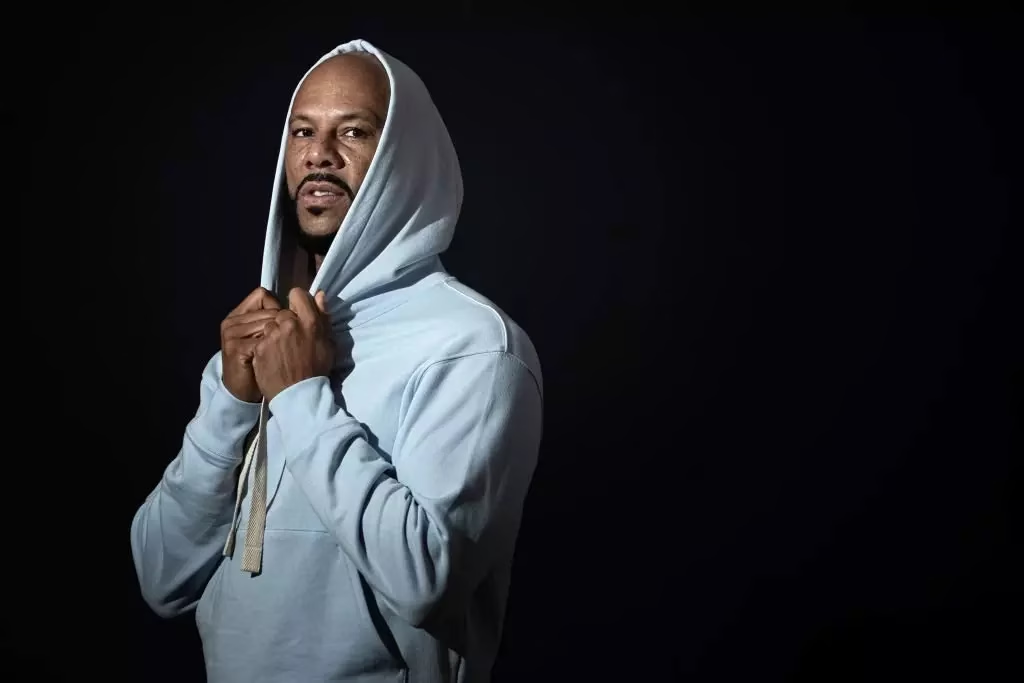
Lonnie "Common" Lynn has been putting out rap records for almost 30 years, but he spent almost all of the 1990s looking for his audience after an initial taste of fame with 1994's metaphorical "I Used to Love H.E.R." garnering buzz among backpackers. Immediately after, he found it: His fourth album Like Water For Chocolate, which just turned 20, boasted an incredible roster of producers (J Dilla, DJ Premier, Questlove), rappers (Mos Def, MC Lyte), and non-rap musicians (D'Angelo, Jill Scott, trumpeter Roy Hargrove, Fela Kuti’s bandleader son Femi). The star support cast, in turn, brought out the best in the headliner, giving him his first hit ("The Light") and his most memorable turns yet on the mic, like when he bucks his woman-friendly reputation to play a villainous pimp opposite MC Lyte, who makes a fool of his character.
Most of these names were joining forces as the Soulquarians, and releasing an unprecedented number of great hip-hop and neo-soul albums between 1999 and 2000; Like Water For Chocolate not only shares company with D'Angelo’s classic Voodoo and Erykah Badu's equally amazing Mama's Gun, but tracks from one could’ve ended up on another. Being around greatness made Common greater, and soon he was gracing Neptunes (Electric Circus, Universal Mind Control) and Kanye West productions (Be, Finding Forever). He found his audience. But 20 years later, Common acknowledges Like Water For Chocolate as a major career high, and he spoke to the Recording Academy on the phone about why.
<style>.embed-container { position: relative; padding-bottom: 56.25%; height: 0; overflow: hidden; max-width: 100%; } .embed-container iframe, .embed-container object, .embed-container embed { position: absolute; top: 0; left: 0; width: 100%; height: 100%; }</style><div class='embed-container'><iframe src='https://www.youtube.com/embed/OjHX7jf-znA' frameborder='0' allowfullscreen></iframe></div>
What do you think when you look back on Like Water For Chocolate two decades later?
I feel very happy and grateful for the artists I was around. That was such a joyful, creative experience, moments like Jay Dee creating "Nag Champa (Afrodisiac for the World)" or me hearing "Heat" on a beat CD or just him playing "The Light" for me. Flying back and forth to Detroit, getting to spend that time with Dilla, then going to Philly to work on stuff and having Ahmir ["Questlove" Thompson] oversee the whole thing, being around Tariq ["Black Thought" Trotter], going to Electric Lady and being able to walk into a D'Angelo session, and Erykah! Man, this was one of the greatest times in my life.
It’s astounding how many great albums came from the Soulquarians collective during this period: Like Water For Chocolate, Mama's Gun, Black On Both Sides, Things Fall Apart, Voodoo…
It was inspiration, it was competition, it was support. Black Thought was the person that was playing me Fela Kuti, who was a real influence. That was my first time working with DJ Premier, so that was a blessing; I was like "Whoaaaa, I have Premo beats!" And I met Jay Dee with Q-Tip at his place back in '95-'96, but I reconnected with him and The Roots while they were working on Things Fall Apart. Mos [Def] came in and did "The Questions" with me. Hearing what Erykah [Badu] was doing was inspiring. We were really iron sharpening the iron when I say we were competition. I obviously wanted Dills to create what he was feeling, but wanted it to be different from everything else he was giving to other artists. But he did that naturally anyway. "The Light" might have been the second song I wrote for that album.
Did you have any idea "The Light" was going to be a hit when you wrote it?
Nah, I’ma be real clear. I never could say I know what a hit is. I write from my heart, and my spirit, and my imagination, and what I think is fresh. I want to touch people’s experience and their hearts and to translate to a feeling for them. And that's why i even called it Like Water For Chocolate, because the concept for that movie was people cooking food and showing their love and how they felt for each other through food. And I was like, "man, I’m showing it through the music and I want people to feel that love and energy to create something within them to find their own inner passion and light." So when we did "The Light" I was really just writing a love song and being really optimistic and candid. I knew it sounded great but I never knew what it would get to be. That was the first song that I had on the radio, on mainstream radio. I was performing at Summer Jam and that was the first time I remember seeing young black girls singing my song. Teenagers to adult women. I was like, wow, this is amazing. Most of the songs I created prior to that were so hip-hop-oriented and weren’t as catchy.
The album has this lush, dense soundscape of live instruments, and a dream team of guests. What was the most difficult thing to pull off?
I really wanted Femi Kuti on it and at the time I knew he really didn’t know who I was too much but somebody on our label—he was on MCA too—hit him up and i guess they played him some of the music and gave him a briefing of who I was. To get him on it was incredible. It also wasn't easy to get D'Angelo because he was working on his own projects, and D is one of the greatest ever, he was a master. But it worked out, I got him on "Geto Heaven." and that was a beautiful thing. What initially happened was the song on D'Angelo’s Voodoo, "Chicken Grease," was for me, and "Geto Heaven" was actually created for D'Angelo. But D'Angelo really loved “Chicken Grease,” so he was like, "Can I get 'Chicken Grease' and I'll give you something."
<style>.embed-container { position: relative; padding-bottom: 56.25%; height: 0; overflow: hidden; max-width: 100%; } .embed-container iframe, .embed-container object, .embed-container embed { position: absolute; top: 0; left: 0; width: 100%; height: 100%; }</style><div class='embed-container'><iframe src='https://www.youtube.com/embed/WAhs3ehjd2Q' frameborder='0' allowfullscreen></iframe></div>
Have you ever regretted letting D'Angelo have "Chicken Grease"?
"Chicken Grease" would have been for me in the same lane as "Cold Blooded" to a certain degree even though it’s not the same vibe or whatever, but "Geto Heaven" added another color to the album and "Chicken Grease" added another color to his album. But it all connected and part of that connection is in the expertise or skill of Ahmir and people who really know how to put together albums. Ahmir is a visionary, D'Angelo too, so "Geto Heaven" fit where it should. Ahmir did the sequencing for Like Water For Chocolate, he truly executive-produced that album.
One of the best things you've ever done is the back and forth with MC Lyte on "A Film Called (Pimp)," truly playing characters. Did anyone give you pause for portraying a pimp?
Yeah. [Laughs.] At the time I was watching a lot of a documentary called Pimps Up, Ho’' Down and it was interesting to see the characters of people that were living that life. They had a pimp that was named Mr. Whitefolks, he sound just as black as anyone else, and they had a female pimp. I thought, let me write my own film and also be able to make fun of myself. The truth of the matter is somebody who’s "conscious" is not always serious. Women would approach me, they thought the conversation was going to be based in what books I've read or astrology, but I still like basketball and hanging out with my friends talking sh*t.
<style>.embed-container { position: relative; padding-bottom: 56.25%; height: 0; overflow: hidden; max-width: 100%; } .embed-container iframe, .embed-container object, .embed-container embed { position: absolute; top: 0; left: 0; width: 100%; height: 100%; }</style><div class='embed-container'><iframe src='https://www.youtube.com/embed/gMwey7ILEms' frameborder='0' allowfullscreen></iframe></div>
That song "Payback Is A Grandmother" added a cinematic quality—you can hear the influence on something like Kendrick Lamar’s good kid, m.a.a.d city years later. Did this album have anything to do with you wanting to delve into acting later?
Yeah, this album helped lead me into acting. I took the music somewhere I had never been and I didn’t know where to go musically anymore. I was really thinking about another creative outlet and i was literally taking piano lessons from Robert Glasper for a second, not long, he came by and taught me for a couple of times but I wasn’t that good. And I was like working on vocal lessons to try to be able to sing, and I was not good at any of these things. But I went to acting class and something about it resonated with me. My A&R Wendy Goldstein actually introduced me to my acting coach when we were in the last leg of promoting Like Water For Chocolate.
Have any surprising people told you they were a fan?
So many different musicians come up to me like, "Man, I listen to Like Water For Chocolate” and I'm like, yo, these are musicians who play something: saxophone, guitar, bass, drums, flute, piano, they listen to it and that’s the honor right there. 18-year-old kids come up to me like, "That’s one of my favorite albums ever." Chris Rock just in the last year, told me "I was just riding and listening to it, that was an incredible album." And I’m like, what? Chris Rock? He's one of the greats.
On 'Things Fall Apart,' The Roots Deepened Hip-Hop