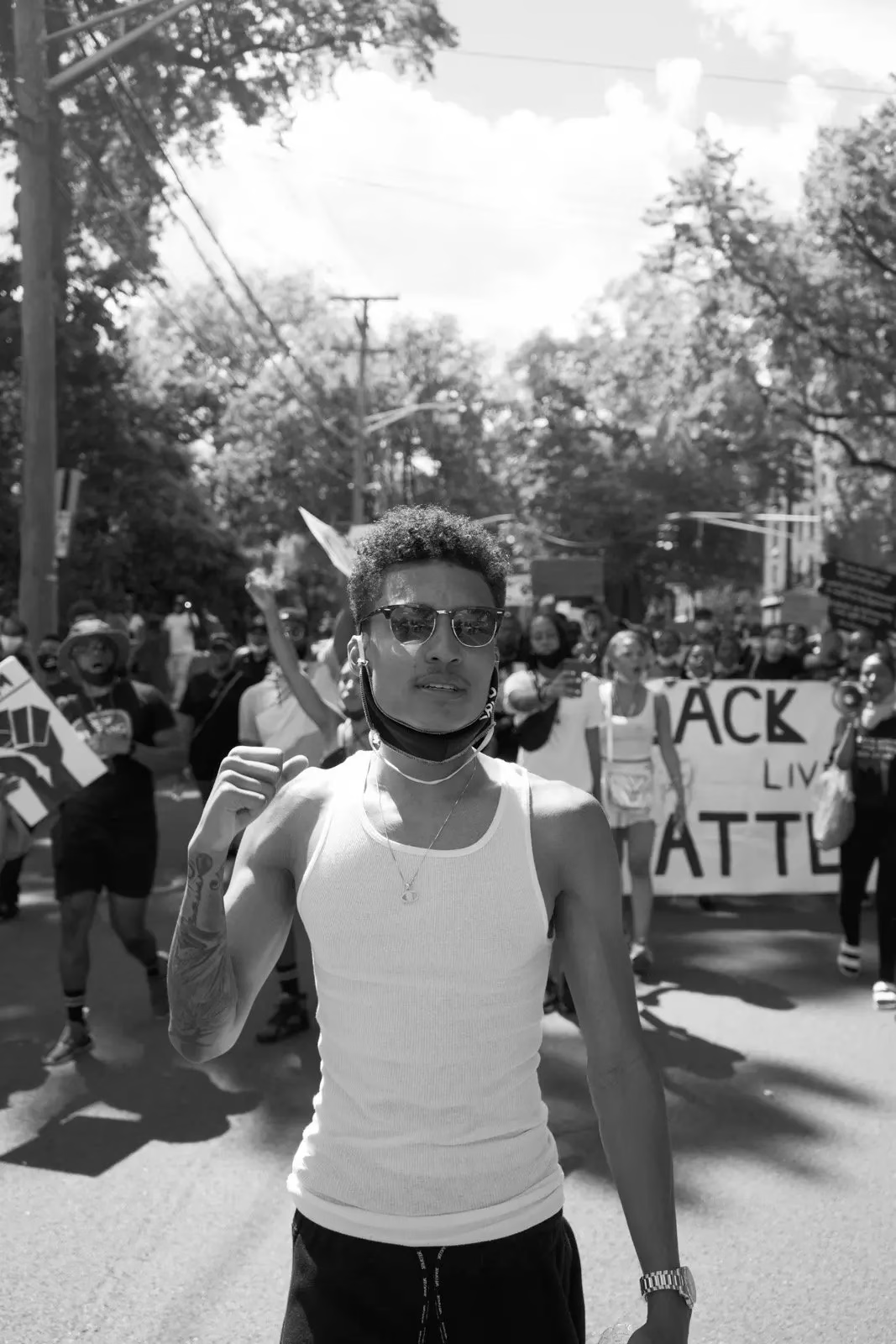
When he's not in the studio working on music or involved in youth activism and speaking at Black Lives Matter rallies, emerging hip-hop artist/producer Niko Brim is helping 93-year-old social impact leader Opal Lee with her tireless fight to make Juneteenth a national holiday.
As the oldest-known celebration commemorating the ending of slavery, Juneteenth marks a special day of remembrance and reflection for many Black Americans. The holiday, also known as Freedom Day or Emancipation Day, honors the day—June 19, 1865—when Union Gen. Gordon Granger arrived in Galveston, Texas, where he informed enslaved African-Americans there of the end of the Civil War, essentially granting them their ultimate freedom.
While Juneteenth is celebrated annually across most of the United States on June 19, it is not recognized as a national holiday.
Lee, widely known as the nation's foremost Juneteenth awareness leader, has dedicated her entire life to changing that. Her story is both personal and universal: At just 12 years old, she lost her home when 500 white supremacists set her house on fire. She's since dedicated herself to educating people about the importance of Juneteenth.
In 2016, at age 90, Lee walked from her home in Texas to Washington, D.C., in an effort to advocate for Juneteenth as a national holiday. She traveled two and a half miles per day to commemorate the two and a half years that slaves waited between when President Abraham Lincoln issued the Emancipation Proclamation, on Jan. 1, 1863, abolishing slavery, and the day (June 19, 1865) that message finally arrived in Texas.
<style>.embed-container { position: relative; padding-bottom: 56.25%; height: 0; overflow: hidden; max-width: 100%; } .embed-container iframe, .embed-container object, .embed-container embed { position: absolute; top: 0; left: 0; width: 100%; height: 100%; }</style><div class='embed-container'><iframe src='https://www.youtube.com/embed//KnvHbgwCBRU' frameborder='0' allowfullscreen></iframe></div>
Lee's hard-fought dream may actually come true: Today (June 19), multiple senators announced legislation to make Juneteenth a national holiday. Lee's own petition urging the same goal has received more than 600,000 signatures at the time of this writing.
Brim, who just wrapped his guest appearance on Rapsody's 2020 A Black Woman Created This Tour, has received over 1 million streams, with hits including "Throne," "Feds Watching" and "Woke." His latest single, "Hard To Believe," reflects his mission to implore Black and brown youth to reclaim their power.
"For 'Hard To Believe,' I wanted to tie the idea of revolution to some of our best moments as a people," he tells the Recording Academy. "A lot of times when revolution or systemic change is brought up, the images used are from the looters and the burning buildings. But they don't highlight the beautiful community and culture that is leading the charge day by day.
"[The song's] lyric video has some of the most brilliant black men and women, prolific writers, speakers, artists, etc. All of these people stood for the same change that we need! I wanted to show that in the video to create a conversation that is more uplifting for us as a people."
To honor the 155th anniversary of Juneteenth, Brim is launching a new show on his Instagram channel called "Power Hour," which "will explore the meaning of 'freedom for all," he says. The weeklong series, which begins nightly at 6:19 p.m. EST and runs from June 19-June 25, launches with Lee as the first guest.
The Recording Academy spoke with Niko Brim and Opal Lee about the significance of Juneteenth, the importance of music to the holiday's celebration and the dynamic duo's commitment to make a difference in the world.
<style>.embed-container { position: relative; padding-bottom: 56.25%; height: 0; overflow: hidden; max-width: 100%; } .embed-container iframe, .embed-container object, .embed-container embed { position: absolute; top: 0; left: 0; width: 100%; height: 100%; }</style><div class='embed-container'><iframe src='https://www.youtube.com/embed//_d3JqaofW38' frameborder='0' allowfullscreen></iframe></div>
Tell us about the importance of Juneteenth.
Niko Brim: Juneteenth is the day that all Africans were freed from slavery. In Texas, two-and-a-half years after slavery was considered abolished, there were still slaves. June 19 is the day that the last remaining slaves in this country were freed from bondage and given the start to this marathon we have been running for human rights. To me, Juneteenth represents freedom—it represents my past, the present and where the future is headed for Black America. The 4th of July never represented that for me and many Black people. [Juneteenth] is symbolic for us, in acknowledging and being aware of our own history. This was not taught to us in schools or seen on the calendar.
Lee: I am part of the National Juneteenth Observance Foundation. The states that don't recognize [Juneteenth] are Hawaii, Montana, North Dakota and South Dakota. Each state has a board member. We currently don't have representation from [those states]. We need many signatures and everyone to shout about it to get Congress on our side to pass this bill. The President would have to sign an executive order to make Juneteenth a federally observed holiday. I hope to see that in my lifetime.
[Editor's Note: In a June 17 guest column for The Billings Gazette, Montana state Sen. Margaret MacDonald wrote, "In 2017 the Legislature adopted a bill establishing Juneteenth as National Freedom Day in commemoration of the Emancipation Proclamation on the third Saturday of June. Montana was the 46th state to officially mark the date." On Thursday (June 18), South Dakota Gov. Kristi Noem proclaimed Friday (June 19) as Juneteenth Day for 2020 only in the state; it is not recognized as an annual state holiday or observance, according to the Argus Leader. On Wednesday (June 17), North Dakota Gov. Doug Burgum announced the state would formally recognize Friday as Juneteenth Celebration Day for the year 2020; state Sen. Tim Mathern plans to propose a bill to recognize Juneteenth as a holiday in North Dakota. In Honolulu, the capital of Hawaii, Mayor Kirk Caldwell announced on Thursday that June 19 will be officially recognized as Juneteenth and will be celebrated as "an annual day of honor and reflection going forward for the City and County of Honolulu."
Opal Lee | Photo: www.OpalsWalk2DC.com
What do you love about each other?
Brim: I wanted to work with Opal so I could actively do all that I can to push our community forward. I immediately fell in love with her passion, her commitment and her will for human rights. When I decided to promote Juneteenth, I came across her through the internet and made it my mission to connect [with her]. Since then, she has been a mentor who has guided me and is one of the cornerstones of the Black community. I'm blessed to know her.
Lee: If I could, I would adopt him! I am so proud of him for how he is educating people, and hope he will continue speaking at the rallies. He is a great rapper, and I love him!
How has music played a role with Juneteenth?
Brim: Music is an important aspect of Juneteenth because it is part of our culture. As we celebrate the Emancipation, we listen to melodies that have been reflective of our times, everything from slave hymns to current-day hip-hop. The music is the voice, and in many ways, the narration. It's the honest experience of us as a people and will forever be a key in all cultural movements.
I think the hip-hop and R&B community is embracing Juneteenth. For years, we were unaware of our history, and now, more than ever, the information is spreading like wildfire. I'm seeing collective support for the holiday, and I hope that for the rest of the 2020s, it will be celebrated on a national level. I would love to see it embraced by the overall music industry entirely, but we'll see.
The holiday still isn't recognized throughout the country, so hopefully starting this year, we can begin annual musical celebrations in honor of the event.
Read: Torae Talks Fighting For Change & Overhauling The Music Industry's Business Model
Lee: Music is an integral part of Black American and African history. The rhythm and vibrations, from drums and voices, create energy that not only moves our bodies, but moves our spirits. Juneteenth represents unity, and when we as people are together, there is an energy there that can transcend all pain and injustices.
When slaves learned they were free, they started celebrating with music, singing and dancing. It was such a joyous time. I have never been to a Juneteenth festival that didn't have some kind of music there; it could be jazz, opera, country or classical music.
Niko, tell me about your new Instagram show, "Power Hour."
Brim: Opal is my first guest on the show, which I created to commemorate the 155th anniversary of Juneteenth. Celebrities like rappers Doug E. Fresh and Rapsody, John Amos ("Roots," "Good Times") and filmmaker Monty Ross (Spike Lee's collaborator on films including She's Gotta Have It, Do The Right Thing and Malcolm X), who convey "Black power," will explore the meaning of "freedom for all" during a week-long conversations series [starting] at 6:19 p.m. EST from June 19 through June 25.
The series' topics focus on the "Twelve Freedoms" granted on June 19, 1865, when Union General Gordon Granger led federal troops to Galveston, Texas, to announce that slaves were freed and the Civil War had ended. They were now able to do business, dress, grow food, marry, own, read and write, preserve history, serve in the military, travel, worship, birth and name their children, and vote, legislate and govern.
Opal, what is it going to take to get Juneteenth to become a national holiday?
Lee: In order for Juneteenth to be a national holiday, we must not live in fear of people that are different from us, but rather accept those differences and get to know those differences. When this happens, it will be harder to judge a person by their skin color. Education is key and that education is not learned in the classroom, but in life and in our rearing. We just hit 100,000 signatures [on the petition]. Now we want 1 million!
Niko, your mom is veteran music fashion stylist Misa Hylton, and your dad is Jojo Brim, CEO of V Records. What have they taught you?
Brim: My parents have always been a great influence on me. My father has always exemplified doing what is best and taking the higher road, and that is something that inspired me. He is a seasoned music executive, who has taught me how to build a brand. I am thrilled to be on his label!
Mom has taught me hard work and the importance of believing in yourself. Between the two of them, I feel very comfortable in expressing what I stand for.
Both of them shared with me the ins and out [of] the industry and the business as well as staying true to myself and making the art I love. Learning these jewels from them helped a lot with the pressures that come with the industry and how to maintain a level head and a true heart in my music.
What are you both working on next?
Brim: I have a new song, "Hard To Believe." The truths and beliefs I've grown up with may be hard to believe for people who aren't Black, but for us, it's inherent knowledge that we must be aware of to operate in society the best we can. I touch on politics and how none of the system was ever in our favor, how our young men are incarcerated for being falsely accused or for standing up for freedom. These are just two of the many unsaid truths about being Black in America that I share on this song.
And this summer, I am releasing my next album, The King Has No Crown, which sheds light on the Black millennial experience. I share my story, rising from the south side of Mount Vernon to be one of the biggest voices for New York. This story is told through my eyes, the eyes of my closest people and the eyes of my city.
Lee: I am ready to restart my trek across America, which they call "Opal's Walk 2 D.C.," to the White House to bring awareness and get Juneteenth to be a holiday that is on the calendar. I want everyone to know that we were not freed on the 4th of July. My walk is 2.5 miles to represent the 2.5 years it took for slaves in the South to be freed.
I am also working on a book called "1619." It dives deep into how the first slaves arrived in America, telling a grueling account from whence they landed and the stories that were passed on through the generations.
Fight The Power: 11 Powerful Protest Songs Advocating For Racial Justice