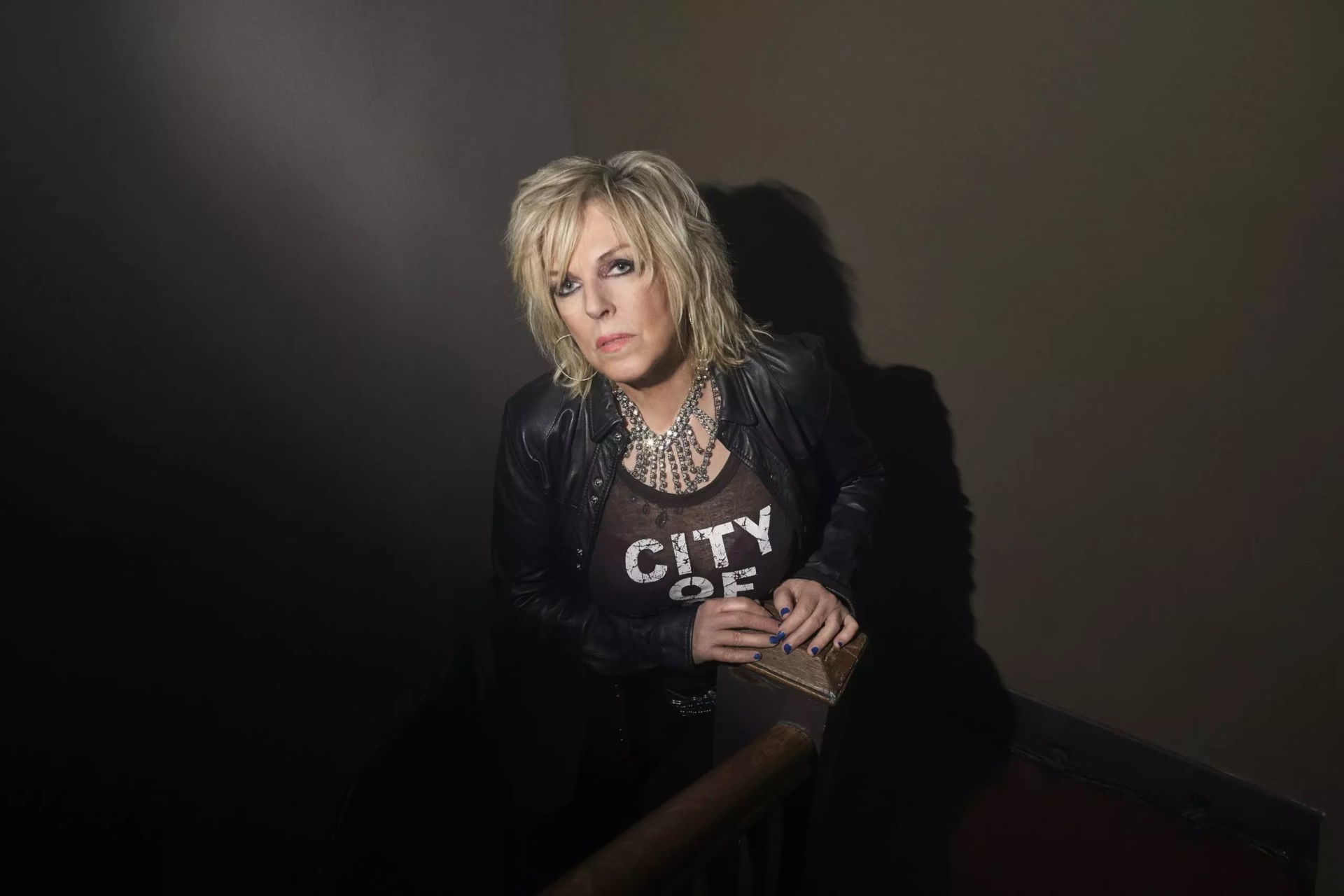
Even the most irreverent artists tend to mellow with age—but not Lucinda Williams. The latest proof is out this Friday, Apr. 24, with her bombastic, defiant and gorgeous new album Good Souls Better Angels. Emanating divine light from just beneath the surface of its devilishly oversaturated guitar tones and her cracked stained-glass voice are what Williams does best: her songs.
"I'm just an anomaly. I'm not like everybody else and I don't know how to explain it. Everybody's asking me, especially now with this album and it's so punk-ish and garage rock-ish and youthful," the 67-year-old Williams told the Recording Academy. "'Wow, you're still out on the road touring and you're still so active and productive. How do you do it?'… 'Are you still going to be able to write songs?' And I was like, 'Yes.'"
<style>.embed-container { position: relative; padding-bottom: 56.25%; height: 0; overflow: hidden; max-width: 100%; } .embed-container iframe, .embed-container object, .embed-container embed { position: absolute; top: 0; left: 0; width: 100%; height: 100%; }</style><div class='embed-container'><iframe src='https://www.youtube.com/embed//3dCgux3O1tM' frameborder='0' allowfullscreen></iframe></div>
Since teaming up with producer, co-writer (and now-husband) Tom Overby on 2007's West, Williams has been downright prolific, releasing seven albums in 13 years, including two double-albums. Relatively speaking, her career was on a slow rise before 1998's landmark, GRAMMY-winning Car Wheels On A Gravel Road skyrocketed her into the upper echelon of American songwriters, bringing with her the blueprint for Americana music that everyone from East Nashville to Silverlake still uses today.
From the very timely and polically charged urgency on her brand-new album to the authentic enthusiasm in her voice over the phone, you can hear Williams just getting started.
"My dad said one time, 'Poets usually don't even get taken seriously for their work until they're at least in their 60s,'" she told us. "It never occurred to me to stop. It's what I do. It comes from me. It's self expression."
A true artist to the core, Williams spoke with us via telephone late last month to talk about her new album and the chaotic world it now enters. The conversation took place before the tragic passing of two of her friends and talented contemporaries due to coronavirus, fellow songwriting sage John Prine and collaboration ace producer Hal Willner. At the time, news of Prine's COVID-19 diagnosis had just struck the music world, putting the crisis into new perspective for almost everyone who ever penned a song, including Williams.
In this extensive interview, Williams opens up about co-writing the songs of Good Souls Better Angels with Overby, recording with GRAMMY winner Ray Kennedy again, taking her landmark album Car Wheels On A Gravel Road on the road for its 20th anniversary, producing and writing with Jesse Malin, the real story behind her GRAMMY-winning song "Passionate Kisses," hip-hop as the new blues music and much more…
It's a bit of a loaded question these days, but how are you doing?
I know right? You really want to know the answer? Well, right now, currently, I'm pretty concerned about John Prine. I found out about that yesterday [this interview took place on March 30, 2020]. It's starting to hit close to home. At first, I didn't know anybody personally who even had it. Then a good friend of mine got it, but she's doing okay now. She's fine. She climbed out of it. Yeah. Then the next one was Jackson Browne. But apparently, he got a light case of it… Now I'm angry, as are a lot of people, because the idiot who's in the White House, the way he's been handling [this]. They could have made sure that things were done sooner. So, that's a whole thing.
That's really the perfect segue into your new album. Good Souls Better Angels has so much snarl. There's such a punk spirit to it, starting right out of the gate.
I know. Because I'm a punk. Maybe people are going to figure that out now instead of this whole, "Well, I've always been pegged country or country something." It's kind of, just kind of got stuck. I guess by default, because I started out as a singer/songwriter. I mean, I was and am a singer/songwriter, but for a long time, I didn't even have a band or anything. I just played around in the early days by myself. So, it's a natural progression, I guess, to get tagged in that.
When I was trying to get a record deal in the '80s, the thing that kept me from getting a deal was there was no market for Americana and they kept telling me my music fell in the cracks between country and rock, which is exactly what Americana is or was created for. But I remember when I almost got a record deal with Sony Records back in the '80s, and when I was in LA, the LA label said it was too country for rock and they sent it to Nashville to see if Sony in Nashville was interested. They said it was too rock for country. [laughs] I know, it's ridiculous. So, my stuff's always been mixed up…. Hank Williams was punk. Punk's an attitude. I don't have to tell you that.
I had a lot of fun making this album. It was done relatively quickly with just my band, and other than Ray Kennedy brought this guy in that played a little keyboard parts on a couple of things. But other than that, we just left it alone. Stuart [Mathis] did all the guitar parts and not a lot of cymbals. We told Butch [Norton] to put all the cymbals down because he loves all that stuff.
The other thing that added to it was that Ray Kennedy has a collection, a huge collection of vintage instruments, vintage guitars, and vintage amplifiers. So, I used his stuff that was there. So, everything I played, I was playing at one point through a 1950s guitar going through a vintage amplifier. So, you immediately get that crunchy sound. Then Ray just latched onto this sound for these songs. We went in there really just to cut a couple of tracks and see how it went kind of thing because Ray kept saying, "Well, come by and do a couple things and come over in my studio."
So, it was real casual. It wasn't like a formal thing like, "Okay, we're going to go do a whole album with Ray." We just went in to see how it went and the sound was just [so good]. We all just kind of were knocked back. We all just went, "Holy s**t. This sounds really good." So, we kept going and we cut other stuff too that'll be on the next album. But the sound we were getting was more suited for these kind of songs.
"Punk's an attitude. I don't have to tell you that."
Yeah, the guitar sounds on the record are mind-blowing, but so are the songs. How was it like doing the co-writing with Tom? That was new for you, in some ways.
It is. It's actually been really good. It's been really positive. It's been really kind of liberating. We ended up with more songs than we would have had because it started before this, actually, a little bit like Ghosts of Highway 20, we had everything already written and cut and everything. Tom said, "Well, I kind of feel like maybe we need one more song." He said, "I have this idea for this song," and he had this Ghosts of Highway 20.
He said, "Why don't you write about the South and all these things you see in the South?" At first, I said, "Well, I don't know what I could say that I haven't already said in the song, "Car Wheels on a Gravel Road," and I was resistant about it at first. But he said, "Well, just kind of see." He kind of nudged me a little and he said, "See what you can do." Then I did it. I went in and did it and then we ended up with that song, "Ghosts of Highway 20."
So, he was a little shy about it too. He didn't want to interrupt my space or anything. So, then we were working on stuff in between, way before this album got done and all last year. He's always been into writing everything. So, I would be working on something and he would bring an idea in and he'd say, "Now, you don't have to, but here's an idea I had." One of them was "Man Without a Soul." He had that line and the idea for it. The atmosphere was what everybody's living with right now, what's going on in the country right now.
I go, "Wait a second. Everybody's got a soul," and Tom looked me and rolled his eyes like, "Well, I don't know if everybody does." He goes, "But just look at it like an expression and everything." Because I was remembering that Neil Young song where he goes, "Even Richard Nixon has got soul"? It's like even Donald Trump has got soul and Tom goes, "No, no, no. No. Not in this case."
<style>.embed-container { position: relative; padding-bottom: 56.25%; height: 0; overflow: hidden; max-width: 100%; } .embed-container iframe, .embed-container object, .embed-container embed { position: absolute; top: 0; left: 0; width: 100%; height: 100%; }</style><div class='embed-container'><iframe src='https://www.youtube.com/embed//272voTjeHy4' frameborder='0' allowfullscreen></iframe></div>
So, anyway, it's been a really positive experience and both of us were a little hesitant at first about because the whole thing of, oh, now Lucinda's writing with her husband, Tom, and the whole thing. But it actually hasn't really been like that. We haven't had negative feedback about it. What I always say is, what I like to remind people of is that Tom Waits and his wife [Kathleen Brennan].
It's a great example.
I think that's probably the best example of that because they've done a lot of writing together and nobody said anything like, "Oh, now Tom's working with his wife," kind of thing.
It's almost two minds are better than one. What's the biggest relief about it? Does it take any of the pressure off? I imagine it might.
Well, I still felt the pressure of getting the songs done and finished and everything. I'm not real disciplined… Tom gets worried. He's starting to get used to it now. He was always worried, "Well, you're not writing enough. You're not writing. You're a songwriter. You're supposed to be writing every day, all day." You know?
I'm more like, I kind of work on it on a J curve, as it's called sometimes, like you just go along then there's a big whoosh. Then when I'm in that period, I'm writing, writing, writing. That'll last for a couple of weeks and I'll write. Once I get into that, then I am writing every day, all day. But I do that in spurts.
I didn't think about it as far as taking all the pressure off. I found it somewhat liberating because it does give me that more room. There's more room for more ideas. Bring them on. You know? "Big Black Train" was Tom's idea too. That was another one where he said, "I've had this idea roaming around in my head for a while and about a big black train." It's supposed to be a metaphor for depression, like the big black cloud. He brought that to me and the first thing I said was, "Well," I said, "what am I going to say about a train? "Big Black Train"? Do you have any idea how many songs have been written about trains and black trains?"
Yeah. Especially in East Nashville.
Yeah. Tom goes, "Well, just see what you can do" and I'm like, "Oh, god. I don't know." But I started working at it and somehow, I got inside of it and I got some more lyrics. Then I came up with this melody and it got inside of me and I got it. I did it. Now almost every time I sing that song, I feel like I'm going to cry. There's something about it. It's weird. Other people have told me that, that when they've heard that song, it made them cry.
<style>.embed-container { position: relative; padding-bottom: 56.25%; height: 0; overflow: hidden; max-width: 100%; } .embed-container iframe, .embed-container object, .embed-container embed { position: absolute; top: 0; left: 0; width: 100%; height: 100%; }</style><div class='embed-container'><iframe src='https://www.youtube.com/embed/MQmhLiVVeaA' frameborder='0' allowfullscreen></iframe></div>
I can see why. It's a beautiful song. How were you able to broach the topic of depression, and handle such a sensitive subject matter?
Well, yeah. I've dealt with things like that, the sensitive subjects before. But this one is so much like a metaphor. It doesn't have to just be about depression. Somebody told me, I was doing an interview the other day and she said, "It kind of reminds me of death a little bit." Like getting the train to go to… You know?
Yeah, I thought about [Bob Dylan's] "Not Dark Yet."
Exactly. Yes.
Well, you've also been extremely prolific the last few years, starting your own label, releasing double albums. What do you think the difference is between now and earlier in your career?
I don't know. A lot of it is Tom gently nudging me and, "We got to get some songs written," and that kind of thing. I guess working with somebody else, it's a combination of we're just able to work well together. It kind of goes back to when that album, [2008's] Little Honey and [2007's) West, those two albums were towards the end of my contract with Lost Highway. I think [2011's] Blessed was the last album for them.
Tom and I got engaged around the time that the Little Honey album came out and I was doing press for that album and they were asking, believe it or not, I was getting asked one of the most ridiculous questions, maybe the most ridiculous question I've ever been asked, which was, "Well, everybody's concerned that you might not still be able to write songs now that you're engaged and you've found your soulmate." Yeah. I swear to God, they were asking, in all seriousness. "Are you still going to be able to write songs?" I'm like, "Oh, my God." I go, "Okay. Do I have to explain this to you? Just because you get married, just because you have kids, just because you have a big house, you're making more money, whatever it is, I'm an artist first and foremost." You know?
Absolutely.
It all comes from there. Did Picasso quit painting? There's this whole myth that, well, once you get past a certain age or once this happens, once this happens. I go, "These are all external things." It's just part of life. I can't spend the rest of my life in a miserable state of loneliness in order to keep writing songs, although some people think they do and they subconsciously sabotage relationships because that's the only way they can write songs, because that's all they know to write about.
I figured out a long time ago, way before I met Tom, that at some point in my life, I need to learn how to write other kinds of songs. So, it's kind of a combination of that kind of thinking, and I'm just an anomaly. I'm not like everybody else and I don't know how to explain it. Everybody's asking me, especially now with this album and it's so punk-ish and garage rock-ish and stuff, youthful, and my age and all. I'm 67, like, "Well, wow. You're still out on the road touring and you're still so active and productive. How do you do it?" But anyway, so I started getting asked that question about, "Are you still going to be able to write songs?" And I was like, "Yes."
Yeah. It's what you do.
Then exactly. That's what I do. Maybe it's because I grew up around poets. My dad being a poet. He was married with three kids and taught college, as did most of the writers I grew up around. Most of them taught creative writing. But they all still wrote and my dad said one time, "Poets usually don't even get taken seriously for their work until they're at least in their 60s." It's just a different world. It never occurred to me to stop. It's what I do. It comes from me. It's self expression.
So when all that stuff started coming up, I'd already been thinking, for years, I've wanted to write more topical songs, but good ones. They're not easy to do. I wanted to be able to write songs like Bob Dylan did in his early topical songs like "With God on Our Side" and "Masters of War" and those kinds of just brilliant, really well-written, anti-war protest songs. But they're harder to do probably for most songwriters, I would think. because the easiest thing to write, I think, is an unrequited love song. You can write those forever… There are other things to write about. There's always something to write about. That's the thing. That's the lesson here.
You mentioned your dad and poetry, and you also mentioned Picasso and painting… Have you ever thought, "why songs?" Why are songs your medium for expression?
Yeah. Well, probably because my dad was a writer. I'm not really sure. And my mother was a musician. Not professionally, but she studied piano all of her life and she was a music major at LSU when she met my dad. So, she played piano. So, there was always a piano around the house. My music genes, I definitely got from my mother and my dad, the words part, I got from my dad.
As soon as I was able to read and write, I remember sitting and writing little poems and stories and I think I just gravitated to songwriting because, I don't know, I fell in love with music and it was a great. When I was growing up, it was just such a vital time for folk music and folk rock and rock and all that. There are just amazing stuff coming out. I just gravitated towards that, towards that medium. But that's an interesting question.
Actually, my other interest is photography. I always said if I ever didn't write songs, that would be the other thing that I would want to learn how to do. I don't know how much of that needs to be taught necessarily.
There's something about the imagery in your lyrics feels photographic, so that makes sense.
Yes. Absolutely.
What about producing? I love what you did with Jesse Malin last year on Sunset Kids.
That was a great adventure and project and everything, too. But that was a first. Tom and I both, Jesse approached us and asked us and said, "Would you help me make my album?" We said, "Yeah, absolutely." So, it was like a team effort really with Tom and me. Because my last albums, it's just been us with the engineer, so it's been a co-production kind of a thing.
But the last time I worked with an outside producer really would be Don Was, I think he worked with us on the Blessed album, I believe. Then the West album was with Hal Willner. But then gradually, it was comfortable and we felt confident just because the engineers that I was able to work with have just been David Bianco, he's the first one I worked after we did the Blessed album. I think I started working with David Bianco and it's a very democratic process when I go in the studio with my band and the guys. Greg Leisz was involved with a lot of that, with a lot of stuff, listening back and just talking about what we're listening to and what we're hearing and just all of that. I want everybody to be happy with everything. I don't want anybody to walk out of the studio and feel like they don't like something.
So, it's been a learning experience as we've gone along, and I was flattered to have been asked to work on Jesse's album. Then of course, I got involved with him with a couple of the songs. He asked me to throw my two cents worth in with lyrics and stuff. The whole thing was a real positive experience.
Yeah. It's a great record.
It is a great record. I think it's really good. I think it's his best one. The sound, there were a lot of little of things, like Tom was really good about. The vocal sound I think is really good and we focused on that with Jesse because Tom told Jesse, he says, "You should sing in in a lower key and so your voice is a little more relaxed sounding and not try to push so much and everything," because Jesse was used to singing in his punk band, D Generation.
So, when he became a singer/songwriter from D Generation, he was kind of still pushing his voice past his range a little bit because he was so used to doing that with D Generation. So, Tom got him, worked with him a little, and got him to look at his vocals a different way, and it really made a difference, just that alone.
You did a Car Wheels… 20th anniversary tour recently. How did it feel to revisit that material two decades later?
Well, I didn't have any problem with it and part of that is because several of the songs, I'd been doing already on a regular basis in our show. So "Drunken Angel" and "Joy" and "Lake Charles." Almost all the songs on there were on my set list here or there. Some of them more than others, the ones I mentioned. Like "Joy," we pretty much end every show with that song. I'll always do "Drunken Angel" because that turned into an anthem almost. So it wasn't really that kind of thing like, "Oh, wow. I've got to revisit these old songs."
"Metal Firecracker" was my introduction to your work, and I love that song so much.
Oh, thanks. I think that might be my favorite track, my favorite one to do on the album. It's more sort of a pop-rock kind of a song compared to some of the other ones. So, you can see I'm trying to branch out a little bit there. Of course, well, I kind of did that with that song "Passionate Kisses"… You can see me kind of, a little bit by little bit, trying to move away a little. It's never a conscious decision. It's not like, oh, I'm never going to write another country song or whatever, because I don't think in terms of that anyway. I don't think in terms of what style this is and, well, I should do this style or I can't do this other style or something.
That's the other thing. I'm still going to write narrative songs and all that. This album that's out right now is a lot about that. But that doesn't mean I'm not going to ever write another song like "Drunken Angel" or something. I'm always going to be just doing whatever I do. I'm never going to leave anything behind and never do it again.
It seems like a lot of those labels were forced upon your music anyway. But you did win your first GRAMMY for "Passionate Kisses" and I believe it was in a country category…
It's not a country song. That's what's so funny about it. I know. I mean, duh. Well, the story behind that is that Mary Chapin Carpenter and I have got to know each other a little bit because when she and Roseanne Cash and I did a little acoustic tour in Australia in the early '90s, and we did these writers-in-the-round things, and Chapin had heard "Passionate Kisses," and she had started doing it at her live shows. During that tour, she asked for my blessing because she wanted to record the song. Of course, I said yes, said that would be awesome. So, she cut the song and then she started having problems with some of the people at our label because she wanted it to be the first single. They said no, that they didn't want it to because it wasn't country enough. This is the ultimate irony.
<style>.embed-container { position: relative; padding-bottom: 56.25%; height: 0; overflow: hidden; max-width: 100%; } .embed-container iframe, .embed-container object, .embed-container embed { position: absolute; top: 0; left: 0; width: 100%; height: 100%; }</style><div class='embed-container'><iframe src='https://www.youtube.com/embed//5TCMpA5TfHc' frameborder='0' allowfullscreen></iframe></div>
Chapin, bless her heart, she stood her ground and she said, "Look. I've been playing this at my live shows. My fans love this song. I think it should be the first single." So, she fought with them about it and then they finally conceded and they put it out, and lo and behold, it wins a GRAMMY for Country Song of the Year [Best Country Song, a songwriter's award]. Nobody was more surprised than I was. But it was kind of like the label said it wasn't country enough and there it wins a GRAMMY for Country Song. I was like, "Wow. This is crazy."
Yeah. She proved the label wrong. You've also won in a Rock category, and Folk...
Tom and I were talking about that one time and he said, "You've been nominated just about every in just about every category almost, except for hip-hop and jazz."
And you're not done yet. So, you never know.
Yeah. I'm not done yet. Exactly.
Speaking of hip-hop, some of the more rhythmic, lyric-heavy songs you do really reminds me of that style.
Yes. Well, that's because I got into it at a certain point because I like good songwriting, and Tom's turned me on to some really great music, because he worked at labels for years and years. So, he's like a music freak and he knows about almost any band you mention to him. So he turned me onto Thievery Corporation and I just loved it and still love them, and also a hip-hop artist out of Minneapolis who goes by the name Atmosphere. Just brilliant writing. Hip-hop kind of in that vein, but it's more musical and there's stuff mixed in. I just love it.
I think that some of the hip-hop artists really are kind of the blues artists of today in a way. The blues/soul type. See, again, there are probably some of them that don't want to be lumped into the hip-hop thing maybe. It's like because somebody like Atmosphere, when you hear their stuff and look at [Slug's] lyrics and everything and he's a really good writer and he's very compassionate and you can hear it. I've met him before and he's just a really nice, really cool guy, a really good person. Tom's from Minneapolis, so he knows him and he turned me onto his music and I just fell in love with this one particular album called Southsiders. It's just really good.
Then there's another artist, Tricky, who's out of London, and his stuff is really good. Yeah. His stuff is really good too. A lot of people are so close-minded, if they just hear a certain style of music, they go, "Oh. I don't like that kind of music," without even really listening to it. I don't listen to the radio, commercial radio. So, most of the stuff I like isn't going to be on the radio… Well, now you've got satellite radio and all that, so that's all changed now. But I'm talking about the top 10 or top 100 Billboard artists. You're not going to find Atmosphere on the top 100 Billboard artists in any particular year or something like that. So, you've got to go outside the lines a little bit to find really good artists.
