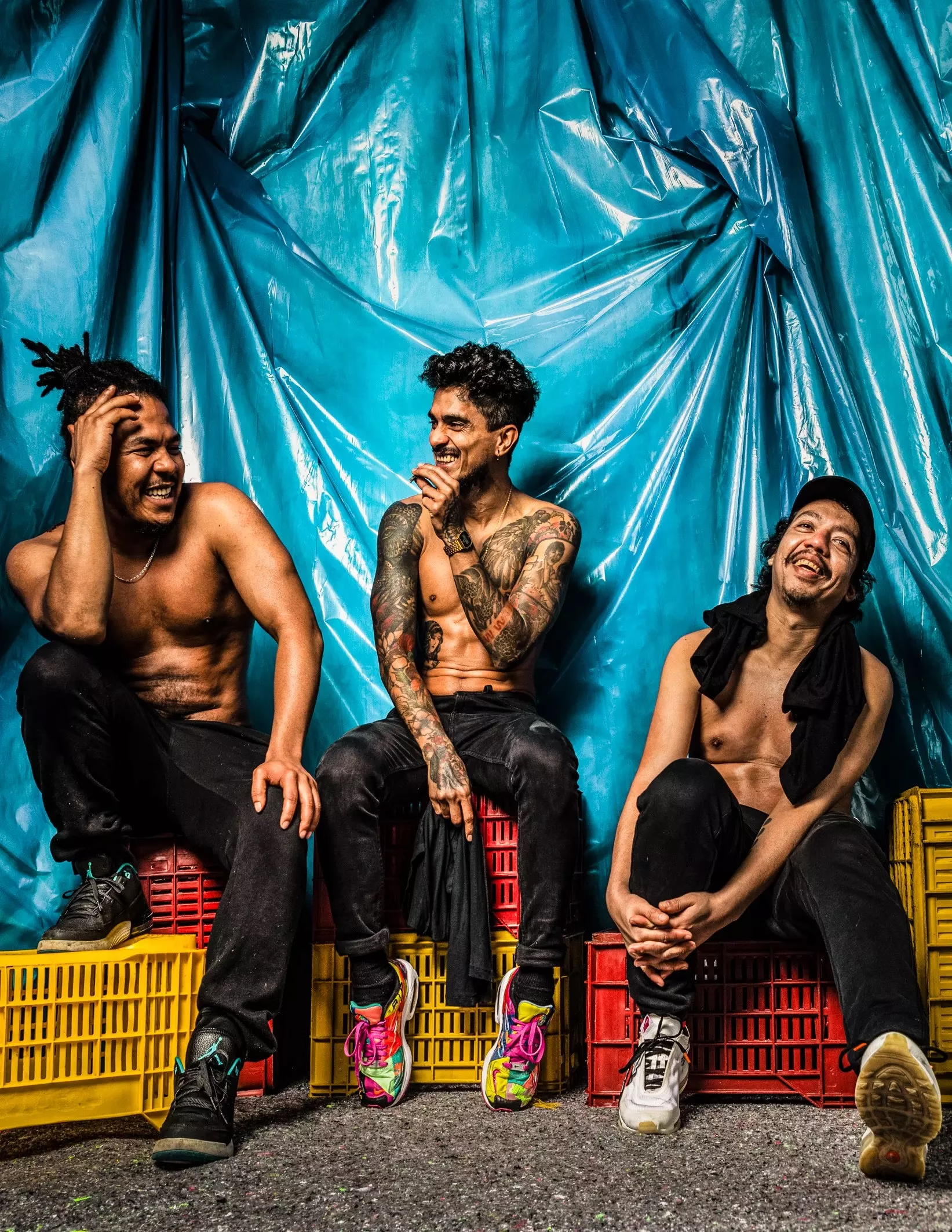
With the unprecedented global disruption of 2020, it's important to support the music community however we can. With our series Record Store Recs, GRAMMY.com checks in with vinyl-loving artists to learn more about their favorite record stores and the gems they've found there.
To listen to Colombian trio Ghetto Kumbé's music is to go on a lively, joyful journey through time and space, where borders no longer exist and drums and dancing are aplenty. The group consists of singer/producer El Guajiro, percussionist Chongo and West African percussion master Doctor Keyta—all veteran musicians who grew up on Colombia's musically and culturally rich Caribbean coast.
Their music seamlessly fuses traditional sounds with modern electronic beats and aesthetics. For example, their use of call-and-response lyrics come from the rich African and Afro-Colombian tradition called gaita, and the hand drums and rapid rhythms they incorporate also come from Afro-Colombian traditions.
Read: Amid Black Lives Matter Conversations, Black Latinx Artists Urge Non-Black Latinx To Do Better
Based in the talent-filled musical melting pot of Bogotá, Ghetto Kumbé have been making their mark ever since they released their debut EP, Kumbé, in 2016. They've since opened for Radiohead, performed at Barranquilla's world-famous Carnival and gotten a Boiler Room under the belt in early 2020. Now, with their self-titled debut album, released in June, they're ready to bring their global sound and the messages of unity around the world.
For the latest Record Store Recs, Edgardo Garcés, a.k.a. El Guajiro, takes us on a musical aventure to his favorite record stores in Barcelona, Paris and beyond and offers a taste of the music that moves and inspires him.
The Last Record Store Recs: Willaris. K Finds The Experimental Beats In Melbourne
Pick three to five records stores you love.
Crocodisc in Paris
Superfly Records in Paris
La tienda de Jacobo a.k.a. Inter Discos Bogotá in Bogotá
Munster Récords in Madrid
Garcés at Superfly Records in Paris | Photo: Courtesy of artist
For at least one of your favorite shops, share a recent record or two (or three or four…) you bought there and what you love about the record/artist.
I really like African music, musica picotera, as we say in the Caribbean coast in Colombia. This music has influenced us since we were little. To be part of this culture in Colombia is amazing.
One of the first vinyls I bought was in a very small shop without a name in Barcelona—it just had a little sign with discos vinilos ["vinyl records"] written on it. Inside I met a vinyl collector, who had some great African records—gems. Among others, one of my favorites I found one from Nigerian bassist Oliver de Coque, an album is called Mbulubia Uwa (Destiny).
I also love salsa, which influences me as a singer—especially Hector Lavoe, Ángel Canales and Saulo Sánchez, the singer of the [Colombian] salsa band Pantera.
Once, at one of my favorite shops in Paris, Crocodisc, I found a vinyl from a salsa band called Doble R. It was the first time of my life I saw this name, so I was curious—it was a salsa group from Curaçao. Salsa from the Antilles [islands]—wow! I had to buy it. On the album, I heard one of the most impressive voices in salsa, Ompi Stefania, an amazing singer who has become another reference for me.
In this same shop, I found the Pantera album from 1979. This vinyl has a particular history and is very hard to find. They said that it was a pirated copy and actually, that's the version that every collector wants.
Garcés with vinyl selects | Photo: Courtesy of artist
What's an upcoming/recent release you have your eyes on picking up and why?
We just released our new album! It's called Ghetto Kumbé—it came out on July 31 on ZZK Records. We released a green edition vinyl that sold out in month and we will release a second edition, orange this time, very soon.
What I liked most about it were the creation and the recording processes. It's our first full-length album and we wanted to do something special. It's eleven sincere tracks, with a lot of messages that are important to us, that we wanted to pass to the listeners. And we're always trying to highlight and preserve our roots. We're very happy to show the album to the world!
<style>.embed-container { position: relative; padding-bottom: 56.25%; height: 0; overflow: hidden; max-width: 100%; } .embed-container iframe, .embed-container object, .embed-container embed { position: absolute; top: 0; left: 0; width: 100%; height: 100%; }</style><div class='embed-container'><iframe src='https://open.spotify.com/embed/album/22s9wUm9hVB4AqmqFfv99P'frameborder='0' allowtransparency='true' allow='encrypted-media'></iframe></div>
Another Record Store Recs: Simón Mejía Of Bomba Estéreo Takes Us To Colombia
What were the first CD and first vinyl you remember purchasing when you were younger?
Actually, I remember my first cassette. I didn't have the money to buy CDs, so my plan was to go to some friends' houses to listen new music and record it on my cassettes. Sometimes I would even spend all day next to a radio to wait to hear my favorite songs and bands and record them on my cassettes.
One of the first cassettes I bought was one from the Colombian band 1280 Almas. I always was a big fan of the music and bands from Colombia. When people [including Juanes] were listening to Metallica and other foreign bands, I was really into Colombian [rock] bands like La Pestilencia, La Derecha and 1280 Almas—they were my favorite because of their Latin style that was pretty new at the time. Also, Aterciopelados and an infinite list of local bands that have the level to play at any festivals or with any other international band.
In your opinion, what can music fans do to better support BIPOC artists and business owners?
First of all, more than divide people because of ethnicity or color, we have to support everyone. In Colombia also, there is racism against indigenous people and Black people, but it is changing slowly. Mucisians have a big responsibility in the evolution. Traditional music bands and [fusion] projects like Ghetto Kumbé are sharing strong messages to people in every country and beyond to shift the mentality [of division and racism].
To support the artists' projects and independent artists, the fans needs to buy the music, physically and digitally. And when we are able to do concerts, we will need people to come and see us.
