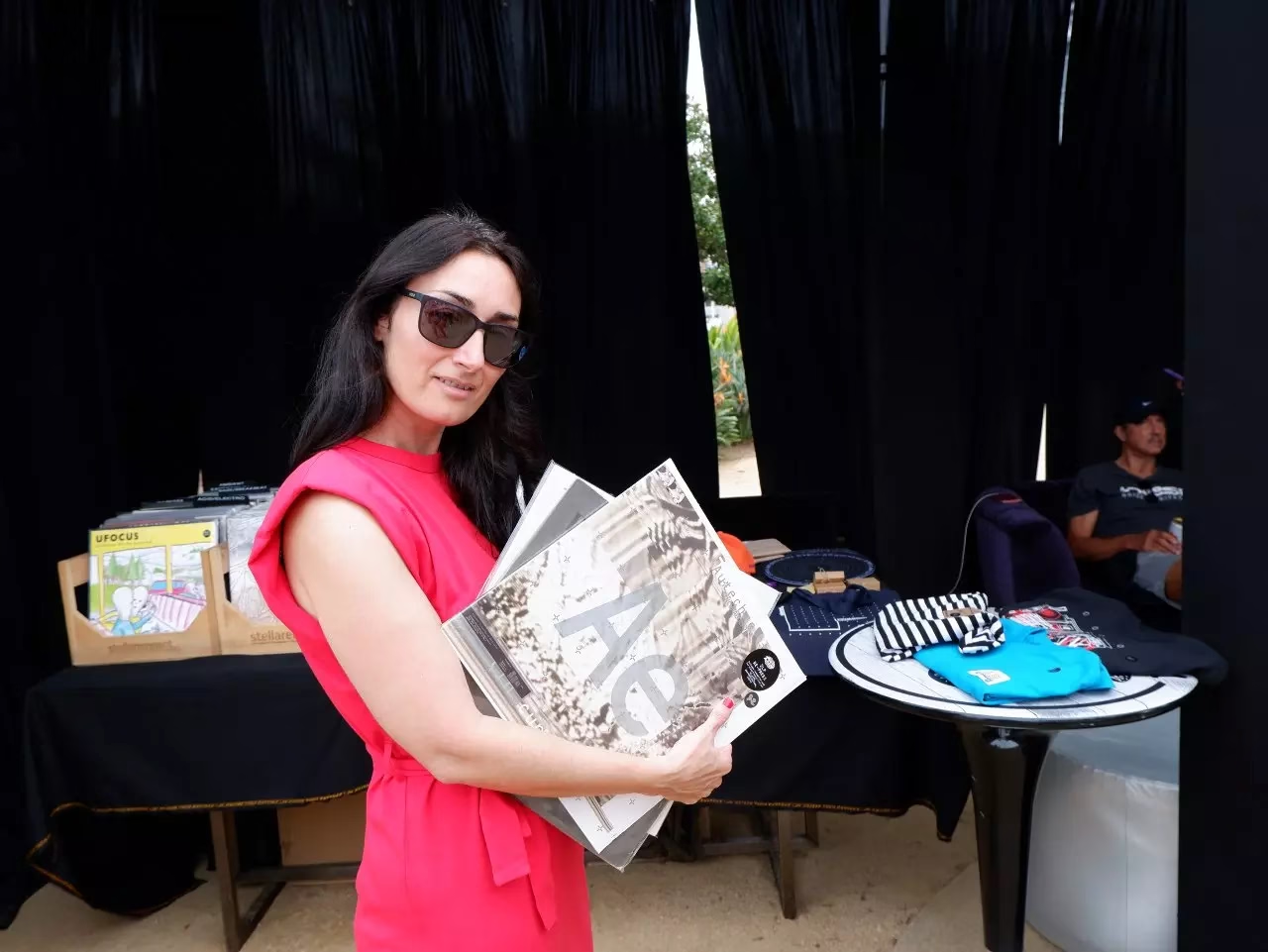
For the first-ever IRL iteration of Record Store Recs since its launch in May 2020 to support record stores and artists during the pandemic, a few of the DJ/producers who played CRSSD Festival 2021 in September joined GRAMMY.com at the Stellar Remnant popup.
British hard techno queen Paula Temple found bangers in the techno section, of course, along with an album from her favorite ambient artist. Under the warm San Diego sun, the producer detailed her selections with GRAMMY.com, along with what she thinks makes a great dance track, her teen years sharing the gospel of Jeff Mills at the record shop where she worked, and more.
<style>.embed-container { position: relative; padding-bottom: 56.25%; height: 0; overflow: hidden; max-width: 100%; } .embed-container iframe, .embed-container object, .embed-container embed { position: absolute; top: 0; left: 0; width: 100%; height: 100%; }</style><div class='embed-container'><iframe src='https://www.youtube.com/embed/wwCX_ywSqFc' frameborder='0' allowfullscreen></iframe></div>
Have you been playing shows or is [CRSSD] your first show back?
I've only played a few shows. I did a big one in Brussels. It was huge. That was with Charlotte de Witte. And then I did a huge one last week in Paris. That was with SNTS. We actually dressed up for that one in a black veil, and we looked like we were going to a funeral. The crowd loved it. It was very deathly techno, but it worked.
Are there any sets you're excited to check out this weekend?
Kobosil and ANNA. I've never seen ANNA yet. I've seen Kobosil a few times. We're on a lot of lineups together. That's all we've got time for, to be honest.
Paula Temple shops the Stellar Remnant pop-up at CRSSD. Photo: Ana Monroy Yglesias
What are you usually looking for when you're crate-digging?
I automatically go to the techno section—there are three sections I always go for: the ambient, experimental, and techno. And that's exactly what I just did, so no wasting time. I'm not an expert in any genre really, but these are in my heart. Immediately I was so surprised, I found a whole bunch of great stuff in techno. And then I thought, okay, check out electronic, and I was like, "Wow. Classics."
Let's talk about what records you got. Tell us what you got and why you picked it out.
Autechre, Incunabula (1993)
Well this record from Autechre I bought when I was 15, so that would've been about 26 years ago. This is probably the most influential album that seriously affects me. I love this album to this day. It came out on Warp Records, which is still a legendary label, but they were innovative at the time. They started off pretty much in 1990-91 with bleep techno. They actually had some hits in the U.K., and actually broke into the charts.
At this point [Warp Records did] the Artificial Intelligence series [where] they introduced some insanely impressive artists. It was called intelligent dance music, IDM.
Were they one of the first labels to put out IDM?
Yeah. That's how I got to know IDM. These guys [Warp Records], were based in Sheffield and I actually moved to Sheffield because of this record label, because of this duo. And then they all moved to London when I moved to Sheffield, so that was sad. I was hoping to get into that, I don't know, electronic music culture whilst I was living there. That was when I started making music full-time, when I moved to Sheffield.
But this album is phenomenal. Nearly every track is classic electronic. The most emotional [track] will be "Windwind." I love it.
Paula Temple shops the Stellar Remnant pop-up at CRSSD. Photo: Ana Monroy Yglesias
Various Artists, Ivan, Come On! Unlock The Box! (2015)
This compilation is from Trip, Nina Kraviz's label. I think it's more like a triple pack, but what I particularly like on this album is the K-HAND track ["The Box"]. She died just recently. This track is pure beautiful legacy, one of the most gorgeous tracks I've ever heard. It was really sad that she passed away at such a young age. All I did for a day was just listen to this nonstop.
But you know, all the other artists, like Vladimir Dubyshkin, are getting a lot of recognition through Nina's label, and they're just really good tracks. I really like Philipp Gorbachev [who's on here as well]. It's just a really good compilation.
Abul Mogard, Kimberlin (Original Soundtrack) (2019)
Abul Mogard, he's my favorite ambient artist. I [had] believed this self-prophesized legend of this person where he's a 65-year-old Serbian man retired from factory work, but [I just learned] it may not be true, which is kind of heartbreaking. People are starting to get suspicious.
Regardless of that, the music itself speaks mountains. What I love is the hanging of the notes—it's pure ambient music—and it unfolds very slowly. It has really beautiful delays and reverbs, but it's the way the notes bend over time that gives so much emotion.
When this person titles [the track] "Flooding Tide," you feel that in the music. It's exactly the imagery and the feeling and everything. And it's very emotional, very sad. It's like a statement on humanity and what we've been doing wrong, and we're going off the rails and there's nothing we can do about it. This is the soundtrack.
Rrose x Bob Ostertag, Motormouth Variations (2011)
Rrose is actually a friend of mine. I love this person's work to bits. It's so very important. This is a very vital album that they did with Bob Ostertag and a very important label as well, Sandwell District. So, it's very nice to see this in the collection.
Stenny, Upsurge (2019)
I found out about this [album] from a club in Munich called BLITZ. I actually played there the last Christmas day before the pandemic. And then afterwards, we sat in the back room talking about music. This was playing and I said, "Pauly, you got to listen to this, this is Stenny's album!"
I couldn't describe it. It's delicious because of the textures that are in the tracks. It's quite laid back, but it's just beautifully textured, very interesting, and different, very artistic. Not the usual techno obvious stuff— it really gets you listening. It's on Ilian Tape, which is a very, very good label. Thank you, Munich BLITZ.
Another Record Store Recs: T.Williams Shares His Fire House Music Selects & Love For Emotional Dance Records
Are there any other upcoming releases that you have your eye on picking up?
Oh, yes. GEGEN DECADE. Maybe I'm a bit biased about this because I have a track on [part two of] this -part album. It's is by a label and a club in Berlin called GEGEN to celebrate their 10 years, so they're calling it DECADE. It's a sex-positive queer nightclub. And, they brought together all the queer artists that they love and put out this fabulous album. It's so good. So, I'll be playing a few tracks from it at the [CRSSD] afterparty as well. [Part two of] the album is coming out at the beginning of October.
What do you think makes a great dance track?
It depends for what purpose. At a festival, I like to have surprise and emotion. Festivals love breakdowns—that's fine, but to do it in an unusual way, I love down tracks like that. And, they give you something, but they give you something more on top of that that you didn't expect. So like, okay, this is the obvious thing that happened. And then, "Ooh, that just happened out of the blue."
And, for maybe a club—I tend to play more underground clubs—but it's the intensity. Layers and layers of intensity.
More Record Store Recs: Öona Dahl Tells Us Her Favorite Places To Find Vinyl In L.A. And Berlin
And when did first get into techno and dance music more generally?
A very young age, when I was about nine. It was the Pet Shop Boys, so nothing very underground. [Laughs.] It was bands like the Pet Shop Boys. Then I was about 11 or 12 when the rave scene started to happen in the U.K., and I was still too young to go to raves. So, that was artists like 808 State and [U.K.'s] LFO.
Then I got into grunge, but then there's this crossover with Nine Inch Nails' first album [Pretty Hate Machine], which was an electronic beat, but also kind of EBM-influenced. And then from that, it was Jeff Mills. He was actually the turning point for me—Jeff Mills' Waveforms Volume 1 that came out in Tresor, and I was about 15 at the time.
It was so fresh, so extreme, something I'd never heard of before. I just started working at a record shop at 15, and I was getting everyone to buy the Jeff Mills album. "You've got to listen to this!"
And then when did you start DJing and producing yourself?
16.
Wow.
Yeah. Straight away. There was this unusual—it was more like a bar, pretty illegal, actually. It had no license, and wasn't meant to exist. So, at 16 I got my first decks and they asked me to play, probably because I was doing it for free. I'm like, "Yes, please." I didn't know how to DJ. But you know, I went straight in and played the heaviest, fastest techno and trance, scared everyone sh*tless. But at that age, you just love that energy. I haven't changed.
What's inspiring you to make music right now?
Actually, Moog. I just got this triple synth sound studio from them. It's got the DFAM, which is a drum machine, the Mother-32, which is a monosynth, and then the Subharmonicon, which you can do chords with. It is polyrhythmic and the combination is—I haven't wanted to make music for a long time, or I haven't felt like I could bring something original. Now, all of a sudden, I'm using hardware which I haven't really done [before]. I had the odd synth, but not a full center where I can make everything with hardware.
I'm actually making music with my wife now for the first time. Because we feel like we're on the same level, we're learning this semi-modular system together. She's more techno than me. She never heard of techno before I met her. She's from Detroit and she lived in Chicago for a long time. She didn't know anything about Chicago house music. But here we are now in 2021. We're making music together and she made this really sick, hard, industrial-like rhythm. We ended up making a track out of that. So insane. We want to keep making more tracks together.
"At Night, The Disco Goddess": Why Nirvana Songs Make For Killer House Music