By the mid-2000s, Red Hot Chili Peppers (RHCP) were deservedly enjoying the most commercially and creatively successful period of their 20-year career. After all, they'd triumphed over their tumultuous and tragic early years—which, however, musically venerated and influential, included multiple lineup changes and bouts with drug abuse—to achieve massive artistic and mainstream prosperity via Californication (1999) and By the Way (2002).
Admittedly, not all fans were pleased with the group substituting some of their beloved, raucous playing and risqué subject matter with more accessible approaches; yet, it's hard to deny that both albums were significant for their high quality and myriad industry accolades as well as for how they embodied the band's mostly shared sense of healing and growth. (This was particularly true for guitarist/backing vocalist John Frusciante, who'd conquered his heroin addiction and rejoined the group with newfound confidence and ingenuity in 1998).
Feeling immensely prolific and capable, the Chili Peppers, following the two-year tour for By the Way, reteamed with Rick Rubin, who produced their previous four albums, in September 2004 to embark on their most ambitious and diverse project thus far: Stadium Arcadium.
Recorded at The Mansion in Los Angeles, where the group also laid down Blood Sugar Sex Magik in 1991, Stadium Arcadium, a 28-song double album, incorporated virtually every style the quartet had ever done. Naturally, that flexibility and inventiveness led to some of the most extensive songwriting and captivating arrangements they'd ever made. As a result, Stadium Arcadium is best viewed as an incredibly rewarding and varied tribute to the group's history.
Of course, double albums had been a popular music tradition for decades: Bob Dylan's Blonde on Blonde (1966), Pink Floyd's The Wall (1979), 2Pac's All Eyez On Me (1996)—the list goes on. It was almost inevitable that the Chili Peppers would issue one, too. (In fact, they'd intended to release Stadium Arcadium as a trilogy, dropping six months apart, before deciding to put out everything at once, the band told NME in 2006.)
In his July 2006 interview with Total Guitar, Frusciante revealed they had no reservations about attempting such a feat, either: "We don't just make music … for our own pleasure; we make music for our audience. We write 28 songs that we think are top-notch, that's what we want to give to the public … We're putting out what we believe is worthy." To his credit, every track on Stadium Arcadium earns its place and contributes to the greater whole.
It's also worth noting that making Stadium Arcadium was more congenial and collaborative than By the Way, due mostly to the repaired relationship between Frusciante and Red Hot Chili Peppers bassist Flea. Due to his melodic prowess and characteristically adaptable methods, Frusciante was often seen as the heart of the Chili Pepper's sound around this time. That was especially evident on By the Way, on which he desired to move further away from the edginess of the band's past and toward the harmonious arrangements of groups like the Beatles, the Beach Boys and his own fruitful solo discography. Consequently, Flea, who wanted to emphasize their prior funk and punk elements, felt somewhat uninvolved and unappreciated to the point that he contemplated quitting after the band finished their By the Way World Tour; the two worked out their differences by the time Stadium Arcadium got underway.
<style>.embed-container { position: relative; padding-bottom: 56.25%; height: 0; overflow: hidden; max-width: 100%; } .embed-container iframe, .embed-container object, .embed-container embed { position: absolute; top: 0; left: 0; width: 100%; height: 100%; }</style><div class='embed-container'><iframe src='https://www.youtube.com/embed/Sb5aq5HcS1A' frameborder='0' allowfullscreen></iframe></div>
Speaking to Kerrang! in May 2006, Frusciante admitted, "It's more of a band now. I don't force my ideas on people as much as I did." Flea concurs, clarifying that creating Stadium Arcadium was a healthily democratic and communal process. In a 2007 chat with MTV News, vocalist Anthony Kiedis noted, "There was very little tension, very little anxiety, [and] very little weirdness going on … everyone felt more comfortable than ever bringing in their ideas."
Read: Nirvana's Era-Defining 'Nevermind': For The Record
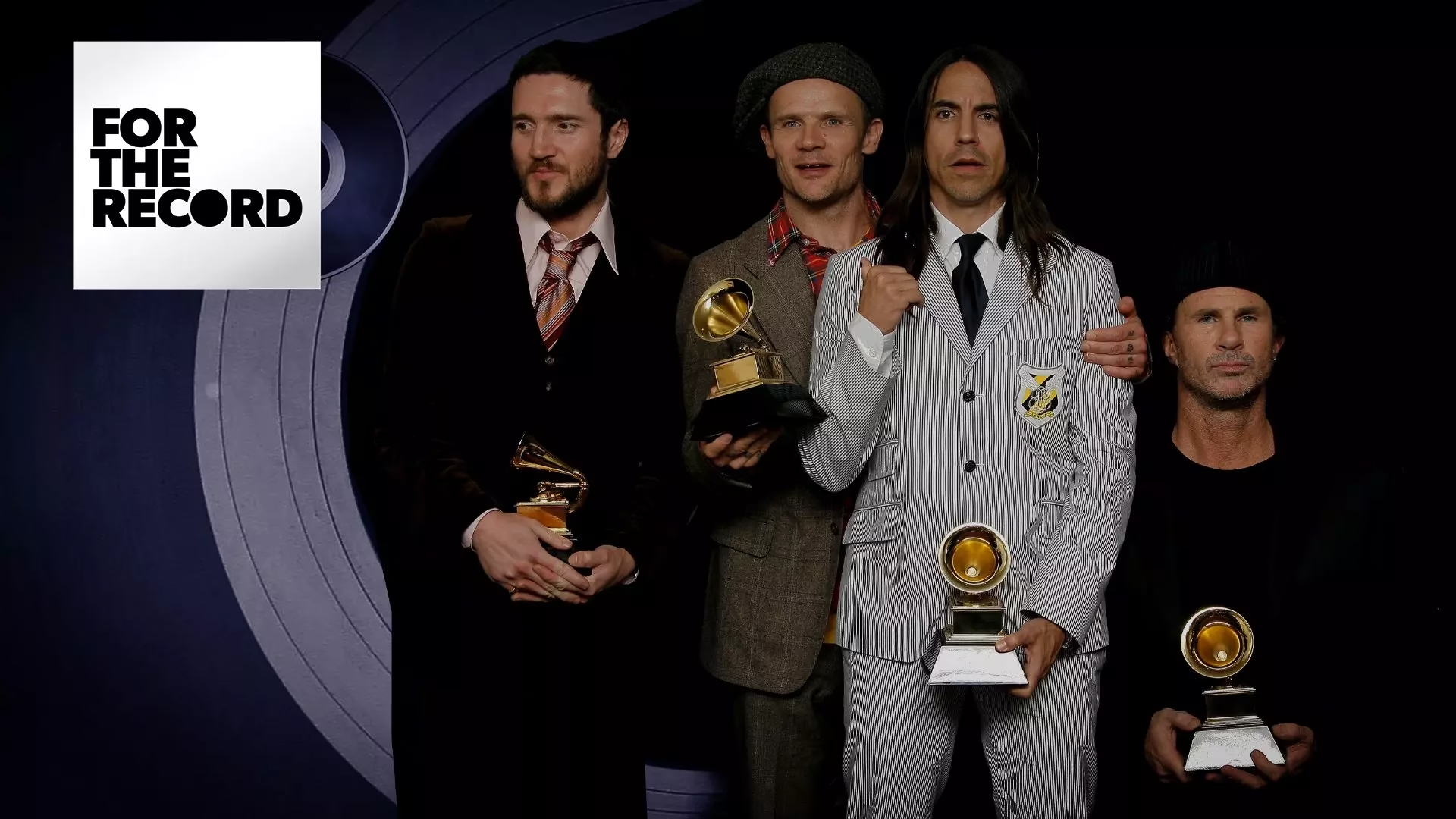
Those creative peaks and compromises undoubtedly make Stadium Arcadium such an all-encompassing victory. In fact, it became the Chili Pepper's first No. 1 album on the Billboard 200 and earned them four GRAMMY Awards at the 49th GRAMMY Awards in 2007: Best Rock Album, Best Boxed or Special Limited Edition Package, and Best Rock Song and Best Rock Performance by a Duo or Group with Vocal, the latter two for album opener "Dani California." (Producer Rick Rubin would also win the GRAMMY for Producer Of The Year, Non-Classical that night.)
<style>.embed-container { position: relative; padding-bottom: 56.25%; height: 0; overflow: hidden; max-width: 100%; } .embed-container iframe, .embed-container object, .embed-container embed { position: absolute; top: 0; left: 0; width: 100%; height: 100%; }</style><div class='embed-container'><iframe src='https://www.youtube.com/embed/oDNcL1VP3rY' frameborder='0' allowfullscreen></iframe></div>
Fifteen years later, Stadium Arcadium endures as one of the quartet's most representative and striving projects. Divided into two parts—the engaging "Jupiter" and the comparatively esoteric "Mars"—it logically continues the contemporary rock templates and earworm songwriting of By the Way and Californication. Specifically, the ironically sunny elegy "Dani California," which centers on the same character from the title tracks off the aforementioned predecessors, is undeniably catchy and tightly composed, while "Snow (Hey Oh)" and "Stadium Arcadium" are lovingly poppy and symphonic. Later, the acoustic guitar strums and radiant harmonies of "Slow Cheetah," "Desecration Smile" and "Hey" border on folk rock, whereas "So Much I" is peak alternative rock smoothness.
Of course, the real brilliance of Stadium Arcadium is how it peppers (no pun intended) more modern flavors with comprehensive doses of wide-ranging nostalgia. In particular, tracks like "She's Only 18," "Animal Bar" and "Turn It Again" harken back to the heavier funk and metal motifs found on earlier RHCP albums such as Mother's Milk (1989) and One Hot Minute (1995). Similarly, songs like "Charlie," "Hump de Bump," "Warlocks" and "Readymade" recall the frisky funkiness of Freaky Styley (1985) and The Uplift Mofo Party Plan (1987) via playful horns, resourceful percussion and Flea's trademark slap bass vigorousness. RHCP even recapture a bit of their early rap rock sound, a genre they helped define on albums like Blood Sugar Sex Magik, on "So Much I" and "Storm in a Teacup," among other tunes.
Although Kiedis, Flea, and drummer Chad Smith excel throughout the album's two-hour runtime, it's perhaps Frusciante who shows the most range and advancement throughout Stadium Arcadium. From start to finish, he implements some truly exploratory vocal and guitar techniques, retaining his recent minimalism while tapping into a newfound appreciation for double-tracked recording and the flashiness of Eddie Van Halen, Steve Vai and the Mars Volta's Omar Rodríguez-López, the latter of whom he'd collaborate with throughout the decade. "We Believe" finds Frusciante employing angelic backing harmonies, quirky psychedelic licks and echoey progressive rock weirdness. His supplemental singing is also sublime on "Torture Me," "Stadium Arcadium" and "She Looks to Me." Meanwhile, he flexes his improvisational soloing skills on "Strip My Mind," "Wet Sand," "Hey" and closer "Death of a Martian" to conjure the emotional heft and fuzzy theatrics of Jimi Hendrix, David Gilmour, Eric Clapton and Jimmy Page.
Red Hot Chili Peppers have long been one of the most daring and diverse bands of their generation; each album and phase has its unique touch and deserves its own audience. Even so, Stadium Arcadium, an all-encompassing magnum opus, offers just about everything one could possibly want from a Chili Peppers record—and then some. It sees the quartet expanding upon their stylistic past while commemorating their newly restored bond; all the while, Stadium Arcadium amplifies the idiosyncratic essentialness of the Red Hot Chili Peppers as both a collective force and individually distinctive musicians.
Beck, Morning Phase: For The Record
