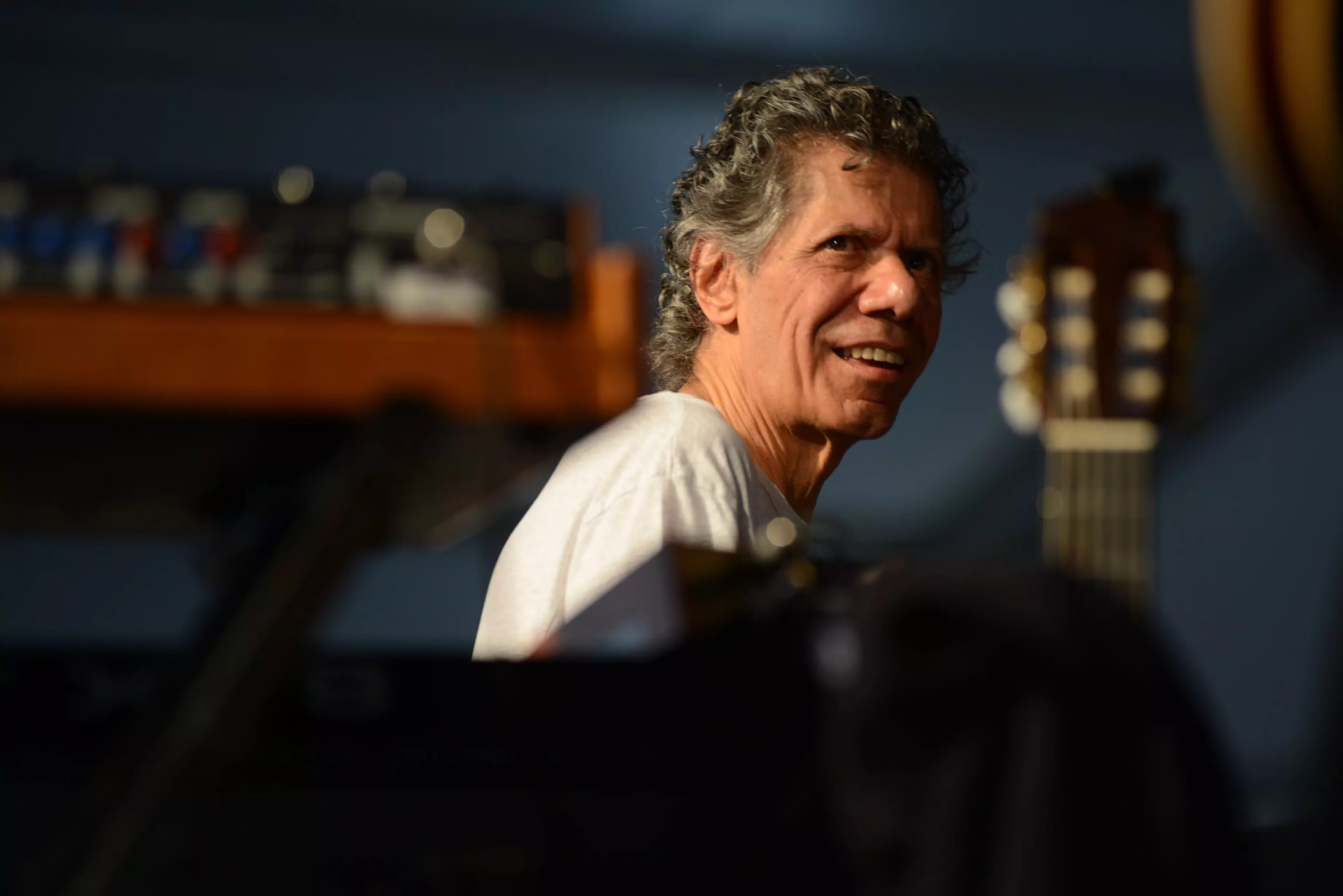
Chick Corea was one of the most advanced thinkers ever to grace the piano, but he rarely spoke in terms of minor-third intervals or the Mixolydian scale. Drop into virtually anything the man said about his art, and it’ll probably hinge on two words: fun and games.
"Trust yourself to say, 'I don't know what I'm going to do next, but I'm just going to do it because it's fun,'" Corea advised in a YouTube clip in 2020 while talking about his old colleague, Miles Davis. That year, when speaking to JazzTimes, he continually circled back to the phrase, "That's not the game I'm playing." "Oh, would you call that music?" he asked in the 2019 documentary Chick Corea: In the Mind of a Master, between virtuosic runs on the keyboard. "I don't know; I don't care what it is. It's just a lot of fun, you know?"
<style>.embed-container { position: relative; padding-bottom: 56.25%; height: 0; overflow: hidden; max-width: 100%; } .embed-container iframe, .embed-container object, .embed-container embed { position: absolute; top: 0; left: 0; width: 100%; height: 100%; }</style><div class='embed-container'><iframe src='https://www.youtube.com/embed//KOnHPr6CL3U' frameborder='0' allowfullscreen></iframe></div>
Corea's fealty to fun made him into a boundless, filterless fount of ideas—great ones. They're all over his boundary-busting 1970s band Return to Forever, his luminous albums with vibraphonist Gary Burton, his Akoustic and Elektric Bands, and beyond. Talk about a batting average: across almost 90 albums, he won 23 GRAMMYs and was nominated fo/r 67. Currently, he's in the running for the 63rd GRAMMY Awards for his trio album Trilogy 2, featuring bassist Christian McBride and drummer Brian Blade.
Sadly, Corea won't find out if he'll add a 24th GRAMMY to his shelf. After a brief battle with recently-diagnosed cancer, the piano titan died Tuesday, Feb. 9, at his home in Tampa Bay, Florida. He was 79. "It is my hope that those who have an inkling to play, write, perform or otherwise, do so," he said in a statement. "If not for yourself, then for the rest of us. It's not only that the world needs more artists; it's also just a lot of fun."
And fun was arguably Corea's entire MO, from his stylistic interplay to his pianistic touch to the way he dealt with his audiences.
Armando Anthony Corea was born in Chelsea, Massachusetts, on June 12, 1941. "Chick" came from "cheeky," his aunt's baby-name for him due to his chubby cheeks. His trumpeter father sat him in front of a piano at four; at eight, he began taking lessons from the Boston concert pianist Salvatore Sullo. After high school, he moved to New York City to study at Columbia and Julliard but soon drifted from academia into the nightclub circuit. Initially steeped in bebop artists like trumpeter Dizzy Gillespie and pianists Thelonious Monk and Bud Powell, Corea soon became enamored with music from south of the border.
The music of [the bebop] era was quite demanding. You had to be into it to really grasp it," Chick told All About Jazz in 2020. "Whereas when I heard Latin music, that beat I heard coming out of New York and out of Puerto Rico and out of Cuba—Eddie Palmieri and Machito and these bands—that gave me a whole other emotional outlook to music. I thought, 'Wow, this is uplifting, happy music, and it struck something.'" Corea touched on this sense of exuberance in his work with Latin-adjacent artists, like saxophonist Stan Getz, trumpeter Blue Mitchell and flutist Herbie Mann.
Corea's interest in this sphere also led him to the guitar master Paco de Lucía, a close friend and collaborator for decades; Corea wrote "The Yellow Nimbus" as a duet with him. "When we played together, I thought I would see a yellow cloud around his head, like a circle," he explained in his 2020 live, solo album Plays. ("Paco inspired me in the construction of my own musical world as much as Miles Davis and John Coltrane, or Bartok and Mozart," Corea said six years prior upon de Lucía's death.)
Latin influences also permeated Return to Forever, Corea's enchanting fusion band that always seemed to hover a few inches above the ground. But even though albums like 1972's Return to Forever and 1973's Light as a Feather were commercial successes, this wedding of musical hemispheres wasn't to court crossover success, but chase that ineffable feeling of freedom.
"It's the media that are so interested in categorizing music," he told The New York Times in 1983, a year after "The Yellow Nimbus" came out. "If critics would ask musicians their views about what is happening, you would find that there is always a fusion of sorts taking place. All this means is a continual development—a continual merging of different streams."
<style>.embed-container { position: relative; padding-bottom: 56.25%; height: 0; overflow: hidden; max-width: 100%; } .embed-container iframe, .embed-container object, .embed-container embed { position: absolute; top: 0; left: 0; width: 100%; height: 100%; }</style><div class='embed-container'><iframe src='https://www.youtube.com/embed//jlNQBmBTiME' frameborder='0' allowfullscreen></iframe></div>
Genre aside, Corea spent his life combing through every mood and format he could think of, from starlit, quasi-ambient duets (1973's Crystal Silence, with Gary Burton, to classically-minded post-bop (1981's Three Quartets, with tenor saxophonist Michael Brecker). The last few years of Corea's life marked an explosion of diversity and prolificity. In 2016, he underwent a six-week stand at New York's Blue Note club with more than 20 different groups.
Three years later, his Latin interest crescendoed with Antidote, a jubilant collaboration with the eight-piece Spanish Heart Band. "The game I like is where we become a unit," Corea said in In the Mind of a Master, released concurrently with Antidote. "Everyone's giving and taking, and all [are] creating the music."
<style>.embed-container { position: relative; padding-bottom: 56.25%; height: 0; overflow: hidden; max-width: 100%; } .embed-container iframe, .embed-container object, .embed-container embed { position: absolute; top: 0; left: 0; width: 100%; height: 100%; }</style><div class='embed-container'><iframe src='https://www.youtube.com/embed//KFclSfwU8oY' frameborder='0' allowfullscreen></iframe></div>
No matter which context he was in, Corea's effervescence is evident in his playing itself. His fluid phrasing and jewellike tone, which appeared almost fully-formed with his first two albums, 1968's Tones for Joan's Bones and Now He Sings, Now He Sobs, made even his knottiest material pleasing to the ear. About his way with a Fender Rhodes, "It's almost like his fingers bounce off the keys," WBGO's Nate Chinen told NPR in 2016. "His touch on that instrument is really distinctive. You know it's him within a note or two."
This accessibility and distinctiveness are testaments to Corea's emphasis on communicating to the listener, and he couldn't have done so if the music flew over peoples' heads. This became a primary value to Corea in the mid-'70s, when he converted to Scientology and underwent an auditing system that set him on a lifelong psychospiritual journey.
"A very simple thing happened to me right in the very beginning," Corea told The Village Voice in 1977. "I experience this in live hundreds or thousands of people in front of me—I now have the ability to give across a musical communication with clear intent. I know what I'm doing and who I'm communicating to, and I give the communication across, and I see what happens in front of me." (Corea dedicated myriad albums to Hubbard and remained a highly visible member of the controversial religion until the end of his life.)
<style>.embed-container { position: relative; padding-bottom: 56.25%; height: 0; overflow: hidden; max-width: 100%; } .embed-container iframe, .embed-container object, .embed-container embed { position: absolute; top: 0; left: 0; width: 100%; height: 100%; }</style><div class='embed-container'><iframe src='https://www.youtube.com/embed//YfG1P0nm2v8' frameborder='0' allowfullscreen></iframe></div>
In what would be Corea's final album, Plays, he eschews a superstar's trappings: no backing band, no staid reverence, no canned commentary. "Here I am with my piano," he declares at the top, alone onstage. "The piano's tuned up all nice, but now we have to tune up. Yeah, we." At first, it's an awkward moment. He plays a middle A; the giggling crowd tentatively sings it back to him. One note becomes two; two becomes three, and so on.
But by the time Corea lays into a medley of Mozart's Piano Sonata in F, and George Gershwin's "Something to Watch Over Me," the gag reveals itself to be something much more profound. Suddenly, the barriers vanish. His game opens up to everyone. His fun becomes ours.
10 Essential Cuts From Jazz Piano Great McCoy Tyner