
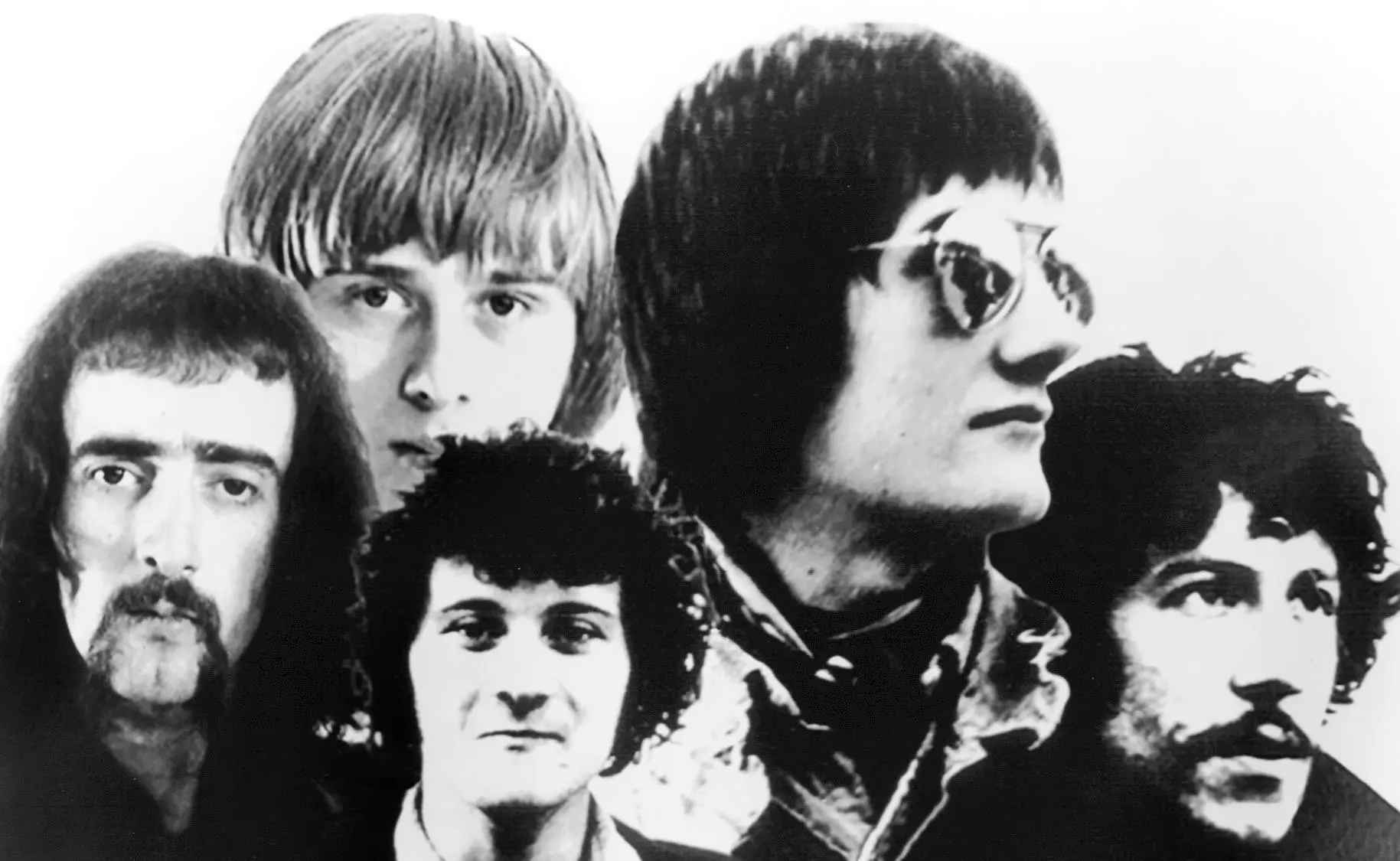
Prior to their biggest hits, many bands in the classic rock pantheon could have easily ended when their founders departed or died. If Pink Floyd hung up their spurs after Syd Barrett faded into the ether, they would remain a great psychedelic band. If AC/DC never rebounded from Bon Scott’s "death by misadventure"—hey, we’d still have Highway to Hell. Now picture Fleetwood Mac splitting up 50 years ago when Peter Green stepped away. No "Dreams," no "Little Lies," no (gasp!) “Landslide.”
Go ahead and process this nightmare scenario, but then think of all the treasures we’d have anyway: the engrossing ambient jam "Albatross," the witchy "Black Magic Woman," the introspective "Man of the World." the stinging "Oh Well." All of which were written by—you guessed it. Out of those, only "Oh Well" broke the Hot 100, and it’s not like this version of Fleetwood Mac would become a household name like the Stevie Nicks- and Lindsey Buckingham-led lineup did. Regardless: legacy secured.
After 1969's Then Play On, Green left the band in 1970 in the midst of schizophrenia and drug mania, afflictions he never fully emerged from. Sadly, Green died in his sleep on July 25 at his home on Canvey Island in Essex, as announced by his legal team and reported by the New York Times. He was 73. "Stu Sutcliffe, Brian Jones, Peter Green…" fellow English rock great Robyn Hitchcock tweeted in 2018. "Notice how many mega acts have a founding ghost?"
<style>.embed-container { position: relative; padding-bottom: 56.25%; height: 0; overflow: hidden; max-width: 100%; } .embed-container iframe, .embed-container object, .embed-container embed { position: absolute; top: 0; left: 0; width: 100%; height: 100%; }</style><div class='embed-container'><iframe src='https://www.youtube.com/embed//J0ag8DkipmQ' frameborder='0' allowfullscreen></iframe></div>
Peter Green was born into a Jewish family as Peter Greenbaum in 1946. By age 15, he had dropped the "-baum" and picked up the blues, obsessing over giants like Muddy Waters and B.B. King. (The King of the Blues Guitar later lauded Green as "the only one who gave me the cold sweats.") After backing up Peter Barden in his band Peter B’s Looners—that’s the keyboardist who went on to form the prog-rock band Camel—Green did what Eric Clapton, Mick Taylor and a mess of other guitar greats did and joined John Mayall’s Bluesbreakers.
In fact, the so-called "Green God" was Clapton’s replacement; imagine filling those shoes. When Decca Records’ Mike Vernon strolled into the studio to find an unfamiliar amplifier, "Where’s Eric Clapton?" he asked Mayall. "Don’t worry, we got someone better," the guitarist responded. "This is ridiculous. You’ve got someone better? Than Eric Clapton?" the incredulous producer demanded of him. "He might not be better now, but you wait," Mayall responded. "In a couple of years, he’s going to be the best."
When Aynsley Dunbar left Mayall’s drum seat, he was replaced by Mick Fleetwood—thereby, along with bassist John McVie, making three future Mac members in the Bluesbreakers. In 1967, for Green’s birthday, Mayall gave him an hour of free studio time. So he brought in Fleetwood and McVie and recorded four songs. One of them, an instrumental, was called "Fleetwood Mac," which Green named after his "favorite rhythm section."
That year, Fleetwood was fired from the Bluesbreakers for overdrinking; Green departed soon after. Vernon helped him assemble a new band with a second guitarist, which had a mouthful of a title: "Peter Green’s Fleetwood Mac Featuring Jeremy Spencer." Thankfully, they sloughed off the last three words and released their fiery debut self-titled album in 1968, which featured standards like Robert Johnson’s "Hellhound on My Trail" and bluesy originals by Green and Spencer.
<style>.embed-container { position: relative; padding-bottom: 56.25%; height: 0; overflow: hidden; max-width: 100%; } .embed-container iframe, .embed-container object, .embed-container embed { position: absolute; top: 0; left: 0; width: 100%; height: 100%; }</style><div class='embed-container'><iframe src='https://www.youtube.com/embed//gjOGaDseKgw' frameborder='0' allowfullscreen></iframe></div>
The next links in the chain of Peter Green’s Fleetwood Mac were two killer singles: 1968’s "Black Magic Woman," which Santana later made a hit, and the same year’s "Albatross." The latter is a thing of unearthly beauty—a yawning ambient jam suitable for waking up with the sun. Where most early Fleetwood Mac feels at odds with the band’s later sound, "Albatross" foreshadows their future as dream-pop progenitors. "Playing fast is something I used to do with John when things weren’t going very well," Green later said. "But it isn’t any good. I like to play slowly and feel every note."
Lastly, Green gave Fleetwood Mac Then Play On, their first front-to-back terrific LP. Several of its songs, like "Closing My Eyes," "Rattlesnake Shake" and "Before the Beginning," were Green’s; others were contributed by Danny Kirwan, their new guitarist who would remain in the band for a period that spanned 1970’s Kiln House and 1972’s Bare Trees. Before Green peaced out, he dropped "Oh Well," a blues burner that went on to launch ships from the Black Crowes to Jason Isbell and the 400 Unit.
Green sadly deteriorated soon after; he took profuse amounts of LSD, wore robes and a crucifix, and thoughtlessly gave away his money. After an infamous acid party in Munich, he never really came down. Fleetwood, for his part, believed a cult got him. "They called them the German Jet Set," he said in the 2009 documentary Man of the World. "They captured Peter completely, and pulled him away." After his final song with Fleetwood Mac, "The Green Manalishi (With the Two Prong Crown)," which he wrote after a hallucinatory nightmare in which a green dog barked at him, he was out.
Despite releasing a handful of solo albums and enjoying a brief resurgence in the 1990s with his new band the Splinter Group, Fleetwood Mac eclipsed Green tenfold in the commercial sphere. And most of us know their story from there—the million-selling hits, the interband trysts, and the famously experimental Tusk.
But don’t think of this Fleetwood Mac as a nonstarter version of a more famous band it shared a name with. Without the "Green God" to form them out of dust, one may as well kiss Rumours and the rest goodbye.
