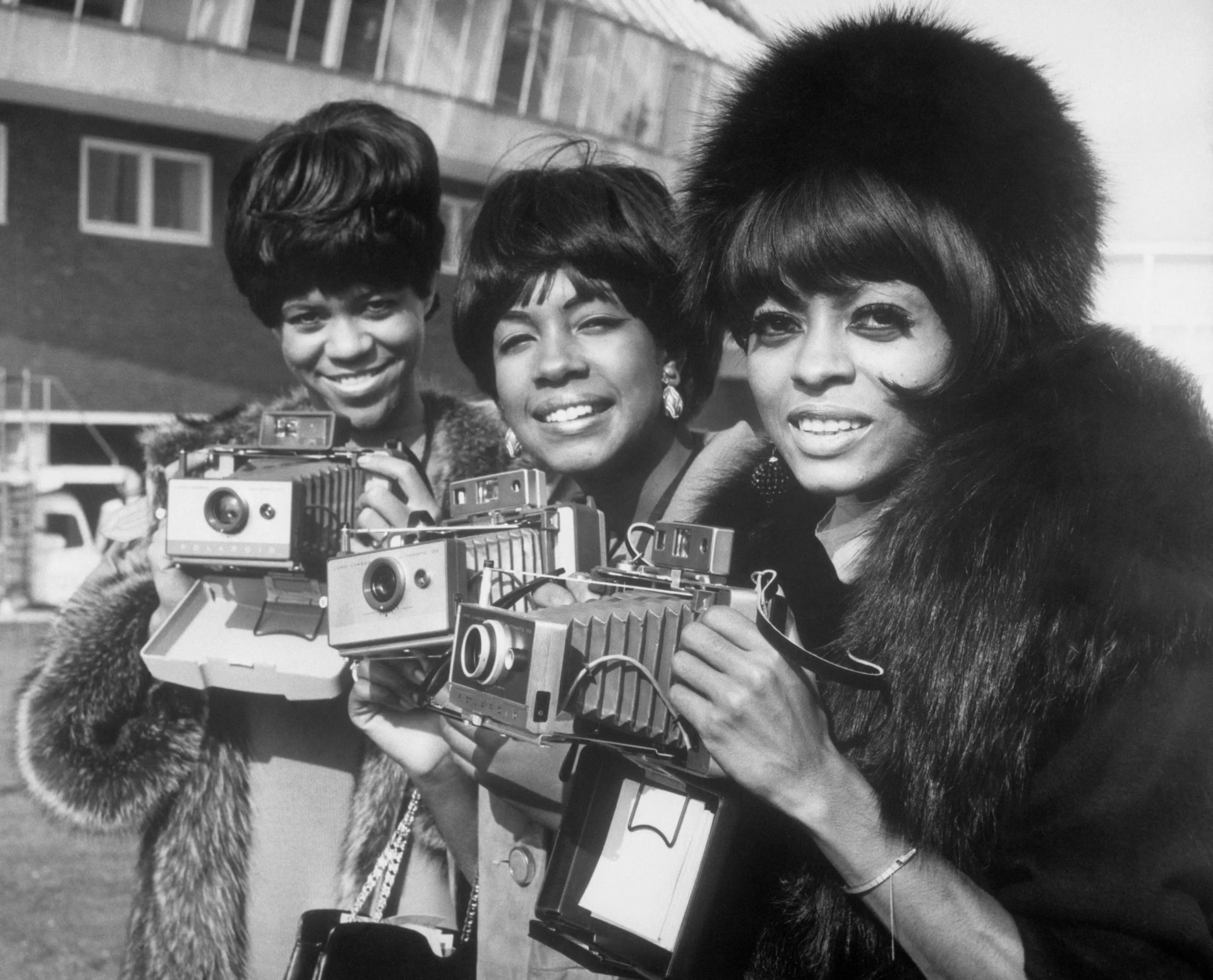
The Supremes were still in high school when their star began to rise, and at the dawn of 1962, their co-founder, Mary Wilson, sat in a modern literature class pondering her relationship to others. For her final exam, she had to write an essay with a psychological bent. While addressing her chaotic childhood, Wilson inadvertently summed up her dynamic with the other Supremes—the wounded Florence Ballard and the dogged Diana Ross.
"I have developed a protective shell, which whenever I feel I may face a conflict, I draw into. Why? Is it because I subconsciously feel I might be snatched again?" Wilson wrote in her 1986 autobiography Dreamgirl: My Life As A Supreme. "I try to cover up my deficiency by developing a pleasing personality. Actually, underneath this, I am still a young and frightened girl."
Five years later in 1967, during a period where Ballard left the group in a tailspin, and Motown president Berry Gordy rebranded them Diana Ross and the Supremes, Wilson realized she was the last to hold onto the image of the group as a holistic triad. "I saw nine years of work and love and happiness fade away," she wrote. "The Supremes still stood in my mind as a dream from childhood, a wonderful dream that had come true. I believed The Supremes would last forever. Now I knew that even dreams that come true can change."
"With one look at Flo," she added, "I knew that dreams don’t die; people just stop dreaming."
Wilson went on to neither be a household name like Ross nor a tragic figure like Ballard, who wrestled with addiction until her 1976 death at only 32. Instead, she was the group’s nucleus, acting as a buffer between Ballard and Ross and soldiering on in their absences as the last original member. After The Supremes called it a day in 1977, she entered an inspiring second act, touring extensively, authoring books, stumping for artists’ trademark rights, and collaborating with the GRAMMY Museum on the Legends Of Motown: Celebrating The Supremes exhibit.
<style>.embed-container { position: relative; padding-bottom: 56.25%; height: 0; overflow: hidden; max-width: 100%; } .embed-container iframe, .embed-container object, .embed-container embed { position: absolute; top: 0; left: 0; width: 100%; height: 100%; }</style><div class='embed-container'><iframe src='https://www.youtube.com/embed//tGCwWipSEMY' frameborder='0' allowfullscreen></iframe></div>
Tragically, two days after eagerly announcing new music on YouTube, Wilson died unexpectedly at her home in Henderson, Nevada on Feb. 8. She was 76. "I was extremely shocked and saddened to hear of the passing of a major member of the Motown family, Mary Wilson of the Supremes," Gordy said in a statement. "I was always proud of Mary. She was quite a star in her own right and over the years continued to work hard to boost the legacy of the Supremes. Mary Wilson was extremely special to me. She was a trailblazer, a diva and will be deeply missed."
Wilson’s journey to that burning, yearning dream—one of young infatuation on a Biblical scale—began on March 6, 1944, when she was born to a butcher father and homemaker mother in the sleepy town of Greenville, Mississippi. Hers was a long-delayed birth. "A little past midnight, I was finally born," she wrote in Dreamgirl. "I now wonder if my first appearance in life was somehow indicative of the path my life would later take. Even at my birth, I was a fence-sitter."
The family relocated from Saint Louis to Chicago before Wilson moved in with her aunt and uncle, Ivory "I.V." and John L. Pippin, who led her to believe they were her parents. When Wilson was six, she traumatically learned I.V. was, in fact, not her mother. "My whole world had been turned upside down," she wrote. "I'd trusted these people, and they had lied to me." Three years later, her father, Sam, lost his leg in a factory accident.
In 1956, with her birth parents in tow, Wilson moved to the Brewster Projects, a complex of government-owned apartment buildings. Despite the jarring change—and prevalent gang violence—Wilson viewed her new climes rosily. "It was quite crowded compared to suburbia, but I loved it," she wrote. "You had to learn to get along with all kinds of people." While auditioning to sing in a school talent show, a hurled insult from a classmate resulted in punches from Wilson.
"I was not a fighter," she wrote, "but I would fight to be part of a group."
<style>.embed-container { position: relative; padding-bottom: 56.25%; height: 0; overflow: hidden; max-width: 100%; } .embed-container iframe, .embed-container object, .embed-container embed { position: absolute; top: 0; left: 0; width: 100%; height: 100%; }</style><div class='embed-container'><iframe src='https://www.youtube.com/embed//dfl3EYFjHJU' frameborder='0' allowfullscreen></iframe></div>
One of the characters Wilson ran into in the projects was a young Diane Ross—she’d change it to "Diana" later. But she more immediately took to another neighbor, Florence Ballard, who she describes as a Hollywood-style beauty even then. After bonding over a shared love of singing—Ballard sang a mean "Ave Maria"—in early 1959, Milton Jenkins of the all-male vocal group The Primes approached her to form a female counterpart.
"Between her gasps for breath, I could see she was grinning from ear to ear," Wilson wrote. "She grabbed my arm and asked excitedly, ‘Mary, do you want to be in a singing group with me and two other girls—’ 'Yes!' I replied before she even finished the question. It didn't occur to me to ask what the group was about, or who was in it, or anything." During a jittery rehearsal at The Primes’ bachelor pad, Wilson found herself next to Ballard, Ross, and a fourth girl, Betty McGlown. Their voices fell together effortlessly and gracefully. The Primettes were born.
With Jenkins as their manager, The Primettes pounded the pavement in local clubs until a series of connections—from Smokey Robinson to Gordy, who let them sing and clap on Mary Wells and Marvin Gaye recordings—led them to Hitsville, U.S.A.
Asked to come up with a new name, they pored over a list of them, suggestive of regality and class—The Royal-Tones, The Jewelettes. But the name Ballard settled on for the group telegraphed something else entirely: divinity.
As word of the Supremes extended outside town, Wilson noticed their similarities and differences more acutely. Ballard, who had survived a sexual assault by an acquaintance, had begun to psychologically fray. Meanwhile, Ross was pure quantum ambition.
"Flo, a Cancerian; Diane, an Aries; and me, a Pisces—three completely different, insecure people," Wilson explained. "What each of us saw in the other two were the parts of herself she lacked or couldn’t assert or tried to deny: Flo’s earthiness, my nice-guy demeanor, and Diane’s aggressive charm. We accidentally discovered that three separate, incomplete young girls combined to create one great woman. That was the Supremes."
"I saw the group as something bigger and more important than any one of us," she declared elsewhere in the book. "I was content to play on the team."
<style>.embed-container { position: relative; padding-bottom: 56.25%; height: 0; overflow: hidden; max-width: 100%; } .embed-container iframe, .embed-container object, .embed-container embed { position: absolute; top: 0; left: 0; width: 100%; height: 100%; }</style><div class='embed-container'><iframe src='https://www.youtube.com/embed//ZAWSiWtUK2s' frameborder='0' allowfullscreen></iframe></div>
If the Supremes were a collective dream, the Supremes’ string of 1960s hits—most of them written by Motown's powerhouse Holland-Dozier-Holland songwriting and production team—have a dreamlike quality. These are universal songs you hear at cookouts and supermarkets and in Ubers; thus, they tend to drift between life stages and experiences. And of their twelve No. 1 hits, Wilson appeared on each.
The group received two GRAMMY nominations—one for Best R&B Recording for "Baby Love," the other for Best Contemporary Rock & Roll Performance for "Stop! In the Name of Love." (In 1999, "Where Did Our Love Go" and "You Keep Me Hangin’ On" were added to the GRAMMY Hall of Fame, and in 2001, "Stop! In the Name of Love" followed suit.)
After Ballard left the band in 1967, Cindy Birdsong of Patti LaBelle & the Blue Belles took her place, and they continued as Diana Ross and the Supremes. In 1970, Diana Ross left the band to start a solo career, leaving Wilson as the final original member amid a succession of replacement singers and shifting band names, like "The New Supremes." They never recaptured the commercial success they once enjoyed.
However, Wilson remained their North Star, touring tirelessly, practicing yoga, and authoring Dreamgirl and its 1990 sequel, Supreme Faith: Someday We’ll Be Together. Her legacy also involves musicians’ rights; after non-founding members of the Supremes toured under the band name, she campaigned on behalf of artists’ trademark ownership. Wilson also fought for higher pay for musicians on streaming sites through her support of the Music Modernization Act. Her 2019 coffee-table book Supreme Glamour homed in on the iconic group's fashion, compiling images of their famous gowns.
Last Saturday, she appeared on YouTube with a blazing grin, vivaciously announcing new music through Universal Music Group, hoping it would come out before her March 6 birthday. Then, in her sleep, she slipped away.
But her dream remains, as long as there are listeners to make it their own.
<style>.embed-container { position: relative; padding-bottom: 56.25%; height: 0; overflow: hidden; max-width: 100%; } .embed-container iframe, .embed-container object, .embed-container embed { position: absolute; top: 0; left: 0; width: 100%; height: 100%; }</style><div class='embed-container'><iframe src='https://www.youtube.com/embed//Itn438i30hk' frameborder='0' allowfullscreen></iframe></div>
GRAMMY Museum Announces Reopening Of "Motown: The Sound Of Young America" Exhibit
