
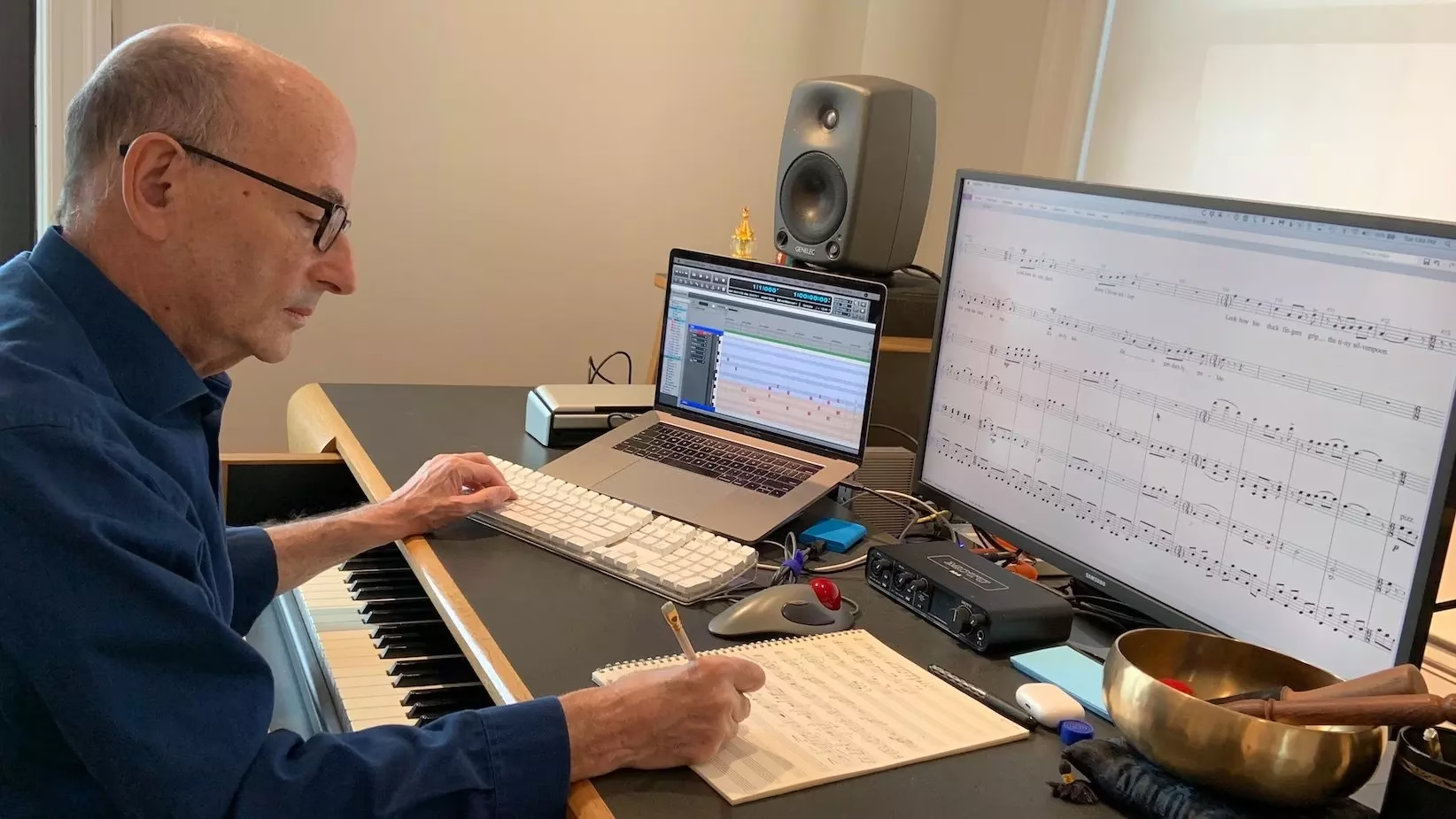
Richard Einhorn is an American composer and, formerly, a record producer and recording engineer. Around 1990, he began to experience hearing problems.
Twenty years later, while on a composing retreat, Richard felt dizzy and went completely deaf in his right ear. As a result of his hearing’s overnight descent, Richard eventually fashioned solutions drawing from his knowledge of music and audio technology.
In honor of both Better Speech and Hearing Month & Mental Health Awareness Month, Einhorn highlights the impact hearing loss can have on mental health with 5 things to know.
“Noise or music induced hearing issues are preventable.”
My hearing loss was bad luck. It came mostly from viruses and inheritance, but noise- or music-induced hearing issues are preventable. People get buzzing in their ears, which is called tinnitus, which can be very annoying. There are pitch distortions.
So, somebody will be playing, say, a C, and what you'll hear is two notes — and neither are C. Maybe you’ll hear a C sharp or an A, and it sounds horrible because everything else becomes distorted.
Alongside volume loss, you have problems detecting loudness. Everything sounds really quiet until it hits a certain threshold, and then everything gets super loud right at once. These are real problems that are preventable for most people.
There's no reason why people can't hear well into their 50s, 60s, or even 70s. The way to prevent that is with protection — very simple protection.
“If you want a professional career in music that lasts more than five or six years, the time to start taking preventative steps to preserve your hearing ability was yesterday.”
That's really the truth. You should be conserving your hearing from your first professional gig onward, even in the rehearsals for that first first professional gig.
Whether you play pop music, classical music, or even strum on a ukulele, it doesn't matter — you really need to protect your hearing. Many of the musicians that I know who still have good hearing in their 40s, 50s, and 60s, even wear earplugs on the subway in addition to live concerts when they're doing a gig. They were sent the proper in-ear monitors.
This is really critical technology. This is a health hazard of music, and the only way to prevent it is to be proactive — and you need to start immediately.
“In order to hear properly and protect your hearing when you’re performing or experiencing live music, use musician’s earplugs.”
Musician’s earplugs attenuate the volume but don't mask the high frequencies, which is a common complaint that people have.
So, a very simple thing to do is to just simply spend a little extra money. You can get very good musician’s earplugs for around 25 bucks. You can also spend a lot more on them. You can then lower the volume down to a safe level and still hear everything that you want to hear.
In terms of the feel, you'll still be feeling the music if it's loud through your body, but the loud sound levels going into your ear (which is extremely delicate) will be at a more acceptable level.
If you're a professional musician who needs a more professional solution, the best thing that you can do is to use in-ear monitors. These seal the ear off from the environment, which protects you from it, but then allows you to hear a mix of the music without all the reverb in such a way that you can actually hear what you're playing.
They're very sophisticated and a lot of the better ones — for example, the Sensaphonics ones — allow you to be able to interact with your band members and speak to them via the in-ear monitor. You're in an environment that's very safe, and that is really critical.
Yes, it's not cheap. The good ones are not cheap. But they're worth it — believe me. Speaking from experience, it's a lot less expensive than hearing aids — and a lot less costly emotionally than hearing loss. Which is a very difficult thing to deal with, especially if you're a musician.
“Hearing loss can have a tremendous impact on your mental health.”
Helen Keller once said that blindness separates you from things, but hearing loss separates you from people. And that's really true. It's really hard.
Typically, it becomes really hard to hear a noise, and one of the odd things about hearing loss is that nearly every place becomes noisy because among the things that you lose is the ability to distinguish foreground from background.
The ability to pick out a voice from the background is lost, and that applies to music. It becomes harder to hear the differences in texture. We hear analytically as musicians, and it's harder to do that. It's harder to make decisions — musical decisions.
It doesn't necessarily affect composers, because composers have been trained to hear in their minds. That's how Beethoven could write music when he went almost completely deaf. Alhough, what it does do is it drastically decreases your enjoyment of music.
I don't have a right ear that works very well. All I have is the left ear. I hear everything in mono. I don't hear as much excitement in the bass because there isn't as much sound coming at me from all sides. I have a lot of trouble.
I really can't distinguish left from right, and everything kind of jumbles up. The impact of the music diminishes.
“Hearing loss doesn’t only lower volume; hearing loss distorts the sound.”
A lot of people in their early careers don't understand what hearing loss is; they think it just means volume loss. That's the least of their problems.
If you don't wear earplugs if you're performing metal — something loud — believe me, you will be hearing distortion within two or three years. You won't be able to hear accurately. It's just that simple.
There's research that demonstrates that a single exposure to the kind of high-decibel concerts that are very common in music, or even a sporting event, leads to problems 20 years down the road. So, the best thing you can do is to protect your hearing.
A Safety Guide To Decibel Levels And How To Stop Hearing Loss Before It's Too Late
