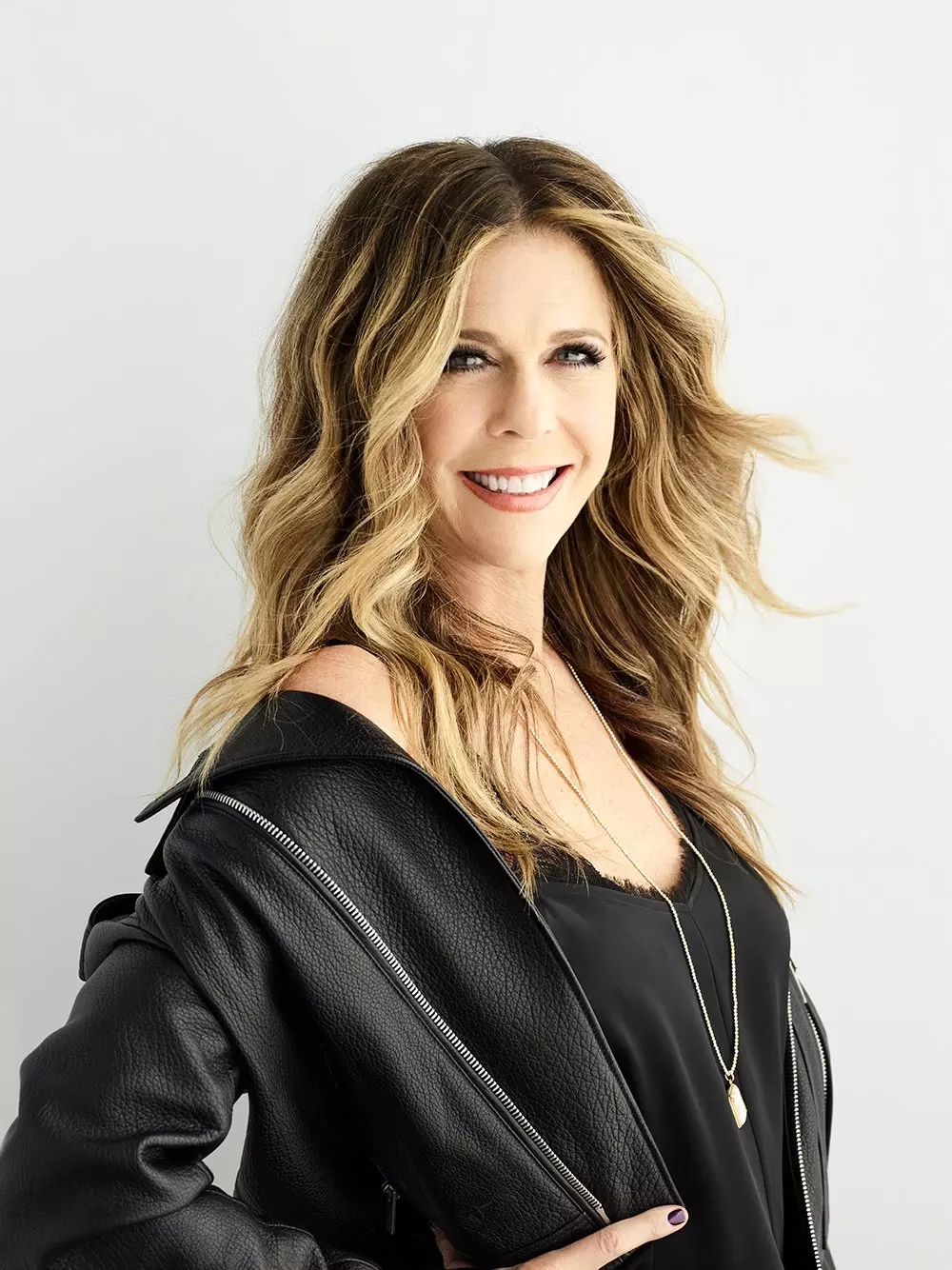
Rita Wilson is sick of talking about being sick. As the first public figure to be diagnosed with Covid-19 back in March (along with her husband Tom Hanks), the actress, producer and singer/songwriter probably hasn't been able to escape questions about the mysterious illness, which, in 2020, exploded to pandemic levels and has more or less shut down the entire entertainment industry.
What Wilson would much rather chat about, understandably, is the music she's released this year—gorgeous, gentle acoustic ballads that recall her greatest influences: pop-country trailblazers like Dolly Parton, Jessi Colter and Bobbie Gentry. Though she only just released her fourth studio LP Halfway To Home in 2019, Wilson has kept busy: recently she unveiled the single "Everybody Cries," which accompanies the Rod Lurie war drama The Outpost. She also dropped the poignant "Where's My Country Song," which pays tribute to the "women out there quietly doing jobs that sometimes we just are aware of, but we aren't really paying attention to," as she tells GRAMMY.com.
You may have also caught Wilson in a recent viral video, where she's expertly rapping to Naughty By Nature's 1992 hip-hop classic "Hip Hop Hurray." Though it was originally something she had to practice for a part in a movie, the video was so popular that Wilson teamed up with Naughty By Nature for a remix, with profits being donated to MusiCares' Coronavirus Relief Fund. Once touring is allowed to resume, she says, you should definitely expect to see her perform "Hip Hop Hurray" live with the trio.
Below, Wilson opens up about her most recent musical endeavours, what draws her to the country genre and how "Where's My Country Song" ties into a larger conversation about women's emotional labor.
<style>.embed-container { position: relative; padding-bottom: 56.25%; height: 0; overflow: hidden; max-width: 100%; } .embed-container iframe, .embed-container object, .embed-container embed { position: absolute; top: 0; left: 0; width: 100%; height: 100%; }</style><div class='embed-container'><iframe src='https://www.youtube.com/embed/zoexehHI6gg' frameborder='0' allowfullscreen></iframe></div>
You recently released the single "Everybody Cries," which appeared in the film The Outpost. Was that song written specifically for movie?
Yes, it was. How it happened was the director Rod Lurie reached out to me because he had heard other previous albums that I had done and felt that the movie needed a female voice and he felt that it might be possible to fulfill that vision, which was really an honor.
I was able to see a little bit of the film because the song is used in the body of the movie. And then again, later in the end credits. I think [Lurie] also was looking for a female perspective on things. What was absolutely so sad was that when Rod was doing the movie, he lost his son, and here he is doing a movie about these young men who lost their lives. And I think that very much connected him to the story on an even deeper level. And then what I responded to was just being a mom [myself]. You raise these children, whether they're male or female or whatever gender they identify with, and you try to make them good and courageous and strong people. You try to keep them safe. And then at 18 they can make their own decisions and their own choices.
When you think of all the service men and women who have given their lives for our country and for our freedom for our democracy, I also think about the mothers and wives and daughters who had to say goodbye to their loved ones, just sending them off to serve.
I think the movie is really beautiful and I'm really so, so grateful to be a part of, of it in any way, particularly with this song.
<style>.embed-container { position: relative; padding-bottom: 56.25%; height: 0; overflow: hidden; max-width: 100%; } .embed-container iframe, .embed-container object, .embed-container embed { position: absolute; top: 0; left: 0; width: 100%; height: 100%; }</style><div class='embed-container'><iframe src='https://www.youtube.com/embed/dk34NiROTlc' frameborder='0' allowfullscreen></iframe></div>
It is a really beautiful song. Speaking of songs written specifically to showcase the female perspective, I also enjoy your recent single "Where’s My Country Song." The way it describes the average working woman’s experience, it reminds me a little of Dolly Parton's "9 to 5."
That's a huge compliment. Thank you. I'll take that.
You’re welcome! You've said in previous interviews that this song was inspired by your mother. Do you feel like maybe it holds a special kind of resonance now?
Well, actually the original idea of the song was inspired by a single mom that I know who's working really hard and her mom helps her raise her kids. And then I started thinking about my mom because I could not have also raised my kids doing what I do without my mom and my dad. So many times, people will say things like "what do you do?" And I've heard women say, "Well, I'm just a mom and that's me." It's like what you should say‑I mean, I don't know what they should say‑but [as a mom] you are probably given the most important job of your life. You’re trying to raise these humans, good humans and put them in the world and carry on.
Then that led me to all the women that are out there quietly doing jobs that sometimes we just are aware of, but we aren't really paying attention to because they're the jobs that get us through our lives. Let's say it's somebody who's working in a warehouse or somebody who's working in an office for your bank or somebody who's working at a grocery store or somebody in agriculture, who's making sure our fruits and vegetables are brought to us. Then I read that during the pandemic and the COVID-19 crisis that 75% of essential workers are women. And you look at that and you say, okay, great. That is again, another example of how many important jobs women are tasked with.
And then I also think that aligned with not just country music, but all music, and movies, that women can sometimes be idealized and written about in a way that is wonderful, there's room for everything, but it's not the whole picture. So, I started thinking about, well, where's that song? Where's the song that is talking about those women? I just felt that I wanted to explore that and see what I could come up with.
And I had the title, "Where's My Country Song." I wrote it with Lee DeWyze who won “American Idol” a few years ago. [He’s] a really talented songwriter and an amazing singer. So that's how it evolved. It kind of was a stream of consciousness, and that's how songs happen. That's the crazy thing: I didn't think, “I'm going to set out to write this song.” But when I started looking at all the other women that are out there that don't get the sort of appreciation and sort of thanks and gratitude that they really should get.
<style>.embed-container { position: relative; padding-bottom: 56.25%; height: 0; overflow: hidden; max-width: 100%; } .embed-container iframe, .embed-container object, .embed-container embed { position: absolute; top: 0; left: 0; width: 100%; height: 100%; }</style><div class='embed-container'><iframe src='https://www.youtube.com/embed/xeNd3Jv1YRw' frameborder='0' allowfullscreen></iframe></div>
Yeah, what's interesting about the essential worker conversation we’re having now is that there’s a lot of performative thanking and acting grateful—billboards, TV commercials and stuff—but what these women really need is a living wage, quality health insurance in case they get sick and guaranteed childcare. They’re looking out for us—what choice do they have? But who is looking out for them?
Exactly. It's sort of like, well, when you look at what women did, even during World War II where they were really influential and important in terms of joining the workforce, when men were all fighting and then when everybody came back from the war, women were sort of displaced again and sort of like, "Okay, thanks for helping out then, but now go back to whatever you were doing." I know so many amazing women who do extraordinary things with so much of their lives and a lot of them just, I never really hear complaints. Women are sort of amazing in that way. They just get to it and do what's required without a lot of whining.
This also ties into the ongoing conversation about emotional labor, both in and out of the workplace. Have you read very much about that?
What does that mean? Emotional labor.
It's basically like all the unseen work that women do—in the house, as parents, in the workplace. For instance, in relationships, women tend to “manage” the household and “assign” chores to their partners.
Yes! Like, even if I am in a relationship, there's always somebody who's taking on the extra—let's call it home labor or emotional labor. But emotional labor to me says something like you are taking on not just the scheduling, but the wellbeing of people in your life.
Exactly. Or, in the workplace, women colleagues might be expected to organize a party if someone's having a birthday.
Oh, absolutely. I played a character on "The Good Wife." And she was a killer lawyer, killer litigator. And so, I went in my research in killer litigators. This thing came up that I thought was just mind-boggling, which was, this amazing lawyer said that, even though she won all of her cases and she was sought after and she was number one in her field, she still felt the need to bring cookies or cupcakes to a meeting. And that was her way of saying, "Don't be threatened by me. I'm just a woman who really just likes to bring sweets to you. I'd rather be doing that." Which I think is so... It's so crazy that women even have to think about that.
Speaking of roles, I know that you you've done music for a long time, but I think the first time I personally realized that was watching you play Marnie's mother on "Girls." You kind of hop on stage with her and try to salvage her own show.
So much fun.
Did you have any input on how your character would sing?
What I loved about that character was that she was such a narcissist and it didn't really matter if she was going to be embarrassing her daughter. It was just literally like, give me more attention. And so that's why that character was so much fun to play. And that gift that Lena Dunham gave me.
<style>.embed-container { position: relative; padding-bottom: 56.25%; height: 0; overflow: hidden; max-width: 100%; } .embed-container iframe, .embed-container object, .embed-container embed { position: absolute; top: 0; left: 0; width: 100%; height: 100%; }</style><div class='embed-container'><iframe src='https://www.youtube.com/embed/hKX9dAUw2zQ' frameborder='0' allowfullscreen></iframe></div>
You also have a collaboration out right now with Jimmie Allen and Tauren Wells, "When This Is Over." How did that come about?
Jimmy’s an amazing artist. I became a fan of his just by hearing him on the radio. And then he reached out and said, "listen, I'm doing this collaborative EP. Do you want to be a part of it?" I said yes, not even knowing what the song was. And then he sent the song and I was like, "dang, this is a really good song!"
In terms of genre, your music is very much aligned with country. What draws you to country music? Who did you grow up listening to?
I was lucky enough to be exposed to all genres [and artists] when I was younger. The very first [artist that stuck out to me] was Bobbie Gentry because of "Ode to Billy Joe." That song was just a magical, mysterious, dark story that when you hear as a nine or ten-year-old or however old I was, when that song came out, it just grabbed you and sat you down at a chair and you couldn't move. You're like, what is going on in that bridge? Why are these people talking about black eyed peas? Somebody jumped off a bridge, like what? Go back to that story. What did I miss here?
And then secondly, Dolly Parton, because Dolly Parton was incredible. Jessi Colter, loved her. I don't know if you remember her, but she had that song "I'm Not Lisa." It's heartbreaking, it's so good.
Johnny Cash, Willie Nelson. And then later when I was older, the artists that I liked I guess would be kind of crossover artists like Linda Ronstadt, Emmylou Harris. When those three ladies—Emmylou, Dolly and Linda—did that trio, that was just like, oh my God, that was heaven. And then later on, of course, when females really dominated country music again, like Faith Hill and Shania Twain and Reba [McEntire] and Deana Carter, and the list goes on and on.
To me, it's always been about the story, the story in the song. And, of course, Tammy Wynette has to be mentioned because she really took chances. And Loretta Lynn, that was incredible. When Tammy Wynette was writing about divorce, but having to spell it out," D-I-V-O-R-C-E." And Loretta Lynn is singing about the pill. Now this is courageous and this is really bold, back in the day.
It's interesting, because I think it must have been so much harder to be that bold in the ‘60s and ‘70s. Because it's like, you're really going to be singing about this? And you're talking about country music. Applause to them for being so courageous.
<style>.embed-container { position: relative; padding-bottom: 56.25%; height: 0; overflow: hidden; max-width: 100%; } .embed-container iframe, .embed-container object, .embed-container embed { position: absolute; top: 0; left: 0; width: 100%; height: 100%; }</style><div class='embed-container'><iframe src='https://www.youtube.com/embed/cJZ_ViDADOE' frameborder='0' allowfullscreen></iframe></div>
Yeah, although the Pill and divorce would be potentially polarizing half a century ago, country music can still be an unfriendly environment for today’s divisive topics. I mean, look at the Chicks.
[The Chicks] never shied away from being political. And it's so crazy to me what happened to them and their career and where we are now, what people are saying, like what the... I don't even want to go there. I can't get political on this, but they were very brave.
While I have you, I’d love to ask you about your recent viral moment rapping Naughty By Nature’s "Hip Hop Hurray." Has anyone tried to get you to rap anything since then? You're very good at it!
Somebody reached out to me that I'm most likely going to do a collaboration [with].
I had to learn that song for a movie and it took me like a month to learn it. That was not an easy thing. And that's what is so major about Naughty By Nature: I learned so much from them about that genre and how difficult it is. It's really incredibly challenging. One thing that [Naughty By Nature] did say is that when we go on tour again, that they want to invite me on stage, and I'm going to. Oh yeah. I will be there rapping with Naughty By Nature.
Quarantine Diary: Louise Goffin Is Exercising, Taking Walks & Covering Cage The Elephant
