
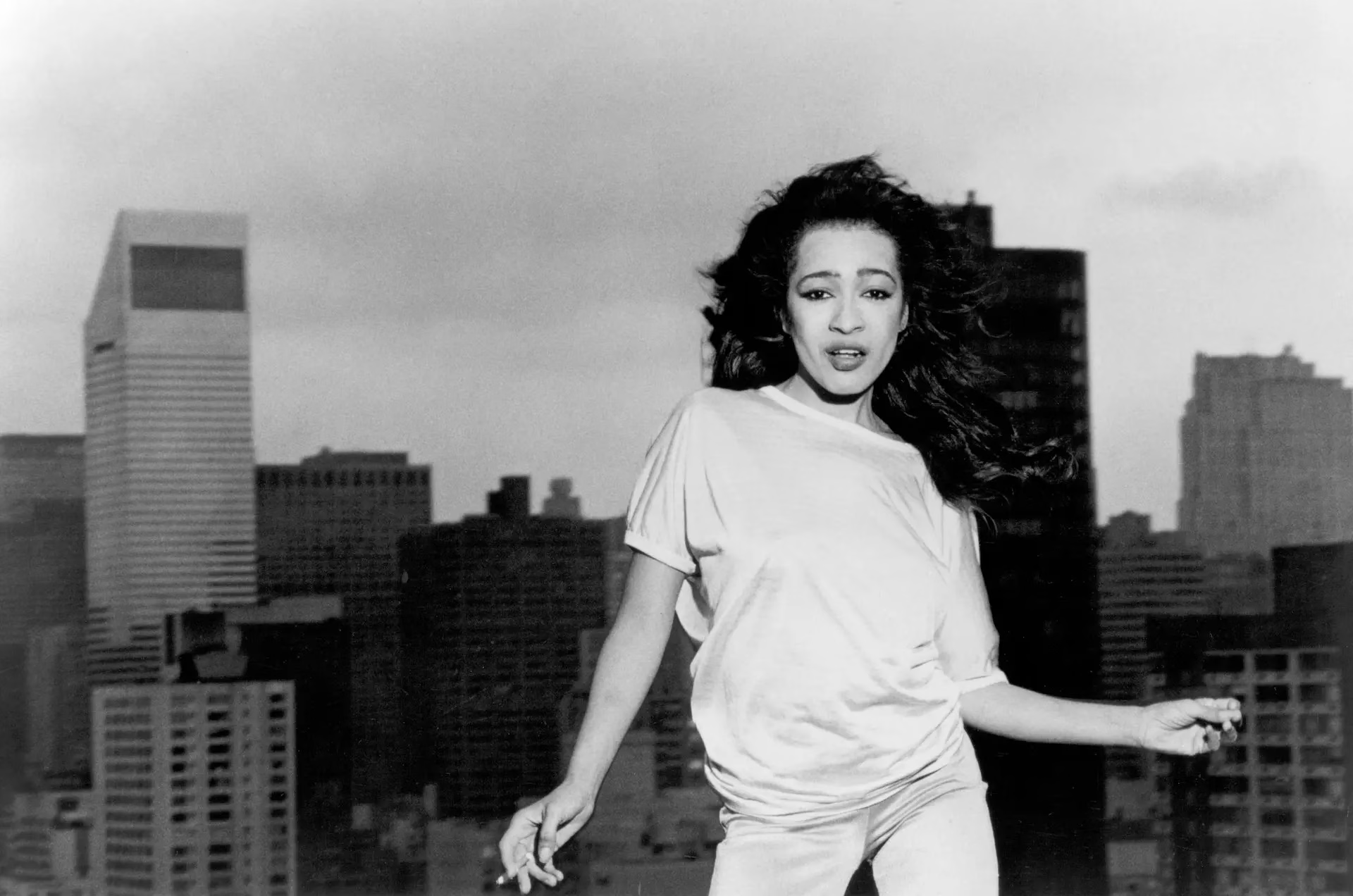
Ronnie Spector was just 16 when she recorded what would become not only the biggest hits of her career, but one of the most acclaimed — and culture-changing — songs of all time.
"Be My Baby" and The Ronettes, with the indelible, smooth falsetto of the New York native at the helm, signaled a generational shift in not only music, but fashion, femininity and American culture along with it.
It was a monumentally influential career that came to an end this week as Spector, a GRAMMY nominee and GRAMMY Hall of Fame member, passed away at age 78 on January 12 after a short battle with cancer. Only weeks earlier, her Ronettes Christmas classic "Sleigh Ride" cracked the Top 10 on the Billboard Hot 100, marking a record-breaking 58 years and 2 month break between Top 10 hits. (Their previous track was, of course, "Be My Baby," which peaked at No. 2 in 1963.)
"You have to have all of the ingredients to be a rock 'n' roll singer, and one of those is you have to be a little sexy," Spector said in a 2015 interview about the secret to her success. "You don't have to be clothesless — it's the way you look, and the way you look at your audience. I don't see any performers out there today that relate just to the audience … That's what people are missing today — you don't need all those dancers. Just sing and perform to the people. Feel the people. Everything is for the people."
<style>.embed-container { position: relative; padding-bottom: 56.25%; height: 0; overflow: hidden; max-width: 100%; } .embed-container iframe, .embed-container object, .embed-container embed { position: absolute; top: 0; left: 0; width: 100%; height: 100%; }</style><div class='embed-container'><iframe src='https://www.youtube.com/embed/jSPpbOGnFgk' frameborder='0' allowfullscreen></iframe></div>
Born Veronica Yvette Bennett in New York City's Spanish Harlem into a musical family, Spector was originally taken aback by Frankie Lymon and the Teenagers earworm "Why Do Fools Fall In Love?" She sang it with a ragtag group of family members at the Apollo Theater's famed Amaueter Night and earned herself raucous applause from the famously fickle audience. "It made me feel like a star," she'd later say. (Lymon's vocal stylings also influenced those "Oh-oh-ohs" heard in subsequent Ronettes records.)
A case of mistaken identity in 1961 gave the subsequent Ronettes a big break at early 60s New York City hotspot The Peppermint Lounge, with a promoter thinking they were another group and invited them onstage. "'Hey girls you're late," Spector recalled during one of her many appearances on "The Late Show with David Letterman." "So we went inside and that was the beginning of The Ronettes. We danced a lot."
Read More: 30 Songs That Use Hal Blaine's Iconic "Be My Baby" Beat
From there, Spector, along with sister Estelle Bennett and cousin Nedra Talley, formed The Ronettes and had middling success until they auditioned for the burgeoning pop producer Phil Spector. It was a few songs into their collaboration when they recorded "Be My Baby" on July 5, 1963. According to Ronnie, "Phil was infatuated with my voice, my body, everything. It was mutual. 'Be My Baby' — which Phil wrote with co-writers Jeff Barry and Ellie Greenwich — documents that initial explosion."
At the time, the creative team had a hunch they were onto something special. After all, pop productions at the time were simple affairs, and novelty songs the rage of the early '60s. As she remembered, "Phil picked me up at the airport and kept saying: 'This record is going to be amazing.'"
<style>.embed-container { position: relative; padding-bottom: 56.25%; height: 0; overflow: hidden; max-width: 100%; } .embed-container iframe, .embed-container object, .embed-container embed { position: absolute; top: 0; left: 0; width: 100%; height: 100%; }</style><div class='embed-container'><iframe src='https://www.youtube.com/embed/zgOONhI3FnM' frameborder='0' allowfullscreen></iframe></div>
Ronnie also noted that "the recording captures the full spectrum of my emotions: everything from nervousness to excitement. When I came in with 'The night we met I knew I needed you so,' the band went nuts. I was 18 years old, 3,000 miles from home, and had all these guys saying I was the next Billie Holliday."
"Be My Baby" (which also happened to be Cher's first studio recording serving as an uncredited backup vocalist), instantly made waves upon its release in August 1963. Dick Clark called it "the record of the century" on his immensely popular American Bandstand. Beach Boy legend Brian Wilson, then only 21 years old, was driving the first time he heard it and had to pull over to the side of the road. "It blew my mind," he told the New York Times to mark the hit's 50th anniversary in 2013. "It was just shock … I started analyzing all the guitars, pianos, bass, drums and percussion. Once I got all those learned, I knew how to produce records."
In later years, Bruce Springsteen would list the song as one of his most influential, Rolling Stone would rank it No. 22 on its list of the greatest songs of all time, it would top the list at No. 1 on Billboard's rundown of the greatest girl group songs ever.
Read More: The Supremes Were A Dream, And Mary Wilson Dreamt It
"Be My Baby" was unleashed during an auspicious time in American culture, shooting to No. 2 on the Hot 100 in October 1963, with The Ronettes' famed beehive hairdos and a then cutting-edge and boundary-pushing fashion sense becoming a de facto style of the time. Only one month later would see the assasiantion of John F. Kennedy, and the following February, The Beatles stormed America. The Ronettes staked their claim in the annals of music history with follow-up hits including "Baby I Love You" and the thunder-and-lightning-sprinkled "Walking in the Rain," the latter of which scored the group their lone career GRAMMY nomination.But as Ronnie told David Letterman, they were derailed just as quickly as they shot to the top. "The Beatles were the end of the girl group era, the black group era, the doo-wop era, and the best era," she asserted. "After the Beatles, they wiped us all out."
And while svengali Phil Spector was partly responsible for their rise thanks to his innovative Wall of Sound production technique, he also was a detriment to the group's success when The Ronettes had the world at their doorstep (not to mention his own well-documented personal failings).
"Phil said, 'You go on tour with the Beatles or you marry me,'" Ronnie said, pointing out one example of The Ronettes missing a chance to link with the Fab Four. "At the time I was very much in love. I figured, 'Hey, he was my producer and writer and [I can] stay home and get the other thing too."
With the decision made, the popularity of The Ronettes steadily declined until they went their separate ways in 1967.
<style>.embed-container { position: relative; padding-bottom: 56.25%; height: 0; overflow: hidden; max-width: 100%; } .embed-container iframe, .embed-container object, .embed-container embed { position: absolute; top: 0; left: 0; width: 100%; height: 100%; }</style><div class='embed-container'><iframe src='https://www.youtube.com/embed/4l5t1FUscUI' frameborder='0' allowfullscreen></iframe></div>
While their run was brief, Ronnie's influence has been felt decade by decade in the proceeding years. By the '60s, the musicality of The Ronettes was felt everywhere, even in a song as disparate as Frank Sinatra's "Strangers in the Night." In the '70s, she helped the E Street Band stay afloat. A seminal '80s hit anthem salutes "Be My Baby" and Ronnie herself in the form of "Take Me Home Tonight," during which Eddie Money croons "Just like Ronnie sang…" to which she chimes in, "Be my little baby."
As the millennium hit, Amy Winehouse based not only her sound, but also her appearance on Spector. And countless film classics, including memorable scenes in Dirty Dancing to Martin Scorsese's Mean Streets have prominently featured "Be My Baby," marking it as a song of a generation.
Perhaps most poignantly, Ronnie effectively separated her career and reputation from producer Phil and made her mark as a dynamic talent all her own. "When I was making my hit records, my ex was always 'the genius,'" she later told The Guardian. "You felt like: 'Well, who am I?' You felt that small. I'm so glad I'm still on this Earth to see women going out there and saying: 'You can be fabulous like me, you can do anything.'"
