
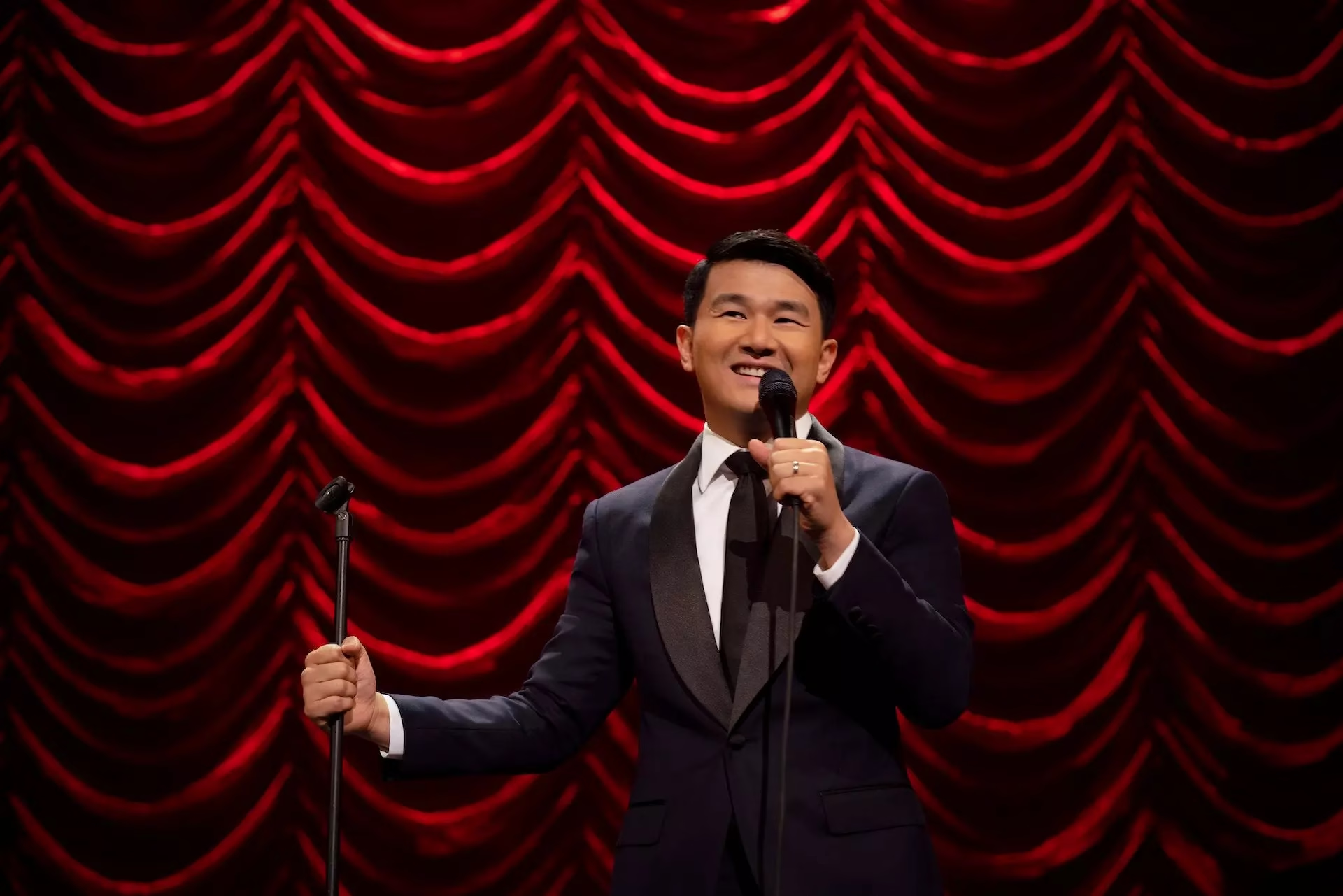
The opening of Ronny Chieng's 2019 Netflix standup comedy special, Asian Comedian Destroys America!, is almost prophetic. In the first 10 minutes, he spills biting critiques about the return of infectious diseases like the measles, the rise in "stupid anti-vaccination idiots," the role the internet plays in making people dumber and how Amazon makes it so you never have to leave your house to buy anything—all things highly relevant in today's pandemic-struck world. It's like a dark comedy turned accidental prophecy.
"Predicting the worst things to happen in the world, turns out, isn't that hard," he tells GRAMMY.com by phone while quarantining in Sydney, Australia. "You just have to assume everything's going to be terrible."
Released last December, the special sees Chieng ridiculing the absurdities of American culture from an outsider's perspective. He destroys America's addiction to hyper-consumerism—"We need [Amazon] Prime harder, faster, stronger … Prime Now … When I press buy, put the item in my hand, now!"—and obsession with individual freedoms.
<style>.embed-container { position: relative; padding-bottom: 56.25%; height: 0; overflow: hidden; max-width: 100%; } .embed-container iframe, .embed-container object, .embed-container embed { position: absolute; top: 0; left: 0; width: 100%; height: 100%; }</style><div class='embed-container'><iframe src='https://www.youtube.com/embed/BGEAiUeiaKs' frameborder='0' allowfullscreen></iframe></div>
Chieng, who was born in Malaysia and reared in Manchester, New Hampshire, Singapore and Australia, brings a truly international point of view to his comedy and special. And even though his jabs against American culture are painfully, and hilariously, revealing, his sharp takes come from a place of love.
"I think the American values are universal and I think people get behind that," he says. "That's why immigrants go to America, because they see something there in the ideology of what the country is supposed to be about. Now, the execution in America is not always [clear,] as we've seen since the founding of America. The execution of those ideals has never been perfect. But I think the fact that America, hopefully, is striving towards those ideals of equality is what draws people there."
Of course, Chieng has never shied away from calling out stupidity in America and around the world. As a correspondent on "The Daily Show With Trevor Noah" since 2015, he's tackled everything from coronavirus misinformation to frivolous lawsuits against food companies. The beloved show's commitment to finding a deeper meaning within seemingly simple jokes, he says, has impacted his own approach to comedy. It's a concept he practiced in Asian Comedian Destroys America!
"'The Daily Show' changed the way I think of comedy forever now," he says. "I feel like I definitely think of jokes now in terms of, 'What are you trying to say with the joke? Is what you're trying to say intentional or not? Is this really the message you want to put out there?' I think I feel a little bit of an additional burden to make sure that I represent myself and, by extension, Asian people in general in a certain way. I want to represent them with power and dignity and strength and intelligence."
GRAMMY.com spoke with Ronny Chieng about the perceptive messages behind Asian Comedian Destroys America!, the future of live comedy and the importance of racial diversity and authenticity in mainstream storytelling.
<style>.embed-container { position: relative; padding-bottom: 56.25%; height: 0; overflow: hidden; max-width: 100%; } .embed-container iframe, .embed-container object, .embed-container embed { position: absolute; top: 0; left: 0; width: 100%; height: 100%; }</style><div class='embed-container'><iframe src='https://www.youtube.com/embed//O_KpLrHCAx0' frameborder='0' allowfullscreen></iframe></div>
Even though you released your special last December, it talks about a lot of issues we're experiencing as a society right now in terms of global health and race relations. When you think back on the special through this lens, how does it feel to have basically predicted our current situation?
I wish I could have predicted the stock market; that would actually have been useful. Predicting the worst things to happen in the world, turns out, isn't that hard. You just have to assume everything's going to be terrible.
I was trying to give a timestamp to the special, actually ... Not that I didn't want it to be a classic, timeless special, but I just wanted people to know the context in which I was making it and I was writing it and I was performing it. This was the world we were in … So I was deliberately trying to make sure people understood that this was me in America in 2019, and I guess I'm kinda of glad I did that ... I want people to know that I was thinking of this before all this happened.
In the special, you make a case for an Asian-American president. In your opinion, how would an Asian-American president handle this kind of double-barreled blast of a pandemic and nationwide protests?
I think the spirit of the joke was that Asian people will approach problem-solving with logic and science-solution-based ideas. So I would love to believe that if an Asian person [were] president, they would do the same thing. I don't want to point fingers here, but you look at the Asian countries and how they handled the coronavirus outbreak, and most of them handled it a lot better than America: Singapore, Vietnam, Taiwan, Japan, South Korea. So bringing some of that scientific-based thinking into American politics, I think, could help.
And with regards to the nationwide protests, I'll be damned if I know how to solve any of this; it's a mess. But again, in the spirit of the joke, I think there's something towards having a third-party race that acts as a referee in situations, that has no racial agenda [and] who just wants things to work and wants things to work well. I think everyone could benefit from that kind of approach ... a more logical and unbiased approach would help everything.
<style>.embed-container { position: relative; padding-bottom: 56.25%; height: 0; overflow: hidden; max-width: 100%; } .embed-container iframe, .embed-container object, .embed-container embed { position: absolute; top: 0; left: 0; width: 100%; height: 100%; }</style><div class='embed-container'><iframe src='https://www.youtube.com/embed//l7oeWZ5fFXU' frameborder='0' allowfullscreen></iframe></div>
In past interviews, you've talked about the rise in cultural influence of Asian-Americans in the U.S. We are seeing an explosion of Asian and Asian-American culture and creatives breaking through the American mainstream. As an Asian living in America, how does it make you feel to see your people and culture reflected on such a national level nowadays?
Obviously, it feels great to have your ideas and stories being told from an authentic point of view. So for me, storytelling is all about authenticity, and I just feel like the problem with having Asian side characters isn't so much that they are side characters—it's that there's no authenticity in it. It's basically tokenistic.
As someone who consumes a lot of culture, essentially I consume stories. Whether it's standup or movies or television shows, I'm a consumer of storytelling. So it's nice to see people who you can relate to in these stories, because I think for the longest time, we never saw any of that … So we got used to that, until we see stories being told from these authentic and powerful points of view. Then we go, "Oh yeah, we were missing this."
So I think that feeling is what's causing, as you described it, this kind of surge in Asian-American storytelling … I think there's always a search for the original story. We've never told these stories. We've never told them from this point of view. I think people are seeing how interesting that can be.
Read: Rapper Lil Dicky Talks New TV Show 'Dave' And His Creative Ambitions On- And Off-Screen
And also, I think that society's demographic is changing ... I think I read a stat that Generation Z is going to be the most diverse generation in American history in terms of racial demographics. So part of seeing Asian people in storytelling in the West, it's just seeing stories reflecting actual society. We grow up and we see Asian people all the time. They're all around us, but then they're not in the stories that we tell in the West. I think, as the younger generation comes up ... it's not about diversity when we see Asian people or black people. It's about seeing actual society because that's how we understand society to be ... If you watch a TV show or a movie and there are no Asian people or no Black people or no Mexican people in America, you're almost like, "What? How is this America?" It's coming to a point where if you don't tell these stories, it becomes inauthentic storytelling.
I'm in the business of storytelling, so obviously it's nice that people want to hear my stories now. But also as just a consumer, it's nice to see those stories being told on TV; you feel empowered by it. I think storytelling affects society, which affects culture. It has real-world ramifications. If you only see Asian people in storytelling in a certain way, then that's how you think about them in real life.
<style>.embed-container { position: relative; padding-bottom: 56.25%; height: 0; overflow: hidden; max-width: 100%; } .embed-container iframe, .embed-container object, .embed-container embed { position: absolute; top: 0; left: 0; width: 100%; height: 100%; }</style><div class='embed-container'><iframe src='https://www.youtube.com/embed//aLoCFK8a_Fo' frameborder='0' allowfullscreen></iframe></div>
It's getting increasingly harder to smile or laugh these days. In your eyes, what is the role of comedy today? What can the art form provide for everyday comedy fans in our current situation?
I think comedy helps to lighten people's mood and it helps them hopefully get through a day. I think laughter is such a release for people from the tensions of the day, so I think it's really good for mental health. I think it can help you deal with unpleasant situations a little bit better ... Either you yourself, or you see someone else making fun of a situation which you encountered that frustrated you ... and then you see a bunch of other people laughing at that same joke, and [you're] like, "Oh yeah, all these people agree, so I'm not alone, I'm not a weirdo."
Comedy, in a way, can support you in that way, indirectly. Even though you don't know any of these people, you don't know the comic, you don't know the audiences, but you feel supported that your view of the world, other people agree with it, even if maybe you weren't able to express it in that way ... Regardless of your emotional response, we all are talking about the same situation; we are still experiencing that same thing, whatever that joke was about. I feel like maybe that's a way people can deal with their emotions, maybe in a more positive way.
I think there's also a chance, with comedy, to see other people's point of view … whether you're left-leaning and then you see a more conservative comic making his point of view, or you're a conservative person and you see a more liberal comic making that point of view. It's a chance to see other points of view being expressed that you might not always encounter in your life.
You come from a standup comedy background, an industry that has been devastated by the pandemic. What do you think live comedy will look like in a post-pandemic world?
Damn, it's not looking good. Right now, it's looking like a lot of outdoor gigs. I've seen in New York, they're already trying to do more Central Park shows, they're trying to do shows literally in car parks on the back of a truck.
It's sad ... It's my primary profession, so this wasn't a side gig for me; this was my main thing. But I'm pretty hopeful of two things. One: I'm hopeful that comedy will adapt. I think what I've seen over the last couple of months is that people want it ... So it might go back to its roots a little bit, where comedy was always a room of 30-50 people. It's become theaters and arenas and stadiums, but really, comedy was for like 30-40 people in a room. Maybe it might go back to that, smaller numbers.
The other thing I'm hopeful for is that the strength of America is in its innovation. Maybe not its response to emergencies, but in its innovation, America's No. 1, so I'm still crossing my fingers for a vaccine. [Laughs.] And if a vaccine happens in the next year, then I think we can go back to the way it was before in terms of comedy audiences showing up to clubs.
But one thing I have seen—it's still early days, and I'm no longer in New York—but people are showing up. And if you do a gig, people will just show up. I think, if anything, [the pandemic has] shown how indispensable standup comedy is. People just need it. They're willing to risk everything. Performers and audiences are willing to risk everything just to tell these dick jokes ... So for better or for worse, people are still showing up for comedy.
People who are still doing it, they're not doing it for money anymore … It's America, so I would love to see everyone get paid, but there is something powerful in [that]. When people do comedy now, it's purely for self-expression, because there is no money in it, and you're literally risking your life doing a show.
<style>.embed-container { position: relative; padding-bottom: 56.25%; height: 0; overflow: hidden; max-width: 100%; } .embed-container iframe, .embed-container object, .embed-container embed { position: absolute; top: 0; left: 0; width: 100%; height: 100%; }</style><div class='embed-container'><iframe src='https://www.youtube.com/embed//gvddIxZU7_s' frameborder='0' allowfullscreen></iframe></div>
You recently told the "CBS This Morning" podcast that "The Daily Show" changed your approach to comedy in that it makes you think about the message behind the joke in addition to the joke itself. Similarly, your special carries a lot of messages about race, about your experience as a non-U.S. citizen in America. Do you foresee your comedy in the future always having this kind of deeper meaning?
"The Daily Show" changed the way I think of comedy forever now. I feel like I definitely think of jokes now in terms of, "What are you trying to say with the joke? Is what you're trying to say intentional or not? Is this really the message you want to put out there?" I think I feel a little bit of an additional burden to make sure that I represent myself and, by extension, Asian people in general in a certain way. I want to represent them with power and dignity and strength and intelligence.
So the jokes that I do, I keep asking myself, "If this is funny and it works, is it sending the right message?" But the more I do comedy, I think the better I get at telling funny jokes that say what I want them to say. And you can do it subtly or you can do it overtly, but as long as it is saying what you want it to say, and of course that it's funny. That's the real challenge for me, [finding] a combination of those two things. It gets easier for me to find those jokes and make them say what I want them to say, easier. I think it's a combination of getting older, more experienced with comedy writing, and knowing my voice better—knowing what I want to say [and] how I want to say it.
Do you feel your special accomplished that goal?
Yeah, if I do say so myself. I'm very happy with it. I'm happy with how it looked. I'm happy with the material; I was working on it for two years ... I'm really happy with Netflix and my producer at All Things Comedy, Mike Bertolina, and the director, Sebastian DiNatale, [and] everyone who worked on it. It was the first time I was given that [many] resources and creative control to do something that just had my name on it. They all supported that; everyone really supported the vision. I'm always very critical with my own performances.
But overall, I'm really happy with how it turned out, and I think it sent the message that I wanted it to send, even visually. For example, one of the visual themes in the special was—I wanted it to be [like] American show business, because I felt like Asian performers in America were never given that platform, [like] that Johnny Carson show. I wanted to recreate that feeling, that kind of classic American show-business vibe, and have someone on there who not only is an Asian person, but is talking about things not just for an Asian audience. Speaking for myself, everyone gets what they want out of the art that you create, but I personally feel like I achieved that.
<style>.embed-container { position: relative; padding-bottom: 56.25%; height: 0; overflow: hidden; max-width: 100%; } .embed-container iframe, .embed-container object, .embed-container embed { position: absolute; top: 0; left: 0; width: 100%; height: 100%; }</style><div class='embed-container'><iframe src='https://www.youtube.com/embed//o62WBI0pBDY' frameborder='0' allowfullscreen></iframe></div>
Your special ends on a really uplifting note about racial harmony and finding the genuine niceness in strangers. There's been a lot of conversations about race and racial harmony in America these past few months. Where do you see this country going in the future in terms of race relations? How do we get through this turmoil as a society?
Dude, like I said before, I'll be damned if I can solve racism in America. [Laughs.] But I will say that I think the American values are universal and I think people get behind that. That's why immigrants go to America, because they see something there in the ideology of what the country is supposed to be about. Now, the execution in America is not always [clear,] as we've seen since the founding of America. The execution of those ideals has never been perfect. But I think the fact that America, hopefully, is striving towards those ideals of equality is what draws people there.
And then on a less philosophical note, if you want some actual hard data to be hopeful about, I think Generation Z is the most diverse generation. I think they'll be better equipped to handle a lot of this for many reasons. One: They've grown up with technology. Two: They've grown up with a lot of people around them who aren't of the same race, so I think they'll be more harmonious in their approach ... Again, I'm no sociologist, but I think what we're seeing right now is the last death throes of an older generational way of thinking. For me, this battle, as much as it is racial, it's also generational. I think it's old versus new, what we're seeing a lot of right now. I personally hope that "new" wins, because I think "new" is more progressive and I think they're less racist.
You have this great joke in your special about how Chinese citizens and non-U.S. foreigners look at America as being the best. You compare America to being the NBA. Given everything that's happening here recently, do you still stand by that belief that America is the best?
It's tough to judge someone when they are at a low point. If you judge anyone by their lowest point, no one is going to look good. Undoubtedly, I think America is at a bit of a low point right now. Do I still believe in the experiment? Yeah, I do, and that's why I'm going back. Even now, I just think of [America] as home … Is America the best? I think how it handles the next year will really determine.
One thing that is hopeful is that I think it's the only country that is capable of change like this ... a country that's capable of change through citizen protesting, through democracy, essentially; that's not as common as you would think. A lot of other countries wouldn't let it even get to this point where people can protest and air their views publicly. Obviously in America, it hasn't been just smooth protests. But I feel like the protests are making change happen. I think laws have been changed already, I think some people have been arrested. I guess what I'm trying to say is that, in America, I think change is still possible, which for a lot of countries it's not.
Yvonne Orji On Her First-Ever HBO Comedy Special, Faith & Celebrating Black Joy
