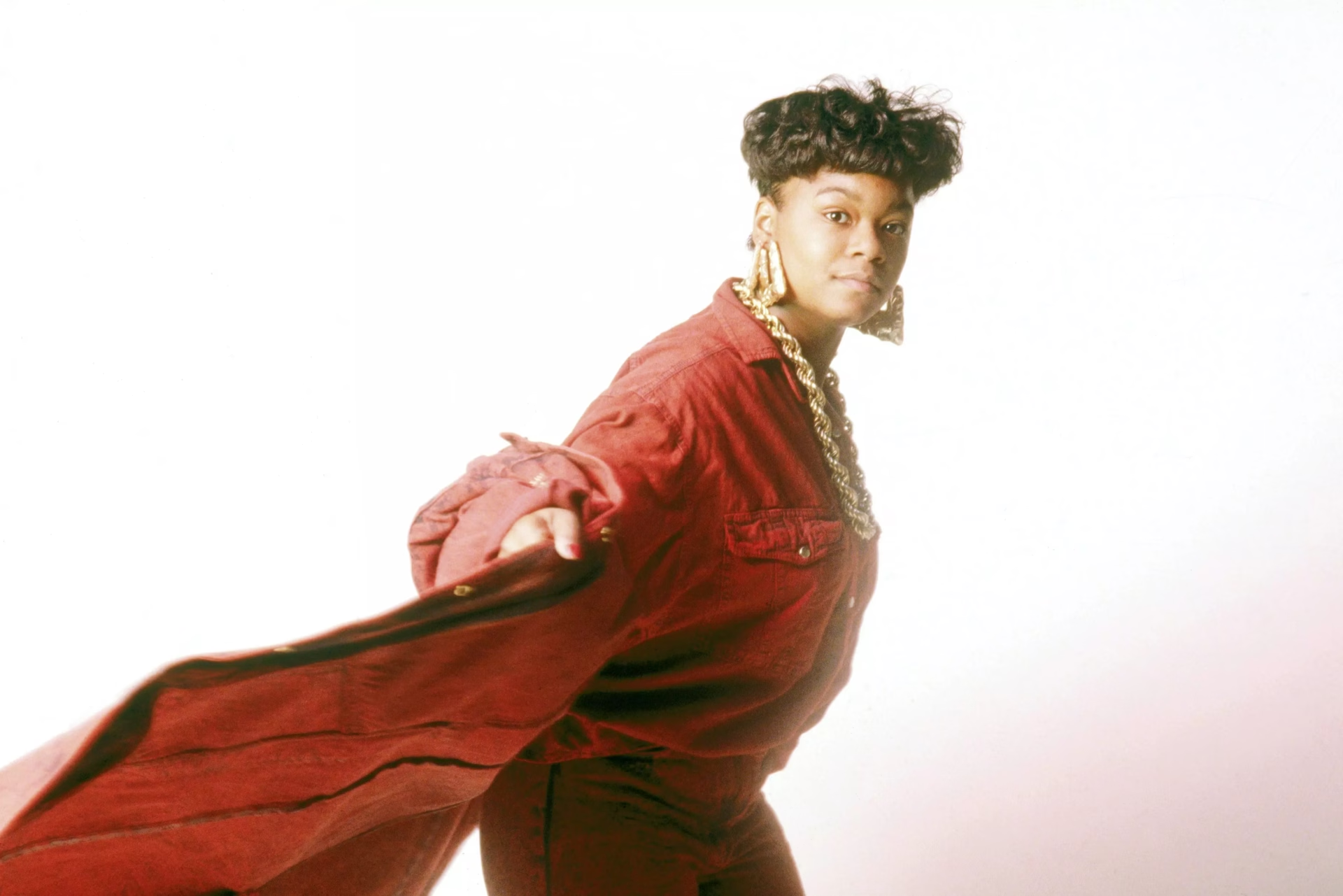
Throughout history, many important movements have omitted the significant contributions of women. History simply became his-story. The same is true in hip-hop, a genre that is historically and largely dominated by men.
<iframe width="620" height="349" src="https://www.youtube.com/embed/IKA8H_LolNM" frameborder="0" allow="autoplay; encrypted-media" allowfullscreen></iframe>
But hip-hop pioneer Lolita "Roxanne Shanté" Gooden is adding more proof that #TimesUp with her new biopic, Roxanne Roxanne, which premieres March 23 on Netflix.
Starring Chanté Adams (portraying Roxanne Shanté) and Mahershala Ali, the movie takes viewers back to the early '80s when the fiery Queens, N.Y., rapper emerged as a streetwise hip-hop teen legend on the strength of her recording of "Roxanne's Revenge," which is cited as the first (ever!) battle response song recorded and released in hip-hop.
As the film spotlights, before female hip-hop artists like MC Lyte, Queen Latifah, Salt-N-Pepa, Lauryn Hill, and Lil' Kim sold millions of albums, the young Shanté was in the trenches fighting for a spot that already belonged to her and laying the groundwork for the great women who would follow in her footsteps.
"We all stand on the shoulders of someone," says GRAMMY nominee MC Lyte. "Because she was a solo artist so early on, she paved the way when it came to people being able to accept a female MC as an entity of its own."
That might be one of the reasons executive producers of the film, Mimi Valdes and Nina Yang Bongiovi, reached out to Shanté about making a movie. While hosting an event for the American Black Film Festival, Shanté remembers being approached by the ladies.
"They came down from the balcony after the show," Shanté recalls. "We've been looking for you and we want to make a movie about your life."
Within a year's time, Shante was at the Sundance Film Festival with a critically acclaimed movie about battling both on and off the mic.
Hip-hop was born in New York City. Before anyone had even given the music genre a name, Shanté was in the thick of it. Raised in gritty Queensbridge — the nation's largest public housing development and home to hip-hop legends such as MC Shan, Nas and Mobb Deep — Shanté was a ferocious competitor who played with verbs and nouns on street corners. In 1984, when she was only 14 years old, Shanté recorded the epic "Roxanne's Revenge" at the apartment of DJ Marley Marl, a neighbor and music producer.
<iframe width="620" height="349" src="https://www.youtube.com/embed/z93Qxl51g4M" frameborder="0" allow="autoplay; encrypted-media" allowfullscreen></iframe>
It was a powerful, unforgettable and game-changing rebuttal to UTFO's "Roxanne, Roxanne," a song about a woman named Roxanne who ignored the group's advances. Shanté's lyrics were delivered off the top of her head — no pad and no pen — and she literally did it in between laundry loads. On that night, she adopted the name Roxanne, added her middle name Shanté into the equation and emerged as a rechristened shining star.
"I was about 14 or 15 years old sitting in my living room in London when I first heard Roxanne Shanté," recalls Monie Love, British MC and member of the legendary hip-hop group Native Tongues. "She was articulate, smart and just a beast. She gave the guys what they dished out but with a woman's touch. She didn't have to become a man to beat a man, and I loved that."
Indeed, Shanté was a powerhouse. Her voice and heart were bigger, stronger and more powerful than her petite teenage frame. She was brave, maybe even the bravest.
"She went toe to toe with the guys and that was exciting," recalls MC Lyte. "It was unbelievable."
"Roxanne's Revenge" would go on to sell more than 250,000 copies and spark the "Roxanne Wars," one of the most infamous and longest-running feuds in hip-hop. She had tapped into something — a girl beating the guys at their own game. She was hip-hop through and through but she was still a young teen, and many didn't think the two made a good couple. Case in point, Shanté recalls entering a rap competition that crowned the winner with a "best rapper” distinction.
"I went against 11 opponents in one day. All men," says Shanté, who remembers the whispers about how great her performance was throughout the day, which led her to feel confident that she'd win. "Kurtis Blow, who I'm great friends with today, was one of the judges, and he asked what it would take for me to lose. They told him that Shanté would lose if he gave her a 2."
And he did. Shanté was crushed. She had won but lost.
"[Roxanne Shanté] paved the way when it came to people being able to accept a female MC as an entity of its own." — MC Lyte
Despite these types of obstacles, Shanté has the spirit of a champion. She continued as a force in hip-hop as a member of the groundbreaking hip-hop collective Juice Crew. She released two solo albums, 1989's Bad Sister and 1992's The B*** Is Back, but neither achieved major mainstream success. Always up for a battle, she waged war against a slew of popular female rappers in 1992 with her single "Big Mama."
"She dissed all of us rappers by name. But I didn't respond," Monie Love remembers. "I had too much respect for her to answer back. She empowered me and inspired me to become a rapper."
<iframe src="https://tools.applemusic.com/embed/v1/album/330089743?country=us" height="500px" width="100%" frameborder="0"></iframe>
That's the funny thing when it comes to women in hip-hop. There can only be one queen. While the genre is competitive by nature, history has shown that men often collaborate and work well together. Women, on the other hand, are often pitted against each other.
"It's just the way it’s been structured for women in hip-hop," Shanté says.
But there's so much more to Shanté's story. Life doesn't suddenly end once the music stops, and it doesn't restart once a movie is made about you. Life is all the stuff in between and beyond. For Roxanne Shanté, it's about being a survivor, pioneer, trailblazer, mother, wife, friend, daughter, and an unbreakable spirit. Her life is marked by the power of believing in yourself despite what the world keeps showing you.
Years after that rap competition, Shanté bumped into Kurtis Blow. He told her that she really had won that rap battle years ago.
"At that time, hip-hop was just getting started, and people were starting to get major [record] deals," she recalls. "There was no way hip-hop was going to be taken seriously if the best of the best was a 15-year-old girl."
Too bad hip-hop didn't know who it was back then.
(Lakeia Brown is a freelance writer and host of the podcast, Decoded with Elle Bee. She has been published in publications like O, The Oprah Magazine, Essence and Complex. You can follow her on IG @decodedwithellebee.)
