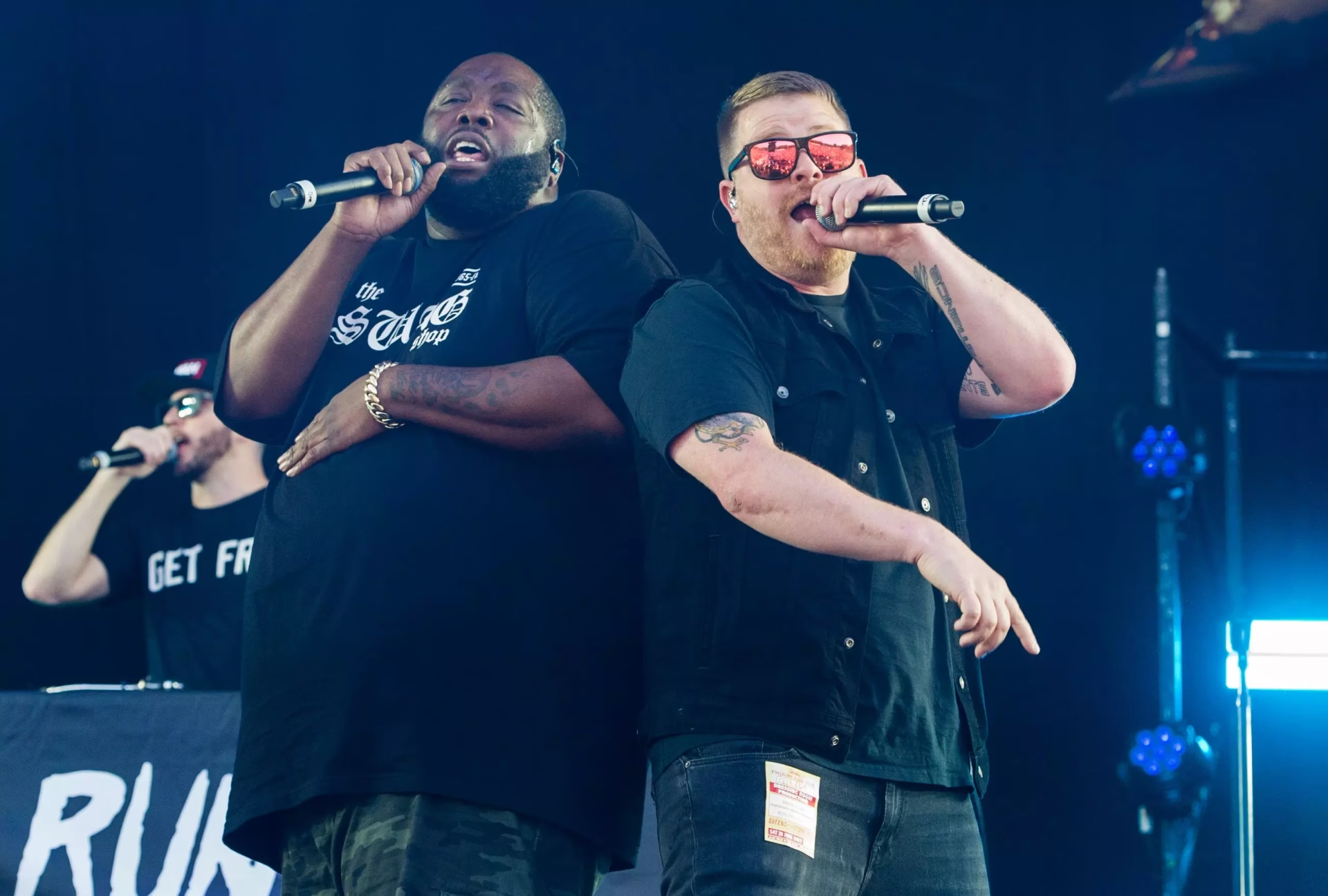
"The people said to us, 'Mike, El, we need the music. We want it now,'" explains Jaime Meline, better known as El-P. Though our interview occurred three days prior to the death of George Floyd at the hands of members of the Minneapolis police force, he couldn’t have been more right. El-P and his partner, Killer Mike (real name Michael Render) had been asked whether they’d want to delay the release of their fourth album as Run the Jewels until the end of the pandemic. Now, the rap duo have released RTJ4 earlier than expected, two days before the original release date.
"The world is infested with bullshit so here’s something raw to listen to while you deal with it all," they said in a statement, alongside a list of organizations fighting for justice, change and equity to contribute to. But even when they thought the album would only be released in the midst of the coronavirus lockdown, Run the Jewels remained focused on the strength and defiance that their music could bring those struggling to find hope, fighting the oppression of Black lives.
As might be expected from Run the Jewels, even without the context of national protest and outrage, the rap duo’s focus was already set on fighting institutions of systemic racism and urging their listeners towards tangible change. "It's not enough to simply hate slavery and say you love freedom," Killer Mike explains. "It is only enough if you are John Brown and you are willing to make sure that other human beings are free, and to understand the use of any means necessary to do so."
Killer Mike and El-P spoke with the Recording Academy about rap as visual art, being each other’s biggest fans, and how Run the Jewels 4 puts the duo on pace with the likes of Led Zeppelin and OutKast.
If one of you brings an idea to the table, do you spend time contextualizing it together, or do you just implicitly trust you'll be able to relate to that concept?
Killer Mike: A big part of our secret is that we work in the same room together, present in the moment. Even if El is working on beats and raps for the first half of the day, and then I tend to be a later riser and worker than him, the energy is still so fresh. Being in the same room, you get to be you. Everyone is fully themselves when they wake up and they're in the bathroom mirror before the shower. After that you're still you and a true version of you, but it is in relation to the people outside of you. So I am Michael Render and Killer Mike. I am still the same human being within Run the Jewels, but in the concept of adding the other perspective, you get to see Mike in what I feel is a different light and a different perspective. I still rally against the evil and the masters that oppress me, but the difference is in interpretation. Now my audience not only sees a Black man rallying against the oppressors, they get to see his friend and white counterpart say that these are evil bastards as well. Now Mike is not just Ice Cube 2.0. Mike is not just Chuck D 2.0. I am all that, and I'm a student of those artists and bringing that to Run the Jewels, but it becomes what I feel is different and could be considered a richer experience because of the added perspective of it now existing together on some transformative shit. Imagine if you had Cube shoved in the Beastie Boys. At times Run the Jewels records are all that.
El-P: It starts with spontaneity and no rules. I'll put music on and either I'll have an idea or I'll wait for Mike to get inspired—what we call "catching the holy ghost." You let your instincts move you, and then it's a process of going back, relating to it, and understanding what it is. Often we go back and change and move things around—even completely rewrite. We left a lot of room for ourselves to keep asking, "Is the first thing that I said what I wanted to say, or is it a good starting point to climb up from?"
Mike is very spontaneous. I'm a different type of writer. I sit there and I write, and you might not hear a peep out of me for six hours. And then when I get up, I have something. Mike has a whole different way that he approaches it. He gets moved by the music and he starts rapping, connecting words and ideas. There's this really beautiful mixture of something really constructed and something really spontaneous, and then both of us pull inspiration from each other. He goes back in and constructs a little bit afterwards, and I go back in and I loosen up a little bit. It's a really fun, interesting process, and it's one of the reasons why I still get excited about making Run the Jewels music. I literally cannot predict what the hell is going to happen when we get together.
That's the beauty of solidarity and collaboration. You have a partner who emphasizes your strengths and allows you to challenge yourself. There's so much family in rap, but it’s not often discussed how that affects the process.
El-P: When you're working with someone that intimately cares what you care about, you're saying, "We have agreed that both of us are dedicated to what you're doing being the best version of what you're capable of doing. Your voice is trusted." Artists are very prickly. We're sensitive people. We want people to love what we do. We want to be understood. And that comes in when we collaborate. At the end of the day, no matter what, Mike knows that if I say, "I think that you can do this better," or if he says, "This doesn't feel right to me," this is a safe space and there's something unbelievably freeing about that. But it takes work. It's a trust fall. You have to be really secure in that knowledge that the other person wants the best for you.
"We didn't have the same melancholic cloud hanging over our heads that we did when we did the last record. We wanted this to be a lean, mean, fun, and angry record."
Mike, I remember you calling your last record the "blue" record. Where does this one fit in a grand scheme of color and/or feeling?
El-P: Oh god, I love you so much for asking that question. That just shows me that you're an artist. When Mike and I talk about our records, we don't talk about what we're saying, we talk about what we want to feel. We talk about colors and the essence of the way that we want the images in our heads to react off of the music. This record is red and orange and purple, with flames behind it. We didn't have the same melancholic cloud hanging over our heads that we did when we did the last record. We wanted this to be a lean, mean, fun and angry record. When the moments of blue hit, then you’ll be ready for them.
Killer Mike: I hope people enjoy the electricity. We really were coming out of a blue period. When Picasso came out of his blue period, it was with brilliance. I'm a visual artist first. Not a very good one—thank God I can rap, right? But I sit on the board of the High Museum literally for the chance to see cool art before anyone else. Picasso means a lot to me. The art world should still be thankful for him coming out of the blue period—and his blue period was one of the dopest periods in art! So our blue album was amazing, but this record is vibrant, it is alive, it is ready for the fight. It is rebellious, it is rambunctious. It is Run the f**king Jewels sharply whittled down to a fine-tipped spear, ready to pierce your heart again.
El-P: I look at this record as stumbling with romance and love through chaos, and coming out the other end not masters of the world, but masters of our heart. We're never saying, "We know what is right." But we are saying, "We are lovers of life. We are on the side of humanity. We are on the side of love." And that is messy and chaotic and fun and funny. And also sometimes it means saying something so exposing of yourself that it takes legitimate bravery, and we will not flinch away from those moments either.
That ties to the track "Never Look Back," where you encourage people to fight the impulse to ignore the past.
El-P: It's an instinct for many people, and for me, to always look forward, to never engage with the ghosts of your past because it can be painful. And I think that’s what this record was about. Each of us are reckoning a little bit with the people that we love, and we do it in our own way. It's little montages, little impressionistic moments of our past that are open-ended questions.
I love Mike's verse on that one. I always tend to be more into my partner's verse because it's not where my mind is. I'm the official Mike fan in the group. [Laughs.] He has to be the El-P fan in the group. I love Mike presenting imagery, not solutions and not critique. But when Mike says that his dad said never give a woman any money—and I'm paraphrasing here—and he said he had to ask dad, "Does that include mommy?" It's such a cool little moment and means so much.
<style>.embed-container { position: relative; padding-bottom: 56.25%; height: 0; overflow: hidden; max-width: 100%; } .embed-container iframe, .embed-container object, .embed-container embed { position: absolute; top: 0; left: 0; width: 100%; height: 100%; }</style><div class='embed-container'><iframe src='https://www.youtube.com/embed/ryPh7321H6U' frameborder='0' allowfullscreen></iframe></div>
Killer Mike: I was dealing with the death of my mother over the past two or three years. She died while I was on the plane on the way home. My friend Sleepy was right there at her bedside, and we were FaceTiming. She was happy. But my mother really was an artist, and like many artists she suffered from bouts of depression and mania, and she suffered from addiction. She always accepted responsibility for going a little earlier than she should have, but she told me certain things that moms just don't tell sons—but they're very valuable things. My mother taught me how to survive the streets. That is not a cliche. She made sure that I did not go to jail by doing dumb shit. She was also a brilliant business woman. She bought a house at 19, paid it off by 29, and never depended on people for things. But I cannot allow myself, even now, to stop and consider that she could be gone. If I did, it would cripple me. So I get up every morning, I talk to her shrine and I listen to her old voicemails.
As a dad, I relate to my dad [saying never give a woman money]. I pay child support. My son graduated yesterday. Child support ends this month. I've paid a quarter million dollars. That's a funny anecdote to me now as a dad. I'm listening to my dad, but I'm like, "That doesn't work in the real world, dad. You gotta take care of your kids." That song allowed me to acknowledge things that I feel and care about, and at the same time, the only way I am where I am and manage to be sane is to keep moving forward. I move forward to the next Run the Jewels, therefore I don't get stuck in Ferguson. I don't get stuck with Eric Garner and Erica Garner and the memory of them and how heavy it is. As a Black man in America, it is heavy. "Never Look Back" allows me to push forward. It doesn't mean the pain doesn't happen. It means the trauma doesn't paralyze you.
I’m so sorry for your loss. Thank you for sharing. What was the connection that led to you having Mavis Staples feature on "Pulling the Pin," and how did you arrive at her being the perfect fit for that song?
El-P: I had written that hook, and we tried it multiple different ways. We had tried it with me doing it. We tried it with Mike doing it. We tried it with me and Mike doing it. We tried it with other singers. It was exhausting. But when you write something and your partner loves it, that's the ultimate compliment. Mike, being like, "That represents me too, you nailed it"? That was amazing. And he was like, "But you can't sing it. And I can't sing it. And nobody that we've tried can sing it." And I was just like, "Motherf**ker!" [Laughs.] It had to happen that way. Mike had to be a stubborn motherf**ker in that case. Don't let it get to your head, Mike, you can't do that to me on every song. [Mike laughs.] Mike was very adamant about wanting it to be someone who could convey a pain and a soul. So, despite how exhausted I was, I understood that and we kept looking. One of our managers brought up Mavis, because Mike had a connection. We obviously love Mavis. Mike had been asked to write for her a couple of years ago, but it didn't happen. But they kept in touch, so when Mavis came up, it was almost like, "Why didn't that come up on day one?" We were lucky enough that Mavis heard the song and she of course loved Mike already. She heard the lyrics and she was like, "Yeah, let's go." So I was on the plane the next day to Chicago, and then I'm hugging Mavis Staples.
Killer Mike: That's so dope.
El-P: She's the most huggable human on the planet. What a beautiful soul. To be able to include her in our music and for her to represent us? For her to say "This is worthy of me putting my energy into it"? This woman is a legend. She is a musical and a human legend. It was just very, very touching.
<style>.embed-container { position: relative; padding-bottom: 56.25%; height: 0; overflow: hidden; max-width: 100%; } .embed-container iframe, .embed-container object, .embed-container embed { position: absolute; top: 0; left: 0; width: 100%; height: 100%; }</style><div class='embed-container'><iframe src='https://www.youtube.com/embed/rb87c2yMe6Q' frameborder='0' allowfullscreen></iframe></div>
What do you think it is about you two that makes that kind of unexpected team-up possible? For instance, I don't know anyone that would have expected to see Pharrell and Zach de La Rocha on the same track.
El-P: [Laughs.] We live for that shit, man.
Killer Mike: All of it happens from a really organic place. Zach and El have been friends for 20 years or better. Since being introduced to Zach, he literally is a homie. Pharrell and I had known each other from the political world, interestingly enough. Of course, I'm a Pharrell fan. I was shocked and humbled he f**ked with me. But we met each other on the circuit trying to get our respective people elected. I was a Bernie guy, he was a Clinton supporter, but we bonded over trying to help our community. I think that the seamlessness comes from a place of getting everything out of very personal and very friendship-minded places.
This album is not coming out how it was intended. What kind of impact do you hope it can have in this moment?
El-P: I love being able to infuse people with some f**king badass-ery. I just hope that it brings people some joy, puts a smile on your face, makes you nod your head, makes you have a feeling of connection, and makes you want to move and get up. We're all fragile right now. It's dark out there, and it's tough. It doesn't seem to have an end, really, and the ending doesn't seem particularly great either. They asked us if we wanted to push our record back to next year and we were just like, "F**k no." This energy is something that we think can do some people some good right now. So whatever happens happens. I don't know what the result is going to be, but we love this music and I hope that it puts a smile on your face.
Killer Mike: The record company and the marketing team didn't decide this is the perfect time. We decided it was the time. The people who were locked in their homes during the pandemic said to us, "Mike, El, we need the music. We want it now." We will stay on the road when the road opens back up. We will make more music for as long as we are allowed to by our supporters.
<style>.embed-container { position: relative; padding-bottom: 56.25%; height: 0; overflow: hidden; max-width: 100%; } .embed-container iframe, .embed-container object, .embed-container embed { position: absolute; top: 0; left: 0; width: 100%; height: 100%; }</style><div class='embed-container'><iframe src='https://www.youtube.com/embed/vYPIOaqNlyg' frameborder='0' allowfullscreen></iframe></div>
When the first album came out, it felt like the start of a limited series, but now that you've hit gold standard with four records. How do you envision that story continuing?
Killer Mike: The prerequisite for being in an actual group was having four dope records. You have to have four classics in my mind. To me, that's Led Zeppelin, OutKast, EPMD, A Tribe Called Quest. I don't know what the next album is. I don't know if it'll be 5, or if it’ll have a different title. But what I know is that we have an amazing adventure and a journey together as a group, along with our fans, and I don't want this television show, this graphic novel, this movie to end anytime soon.
That makes me think of the cinematic way you talk about real people’s lives and struggles, like on "The Ground Below" where you speak out about supporting sex workers unionizing their services. I don't know what the landscape would look like if you don't have a group like yours saying that.
Killer Mike: I'm glad you caught that because a lot of people are going to take that as sarcasm. I'm very serious about that, even though it comes off funny as shit. People know four things about me. I'm Shay's husband, I'm one half of Run the Jewels and I enjoy marijuana and strip clubs. My wife and I go together and we’ve wound up being friends with everybody—bartenders, waitress, dancers. For years we wouldn't attend this club because the dancers were saying they weren't being treated well by management—so we actually supported them in trying to get a union in the club. For me, it's an amazing cross-section of working classism: the people who support strip clubs are working class men who have unions, and at some point dancers are like, "We deserve a certain amount of workplace dignity too."
I don't know if that would be out there without Run the Jewels. I don't know if you get the song "Liberation" without OutKast. I'm not worried about what the f**k anyone thinks about me and my support of sex workers. I'm worried that they get the same dignity and respect that I deserve and get on my job.
<style>.embed-container { position: relative; padding-bottom: 56.25%; height: 0; overflow: hidden; max-width: 100%; } .embed-container iframe, .embed-container object, .embed-container embed { position: absolute; top: 0; left: 0; width: 100%; height: 100%; }</style><div class='embed-container'><iframe src='https://www.youtube.com/embed/mCQtCj39TN0' frameborder='0' allowfullscreen></iframe></div>
That same freedom powers the song "Ju$t," where you say, "Look at these slave masters posing on your dollar." It feels so crucial to have somebody in 2020 still bringing up the word "slave" and making it clear that this is not over, that you have to wake up and know that oppression is there.
Killer Mike: Shouts out to Pharrell for that hook. As I'm talking to you, I am literally wearing a "Kill Your Masters" T-shirt, which is a saying I've lived by for years. I'll never forget a white attorney associate of mine saying, "You know, I'm troubled by the shirt. It might incite violence against white people." I said, "Well, for that to happen, that would mean you would assume yourself my master. My master is sugar. I eat too much candy. When I put on my Kill Your Masters shirt, it just reminds me, "You've still got to go to the gym in the morning, fat boy. Eat a little less sugar, you won't have to work as hard." [Laughs.]
If somebody is going to say that they feel uncomfortable by a statement that you’ve made, it shows more about them than it does the statement.
Killer Mike: Yes! And then I asked him, "Let me ask you a question. If you happened upon a plantation, what advice would you give a slave?" And the phone went silent. It's not enough to simply hate slavery and say you love freedom. It is only enough if you are John Brown and you are willing to make sure that other human beings are free, and to understand the use of any means necessary to do so.
How Anthony Hamilton Is Using His Voice To Create Change For The Black Community