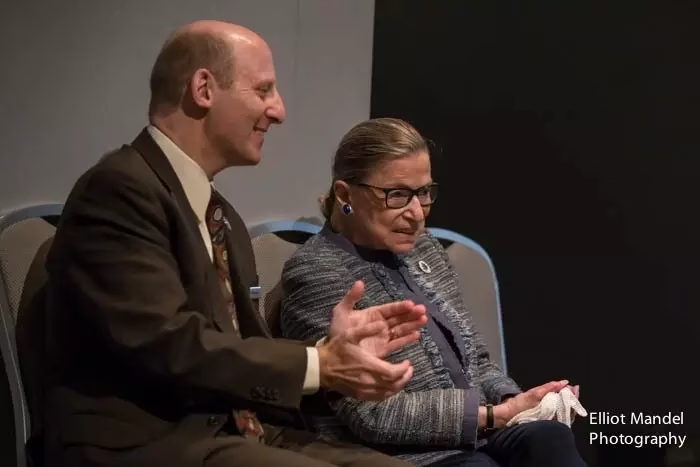
Over the course of her illustrious career, Supreme Court Justice Ruth Bader Ginsburg has become an icon in both history and popular culture. The second female to serve on the U.S. Supreme Court, RBG was known for her gumption, her tenacity and her ability to turn both hearts and minds in the direction of compassion. Lovingly nicknamed "Notorious RBG" after rap artist Notorious B.I.G, the longstanding champion of women was also, however, known in closer circles as a great lover of music—opera in particular.
A sold-out speaker at Glimmerglass Opera Festival, organizer of Opera And The Law talks, and an avid supporter of numerous opera companies over the course of her lifetime, RBG was so fond of the genre that her children would create gifts revolving around opera in one form or another. In 2011, RBG’s son James "Jim" Ginsburg, record producer and founder of Cedille Records, and daughter Jane, a Columbia Law School professor, commissioned three opera songs to be written in their mother's honor for her 80th birthday in 2013. Several years later, to celebrate the 25 Year Anniversary of RBG’s appointment to the Supreme Court, James and his wife, composer/soprano Patrice Michaels, released an album entitled Notorious RBG In Song, which was released in June of 2018. Several individuals involved with this classical compendium, including James and Michaels, spoke with GRAMMY.com about RBG’s love of opera and the story behind the album.
<style>.embed-container { position: relative; padding-bottom: 56.25%; height: 0; overflow: hidden; max-width: 100%; } .embed-container iframe, .embed-container object, .embed-container embed { position: absolute; top: 0; left: 0; width: 100%; height: 100%; }</style><div class='embed-container'><iframe src='https://www.youtube.com/embed/fylRqu39cd0' frameborder='0' allowfullscreen></iframe></div>
"It all began with one song. I was one of three female composers who were each invited to write a song based on a text that was directly linked to Justice Ginsburg for her 80th birthday," Michaels tells us. Originally intended as a standalone song, Michaels became deeply inspired while premiering the three works in her mother-in-law’s honor. "I thought to myself, wow! This is such a beautiful way to glimpse some of the chapters in her life! I think I’d like to create a coherent chronology of those chapters in song."
With RBG’s permission, Michaels went to work studying her mother-in-law’s personal materials in the Library of Congress. A good deal of research and many conversations with her biographers later, Michaels had the documents she wanted to set to music. At first, her intention was only to make an archival recording for herself. However, James was convinced that his wife’s song cycle needed to be heard. "My nosy husband had to poke his nose in and say ‘Oh, don’t you want me to come to the sessions?’ and it just grew from there."
Patrice Michaels, Brenda Rae, Ruth Bader Ginsburg, July 2017
Photo courtesy of the Ginsburg family
The final product, Notorious RBG In Song, features a collection of classical songs inspired by the beloved Supreme Court Justice herself. Opening with Michaels’ dynamic and thoughtfully researched 37-minute song cycle, The Long View: A Portrait Of Ruth Bader Ginsburg In Nine Songs, the album concludes with three other RBG-associated songs by women composers—Lori Laitman, Vivian Fung and Stacy Garrop—and an excerpt from the award-winning comedic opera, Scalia/Ginsburg, by Derrick Wang. A rollercoaster of emotions, Notorious RBG In Song is full of both laugh-out-loud and tearful moments. For laughs, listeners should turn up the volume on "The Elevator Thief" and "You Are Searching in Vain for a Bright-Line Solution." For a good cry, turn to "Celia," a tribute to RBG’s mother, and Garrop’s contribution "My Dearest Ruth," the text of which is based on Marty Ginsburg’s final letter to his wife. "When performed live, there is not a dry eye in the house," James says of the latter two songs.
"The convoluted way in which [Justice Ginsburg] had to achieve her brilliant goals affected many people along the way—especially women."
—Patrice Michaels, RBG’s daughter-in-law
Michaels' song cycle, the catalyst for the album itself, paints colorful micro-portraits of moments in RBG’s life that only those close to her knew about. When asked about their favorite songs in the cycle, Michaels and James have different answers. For Michaels, the one that comes to mind is song number nine, the last in the cycle, which encapsulates RBG’s attitude regarding the qualities a president should look for in a Supreme Court Justice. "It was already very poignant for me to write, and now I don’t know if I’ll be able to even think about it without crying," Michaels shares. As for James, he has a special fondness for "On Working Together," which is told through the eyes of his father. "I hear my father’s voice and humor captured so perfectly in that song," he reflects. The song he speaks of, which happens to be the subject of the 2018 Hollywood film On The Basis of Sex, looks back on the only legal case Ruth and Martin Ginsburg worked on together. "Any remembrances of Dad are greatly appreciated, and music can do it in a way that nothing else can."
When asked if his mother’s love of music had an impact on him becoming a classical record producer, James immediately replies, "Oh most certainly, yes." The Ginsburg household was a musical one, featuring a piano that RBG would play, a record player and a very large vinyl collection. "There was always music playing in the house," he recalls. "We had all of the classical greatest hits, and by age seven, I was already collecting my own LPs." In addition to the household music scene, Ruth and Marty also exposed their children to music outside the home. "Growing up they would take me to orchestras, including the Young People’s Concerts of the NY Philharmonic, which, back then, Michael Tilson Thomas was conducting," Ginsburg recalls. Within no time, young James was taking in the Metropolitan Opera with the same enthusiasm as his parents.
Jane Ginsburg as DJ for University of Chicago’s campus radio station
Photo courtesy of the Ginsburg family
Upon receiving praise for her heavy research and attention to detail composing The Long View, Michaels immediately gives credit to the Ginsburg family. "Well, think about what family I’m living in!" she remarks with a laugh. "If there’s anybody that brings out this attention to detail and real consideration of bringing your best effort to everything, it would be these people. It was a great gift for me to marry into that attitude." Equally humble are composers Derrick Wang and Stacy Garrop, both of whom also spoke with GRAMMY.com. Wang, whose opera was inspired by the true story of Justice Ginsburg’s and Justice Scalia’s unlikely friendship, was moved by the Justices' shared love of opera when he began the project. "In giving me her blessing to share her friendship with Justice Scalia through the opera Scalia/Ginsburg, Justice Ginsburg changed my life—and I am deeply grateful to have been a part of hers."
<style>.embed-container { position: relative; padding-bottom: 56.25%; height: 0; overflow: hidden; max-width: 100%; } .embed-container iframe, .embed-container object, .embed-container embed { position: absolute; top: 0; left: 0; width: 100%; height: 100%; }</style><div class='embed-container'><iframe src='https://www.youtube.com/embed/q6PZRQga9kY' frameborder='0' allowfullscreen></iframe></div>
As for Garrop, she had one of the most challenging tasks of all: setting Marty Ginsburg’s final letter to his wife to music. "It’s a beautiful love letter from a husband with late-stage cancer to his wife. How could I write something so personal without meeting him?" Garrop remembers thinking. But James had an idea of how Garrop could, in fact, get to know his father. "Jim gave me a cookbook, Chef Supreme, which was created by the associate spouses of the Supreme Court." The cookbook, which had numerous memories and personal accounts about Marty in between the recipes, was exactly what she needed to get a sense of his character. "It was clear what a warm, caring person he was—that there was always a glimmer in his eye."
Ruth Bader Ginsburg with husband Martin Ginsburg in 1998
Photo by Annie Groer/The Washington Post via Getty Images
"What a treat it has been to watch you progress to the very top of the legal world."
—Marty Ginsburg, "My Dearest Ruth," 2010
Ruth Bader Ginsburg was truly passionate about bridging the gap between the music world and the legal world, bringing law to the attention of musicians and bringing opera to the attention of lawmakers and judges. In addition to her Opera And The Law talks, which she gave at opera festivals and classical radio stations like Chicago’s WFMT, RBG would bring opera to the courts as well. "She was instrumental in the growth of the song cycle. As Patrice was writing these songs, one-by-one mom would find unexpected occasions for where to premiere them, like at the Second Circuit Judicial Conference," James says, chuckling. Patrice adds, "If anyone had told me 20 years ago that I would be singing for a bunch of lawyers at a judicial conference I’d have said, ‘Really?!'"
Similarly, Derrick Wang was invited to present excerpts from his opera, Scalia/Ginsburg, at the Supreme Court in June of 2013. "It was an honor…and afterward, I got to visit [her] chambers where she and I had a very enjoyable chat about opera and constitutional law," Wang recalls of his first experience meeting RBG. Later, RBG presented further opportunities for Wang to share his opera in unexpected settings, including at the Library of Congress.
"When I am at an opera, I get totally carried away. I don’t think about the case next week or the brief that I am in the middle of. I’m overwhelmed by the beauty of the music, the drama. The sound of the human voice is like an electric current going through me."
—Ruth Bader Ginsburg, CNN Films, 2018
Over the course of her lifetime, RBG emboldened and empowered women and men across the nation to stand up to gender inequality. Meanwhile, she herself was emboldened and empowered by music. One lesson that all music enthusiasts can take from RBG is that we should allow ourselves to escape from work and into music because it will, in turn, help us thrive. "Mom always talked about how well music—opera—could take her out of her work," James explains. "Her mind was always on her next brief or argument or dissent, but opera would take her out of that." At the same time, RBG’s relationship with opera reconciled some of the empathetic responses generated by her work by giving her room to empathize with the characters through music. "It brings to mind a Peter Sellars quote," Michaels adds with a smile in her voice. "Opera is really about justice; people seeking justice in their own personal relationships, and people seeking justice in the larger world."
How the Loss of Justice Ginsburg Impacts Music Creators
