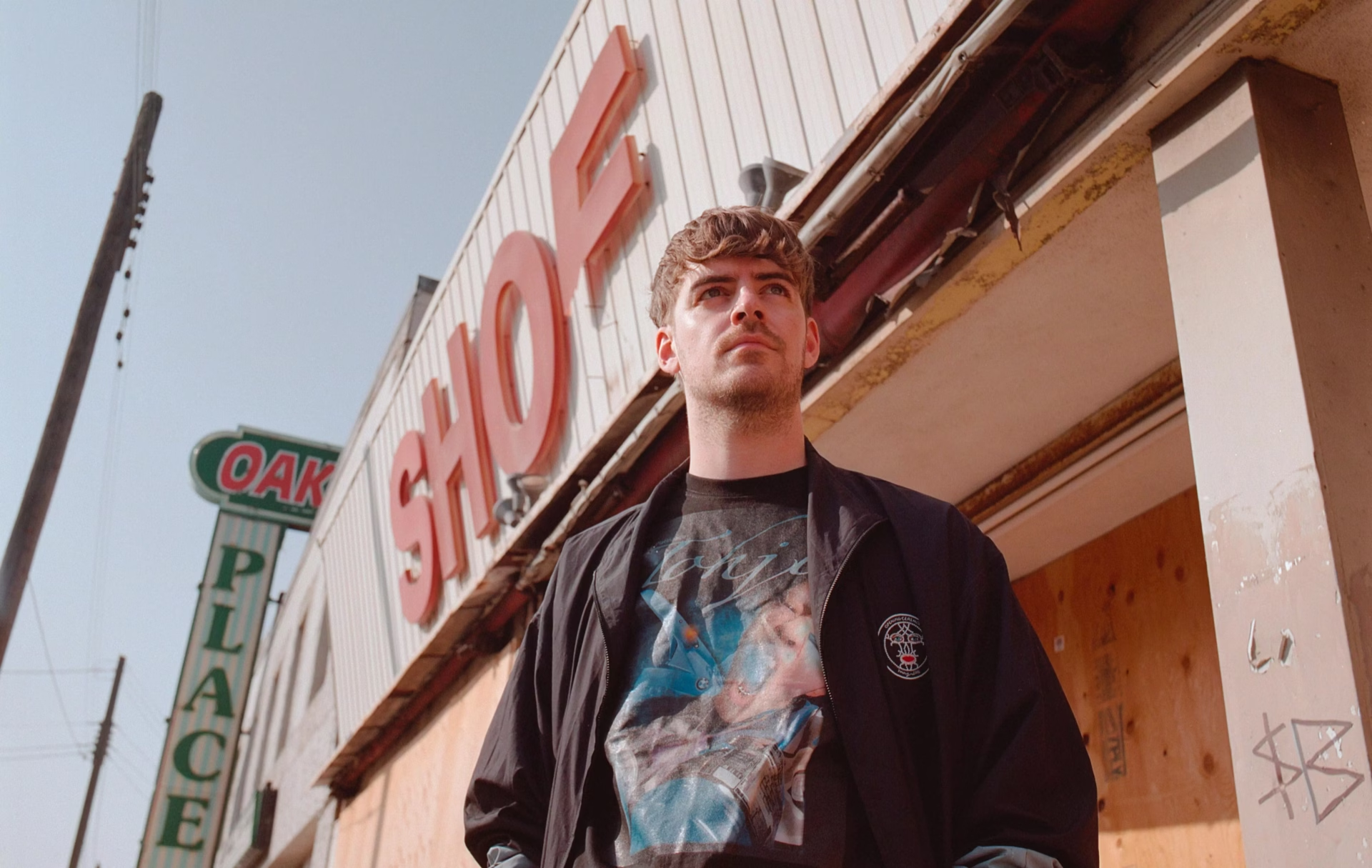
Ryan Hemsworth's goal was simple: To allow his love for indie music to interact with his passion for producing. He's worked with Tinashe, Tory Lanez, Yurufuwa Gang—the list goes on and on, and it's diverse and full of surprises. For Quarter-Life Crisis, his EP released on Nov. 4 via Saddle Creek, the Canadian producer switched gears and brought in a circle of more low-key artists: Charlie Martin of Hovvdy, Frances Quinlan of Hop Along, Claud, Hand Habits and Yohuna. The ambiance is different—it's calm, sparkling, free-floating.
"Time just stretches out a lot," he tells GRAMMY.com a couple of weeks before the EP release, the day that the track "Comfortable" is unveiled. "It sort of was a good thing in the end because I've grown these relationships with everyone on the project."
The artists he collaborated with are also, in one way or another, interconnected. The cohesion came naturally as he "tried to make it more like a mix or a compilation of like-minded people that are all kind of in the same world," he says. That world is heightened in Quarter-Life Crisis—the delicate vocals, the earnest lyrics, the careful movement. It sounds less like a crisis and more like a resolution.
Read on to hear from Hemsworth about the timeline of the EP, the process of collaboration, and the inspiration to combine indie and electronic music.
<iframe width="100%" height="450" scrolling="no" frameborder="no" allow="autoplay" src="https://w.soundcloud.com/player/?url=https%3A//api.soundcloud.com/playlists/1173046456&color=%23ff5500&auto_play=false&hide_related=false&show_comments=true&show_user=true&show_reposts=false&show_teaser=true"></iframe><div style="font-size: 10px; color: #cccccc;line-break: anywhere;word-break: normal;overflow: hidden;white-space: nowrap;text-overflow: ellipsis; font-family: Interstate,Lucida Grande,Lucida Sans Unicode,Lucida Sans,Garuda,Verdana,Tahoma,sans-serif;font-weight: 100;"><a href="https://soundcloud.com/quarterlifecrisishaha" title="Quarter-Life Crisis" target="_blank" style="color: #cccccc; text-decoration: none;">Quarter-Life Crisis</a> · <a href="https://soundcloud.com/quarterlifecrisishaha/sets/quarter-life-crisis-3" title="Quarter-Life Crisis" target="_blank" style="color: #cccccc; text-decoration: none;">Quarter-Life Crisis</a></div>
When did you start making this EP?
The general idea started years ago. I was emailing with Saddle Creek—who's putting it out—probably well over five years ago. It was about this general idea of having a handful of different singers and people from different projects, but putting it all together into one hopefully cohesive project. It's been a long time coming. The songs actually started probably two years ago. I feel like that Hand Habits track ["Comfortable"] that came out today was maybe the first that got this into motion. Since then, I was finishing it through the start of COVID-19. It's sort of a pre-COVID project.
Read: 'Tron: Legacy' At 10: How Daft Punk Built An Enduring Soundtrack
How did you pick who to work with?
Kind of a mix of different ways. Half of them are part of the Saddle Creek label, and Amber is the A&R and she introduced me to a few of them. That helped a lot to get some level of trust going into it, like, "Hey, we know this guy, we know you guys would probably make something good together." That can be the one of the hardest parts at times, especially with a project like this.
Hand Habits, for example, had never really done a collaboration this way. I invited them to the studio and usually they'd play guitar and write everything themselves. I had an instrumental demo ready and I just played them a few different ideas. With the first one, Meg [Duffy, a.k.a. Hand Habits] was already like, "Yeah, this is sweet," just sitting there, humming and writing down lyrics. It was—hopefully for everyone, and myself included—just a refreshing approach. It was the same for Frances [Quinlan] as well. I don't think she'd really worked sitting there with a producer before and making this type of music.
Did you feel any responsibility, especially since it was their first time doing that sort of thing?
Yeah. I wasn't too in my head in the moment, but after I was like, "I'm glad this went well because I probably could've turned them off from wanting to do something like this ever again." I wouldn't want to be responsible for that. [Laughs.]
But with Frances, who's just the nicest person, after she was like, "I've never really considered working in this way, but now I'm really interested in doing this more." Because I never really know; I'm not like most producers that are super cocky and have a big mixing board and are like, "Come on, we're gonna make a gold hit." I'm definitely more self-conscious and I want the other person to be super comfortable and happy. It's hard to turn that part of your brain off sometimes, but I think it went pretty well overall.
Is there anything specific you learned from working with all these musicians?
Definitely a lot of different elements. In a nerdy way, the approach to mixing. I feel like before this, I was really thinking more about how something sounds from the "How does it sound in the club?" perspective—the kicks and bass should be louder. This was more of a freeing experience, where I was playing a lot of it live with guitars and everything and I could actually make it sound rougher. I didn't need to use those words like "slap" and "smack"—I'm not thinking about music in those terms. [Laughs.] It's a personal, nice growth.
Especially working with Frances, who's really meticulous with how she makes music. That song changed a lot and went through a lot of demo stages. One section went from one to another, and we got a children's choir on the chorus and all of this different stuff. That let me step back and be like, "I'm not gonna control this thing. I really want her ideas to get across here." I wanted to amplify that and make it the best it could be in general. That's probably the producer goal in a way.
To me, the EP has this feeling of floating and this dreamy, delicate vibe. Was that something you were trying to capture?
I would say that's kind of what always comes through, for whatever reason or maybe for a bunch of different reasons. I definitely use certain synths that are heavily reverberated and certain sounds that kind of reference to '80s synth-pop stuff. At the same time, I really was going back to my high school indie band influences on these songs—thinking about Grandaddy, and all groups that combine electronic sounds and rock sounds in a not cheesy way.
Tell me about what your life was like when you were in high school and got into indie. How'd you get into it, who'd you like, what shows did you go to?
I started playing guitar in grade seven, and it was through my cousin who had a band. I looked up to him and wanted to emulate everything he did. So, just having a good role model, I think, and letting me steal his old CDs, like Smashing Pumpkins and stuff like that. Through high school, I was always excited to get home right from school and find music and go on blogs all day. I was in Halifax until I finished university, and honestly not a lot of big bands came there, so show-wise, I didn't really go to a lot. I was just sort of on my computer all day, every day.
I feel like I was originally really into this type of music, and sitting on my laptop and getting more into production, it lent itself to the electronic world and doing more and more of that, which ended up being the last 10 years of my life. I was like, "Wow, I can combine these things." I don't know why I was always scared of that a little. I thought it would like turn one side or the other off in those two different worlds, but I think nobody really cares anymore.
Why's it called Quarter-Life Crisis?
When I started thinking about the project, it was more accurate to quarter-life, but at this point I'm 30 now. The general idea was reached when I was playing a lot of shows and electronic festivals and there were definitely a lot of elements that I didn't really love about it. In general, I just wanting to be at home and go back to that sitting on my computer and not having responsibilities again.
Did that crisis just pass through you?
I guess so. Maybe the project is me sort of working that part of my life out. It does feel a bit cathartic to make this music that I've always wanted to but I didn't know if it would be accepted or if I would be accepted in this different world musically. It’s been a nice feeling so far.
For The Record: Joni Mitchell's Emotive 1971 Masterpiece, 'Blue'