Though it's been more than 50 years since Café Au Go Go closed, Blood, Sweat & Tears frontman David Clayton-Thomas still recalls the cultural significance of this famed NYC basement bar. Formerly located at 152 Bleecker St. and operating from 1964-1969, the Greenwich Village hotspot hosted everyone from Cream, with Eric Clapton, to Jimi Hendrix.
"It was the place to be in those days," Clayton-Thomas reflects. "That is where Blood, Sweat & Tears started. We became the house band for a couple of months while recording our first album at CBS Studios on 52nd Street. We would work the club at night and record during the day. It's hard to forget a club like that. It will always be a part of my wonderful memories of New York."
It's not a stretch to say that the resulting Blood, Sweat & Tears self-titled 1968 album, which has sold 10 million copies worldwide and won the GRAMMY for Album Of The Year in 1970, would exist today without the band's experience at this small yet renowned club.
Clayton-Thomas' story illustrates exactly how independent music venues are more than four walls. Within the confines of these cramped clubs is a shared cultural history and community: collective stories of unforgettable nights watching your favorite bands and artists perform. The spirits of these artists—some long gone—are forever etched in the wood and ingrained in the stain-filled dance floors.
Exterior of Café Au Go Go in NYC in 1965 | Photo: Don Paulsen/Michael Ochs Archives/Getty Images
During the COVID-19 pandemic, the live music ecosystem, already hit hard by rising real estate prices, gentrification and urban sprawl, entered crisis mode. Seminal clubs across North America, from L.A.'s historic Troubadour to Toronto's legendary Horseshoe Tavern, lie silent.
Like concertgoers, club and venue owners, too, are eagerly awaiting the return of live music. In the interim, these entrepreneurs do what they can to keep their businesses afloat: Some launched GoFundMe fundraisers, while others turned to social media, patrons and local and federal government for financial support. The politicians are starting to hear these pleas.
Earlier this month, the U.K. government announced a £1.57 billion (approximately $2 billion) aid package for the arts, culture and heritage industries. In the U.S., a pair of senators introduced a relief bill: the Save Our Stages Act. The Recording Academy is also endorsing a pair of solutions: the RESTART Act and the Mixed Earner Pandemic Unemployment Assistance Act.
The sad reality: Without the leniency of landlords and the passing of stimulus acts by governments, many iconic clubs and independent venues will not survive the financial fallout caused by the coronavirus pandemic. Even with these lifelines, the outlook could be grim. According to a survey from the National Independent Venue Association (NIVA) last month, which surveyed nearly 2,000 music professionals across the U.S., 90 percent of independent venue owners, promoters and bookers said they will have to close permanently within the next few months if they do not receive financial relief from the government.
As the majority of the live concert industry across the world remains on pause, GRAMMY.com chatted with a handful of artists, including Rufus Wainwright, YUNGBLUD, Keb' Mo' and others, about their cherished concert memories at some of their favorite clubs and venues.
Rufus Wainwright
Venue(s): The Troubadour and Coronet Theatre in Los Angeles, Calif.; McCabe's Guitar Shop in Santa Monica, Calif.; The Town Crier in Beacon, N.Y.; Ursa, owned by his sister Martha Wainwright, in Montreal, Quebec
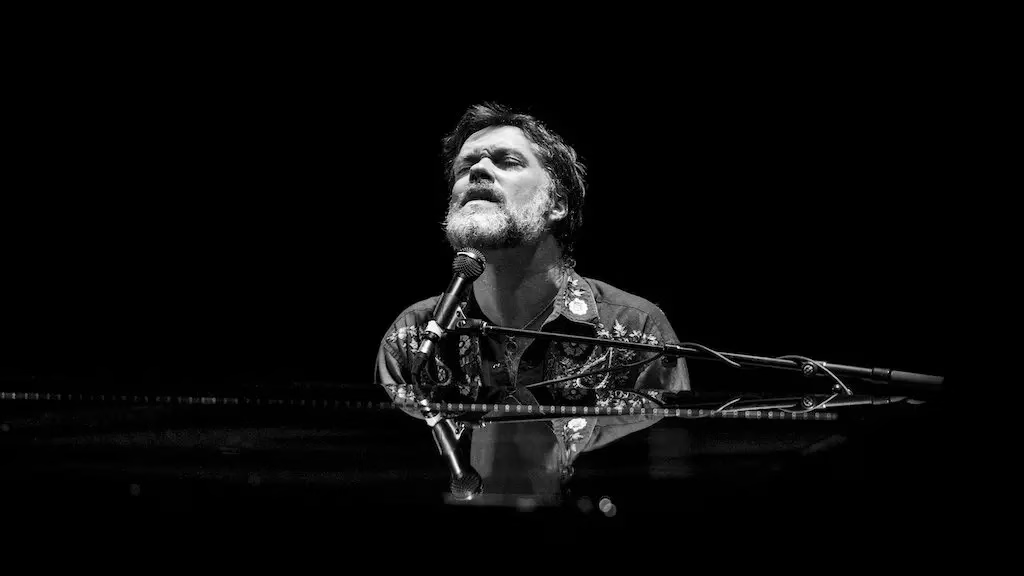
Rufus Wainwright performs in Austin, Texas | Photo: Barbara FG (Cleared for any usage with credit)
Self-isolating these days at his home in Los Angeles finds GRAMMY-nominated singer-songwriter Rufus Wainwright spending time practicing more, especially the piano. "I've been able to dive into the technical forest," he tells GRAMMY.com. Before the pandemic hit, he was on tour and starting the promotion cycle for his newest album, Unfollow The Rules, which he released last month via BMG. He booked gigs at many clubs, including The Troubadour, to promote the record. Then he had to cancel them.
"The Troubadour, for me, is especially poignant," Wainwright says. "I performed there a couple of times over the years, and I've seen many shows there. We were set to play there at the beginning of this tour. This album is very much influenced by the history of Laurel Canyon [in Los Angeles], songwriting and Hollywood, and we had this symbolic show booked at The Troubadour to emulate some of the grand history that occurred in that venue. Sadly, that opportunity got ripped away when the pandemic struck."
Read: Beginnings And Endings With Rufus Wainwright
Other touchstone venues for Wainwright in the L.A. area include: The Coronet Theatre, now Largo At The Coronet, where he regularly performed early in his career and McCabe's Guitar Shop on Pico Boulevard in Santa Monica, where the artist played a series of shows before the pandemic hit.
"I am familiar with the smaller-venue situation mainly because my parents started out playing in coffeehouses in the 1960s and '70s," Wainwright says. "Places like the Caffè Lena in Saratoga Springs, [N.Y.], and The Iron Horse Music Hall in Northampton, Mass., are all part of the really vital, socially important folk music movement my parents [Loudon Wainwright III and Kate McGarrigle] were a part of in the 1960s. For a lot of artists, these venues are like a trampoline that can catch your fall when you aren't necessarily the flavor of the month. I grew up witnessing this dynamic, and I started out in smaller venues. To dominate that dynamic is really important and harder than you think. A lot of big artists cannot play a small venue … it's too scary and too intimate, but I love them!"
YUNGBLUD
Venue(s): The Crowndale in Camden Town, London, England; The Lock Tavern in London, England; The Electric Ballroom in Camden Town, London, England
YUNGBLUD performs at the Electric Ballroom in 2019 | Photo: Matthew Baker/Getty Images
Born in Doncaster, Yorkshire, British rocker YUNGBLUD left home at 16 and moved to London. "I ran away because the north of England is not a place for a kid in lipstick playing rock 'n' roll," he says. Once settled in the south, he discovered the live music mecca of Camden Town, north of England's capital.
"These venues shaped what I am as an artist today," he says. "I remember walking into Camden Town for the first time and my mind exploded; it was everything I ever wanted. It was Willy Wonka & The Chocolate Factory. I had a golden ticket to everything I read about: The Libertines, Amy Winehouse, etc. I used to skive off work to get coffees and go to Camden for hours, telling my dad I had been mugged!
Read: Yungblud Talks Turning His Tour Postponement Into An Online Rock & Roll Variety Show
"Camden was really a big turning point in my career," he continues. "I've played every tiny venue in Camden, from The Crowndale for 10 people to a sold-out show at The Lock Tavern where Amy Winehouse played early in her career and who is a massive inspiration to me. She taught me being you is good enough. Later, I played the Electric Ballroom to 1,500 people. The Camden Assembly, formerly The Barfly, is where my guitar player [Adam Warrington] and I really connected and when we figured out we were going to play music together for the rest of our lives, bonding over our love of Joy Division, Blur, N.W.A, Foo Fighters and David Bowie.
"When I think about Camden, that spirit, and every show I've played in the clubs there, I remember why I'm here and what I'm doing it for … it's all about the passion!"
Colin Linden
Venue: The Legendary Horseshoe Tavern
City: Toronto, Ontario, Canada
Opened: 1947
Colin Linden (R) with Robbie Robertson (L) performing at the Legendary Horseshoe Tavern in approximately 1989 | Courtesy Photo: Colin Linden
These days, Canadian blues artist Colin Linden lives in Nashville, Tenn., but Toronto is where he cut his teeth. The GRAMMY-nominated songwriter and producer grew up fast, sitting in as an underage teen with local legends like Willie P. Bennett and David Wilcox at small clubs around town. Today, Linden figures this is the longest time he has gone without a gig in his 48-year career. "I feel a real need to connect with people," Linden says.
Toronto's legendary Horseshoe Tavern is Linden's seminal venue. He still has a scar on his forehead from a time he played The Shoe in the mid-1980s and bounded off the stage a little too recklessly. And in the early 1990s, he played there frequently with a secret band, which included Bruce Cockburn, called Bambi And The Deer Hunters.
"It is the place where I started playing as a kid and kept on playing over many years," Linden recalls. "It was an important venue long before I ever set foot in there. It's a place where I've had a lot of laughter and a lot of tears. When I think about the Horseshoe Tavern, I think about so many things. I remember sitting in the back alley in booker Peter Graham's car, playing him my demo and talking over my mistakes. I really wanted a gig there."
The most memorable night for Linden at this venue happened on March 13, 1989, when he shared the stage with The Band members Rick Danko, Garth Hudson and Robbie Robertson. "That was such an amazing night," Linden thinks back. "I remember Robbie getting offstage and asking me, 'How can you guys hear anything?' I realized he had not been on a stage in more than 10 years and forgot how loud it gets in a club!"
Keb' Mo'
Venue: Harvelle's
City: Santa Monica, CA
Opened: 1931
Harvelle's | Photo: John M. Heller/Getty Images
Harvelle's, a popular West Coast blues club with a long history, is where Kevin Roosevelt Moore started playing in 1992 before he was known as Keb' Mo' and before he had a record deal. His first audition to play the historic venue failed. Later, he landed a gig at the club through a friend who needed a guitarist. After that, Moore played the venue regularly for years. One Tuesday, Moore was performing when television producer and composer Chuck Lorre was in the audience; an introduction led Moore to land the theme song for the popular CBS sitcom, "Mike & Molly."
"It's very important to maintain the local watering holes of our country," Moore, who this year took home a GRAMMY for Best Americana Album for his 2019 album, Oklahoma, explains. "For me, Harvelle's is the place where I figured out who I was. Harvelle's is where I became 'Keb' Mo'.' If not for Harvelle's, I, and many other artists I know, would not be where we are today. It's so important to make sure these local places that feed the community—socially, culturally, and artfully in a musical way—remain open. When you take away the starting point for musicians, you take away the connection. It's the local pubs and the local dives that make us who we are.
Watch: Keb' Mo' Reflects On The Journey To His 'TajMo' GRAMMY Nomination
"Even today, Lady Gaga, Bruce Springsteen, etc., all want to do a dive [bar] tour because the dives are what's happening," he continues. "It's about connecting to the people. It's raw, it's honest and it's genuine. The place you have to be most genuine of any place is in a dive, because when you play a fancy theater, everyone comes to see you and is expecting something. In a dive, no one gives a crap about you, so you have to go to them and figure out how to connect and reach them. In a way, playing a dive is way more difficult than playing a concert. Harvelle's and all the dives, coffee shops [and] restaurants of the world are very important to creating that connection and community within the music business."
Sarah Jarosz
Venue: The Cactus Café
City: Austin, Texas
Opened: 1979
Sarah Jarosz performs at The Cactus Café in approximately 2006 | Photo: Steve Oleson
At 29, New York City-based American Roots singer-songwriter Sarah Jarosz has already won three GRAMMYs. (Her newest album, World On The Ground, released in June, features production from five-time GRAMMY winner John Leventhal.) Jarosz shares her love for The Cactus Café, one of the storied music clubs situated on the campus of the University Of Texas At Austin in her hometown. The venue has hosted a who's who of Texas songwriting legends and bands over the years, from Townes Van Zandt and Guy Clark to The Chicks and Nickel Creek.
Read: Sarah Jarosz Graduates to GRAMMY Winner with 'Undercurrent'
"Since I'm not able to play shows on the road right now, I've naturally turned my thoughts to some of the first venues I began playing in," Jarosz says. "I have a particular fondness for The Cactus Café. That's the first club I remember my parents taking me to as a little kid, even when it was way past my bedtime. I remember the smell of the coffee brewing, the clinking of the glasses at the bar tucked into the back corner, the warmth of being surrounded by kindred spirits and music-lovers.
"Venues like The Cactus are sacred spaces," she adds. "For the hour or two that you're inside them, the outside world disappears, and musicians and listeners alike find solace in the energy and the sounds."
Jane Bunnett
Venue: Jazz Showcase
City: Chicago, Ill.
Opened: 1947
Jane Bunnett performs at Jazz Showcase in Chicago, Ill. | Photo: Jim Funk
Jane Bunnett, 63, is a soprano saxophonist, bandleader and three-time GRAMMY nominee. The most recent ensemble the Toronto artist assembled is the all-female, GRAMMY-nominated Afro-Cuban jazz group, Jane Bunnett & Maqueque.
She holds a special place in her heart for Chicago's Jazz Showcase, started by Joe Segal in 1947. Legends from John Coltrane to Miles Davis have played this historic club. Today, you'll still find the 94-year-old NEA Jazz Master Segal hanging around, but his son, Wayne, runs the day-to-day operations.
The first time Bunnett tried to sit in and play at Jazz Showcase in the late 1980s, Joe refused to let her play. Flash ahead a decade. Bunnett was back in the Windy City for the Chicago Jazz Festival. After her set, musician Ira Sullivan introduced her to Joe, who didn't recall the incident. Amends were made. In the last five years, the club has become a regular anticipated stop for Bunnett & Maqueque; they were scheduled for another gig there this spring before the pandemic hit.
Read: 'Bitches Brew' At 50: Why Miles Davis' Masterpiece Remains Impactful
"I've got incredible memories of playing that room," Bunnett says. "Right behind the bandstand is a beautiful 10-by-12-foot photograph of Charlie Parker. I remember the first night I'm up on that stage, it was such a joyous moment. Joe sat right in front of my percussionist and just stared. I looked around the room at all the paraphernalia and history and just soaked it in. There I was with a bunch of young Cuban kids in their early 20s who didn't have a clue of who many of the artists pictured on the walls were."
Sierra Hull
Venue: The Station Inn
City: Nashville, Tenn.
Opened: 1974
Sierra Hull (R) performs with Justin Moses (L) at The Station Inn in Nashville, Tenn. | Courtesy Photo: Sierra Hull
At 28, bluegrass/roots artist Sierra Hull has already released four full-length albums. Her most recent, 25 Trips, released in February on Rounder Records, is the follow-up to her GRAMMY-nominated 2016 album, Weighted Mind.
"It's easy to take for granted that a venue like The Station Inn will always be there," she says. "It's a staple of the Nashville community and a musical home for so many of us. I've been deeply inspired by the concerts I've seen by both legends and peers there, and have played the stage myself countless times over the years. It's the type of venue that is perfectly small and intimate yet with a history that makes it feel larger than life.
Read: Sierra Hull Takes Her Place In Bluegrass History, Talks Legacy & New Music At Wide Open Bluegrass
"It really breaks my heart to know that venues we all love are struggling and could potentially go under during this pandemic. I hope and pray they can survive this for the sake of our community and the need we all have to gather together in places with so much history and meaning."
Ondara
Venue: Cedar Cultural Center
City: Minneapolis, Minn.
Opened: 1989
Cedar Cultural Center | Photo: Jahi Chikwendiu/The Washington Post via Getty Images
Ondara, previously known as J.S. Ondara, grew up in Nairobi, Kenya, listening to a lot of rock music before moving to the U.S. in 2013. His debut album, Tales Of America, released in 2019, received a nomination for Best Americana Album at the 2020 GRAMMYs. In May, the singer-songwriter released his follow-up, Folk N' Roll, Vol 1: Tales Of Isolation, an 11-song collection written and recorded by Ondara, in less than a week, while in lockdown in Minneapolis. The compositions speak to our times and collective quarantined experience. A direct response to the global pandemic, the album serves as therapy for Ondara.
Before moving from Africa to America, Ondara had never been to a concert. His first show was at the Cedar Cultural Center, a Twin Cities live music hot spot for the past 30 years. It changed his life.
Read: Kenyan Singer/Songwriter J.S. Ondara On Telling His Own 'Tales Of America' With Debut LP
"I was new to America, and I had spent some time with music unsuccessfully," he recalls. "Nothing was working out, so I decided to go to school. Halfway through my second semester, a friend invited me to a show to see Seattle singer-songwriter Noah Gundersen. I had a completely spiritual experience at that concert. I dropped out of school the following day and went back to focusing on my music and making my debut record. It was life-changing. The novelty of [it] being my first concert, along with my internal turmoil of my desires to be a musician being stifled, all played a part in the experience. It left a lasting impression. I honestly can't wait until I can be in a room full of people again and sing right in their faces."
4 Independent Record Stores Across The U.S. Weigh In On Their Struggle To Survive During COVID-19