Chris Daughtry disliked a Dr. Luke and Max Martin song so much he screamed in the studio while recording it. It was late in the recording process for Daughtry, his namesake band's debut album. Despite being an adept songwriter, the people upstairs asked him to record the pop overlords' co-write "Feels Like Tonight" at the eleventh hour. He couldn't connect with slightly generic lyrics like "I was waiting for the day you'd come around / I was chasing, but nothing was all I found." It didn't feel like him.
"There are recordings of me in the vocal booth going 'F*** this song! I hate this f***ing song!" Daughtry tells GRAMMY.com. Despite coming in a respectable fourth place on "American Idol" in 2006, "It was written for me as if I won the show. If I won, this would have been that song that you sing at the end, where the f***ing confetti's falling on you and you're singing [Clenched voice] 'And it feeeeels like...' You know what I mean? That was going to be my celebratory win."
<style>.embed-container { position: relative; padding-bottom: 56.25%; height: 0; overflow: hidden; max-width: 100%; } .embed-container iframe, .embed-container object, .embed-container embed { position: absolute; top: 0; left: 0; width: 100%; height: 100%; }</style><div class='embed-container'><iframe src='https://www.youtube.com/embed/5PPjXHC_NkU' frameborder='0' allowfullscreen></iframe></div>
By any measure, Daughtry was a "celebratory win" for the band. It became the fastest-selling debut rock album in history at the time, doing numbers that some out-and-out "Idol" winners might envy. But what's he been up to since? Despite the impressive raw data, the singer's label bosses never quite let him off the leash. Plus, endless executive turnover left him adrift, grasping for and missing ephemeral radio trends. But while Daughtry remains his best-selling work, he's arguably just made the first of his own volition.
That album is Dearly Beloved, the band's first outside of RCA, which will release September 17. (These days, they're rounded out by guitarists Brian Craddock and Josh Steely, keyboardist Elvio Fernandes, bassist Josh Paul and drummer Brandon Maclin.) With vibrant highlights like "Desperation," "Heavy is the Crown" and "Break Into My Heart," it's a slick, atmospheric modern rock record with a dystopian-flick vibe. But, more importantly, every second of it is Daughtry's and Daughtry's alone.
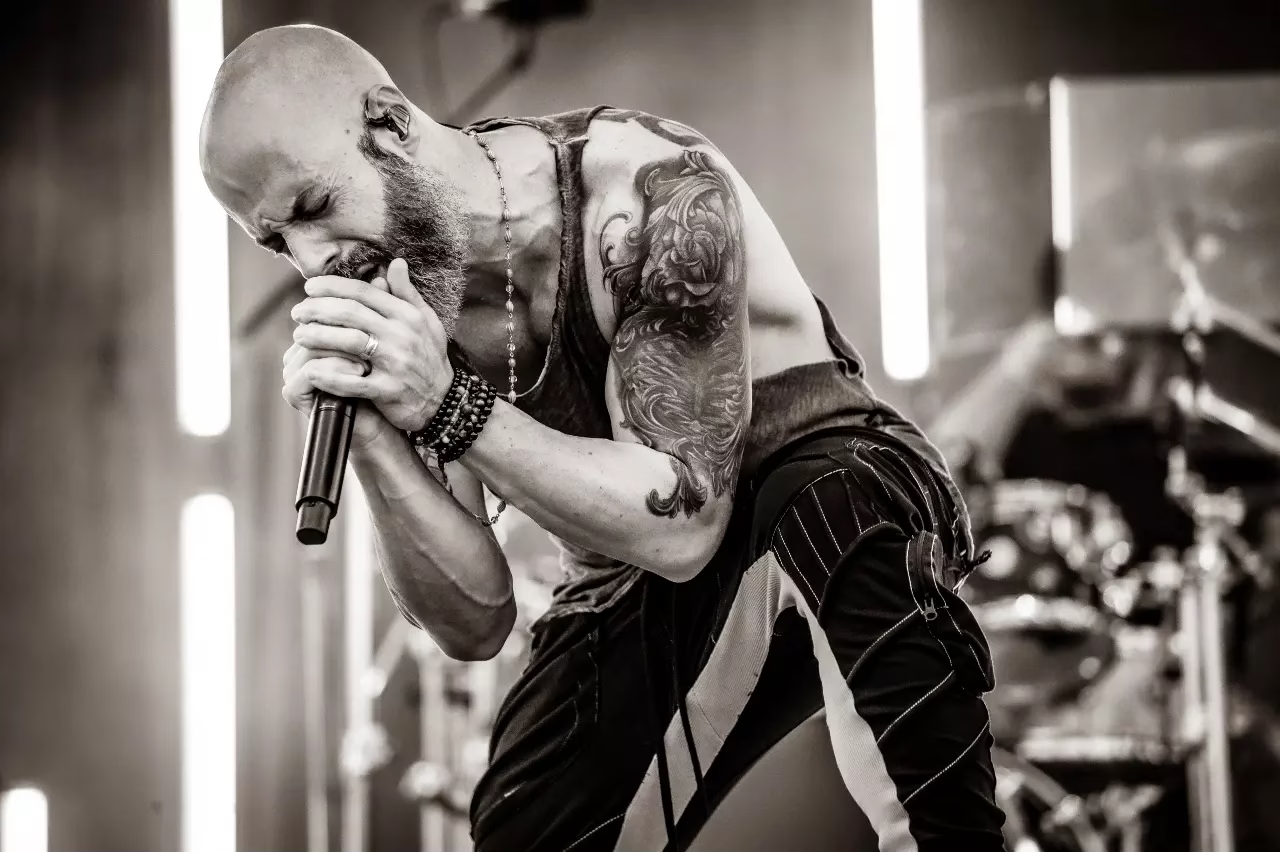
What a difference a decade and a half makes: the once-tightly-goateed young man nervously belting the Box Tops' "The Letter" for a skeptical Simon Cowell has sprouted a Michael Stipe-style beard and procured tribal tattoos. Like a streetbound, malnourished Maine Coon rapidly regrowing its coat and gaining healthy weight upon adoption, he looks prosperous and healthy. For the former service manager at a car dealership who's been through hell and back in music, it's been a wild ride to artistic liberation.
If not for his doggedness drive for success, everything about Chris Daughtry's early life suggested anonymity. He worked said day job in North Carolina while obsessed with '90s rockers from Live to Stone Temple Pilots to Alice in Chains, he performed gigs locally.
After an audition for "Rock Star: INXS" in 2005 proved to be a nonstarter, Daughtry auditioned for "American Idol" with a bittersweet overture from Deanna. "This is his dream, and when he married me, he took on my two kids," she exclaimed on-camera through tears. "I'm so emotional because I know this is his chance." His yowling, pitch-perfect version of "The Letter" was his ticket into the show—despite Cowell's rejection due to perceived "rushing" and lack of charisma.
Throughout Season 5, Daughtry climbed and climbed as the show's resident "rock guy" in the stead of Season 4's Bo Bice, who lost only to Carrie Underwood. But where Bice was a shaggy Southern boy, Daughtry looked chiseled, streamlined and severe, a quintessential modern rocker rather than a throwback. While he wound up eliminated in fourth place, he had clear marketability outside of the show. Sure enough, his looks, voice and vibe carved his path into the majors.
Despite the occasional critical jeers and sheer number of chefs in the kitchen on Daughtry—plus, "I hate the way I sound" on that record, he says today—Daughtry felt validated by the response. Later, he said he harbored no fantasies of winning the show. "I don't know how it could have got any better," he expressed in a 2009 interview. "We've sold almost six million records. So I'm not sure where the title [of "Idol" winner] makes that any better."
"We have these conversations with the band all the time: They're like, 'Man, it obviously worked, whatever you were doing.'" Daughtry says today. "I'm my own worst enemy when it comes to critiquing myself. I'm very happy, obviously. I'm super pumped for what it did. And if that meant not knowing what I was doing and just going in there green and riding the wave of excitement, then so be it."
The band's second album, 2009's Leave This Town, was mostly in the aesthetic mold of its predecessor and landed in the ballpark of its sales. Still, getting there wasn't a given: There was every chance of it flopping. "Leave This Town was a very stressful record because we were right off the heels of major success with the first album," Daughtry recalls. "You can't help but feel this unspoken tension and pressure to do that again."
<style>.embed-container { position: relative; padding-bottom: 56.25%; height: 0; overflow: hidden; max-width: 100%; } .embed-container iframe, .embed-container object, .embed-container embed { position: absolute; top: 0; left: 0; width: 100%; height: 100%; }</style><div class='embed-container'><iframe src='https://www.youtube.com/embed//0d0ICNaiW6A' frameborder='0' allowfullscreen></iframe></div>
And in the end, "It did okay," he says. "It did one and a half million or so, but I felt like I got the record that I wanted. There was no songs thrown in last minute that I didn't write or something like that. Then I think it progressively got a little more trickier to navigate that balance of digging my heels and playing ball.
"There was a part of me that was also seeing a huge decline in record sales, and correlating that with my own creative relevance or abilities," he continues. "And me going, 'Well, maybe there is something to this. Maybe I do need to be paying attention to what other people are doing, and maybe I do need to be changing with the times.'"
When Daughtry listens to Leave This Town these days, he hears a guy beholden to his influences, yet inching toward his own style. "With a lot of artists that I can go back and listen to, you can hear their influences on their first record a lot more than records that proceed it," he says. "To me, I instantly hear who I was listening to at the time, as opposed to like, 'Oh yeah, that's just me.' But that's just me nitpicking. And I don't know if anybody else would hear it, but I definitely do."
His internal editor and nitpicker might make hay with Daughtry and Leave This Town, but Daughtry has special affection for the band's third record, 2011's Break The Spell. "I love that record," he says. "I had a blast making that one. I think that was one of the records that didn't have any real outside influence, but at the same time, didn't really... Well, it showed in the record sales. I didn't really have a lot of backing from the label either."
It's worth noting that Daughtry's career to date had been haunted by an endless parade of new A&R reps, all subjecting him to a new and confusing vision of the band before dematerializing and being replaced just as quickly—rinse and repeat.
"With different A&R people, you have different versions of who they think you are," he says, still sounding pained. "This person, they may think you're this kind of band. Nobody really got where to put us. Nobody understood it after our first two records. There was a lot of turnover at RCA and I think we had a different A&R person for every record."
"It was always trying to get to know the next person and trying to explain the type of record you wanted to make, he continues. "Then, in the middle of making one, you find yourself being like, "I don't know if this is what we were going after, but hey! We're playing ball here and everybody wants to make money and be successful.' So I definitely played my part just from being surrounded by peers saying 'Nobody's playing guitars on the radio now. You got to do this to stay relevant.'"
That Chicken Little-style harbinger of the "end of guitars" brought about Break The Spell's 2013 follow-up Baptized, an extremely commercial detour that remains the biggest sticking point for the singer. He's still audibly frustrated about that experience. "Looking back, there were moments where I'm like, 'Yeah, that missed the mark,'" he admits with a wince. "I can see why maybe we got a lot of flak from the fans on, especially, Baptized. That record was an... experiment, for sure."
Read More: Daughtry Is Reborn On Baptized
The band put most of their chips on the electro-pop single "Waiting for Superman," which seemed like a surefire slam dunk. "A&R at the time got more excited than I've ever seen an A&R person yet over a song," he says. "And you start to go, 'Oh. Well! if they're that excited, that must mean something good. It felt a little over-the-top pop for me, but I was playing ball. I was mesmerized by the hype that was going on around me."
That hype didn't translate into the marketplace, though: "Waiting for Superman" stalled out at No. 66 on Billboard's Hot 100. At this point, Daughtry's frustration reached its boiling point; the back-of-the-envelope calculus for success made no sense to him. "Wait a minute. I'm doing all the things they're saying to do to get this result, but A. they're not pushing it, B. we're not getting the results," he remembers thinking. "Why am I doing something that I don't fully believe in?"
The relative failure of the single catalyzed a period of depression for the singer. Why had he been signed in the first place if they didn't want him to be him? "I started going downward mentally," he says. "I started second-guessing myself as a writer and performer, and my relevance in this new world of music that I didn't quite understand from the time I started in 2006 to now. It just felt so foreign and different to me, and I wasn't doing what I naturally did, which was rock."
Daughtry fulfilled the band's RCA contract with 2018's Cage To Rattle, which the latest suit pitched to him as a return-to-form rock album. "He's like, 'We're going to f***ing make a rock record,' I'm like, 'Yes!' He's like, "Get [Kings of Leon producer] Jacquire King." I'm like, 'Yes!'" he remembers. "Then, a new A&R person comes in and trumps his say." At that deflating moment where he realized this record would be like the rest, Cage To Rattle began to float away from what Daughtry envisioned.
"They're saying, 'Oh man, you do this song, we're going to have a big hit,'" he says. "I'm like, 'I don't know.' I argued with them. I argued, I argued, I argued. I finally caved. The song did nothing and I was like, 'This is it. Once we're done, we're done. We're parting ways. If they don't take me up, I'm not going to be mad at this.'" In the end, Daughtry "parted ways mutually" with his label and management.
Fast-forward to 2020: As the COVID-19 pandemic became entangled with global racial protests, Daughtry looked at the world, examined his feelings and began to write. "I've never really been one to write about current events, never been a political person, never been anyone to be kind of moved by the things going on around me," he says. "This is the first time that I felt compelled to write how these things made me feel."
<style>.embed-container { position: relative; padding-bottom: 56.25%; height: 0; overflow: hidden; max-width: 100%; } .embed-container iframe, .embed-container object, .embed-container embed { position: absolute; top: 0; left: 0; width: 100%; height: 100%; }</style><div class='embed-container'><iframe src='https://www.youtube.com/embed//6NdbIoLOFoc' frameborder='0' allowfullscreen></iframe></div>
Such was the batch of songs that eventually comprised the liberated Dearly Beloved, which Daughtry calls "100 percent, hands down" his favorite record he's made. The single "World on Fire" especially carries the weight of his newfound introspection and world-weariness.
"Right before the s*** hit the fan, Australia was on fire," Daughtry says. And I remember being in the studio and we were just scrolling through Instagram as we do right before a session—we're having our coffee just looking through the news or whatever—and I just remember going, 'Dude, literally, the world is on fire. No matter where you turn, something is totally f***ed.'" And I think [producer] Marti [Frederiksen] was like, "'World on Fire,' man. That's a good song title."
Daughtry. Photo: Sara Fish
Whether or not the glitchy, stadium-scaled rock on Dearly Beloved is your cup of tea, there's a poignant thrill to hearing an artist break out of his industry fetters and do exactly what they want to do. In the videos for both "World On Fire" and "Heavy Is The Crown," Daughtry is cast as a Jack Reacher-style action hero fending off a cabal of shadowy, suited baddies with choreographed moves, which seems pretty biographical. Semi-inscrutably, both end with the same disclaimer: "To be continued."
But those three words seem to sum up Daughtry, who despite commanding millions of fans worldwide, has spent 15 years in the business clearing his throat so he can finally do what he wants to do: Be a rock 'n' roll singer, full stop. Given a crystal ball, is there anything he would tell his 25-year-old self, who, for better or worse, was about to be fed into the thresher of the music business?
"I would say have a clear vision," he concludes. "Because if you don't, someone's going to give you one."