
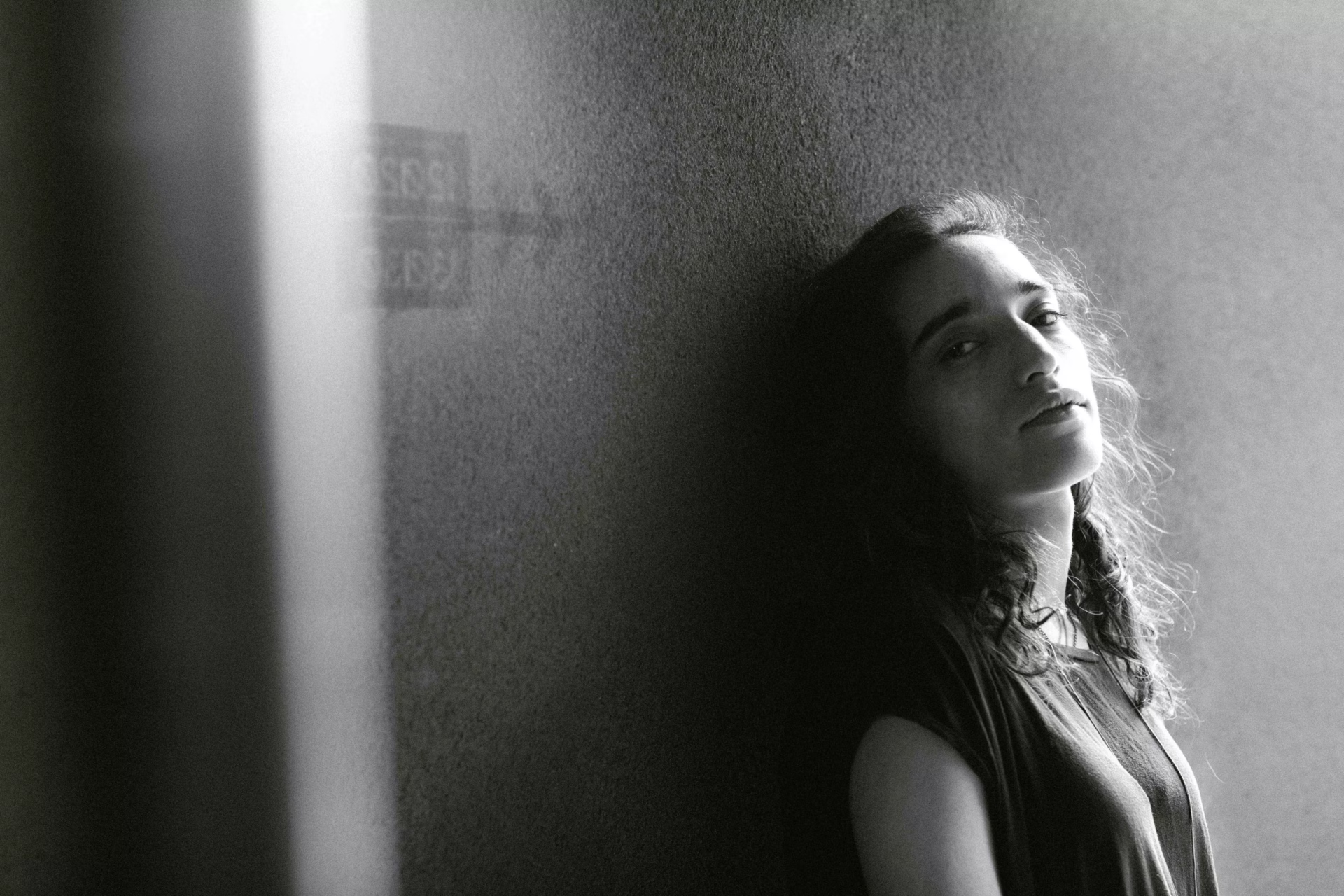
Techno was born in the bedrooms and warehouses of Detroit in the '80s; it was the sound of the future and the sound of freedom. It was given form by young Black and brown innovators, whose communities were hit hardest by Reaganomics and the War on Drugs. It's no wonder that, two decades later, Sama' Abdulhadi would discover the freedom and expansiveness of techno as a teen and bring it back to fellow dreamers and creators in her conflict-impacted homeland of Ramallah, Palestine.
For the past decade, Abdulhadi has been building the electronic music scene in Palestine via her deeply inclusive creative collective, The Union. Her world opened up in 2018 when she became an overnight sensation with her Boiler Room debut, which currently has over 7.2 million views on YouTube and is the twelfth most viewed Boiler Room set (with the majority of the top sets posted 6 or more years ago).
As she tells GRAMMY.com, she went from getting around three bookings a month to 40 a day after Boiler Room. Then, in December 2020, while filming a set for her Beatport virtual residency highlighting DJs of the Middle East, she was arrested. The team had secured permits to film there, at Nabi Musa, a cultural site and tourist attraction that includes a mosque, yet has hosted many non-electronic music events. While the situation has yet to be resolved and has kept the rising star from being able to return home to Paris, it proved to her she's part of the international techno community and they have her back.
<style>.embed-container { position: relative; padding-bottom: 56.25%; height: 0; overflow: hidden; max-width: 100%; } .embed-container iframe, .embed-container object, .embed-container embed { position: absolute; top: 0; left: 0; width: 100%; height: 100%; }</style><div class='embed-container'><iframe src='https://www.youtube.com/embed/f5_WbmIOu74' frameborder='0' allowfullscreen></iframe></div>
Read on for a wide-ranging conversation with the techno powerhouse, who details her meteoric rise, the artists—all dear to her heart—she chose for the Beatport residency, being inspired by her activist grandmother and more.
How did you approach curating the lineup for your Beatport residency celebrating the Middle Eastern scene?
Basically, in the beginning, I was trying to think of the artists that inspired me the most throughout my life, the people that I know and I've seen [perform] and, I really think, deserve a slot in the world and are not heard at all. That's where the idea started.
The Middle East was an easy one—actually, not that easy because I had too many names and I had to remove some. I started with my teacher; he's literally my teacher, the one that taught me in uni and the one that taught me everything about DJing and everything in my life that I know in audio in general. So, that was one of, obviously, the first names.
I was also thinking of my students and the ones that also have been doing some great things and deserve a slot. So this, that, my collective, and my favorite DJ in the world is a Lebanese DJ, so those were my picks. That was mainly it. Then we were thinking of ideas behind each episode. I really wanted to do one Middle East, one North Africa, but we couldn't do that easily.
But we were thinking, "OK, we could do an episode from my collective, The Union." Sadly, we have three really major DJs from The Union that are living abroad right now, so they are not here. So we included the four that are here, and I was the fifth. Two of them [that participated] are people I've been working with, my students. I literally was preparing their set with them and helping them. It's like I'm watching my mini-me.
And the two others are DJs that I really, really look up to in Palestine. Bruno Cruz is one of my best friends from Haifa, one of the first people I met there. And SINAN, I discovered him in an expo that I hosted of DJs from Palestine to showcase for international bookers or festivals.
So this was The Union collective, the first one. The second one was the Middle East, which I talked about. The third one is friends of The Union. The Union always does parties in Palestine and invites other people to come and enjoy them. The last lineup is a mix of them; two of them are Union, but they live on the other side of the world, so it's really hard for us to even meet. The rest are friends that we have met throughout randomness of life by luck, I guess. Which is good. We still have lucky moments here in Palestine.
When you mentioned your favorite DJ, I heard you say during the last show that it's Jason Kaakoush?
Yeah, the Lebanese one. Brilliant. I've been watching him since I was 19. I've never seen him make a mistake and he plays CDJs, which is really hard not to make a mistake. He's such a vibe on stage. His smile is just amazing and he, as a person, is just one of the nicest people I've ever met. I have a lot of favorite DJs. I love a lot of DJs in Lebanon, but every time I see him I get chills and I've been seeing him for 12 years. That's a lot.
Who did you say was your teacher?
My teacher is LK, the first one that played for week two.
I'd love to hear a little bit more about the collective you formed, The Union. What was your vision for it and where are you hoping it'll go?
In the beginning, I really wanted to do a festival here [in Palestine], and I'm not [usually] here. I'm in France most of the time. So, I asked my friends that I work with here, who said, "Let's start building to make a festival one day." So I'm like, "OK, we need to create a community that would want to do that." So we started creating a safe space for everybody to come and party and be totally chill.
We do actually have collectives here in Palestine mostly in rap—some DJs, but a DJs collective that goes maybe from places is different than what we wanted to do. We wanted to create a collective that is not just DJs. We have people that were artists and wanted to do [some] painting in the location. They wanted to just help us fix the place. People that just wanted to party joined the collective.
So the collective becomes insane and the friends of the collective become bigger, and so we created this whole community and a safe space for people to literally do whatever they want, no police, no security, no nothing, but there's always mutual respect and there's always the thing of, "We are all one." For example, nobody takes more than the other. Everybody works everything, so if I'm DJing for two hours, I also would have to stand at the door and sell tickets for an hour, guard the bathroom for an hour. We are constantly all on rotation. The people helping the DJs.
The sad thing is that we have two people that studied sound engineering in the collective, so me and her—two females, too [smiles]—are always in the audio engineering department. But we also teach audio engineering to people who are interested to know how we're doing this. So now we have more audio engineers.
One of my kids, I've been teaching since he was 13. Now, he's 20 and an electrical engineer and a crazy DJ—a really incredible guy. Now he lives in Berlin. I was so sad he couldn't join us for the residency because he's in university now. He is studying this electrical engineering because he really wants to build his own speakers himself. He made a full-on light and laser system, brought it with him from Berlin, put it up in that space that we created. Before he left, he started teaching each one of us how to take it apart, how to fix the wires, and how to do the coding.
It's just sharing knowledge and being in one community. It's not competitive. We're not competing with any other community. We collaborate with all the collectives, and we're just trying to build a base so then there might be can be a bit of competitiveness where there's a little bit of money in the business. It's really cool because we grew so many new DJs that didn't think they wanted to be DJs. A lot of people made a lot of things and we created such a beautiful family that is incredible, honestly.
That's so cool. I mean, I've honestly never heard of anything quite like that. It sounds very inclusive.
This is why I used to love to come to Palestine and play with The Union. I would fly from Europe to here, which would cost 2,000 euros and I would end up having $100 after all the work that we've done, but it's so worth it. Seriously, it is my favorite thing in the world—the best party ever.
Everybody knows each other. It's like how I imagine Detroit or Berlin was in the '80s. It's really heartwarming. It's way more beautiful than going to a club with a bunch of security guards around you when you're trying to talk to people, but you can't talk to people when there's the stage and the separation between the DJ and the people.
Read: Seth Troxler On His Detroit DJ Education & The Rich Black History—& Future—Of Dance Music
What is the scene like in Palestine now? And what was it like back when you were a part of creating that scene?
It was a scene that is growing. Sometimes you do a gig and there are 400 people. Sometimes you do a gig and it's 10 people, literally, two gigs after that. You never know. The opinion was it was growing and growing, but we didn't know that we were living in a bubble and that people didn't know we existed until all this thing happened over in December with me going to jail.
So, now I don't know because for the past year there's been Corona so there's nothing happening. But I hope that now when we do a test run, we'll see what happens. Maybe we actually gained more fans and we have more exposure around Palestine. So it might be going well without us knowing, we can't test it.
It's like, "What is going to happen when we can all get on the dancefloor again together?" I don't think any of us can predict that.
I think everybody's just going to be moving weirdly. I'm not going to know how to talk to this many people. I'm just going to get shocked when I see 1000 people in Berlin. You're talking about 60,000, that sea of humans, but seeing 100 is just insane right now. I feel like I'm going to be weird. I'm so excited for it.
I wanted to talk a little bit more about your experience being jailed and, specifically, what the support from the larger dance community felt like for you. And what your biggest takeaway was from that difficult experience was
That was a really difficult experience. In the beginning, I didn't know there was support happening because I didn't have the chance to talk to my family, or lawyers or anything. I was in the dark completely for the first four days. On my first phone call with my brother, he's telling me that Adam Beyer and Nicole Moudaber and Roger Waters are talking about it and I just started laughing. I'm like, "Yeah, right. You're just trying to make me feel better. This is stupid. Don't say things like that, bro."
That's the thing that made me proud to be part of the techno community. Because it is a community, actually, more than it is an industry. And I've always thought that about techno and they proved it because everybody just stood with each other. I never really expected that at all. It made me so proud to be part of it. Seriously, when something happens to one of them, everybody just goes up.
That was really important for me mentally, to be OK. Because I really was thinking, "Am I doing everything wrong? Am I wrong?" [Being jailed] was really making me doubt myself, but then I was like, "Okay, no. I'm not wrong. We can't be all wrong. It can just be diversity and that is what it is. The world is diverse."
There are all kinds of music that I don't like to listen to, but other people do listen to. That doesn't mean their ears are bad, no. It's just taste. That's the beauty of music, that it is just a language and you cannot control it, it's vibrations and they're going to hit you. They either resonate with you in a good way or a bad way, and that's the cool thing about sound and frequencies, and even the sound of the wind in the trees and the birds.
It's constantly on and they will always hit you and affect you with the vibrations. If you cannot hear, you will still feel vibrations and they will still affect you in a way. That's the beauty of sound. That's why I love it.
Another Techno Queen: Maya Jane Coles On Representation, New Music, Creative Limitlessness & More
That was poetic. I love that. It's so true.
Thanks. [Laughs.] I used to always give workshops when I was back in Egypt. And whenever there was a film workshop, I'd give audio workshops. The film department would give me one day because the sound is always bad in Egyptian films.
I'm like, "The film has zero meaning without sound." If you turn off the screen in a horror movie, you will still be afraid of the sounds. If you turn on the screen and turn off the sound, it will become a comedy show. It will be so stupid you won't feel anything. You won't be jumpy, you won't be scared. Nothing. You might be disgusted by blood or something. Sound is very essential.
Have you thought about doing film composing or scoring?
I did do that for five years of my life. Before I became an international DJ, I was doing that. I was just DJing for fun. I was an audio engineer; a sound designer and music composer for films. That was my main job in Egypt. I used to do sound design and music scores a lot.
That was the main thing. I was DJing as a thing that I liked to do when I come back home in Palestine. I didn't even DJ in Egypt. I DJed twice there in five years. DJing wasn't my job, it was something I did for fun, and then I switched. It was a thing that I've always wanted to go into, but it was never going to happen, ever, so I just put it on the side. You can never become a big DJ. It's impossible. I still don't believe that I'm a big DJ. Whenever anybody says that I'm like, "Nah, that's stupid."
Well, you can go make music for more films. That's a good plan B, I would say.
Always, definitely. I'm actually working on a composition project now for a film, actually. And I did one, actually, for a French documentary about a French techno scene. I have three tracks in that that I made for the film, but they're techno tracks this time. Back in Egypt, I used to do orchestral compositions, jazz, alternative, Arabic, that kind of music. Now they ask me to compose techno for films.
How do you feel like that experience informs your DJing?
I add a lot of ambient sounds now in DJing, so there's a lot of cars, birds, planes and things. I just hear them subconsciously. They just cross my mind [when DJing] and I press a button and it comes out. I've tried chainsaws in a couple of times.
Yesterday, I was recording a set and in the beginning, I have ambience of the street in Pakistan where a street seller—every time I hear that dude, it's like he's rapping. Well, I have no idea what he's selling, but his voice is so good and then you hear a honk here and a motor there, and it's beautiful. So, the intro is the track playing and there's constantly this ambience of this Pakistani dude for three minutes
Do you do field recording or record random stuff when you're out and about?
Yeah, actually. My [BBC Radio 1] Essential Mix, in the beginning, it's a binaural recording, 5.1 surround sound, going from King's Cross in London to Paris. So, you hear yourself going through the metal detectors, and then you hear the announcements in the train, and then the train is moving. Then the track continues. The beat in the track drops when the train moves.
Yeah, I do record a lot. Actually, I never knew that people were noticing the bird [sounds I put in live sets], but it's a thing. Whenever somebody whistles in the crowd, I whistle back by sending the bird. I'm like, "Ta, for you, man! Thank you." Also, when I get on a stage—especially if it's a big stage and nobody can see you—the second I get on the stage I play the first track and then I just hit this screech from the bird and I drop something cool.
I thought I was doing it for me because I thought I was the only one hearing it, but I played a really underground crazy party that they do in France. It's like the parties we're having here [in Palestine], but the only one left in France is that one. They don't tell who the DJs are, and you cannot see them. There are no lights in the place, just one tiny light next to the DJ, who's on a rooftop there. Nobody even looks up because everybody's just dancing, and they don't care who's playing as long as the music is good. It's beautiful.
I go there and I'm playing and at the beginning, I play the bird. I hear from the crowd someone yelling, "Sama!" I started noticing that maybe people know the bird, so I make it more of a signature move now.
"When I see a Palestinian flag in the crowd, I feel the ultimate goosebumps. It's really, really rewarding for me because I've always lived in war, I've always lived under occupation, and I felt I couldn't speak. Now, I can say what I want to say, and some people are hearing it."
I'm sure you've been asked this question a million times, but what does it mean to you to represent Palestine, as well as the larger Middle Eastern dance scene, on the global dance music stage?
It's overwhelming and scary because I always have to answer really, really tough questions that always have a wrong answer. Most answers can be wrong, depending on who's listening. It's tough and it's really not fun that I'm always in political talks. When Trump decided to give Israel Jerusalem as if it's his, I had interviews that same day, seven of them, and I had a huge event that night. I go to the interviews, and all the bands are getting asked about the show. But all the interviewers asked what I think about Trump.
But, at the same time, it's a huge honor to be representing Palestine because I love this country and it's always something that I wanted to do. It makes me proud being Palestinian. When I see a Palestinian flag in the crowd, I feel the ultimate goosebumps. It's really, really rewarding for me because I've always lived in war, I've always lived under occupation, and I felt I couldn't speak. Now, I can say what I want to say, and some people are hearing it.
People are learning what the meaning of the word Palestine is. They don't even know it's a country. Some people are like, "You say Palestine. What does it mean?" I don't know what to tell them. It's a really random question, but I didn't know that there is a human that doesn't know what the word. I thought it was in the Bible. It's like, "You know Bethlehem, you know Nazareth, but you don't know the word Palestine. Wow." It's weird.
Some people also think that these are fictional places, they're just in the Bible, so when I just say, "Bethlehem," in a conversation, they're like, "Wait, that's a real place?" How, how?! I guess ignorance is bliss and they're living the ultimate bliss, honestly.
To follow it with a slightly political question and, to your point, I think that there's a lot of ignorance around what's going on in Palestine. What do you feel foreigners need to know about the humanitarian crisis in Palestine? And what can we do to help or to learn more?
Well, especially for the U.S., it's like, "Don't pay taxes," but you can't [do that]. That is the sad part, is that everybody in the U.S. ends up paying Israel without even knowing it. It's like here [in Palestine], it's also not optional, we have to pay for Israel because they tax us for everything that we do.
But [you can] call your representatives and tell them, "We don't want to pay for Israel's military war. You can pay for Israel's schools, but not bombs." I always wear this [on a] necklace, it's a bomb safe clip, they are literally all around Palestine. You can find them on the ground because of how many bombs [are detonated].
Israel takes three-quarters of the water that we get from rainfall, and they give us a quarter of the water that falls in the West Bank. It's [water from] the West Bank, not Israel. That's free for them. We're not allowed to travel. We're not allowed to import and export what we want. It's chosen by them, everything that we can do. We're not allowed to move between our own cities; between two Palestinian cities, there's the Israeli Army in the middle stopping you.
It's so much. They have so many political prisoners that shouldn't be in prison. My friend's mom has been a Minister since we were kids. She's been in jail for three years now in Israel and it's not the first time. I've seen that woman go to jail since I was 10 years old, she's been going to jail every couple of years. My other friend hasn't seen his dad since he was nine years old because his dad's a political prisoner.
At the same time, you have children every day getting imprisoned, 12-year-olds, 10-year-olds. As a Palestinian, you’re not allowed to ride in certain buses, not allowed to drive or walk on certain streets. It’s proper apartheid.
The thing is, [the conflict] started so early on. Between 1948 and '76, we've had many massacres around Palestine. Millions of people were pushed out, millions of people were killed and then [the land is] Israel's. It's life, I guess. It's happened in other places, so we're just hoping it doesn't happen to us and they don't manage to completely remove us.
I wanted to ask about your grandmother because I read in your New York Times interview that she was an activist and a feminist. How do you think she influenced who you are?
I think she influenced I think my whole family, not just me. My parents too, and that's the way they raised me, that there is no difference between men and women. You can do whatever you want, you keep fighting for that thing, and you just keep saying what's on your mind. She was so strong, so powerful, so wise. She was the spokeswoman of Palestine PLO and the women's rights organization and she only finished high school. And she spoke fluent English.
Even later, she was just this incredibly strong woman, and she never just took no for an answer. She fought to the last minute in a crazy way. When she would protest against somebody, when Israel used to go and demolish things in Nablus, back in the war in Nablus in '67, she would demonstrate and sit in front of the bulldozer. My grandpa would go and pick her up and be like, "Don't be crazy. We have kids at kid." She's like, "But they can't do this."
And when they were holding people in Gaza and killing God knows how many thousands of people, she held a strike in Bethlehem where she created the Women's Organization. She got all these young women that really wanted to fight and that were so strong and so courageous, and brought them in with her and kept going.
When she stopped agreeing with what the PLO was doing, she just left the PLO the next day. That really inspired me. Also, back when I was a kid, she always told me to go for whatever I wanted to do. "Don't let anybody tell you you're not allowed to, especially if they follow it with because you're a girl. That's when you know you can do that and they're wrong."
That first experience was the football [a.k.a. soccer] thing. I was seven years old when we moved to Palestine from Jordan when we were able to come back, and I used to play football in Jordan. When I came to Palestine I went to school and the principal told me, "You're not allowed to play football because you're a girl." I was seven and that didn't translate [for me].
So, I went to my grandma, and she took me by the hand and walked with me back to school. The principal's a woman and my grandma graduated from that same school too, so her picture's on the wall, it was cute. She walked in and she was like, "How would you tell a seven-year-old girl to not do something because she's a girl? Do you know what that is for her to grow up learning that? That is the most wrong thing and you're a woman and you shouldn't do that." And the principal was like, "But no girls want to play football. It's just for her future," and so my grandma went crazier on her.
So, the principal says, "Fine. Let her find girls that want to play football, put their names on a paper and then I'll start a football team." She thought there were no girls who wanted to play. I made a sign-up paper, 20 girls signed up, and she opened a football team. That's why we had the best football team. It's small things like that. Whenever somebody tells me, "But you're a girl," I'm like, "What? You're a boy. Who cares?"
I don't know if you've checked recently, but your Boiler Room has over 7 million views, which is crazy.
No way! It was at four million the last time I saw.
Read: Jayda G Talks New EP, Promoting Diversity In Dance Music & Sharing Joy
So, yeah. You're a big deal. The internet says so. That Boiler Room was obviously a massive point in your career, especially for exposing you to the global scene. What has your DJ career felt like for you since that moment?
It went insane. It just went, "Zoooo," it just flew like a rocket. We were going together, working on each other, me and my DJ career. Then it just went like that and I've been just running after it trying to figure out what's happening, keeping up with everything.
But yeah, it was really rewarding because after working [as a DJ] from 2008 to 2017, that's nine years. In 2018, it was 10 years of me playing techno and nobody had heard it. Then, all of a sudden, I'm getting messages from every corner of the world, [from people in] countries I've never heard of are messaging me. I'm like, "What the hell is going on?"
And even that day [of the Boiler Room], after, we went to the after-party in a house and it was like, "Yay!" A friend was like, "Some of your numbers are going crazy," and I'm like, "Ha, ha. Nice one. That's a joke." Everybody was telling me that, but I thought they were just joking with me or telling me that I did a good job.
When I got home, my cousin opens her phone and I look at the number [on the YouTube video] and it's like, "What the hell is going on?" That weekend, my booker calls me and he's like, "Sama, what happened? Why do I have 40 bookings for you in a day? I used to barely get you three bookings a month." I'm like, "Boiler Room happened." He's like, "Oh, sh*t." And now I have no idea what's happening. The fastest jump in life, I think.
<style>.embed-container { position: relative; padding-bottom: 56.25%; height: 0; overflow: hidden; max-width: 100%; } .embed-container iframe, .embed-container object, .embed-container embed { position: absolute; top: 0; left: 0; width: 100%; height: 100%; }</style><div class='embed-container'><iframe src='https://www.youtube.com/embed/9Wn6x1m1APU' frameborder='0' allowfullscreen></iframe></div>
That must be crazy. Do you feel like you've caught up with it now that things slowed down?
No. [Laughs.] Because also, the me-going-to-jail thing just gave it another boost that was even scarier. I think I'd just like to pace myself a bit, but it's cool. It's good that we had the year break. I'm sad there was corona, but I'm glad I got a break that made me become human again.
Do you think there are any lessons or practices from this last year that you'll bring with you going forward to stay sane?
Hmm, stay sane. That's important. Yes. Back then, I had 20 gigs a month, so I was barely able to sleep. But now, I think, everything will be more regulated. Even me and my team, we fixed all the days now, everything is clear, everything is calm.
I spent the first six months in Paris fixing my new house because I had moved, and I hadn't even gotten my things out because I didn't have time to. I built my [home] studio finally. Now I have a home that is nice. I visited my family. It was good. I'm hoping to be more stable later and not having this crazy roller coaster thing. It was fun though. I like roller coasters, the adrenaline rush.
That was really a great conversation and I appreciate everything you're doing. Hopefully, sometime in the near future, I get to see you in real life on the dancefloor.
I'm coming to L.A. soon, I hope. I was supposed to do Coachella last year, so that is next year [now]. But I'm going to be at III Points in Miami in October and supposed to pass by L.A. It's [going to be] my first time in the U.S. I've just been there once in my life, 14 years ago for a doctor's appointment in Houston, Texas, where my uncle lives.
