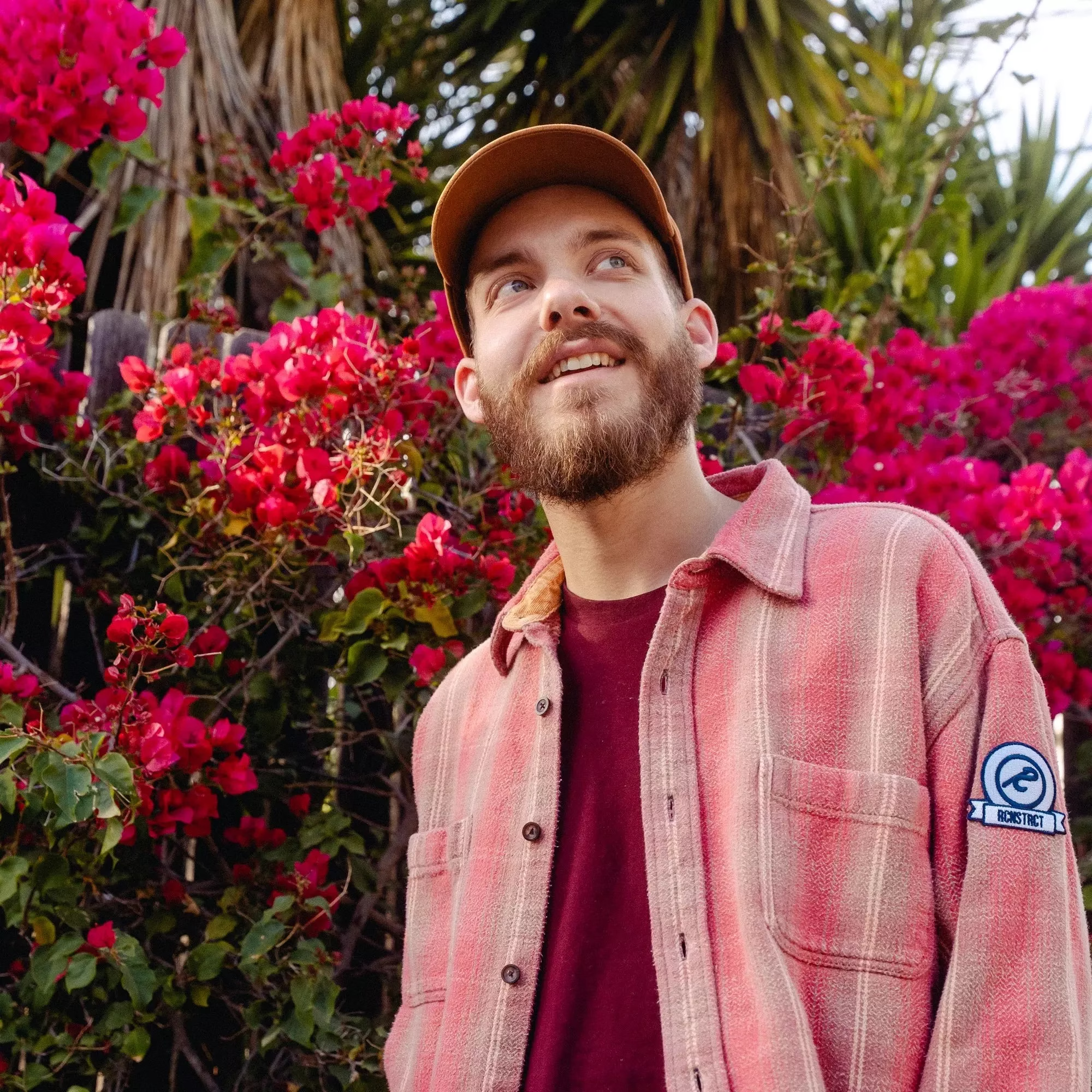
San Holo doesn’t call himself a DJ. Ask him for a more relevant term and his answer is simple: "I'm a musician."
It’s hardly left field to say that San Holo’s emotional productions feel right at home on a hip, college radio station. Instrumentals have always been a part of the Dutch artist born Sander Van Djick’s style, and his powder-pink electric guitar a present force at every live performance. Those hallmarks are likely to remain, even as his act evolves.
His signature approach shines again in his new 20-track LP bb u ok?, which arrived on June 4 via Counter Records. The extensive collection is an exploration of the analog sounds, soft vocals and surprising alt-rock cameos that have always set San Holo apart in a genre saturated by festival bangers and heavy bass. It comes as a follow up to his romantic and uplifting 2018 debut LP, Album1, and while many of those familiar, mellifluous chords persist in bb u ok?, there’s a palpable maturity to the new set of cuts, and a definitive rock edge—both fruits of gained perspective, perhaps.
"It’s like an indie album with EDM energy," he shares excitedly about the new album. "I feel like a lot of songs—even though they are sensitive—still have that level of energy and there's still a drop in there, you know?"
Between the opening strums of "i am thinking of you" and the final mirrored piano plunks of "one more day," he weaves a wistful, musical narrative that pays homage to his time in L.A. where he wrote the majority of the album in just two months. In his interview with GRAMMY.com, he speaks about the inspiration behind the highly personal album, the growing popularity of rock-driven electronic music, and what it was like to create art alongside a few of his greatest influences.
<style>.embed-container { position: relative; padding-bottom: 56.25%; height: 0; overflow: hidden; max-width: 100%; } .embed-container iframe, .embed-container object, .embed-container embed { position: absolute; top: 0; left: 0; width: 100%; height: 100%; }</style><div class='embed-container'><iframe src='https://open.spotify.com/embed/album/046wH7DEfUumC5h9ykIEkd'frameborder='0' allowtransparency='true' allow='encrypted-media'></iframe></div>
You’ve mentioned that Album1 was written during a period of your life when you were in love. How has your current phase of life influenced bb u ok?
It is definitely about the aftermath, or what happens after love and not per se in a very sad or depressing way. It's more about how you move on, and it's also about acceptance. I was in a relationship and it didn't work out. And it hurt like hell. But it's not like I'm saying, "Oh, I wish we could go back." I'm just saying, "This is life, and let's move on."
And I'm grateful for even getting to experience all these emotions. Also heartbreak, I know it sounds weird, but it's also a very important emotion to feel in your life. Life is a huge influence on my music. That's why it's so personal to me, I write everything myself or with people that I love. And when people like my music, it feels so good because, in a way, I feel like they understand me.
What does it take to build a highly personal album?
For me, it's really important that the album kind of feels like an ongoing story. In the first track, you hear a melody, and that melody comes back in the last track. So, it's kind of like a chapter. The first track opens a chapter and the last track closes a chapter, or maybe the book. When I write albums, it’s all about my world. You know the things I feel inside of my world and in my head, based on conversations and experiences with people. And I always try to translate those feelings and emotions that are oftentimes, really hard to put into words.
"the great clown Pagliacci" is one track that stands out specifically. Why did you choose to include that sample?
So, "the great clown Pagliacci" is featured in a part of the album that revolves around loneliness. It’s something I've been feeling a lot—you know, when you're on the stage, and the lights go on, you kind of feel alone again. Even though you're in front of thousands of people, when they're all gone, It feels so lonely back in the dressing room.
I heard the sample on a record from Mr. Hudson, who I love, and I pitched it down and made it my own. I put some guitars on it and I changed it up, but it just felt like when I first heard that doctor say, "I am the great clown Pagliacci." It just really hit me, because I relate to it, because people always think you are the clown, the performer, the artist, just a happy face on stage. But rarely do people get to see all the struggles.
bb u ok? features your own vocals. Was it intimidating to create something so authentically "you?"
It's always a little bit scary, and there are some takes on there that are not perfect at all. You can hear the noise from the laptop or the air conditioning in the background. But something about that made everything feel so much more personal. Because, I can see the Airbnb I recorded at. I can see the garden and the rooms in my head. And it’s just personal, and that's the only way I want to do it.
Instrumentals are a unique element of your sound. Which analog instruments were new to bb u ok?
I think the biggest analog instrument featured on this album that wasn't really featured as much on Album1 is the acoustic guitar, because there's a lot of songs that feature acoustic guitars, chords or melodies played on acoustic and then combined with a heavier electronic beat. That's definitely something new to this album—almost like acoustic dance music instead of EDM.
Have you always known that "rock" would be part of your on-stage aesthetic?
I remember when I started playing guitar in my songs and during my live shows, and even during my DJ sets, I would just pull up the guitar and play some parts. I remember people didn't really like it at first—I think 50 percent didn't really get it. It was after a remix I made got popular, and I went from playing guitar every day to DJing, that I brought the guitar back into my work. I really believed in it, so it worked for me. It’s become my thing. Guitars have a place in electronic dance music—I'm not talking about the aggressive solo [electric] guitars but the sparkly, kind of small indie guitar parts can also fit in.
There seems to be a higher adoption of that trend now. Why do you think that is?
I think it's just a natural progression of artists who make electronic music wanting to add more organic sounds. There's a whole new scene coming up that is incorporating guitars and their vocals into their electronic productions. Maybe it’s because back when I was like 15, I asked my mom, “Mom, can I get a guitar? Can I have guitar lessons?” And nowadays these kids probably say, “Hey Mom, I want to be a producer.” So, [the computer] is their first instrument.
You’re obviously a fan of indie music. What was it like working with a genre pioneer like Weezer’s Rivers Cuomo on “wheels up”?
He randomly hit me up on Twitter one day. He was like, “Hey I just heard one of your songs, and I love it.” I was like, “Is this really happening? Rivers Cuomo?!” I was double-checking if it was really his account. He asked me to send him some stuff—the amount of times artists have told me to send them stuff, and then I send them something and nothing happens.
But I made a track in the studio anyway, sent it to him, and I think, literally a week later, he sent back his vocals, and I was like, "Whoa, this is so good!" And then we went back and forth about some words and some more nuanced stuff. And then he recorded the vocals and I had a great take. For me, it's really funny because I used to be a guitar teacher after I graduated from the conservatory. I used to teach kids "Say It Ain’t So." Now to work with him—it’s so surreal, it's full circle!
Mija is another cool collaborator on the album. Is she someone you’ve always wanted to work with?
I haven't worked with her before but she was always someone that I thought also doesn't necessarily belong in the DJ world. She was a DJ for a while but now she's just doing whatever she wants, and I always felt like I related to her because I felt the same. I just appreciate Mija for doing her own thing.
So is it safe to say you feature a lot of artists who make music you prefer to listen to?
I'm really excited about the collaboration with American Football. They are a band that rarely collabs with anyone and, yeah, they definitely influence my work a lot. I think I am the first electronic artist to ever collaborate with them.
What do you want people who are struggling with a heartbreak to take away from listening to this album?
If you listen to the song and it touches you, then I've already done my job. I just want people to relate to it, whether it makes them sad or happy. For me, that's the beautiful thing about music—it’s different for everyone. I wrote the songs from my perspective and my emotions, and if my emotions can help someone feel something else, that's beautiful.
There's a song on the album called, “i get lonely around people, too.” I guess we all feel lonely around people sometimes, right? It's not like being around people makes you less lonely. It's a feeling that comes from within. The entire song has me repeating that phrase, “Don't you worry, it's not you, I get lonely around people too.” It's about relating to each other and even though we all have our own lives, and we get lonely in our heads sometimes, it's important to understand that we all have our own problems and our own struggles.
Given the content and themes, does now feel like a perfect time to share bb u ok? with listeners?
Even though the album was written before the pandemic, I think a lot of topics make sense for the current state of the world. The last song is called “one more day,” and there's a line that goes: “If we only had one more day, what’s the last thing you would say?” It's something so relevant for me throughout this pandemic because of all these existential thoughts [I’ve had] about life, how fleeting the moment is and how short life is. It still makes so much sense to release it right now.
Porter Robinson Finds Peace With Passionate New Album, ‘Nurture’