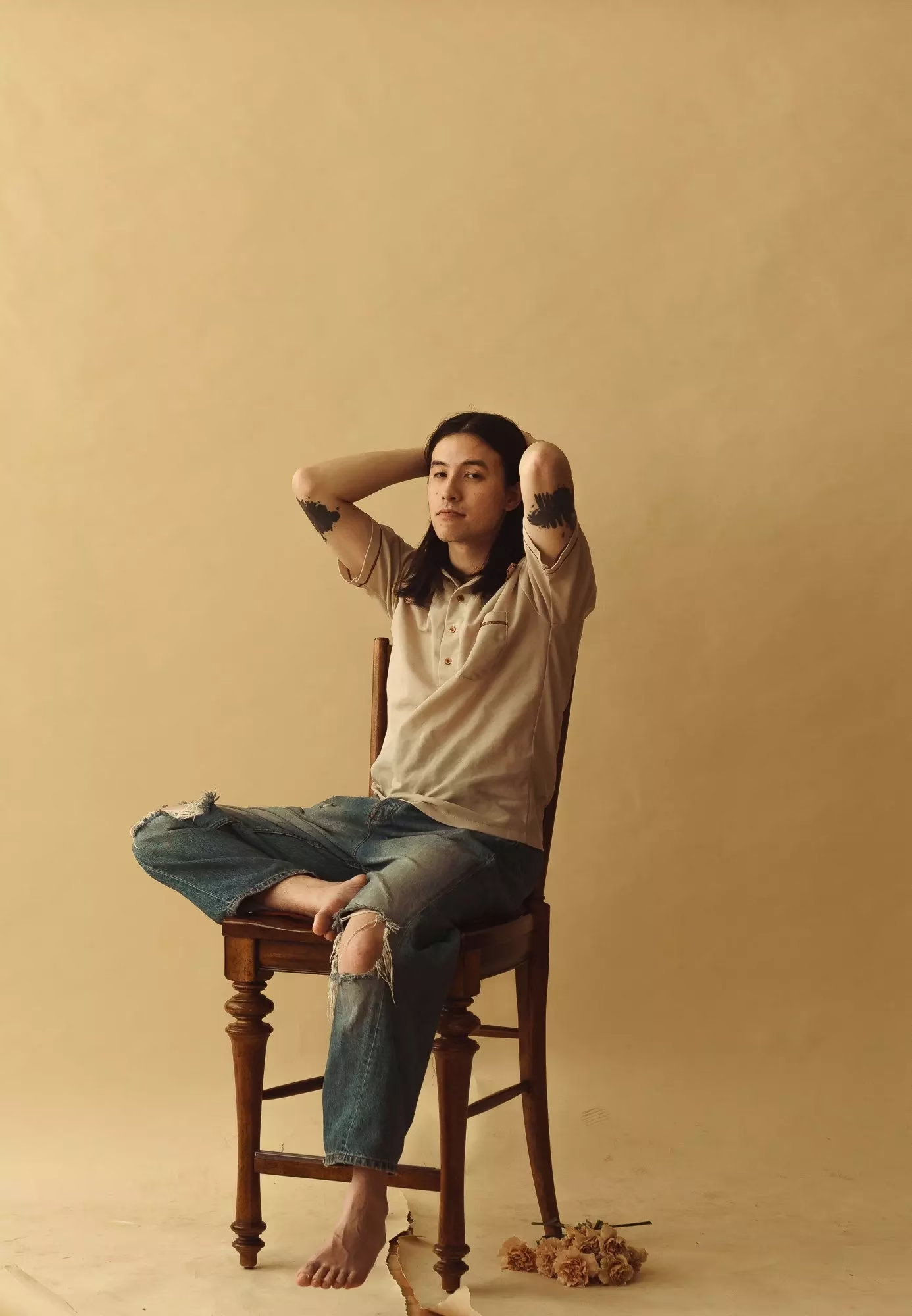
Sen Morimoto could do it all himself, but he chooses not to. And though he has a friendly relationship with Asian-American entertainment company 88rising, he’s not content to churn out content for corporations either. The sweet spot for Morimoto’s art exists in the middle, where his music can reflect himself and the communities around him.
Originally from Wendell, Mass., the 26-year-old musician moved to Chicago in Jan. 2014 and first entered the music scene through a solo performance of his self-produced jazz/hip-hop/electronic music at now-shuttered Logan Square venue East Room the following winter. Morimoto released his debut studio album, Cannonball!, in 2018 through 88rising and local indie label Sooper Records, and he signed on as co-owner of the latter soon after. And though he has helped build a community around his label, he’s well-known throughout the city’s music scene; Morimoto often joins rap crew Pivot Gang on group video calls for friendly beat-making and verse-writing competitions.
Morimoto’s self-titled sophomore album, out Oct. 23, is his best work yet, with its clear presentation of the artist’s multi-faceted sound. Lead single "Woof" transitions from grumble-rapped verses to sung half-rhetorical questions on the chorus, using trap drums and sticky acoustic guitars to convey mental turmoil. The album’s guest list is similarly eclectic, featuring fellow Sooper artists (and personal friends of Morimoto's) NNAMDÏ and KAINA, Pivot Gang’s Joseph Chilliams, Lillie West of rock act Lala Lala, and more.
<style>.embed-container { position: relative; padding-bottom: 56.25%; height: 0; overflow: hidden; max-width: 100%; } .embed-container iframe, .embed-container object, .embed-container embed { position: absolute; top: 0; left: 0; width: 100%; height: 100%; }</style><div class='embed-container'><iframe src='https://www.youtube.com/embed/V_ejET16maY' frameborder='0' allowfullscreen></iframe></div>
In July, Morimoto withdrew his previously recorded performance from the city’s Millennium Park At Home livestream concert series, after he refused to remove a statement critical of Mayor Lightfoot from the performance video. In his initial statement, Morimoto criticized the "lack of action that has been taken by Mayor Lightfoot and our elected officials here in response to some 100,000 protestors in Chicago demanding the police be defunded and CPAC [the Civilian Police Accountability Council (CPAC)] enacted.” After refusing to pull his initial statement from the performance at the Department of Cultural Affairs and Special Events' (DCASE) request, Morimoto made a second statement to Pitchfork, reiterating his original stance, adding, "highlighting that this situation illuminates another way in which the current administration works to silence voices of protest.”
Morimoto and Tasha, the opening act who pulled their performance in solidarity, instead released their performances on a YouTube livestream a few weeks later as a fundraiser for the Prison and Neighborhood Arts and Education Project.
As the weather changes, Morimoto and the Sooper crew are shifting their focus to safe promotional methods, holding COVID-friendly practices with various iterations of the nine-person band backing him for his album release livestream performance, and selling records, T-shirts and tickets directly to fans near a neighborhood farmers’ market. Sen spoke to GRAMMY.com in early October from his Humboldt Park apartment about collaborating with talented friends, learning from jazz summer camp and the cliches of after-gig small talk.
How do you know when to bring a collaborator onto a track, and who it should be?
Part of the reason I enjoy having friends feature on songs of mine is for most of them I’ve worked on their music, so I can tell what they’re into sounding like or what they haven’t done before. Sometimes it’s as simple as being like, "This sounds like a Qari song, what if Qari was on it? Why don’t I just take it to the source?"
We collectively have such a good community of friends, it’s rare that we want to reach out to people outside our world. I just haven’t hit that point where I’ve worked with all my friends yet, even.
It sounds like you’re a fan of your friends.
I am! One hundred percent. Most of the time I just open social media and one of our friends has put something out. Alright, that’s the album I’m going to listen to today!
<style>.embed-container { position: relative; padding-bottom: 56.25%; height: 0; overflow: hidden; max-width: 100%; } .embed-container iframe, .embed-container object, .embed-container embed { position: absolute; top: 0; left: 0; width: 100%; height: 100%; }</style><div class='embed-container'><iframe src='https://www.youtube.com/embed/wyfr5uwf9AQ' frameborder='0' allowfullscreen></iframe></div>
Do you miss that freeform feeling of putting out something randomly, now that you’re putting out albums with campaigns built up behind them?
That’s such a good question. That’s something I haven’t articulated myself, but feel constantly. The rollout process lacks some mystique. There’s not science behind it, I don’t think people like it less or even think it’s phony unless you’re being phony about it. But I definitely do miss, like "It’s only on Soundcloud!" Or "I put it on a website that only plays this album." Old internet stuff.
Do you describe yourself as a saxophone player, or a vocalist, or any given instrumentalist?
I always put that in bios because the music is focused on a wide range of instruments being present, but I don’t consider myself an instrumentalist because I haven’t mastered each instrument. I would say I’m a saxophonist, that’s the one. I feel more comfortable and honest saying I’m a songwriter or composer. If I showed up to the gig and said I was a guitarist, I’d get kicked out of the band. I can fake it through the show for sure, but afterwards I’ll do that classic shitty musician thing, where someone says "Great show" and you say "Thanks" but inside your head you’re like, "F**k, f**k f**k." [Laughs.] You say, "I messed up soooo much," and people are like, "Shut up, I was just trying to be nice."
<style>.embed-container { position: relative; padding-bottom: 56.25%; height: 0; overflow: hidden; max-width: 100%; } .embed-container iframe, .embed-container object, .embed-container embed { position: absolute; top: 0; left: 0; width: 100%; height: 100%; }</style><div class='embed-container'><iframe src='https://www.youtube.com/embed/lkqyYkmjpWQ' frameborder='0' allowfullscreen></iframe></div>
I’m glad you recognize that as a cliche at least.
Oh yeah. I went to a jazz summer camp as a kid, and that was something one of the mentors was really huge on. Because at the end of the week, you play the show, and he was like, "If I hear any of you talking about how you messed up, instead of just being grateful that these people even came and said that it was a good show, I’ll be so f**kin’ mad at you kids." [Laughs.] Old jazz people are super curmudgeon-y and have a certain way of intimidating you. That is jazz elders in a nutshell: really pissed off about being really grateful for something beautiful in life.
I like that you named the album after yourself since it’s almost a "Sen Morimoto’s Music for Dummies." How did you develop that concept?
I was just making tracks throughout a couple years of touring, and I couldn’t understand where the concept was gonna come in, how they were connected. Finally, I was like, the point is that I made it, and it’s music that I make for me and people that feel like me and can connect over it. It wasn’t about defining myself so much as accepting that an album can just be a body of work by an artist and it doesn’t need to be twisted up to be something else.
I do like to just sit down and make music, so there are just piles of unfinished songs that make no sense, and those are a different side of me, but they’re not the business card I’m handing out.
It’s funny to think about how many artists have a hundred songs built up on their hard drive, and sometimes you don’t see it, and sometimes you get a box set 30 years later like Prince.
I always say that to people who are like, "I have this project, and I don’t know if I want to put it out, if I’m even ready to be vulnerable enough to let whoever wants to look at it," which I totally feel every time! But if you don’t put it out now, someone’s gonna put it out for you when you’re dead, and you won’t even get to make the tracklist.
<style>.embed-container { position: relative; padding-bottom: 56.25%; height: 0; overflow: hidden; max-width: 100%; } .embed-container iframe, .embed-container object, .embed-container embed { position: absolute; top: 0; left: 0; width: 100%; height: 100%; }</style><div class='embed-container'><iframe src='https://www.youtube.com/embed/Jmuu0lbleOE' frameborder='0' allowfullscreen></iframe></div>
How did you come to join Sooper Records as a co-owner?
For me, it was an opportunity to build community with friends that I trust already. My whole bit is that I don’t trust the music industry, that’s my one character descriptor. [Laughs.] It felt natural. We were also all excited about the same ideas to find music in Chicago and elsewhere, to put on for music that’s far out and fun to listen to.
Have you heard from anyone in the city government since the DCASE performance wasn’t broadcast?
No, it’s mostly a strong response from the community. I felt super supported by all the musicians, artists and activists who interacted with that situation. I haven’t heard from DCASE, it’s not something I hold against them or any leg of the city government that is under an administration that makes it feel unable to make that call for themselves. I don’t blame DCASE, but I’m not there with it, I’m not willing to put the music on it so I can hide a small piece of that message in there.
Have your feelings changed at all regarding the mayor, CPAC, policing in the city?
No, I mean, changed for the worse maybe. Every day it gets worse. I can’t believe there’s not even the courtesy of being straightforward with the people in Chicago or talking about what these issues are. All you get is a video of the mayor in a cape, and I don’t even know, asking for the census shit, and that just doesn’t matter right now when there’s such real demands being made.
Outside of Chicago, that’s just not the message people hear, because all you get is what’s on TV. The few negative responses I got from that situation were people asking me, "Why, what’s wrong with your mayor? I thought your mayor was some cool liberal mayor." No, you don’t live here, and it’s really different. The narrative is so different outside the city. If anything, I think that’s a good part of what happened: highlighting the tension between the citizens of Chicago, the youth of Chicago, the Black population of Chicago, against the administration. Very overshadowed by silly news media.
NNAMDÏ On Releasing 'BRAT' In A Pandemic: "COVID-19 Can't Stop Me From What I Was Meant To Do"
