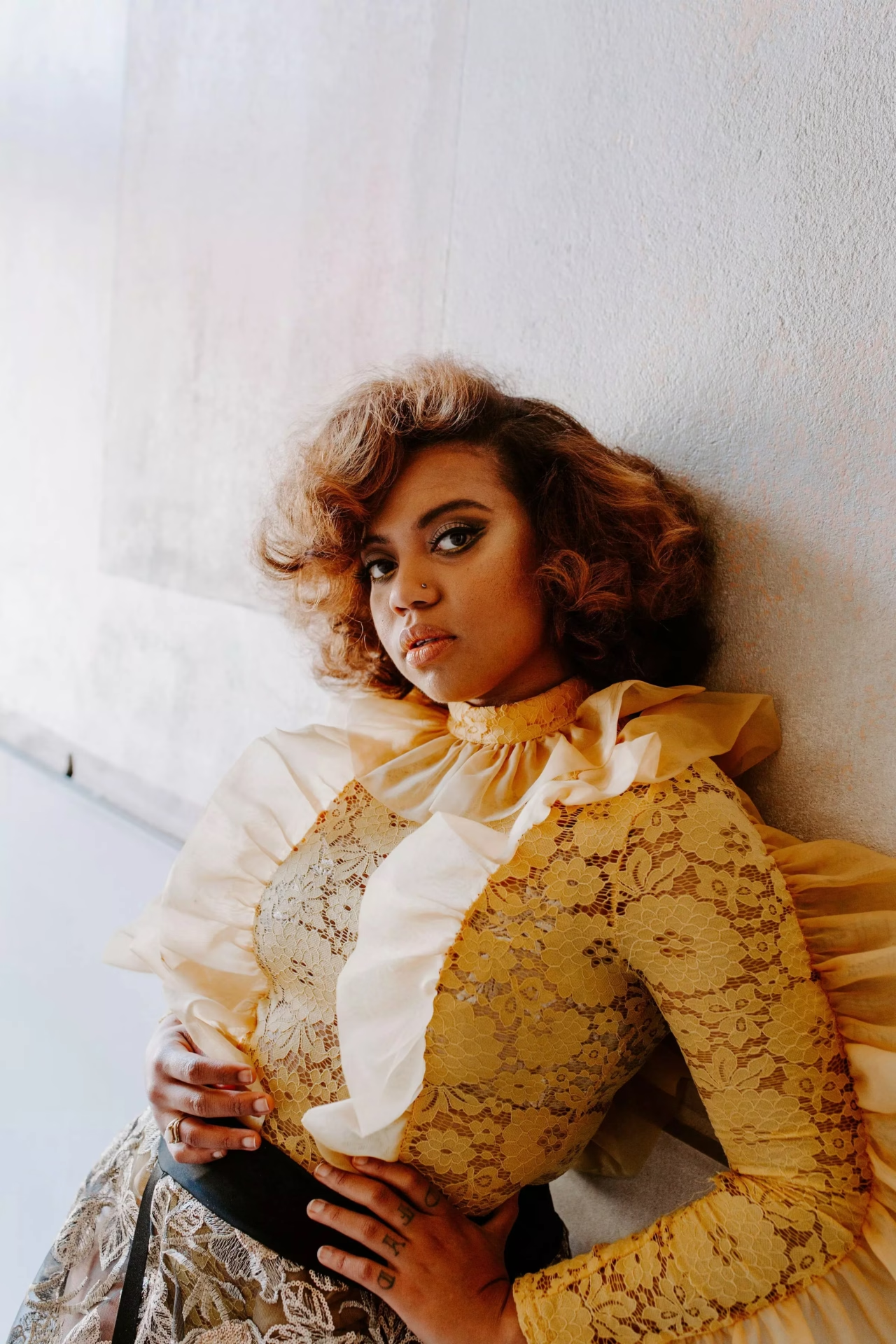
AJ Haynes' quest to empower women offstage began in college after she finished playing a gig. The Seratones frontwoman was hanging out after performing at a women’s clinic with her former cover band when she found herself curious about what the healthcare providers did there. Once she had an overall picture of everything the clinic provided for women, she felt enthralled.
"I started working [there] within the week, and I've worked there off and on for about 10 years," she said in a recent interview with the Recording Academy.
Not that the powerhouse vocalist has stopped performing: her soul-rock band released their sophomore album, Power, just last August. The group's latest is produced by Cage the Elephant’s Brad Shultz, whom Haynes calls "a bolt of electricity."
"Working with him was truly a dream," she says. "There’s a certain honesty and an immediacy he really knows how to channel into song."
<style>.embed-container { position: relative; padding-bottom: 56.25%; height: 0; overflow: hidden; max-width: 100%; } .embed-container iframe, .embed-container object, .embed-container embed { position: absolute; top: 0; left: 0; width: 100%; height: 100%; }</style><div class='embed-container'><iframe src='https://www.youtube.com/embed/HLsNLn4JruE' frameborder='0' allowfullscreen></iframe></div>
But you’ll still find Haynes at Hope Medical Center, in her hometown of Shreveport, La., whenever she’s home from tour.
Haynes has been advocating for women's rights to seek abortions in Louisiana alongside the clinic as the state prepares for a court case that can possibly mean its closure. Obtaining an abortion in the state is legal thanks to Roe vs. Wade, but new legislation may make it even harder to get, as there are only three abortion clinics in Louisiana. Doctors performing abortions must obtain admitting privileges that are often difficult to get from nearby hospitals. A court case to be held on March 4 by the Supreme Court will "hear the clinic's challenge to [the] tough Louisiana law placing new restrictions on doctors who perform abortions. If the law goes into effect, the clinic may have to close down," reports Reuters.
For the singer, her identity as a musician and her identity as an advocate for reproductive rights have become intertwined. Prior to the March 4 court case, and on a pit stop from the Seratones' ongoing tour, Haynes spoke to the Recording Academy about the work she’s been doing to help women learn about their reproductive rights. This interview has been edited and condensed for clarity.
How did you begin your advocacy work for reproductive rights?
I've been working at an abortion clinic as a counselor for 10 years off and on. Reproductive justice has just been a part of my life. I actually got this job because I had a cover band at the time and we got hired to play the Christmas party at the clinic. Afterward, I was hanging out with the owner, the late Robin Rothrock and I was in school at the college across the street. I was like, "Well what do you do there?" because I knew that they provided health services, but I didn't know what all they covered, and she said, "Well, we provide abortion care," and I asked if they needed any help and they had a position as a counselor. I started working like within the week and I've worked there off and on for about 10 years in between working as a teacher, and whenever I'm home, I go in and work as a counselor.
I think of less of what I do now is activism and more of like advocacy. It's just coming from an informed place of being a counselor of having had all this experience working with people one-on-one. To me it's easy. It's like almost second nature because it's such a natural part of my life. I've always been an advocate for reproductive health and for abortion. It's just now that I have a platform and I think the duty of being an artist is that you have the privilege to have this security and safety to say what you want. When I was a teacher, I couldn't do this kind of advocacy work. I'd lose my job. That's the reality that a lot of people are managing is like they have this experience or they have the passion for something that has a major impact on everyone's lives because abortion isn't just about women, right? Abortion is about our communities and how our communities are impacted. Not everyone has the kind of safety to be able to advocate, unfortunately, because we live in such a deeply stigmatized society or because abortion is such a deeply stigmatized thing, when in fact it's our constitutional right. It's scary. I think like the more we can do to open the dialogue around it and to educate people about not only abortion but all of our healthcare process.
What are some of the issues women are going through in regards to reproductive rights in Louisiana?
Well. Some of the legislation restricting access to abortion care is created by people that are not doctors, that don't even know how basic reproductive processes work. They don't even know how miscarriages work. They barely know how periods work and yet they're passing all this legislation that harms our communities. We know
Roe vs. Wade is the law of the land, but why there is no access? You can have a right, but if you don't have access to the things you need, it's almost null and void. And because of all of these restrictions and all of these barriers to access, people suffer.
You are supporting Hope Medical Center in an upcoming court case that involves requiring admitting privileges to abortion providers at hospitals. You don't think that's a good idea, right? Tell us why.
Well, first of all, this is a constitutional precedent that's already been set. What's at stake is not only people's healthcare and our community's welfare, but also the integrity of the constitution. Back in 2016 with the
Whole Woman's Health vs. Hellerstedt case, an exact same restriction was trying to be passed by the state of Texas. Well, that case was struck down. We won that case. This is the exact same, in almost verbatim, the exact same law made with the 5th U.S. Circuit Court of Appeals. So when you look at it like this, we're all kind of scratching our heads like we've been here before. There is a constitutional precedent. 2016, which was not that long ago. So why are we dealing with this again? Why is the state of Louisiana using and wasting taxpayers' money for something that's already been decided?
It's really kind of mind-blowing when you think of it like that. These admitting privileges don't make abortion safe. It doesn't need to be made safe. It's a safe process. These are doctors that are performing a much-needed health service. The admitting privileges don't make this process any safer. In fact, it makes it harder for doctors to be able to do their job ... It's a terrible idea.
<style>.embed-container { position: relative; padding-bottom: 56.25%; height: 0; overflow: hidden; max-width: 100%; } .embed-container iframe, .embed-container object, .embed-container embed { position: absolute; top: 0; left: 0; width: 100%; height: 100%; }</style><div class='embed-container'><iframe src='https://www.youtube.com/embed/LakVRoQayyQ' frameborder='0' allowfullscreen></iframe></div>
Some people think of abortion in a very specific way.
It doesn't matter why someone needs an abortion; it's their constitutional right. And I think that the more we can get away from referring to it as anything other than health, healthcare, anything other than something that's necessary for whatever the situation, right? The stigma is hurting our communities. We never know what someone's reasons are. Or sometimes it is a deeply individual and private, intimate decision and that should be respected. People shouldn't be made to explain why they need access to something that is a constitutional right. Period. There is no ifs, ands or buts. It is their f*****g reason. They need to be supported. They need to be loved, they need to be provided the healthcare that they need. That is the constitutional right.
And so for me, this is about our autonomy. How do we celebrate our lives? Being able to make the decision if, how and when you want to make a family. If, how and when. That's what reproductive justice is about. For me, the [Seratones] song "Power" came together as a way to just encourage people to persist and to continue. I know it is really hard when you don't know what's coming next, but you have the power to fight and to endure and to persist. And that needs to be recognized.
<style>.embed-container { position: relative; padding-bottom: 56.25%; height: 0; overflow: hidden; max-width: 100%; } .embed-container iframe, .embed-container object, .embed-container embed { position: absolute; top: 0; left: 0; width: 100%; height: 100%; }</style><div class='embed-container'><iframe src='https://www.youtube.com/embed/LakVRoQayyQ' frameborder='0' allowfullscreen></iframe></div>
The court case is major because it's the first since the President appointed two Supreme Court justices. What do you hope happens?
I hope that the justices just follow the constitutional precedent, the law of the land that's already been set. This is essentially the same thing that we've already dealt with in 2016 and I hope that from this we also have and develop a greater awareness of how important it is for people to have access to abortion. Not only do I hope that we win the court case, but I hope that from this moment people are really rattled and awakened to see how close we are to losing things that are a constitutional right. I think people don't realize that this applies to everyone. This is not just about abortion care. This is about the integrity of the Constitution. The integrity of the Supreme Court. This is bigger than just us. And I say "us" as in independent abortion health care providers.
Has your advocacy work affected the way you create or see your music work at all?
Absolutely. I mean, my advocacy work and my creative work aren't separate. We're affected by our day to day lives and that's my day to day life; existing as a black woman celebrating this body, celebrating my autonomy, celebrating my freedom, celebrating my power and the power of everyone else within my community. So how would I not be affected by someone trying to systematically and recklessly endanger my life? Because whenever we restrict access to health data, that's what happens. People's lives are in danger. Abortion is healthcare. We can't treat it as if it's anything separate from our processes. For example, miscarriage, birth, all of these human and deeply personal intimate processes where people's space and autonomy need to be respected.
When you have time off, you're at the clinic and when you're not at the clinic, you're touring. Is it fair to say that when you're on tour, you're also doing advocacy work?
Yeah, absolutely. The way it should be, I think you just have to make it all work because this is something that's in court it's something that's worthwhile. As an advocate, I'm not getting on a stage and screaming about abortion because that's not a way to engage people in a way that they can learn. They need to understand my story and they need to understand my humanity, right? We need to teach this elastic empathy and through that opens space and hold a space where we can learn. There's so much misinformation about women's healthcare. Period ... So to address the question of how do I juggle? There's no juggling involved. Our lives aren't as dissectable. If you're a mother, you're a creator. If you're a father, you're a creator. If you're childless, you're creating. And I think that the beauty of being an artist is that I get to allow myself the space to be affected out in the open and to do it in a way that I feel is necessary.
I do want to touch on your tour. How are you liking it?
I don't like the cold, but aside from that, there's been so much warmth and just gratitude and beauty at every one of our shows on days when I'm feeling really worn down because touring is hard. Touring is physically, mentally, psychologically, all of the above, exhausting. But our fans are just incredible. And we have such a diverse group of fans. I have everyone from like, 70-something-year-old German dudes to 14-year-old brown girls. Incredibly diverse. And I think that's a really beautiful thing that these people have. These people coming from such different, well we think of as different, backgrounds. They love what we do because we're speaking the truth. I don't know how to lie and I don't know how not to talk about my experiences. And I think that as an artist you should talk about your experiences with craft. And in a way that does compel people to engage and to have to listen and have to be uncomfortable too. That's how you learn, that's how you grow. And we as artists can demand more of people. I think good artists do. Artists that I admire do.
You mentioned that touring is hard. What do you do for self-care?
I do yoga when I can. Even If I just have my mat with me, I feel better. I try to drink a lot of water and [listen to] audiobooks. I listen to a lot of audiobooks and [have] quiet time. I don't really party a lot either. I know that's breaking the rock and roll stereotype, but I feel like I get so much from performing, that's no party. What more can a girl need?
You all released an album last year. You're on tour now. Do you think you'll take a break before creating something else?
No, girl, I'm ready to write some more. I love the creative process. I actually did some writing before we left for tour. I think you glean from your travels. It's like a discovery process. You tuck something away. Like I'll use that later and you come back to it. But no, you should always be in the mode of creating 'cause it's so fun.
TORRES On Writing Queer Country Songs, The Power Of The Spoken Word And Her New Album, ‘Silver Tongue’