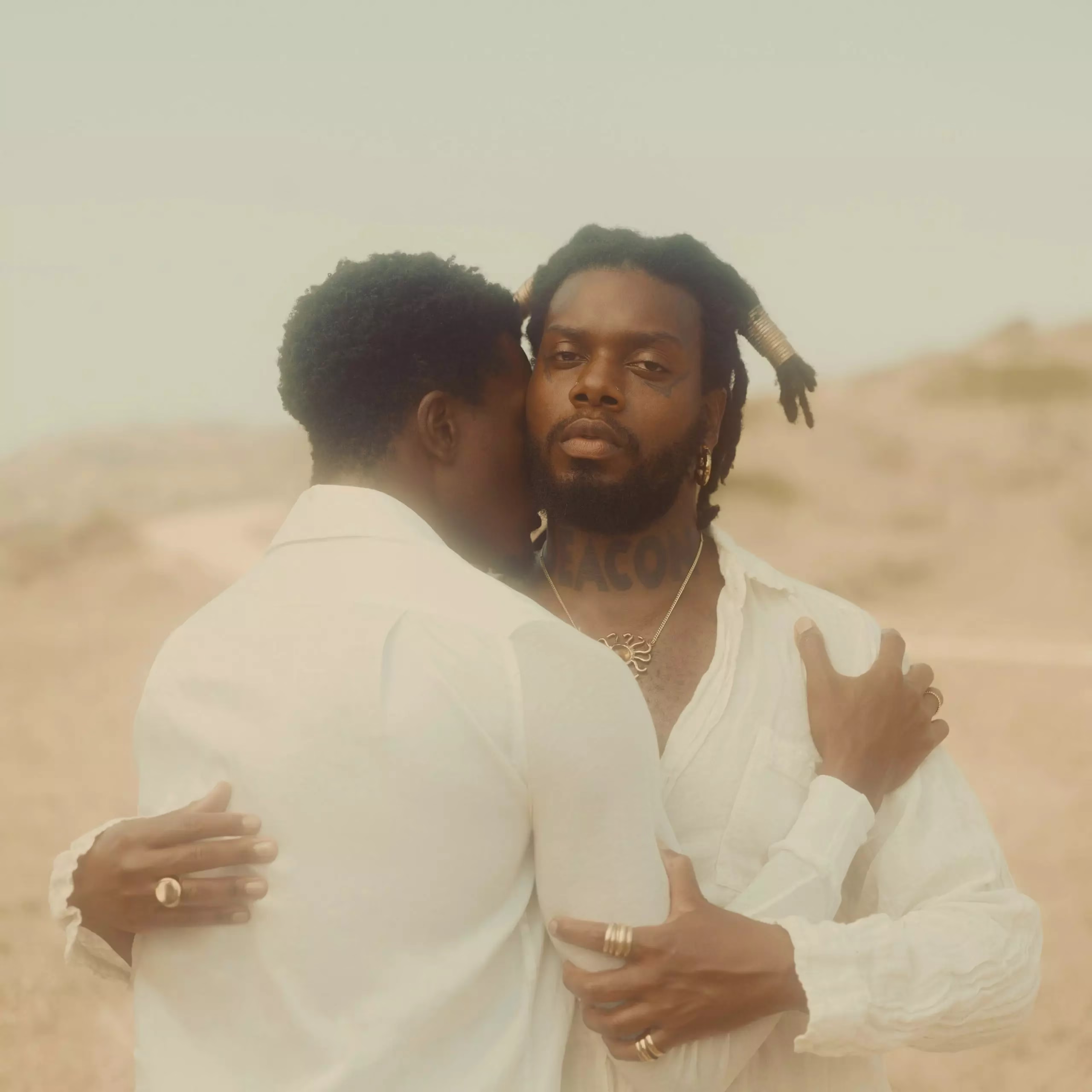
Serpentwithfeet is happy, and you can hear it even when his voice goes beyond language. Midway through “Same Size Shoe” from his new album DEACON, the Baltimore-born singer also known as Josiah Wise introduces a “trumpet” fanfare that’s his own voice layered several times over, heralding a love steeped in understanding and empathy. Released March 26, it celebrates Black gay love with a giddiness to rival pop hits from ‘60s Motown or ‘90s R&B, a pivot from the darker tones of previous serpentwithfeet releases.
The singer enlisted new collaborators like British singers Sampha and NAO (each of whom he had previously opened for in 2016) to attain the album’s bright sound, recorded between Los Angeles and London over the past three years.
On the phone, Wise raves about his current home: “Part of the reason why I love L.A. so much is that people in the industry are so kind. I think it's such a great city because I get to work and I can do sessions and all of this, but then also the people that I work with are so much fun to be around.” Even with 808s from “Mo Bamba” and “Panini” production duo Take A Daytrip, the music hangs in the air like a generous dollop of whipped cream atop a dessert.
DEACON’s joy is a perfect fit for the beginning of spring, as people tentatively return to gathering together safely. “Malik” and “Amir” are composite character sketches of past lovers, while the closing track “Fellowship” celebrates friendship.
"I hope that people are encouraged to be soft, and to be gentle as they can be," Wise says in conclusion. "I think that that's all I can really wish for, is that people listen to this work, and maybe it will give them some encouragement to be gentle."
You just released the Apparition EP in April 2020. What was the development of DEACON like?
The thing is, I'm always working on music, and I like to organize; "Okay, like, this feels like it's part of this particular idea." The Apparition songs definitely didn't fit what I was going for on DEACON. I said, "This should be its own project." It's funny, because people have asked if this is a concept album, and I've never considered any of my projects concept albums, because that just seems really ambitious. But I do think I'm pretty good at knowing what the mood is, and I just knew the mood and the sonic palette for DEACON, so I try to stick within those confines.
The idea was to make something that felt really airy. I really wanted to feel and hear breath, and when I think breath, I think about space, the space to breathe, and about ventilation. That was my interest. Does this album have space? Does it feel loving? Does it feel gentle? Those are the feelings and the ideas I was in pursuit of for DEACON.
Possibly my favorite part of the project is the “trumpet” line on "Same Size Shoe." Can you tell me about writing that fanfare but recording it as a vocal?
I had that idea very early on. And I was uncertain about keeping it because I didn't know if it was too campy, but actually I love the campiness of it now. I just wanted to do a vocal fanfare moment. It's just so apropos. I think that song is so much about celebrating, celebrating Black love, Black gay love, and I just wanted something that felt jubilant and jocular, and doing a vocal fanfare just seemed really appropriate.
Where did the concept for “Same Size Shoe” come from?
I was just thinking about being with someone that I can trust, being someone who I don't have to explain anything to. Being with someone who has a similar cultural reservoir or cultural experience as me—I was writing about dating and being in love with Black men, and just the ease and the trust that is there. When you ask someone to walk in your shoes, well, I hope they wear the same size shoe. Because it's pretty painful if they don't! And that's one of the last lines of the song, like, "You can walk a mile in my shoes, that's why I trust you."
As you're recording and working on music, do you have a set process to keep track of your ideas?
I love being in the studio. But I think there's always an intention for sure, every time I go to the studio. The same way, with every project I've done, I knew what I wanted to do. I keep a little document of all the ideas of "Okay, so for this next thing, this is the territory I want to explore." Or, "I want things that are all above 130 BPM." I have to be pragmatic in that way. It doesn't mean that everything I put out is going to fit that criteria. But it's really helpful for me to start with a set criteria. Maybe that's the school kid in me coming out, like I need direction, and because I don't have a teacher, I'm the instructor. I have to be my own taskmaster.
Is it an emotional process when you're recording, to lay down these vocals, especially if you're recording by yourself?
Well, I've never had a session and started weeping or anything. But there are moments when I surprise myself and I give myself a high five a lot. I forget which writer said this, but they said you aren't writing until you've scared yourself. And I sort of take that same approach to music making, like I'm not making my best music until I've scared myself, or cry to myself, or done something where I feel a little like, "ooh."
"Hyacinth," I think, surprised me the most. It was interesting to see what happened when I got in front of the microphone, where I would have things written out, and then I would start singing, like, “Yeah, this word doesn't work.” I ended up surprising myself. That particular song, I didn't weep or anything, but was very emotional, in a sense, because I had told myself years ago—before I dropped the first EP blisters in 2016—I knew that the next project I wanted to do, I said, I want it to be really loving, and I want to write a song about nature. But I just didn't have a gentle touch. And I think you can have an agenda but sometimes you have to live to execute it.
When I wrote "Hyacinth," I was like, "Whoa, this is what I said I wanted to do five years ago." I was really touched that I was able to write something like that. So, in that way, it can be an emotional or wonderful reflecting process.
Were there any other parts of this recording or the writing that scared or surprised you?
"Sailors' Superstition," with Take a Daytrip. They're genius. It was stepping out of my comfort zone, but in the most wondrous and rewarding way. There was nothing stuffy or uncomfortable about those sessions. I had a lot of fun. They're both also very quick.
I knew I wanted to do something that was more danceable, and we talked about some ideas. When they heard what I wanted, they said, “Okay, great. It needs to be this BPM, we need to have the kicks on the twos,” and they just had their producer lingo. I was like, "How are y'all working like this?" Within 15 minutes, we had an instrumental. Even when I was recording my vocals, I did different takes, and they were like, "Oh, do this one, 'cause you were more in a pocket," or "Use this one, because you'd like your inflection here."
Sampha, while working on "Fellowship," stopped me from singing. I was recording the chorus and he was like, "Stop!" and I was like, "Whoa, I've never had somebody tell me to stop." And he was like, "I'm gonna sing with you, but I want to sing at the same time as you." And then he was like, "Lil Silva, you come and sing too." But that was Sampha's idea, to have us all sing together. Because I was just doing it by myself, and trying to make a really pretty chorus, with my little vocals. And he was like, "Nope, that's not it." But I was open to it, because it's Sampha.
The harmonies on "Fellowship" reinforce the theme of the song. Can you tell me about that song as a platonic love song?
I think friendship is such a wonderful, magical gift. And I definitely do feel like I have been gifted with friendship, and obviously, I've worked for it and all of that. "Fellowship," we wrote in 2019. And I was just thinking about how wonderful it is that I have people in my life that I can be my full self with, that I don't have to be around my friends and wonder, "Oh, can I not crack that joke," or "Can I not talk about my dreams, because they might sh*t on my dreams?" Or “Can I not wear this crazy outfit?”
My friends have seen me in so many different times in my life, and a lot of my friends I've had for years. I mean, I'm still friends with people from high school and college, and they're so, not just accepting, but they celebrate me and I celebrate them. And we also have lots of fun together now in the same way that we laughed and cut up when I was 16.
To me, this album sounds very happy and positive and upbeat. Are there any undercurrents of negative emotions, or bittersweetness to these songs for you?
I don't think so. So much of my previous work was about bittersweetness. The bittersweetness of grief, because grief means that you have loved, grief means that you have cared and you've been cared for. What I was talking about on [my 2018 album] soil, my grief was a response to having such a wonderful love experience.
But this time around, I didn't want that bittersweetness. I wanted to talk about maintaining and celebrating the love that I have in my life. And you know, I was very intentional about editing lyrics for a long, long time to make sure that there was no angst or bitterness. That took a lot of time, actually, to make sure that it actually felt joyous, and not fake joyous or half-joy.
Are there other works that fill that same space of celebrating Black gay love for you?
I'm inspired by so many different things. I think about TV shows, like I look at “Noah's Ark,” which I show a clip of actually in "Same Size Shoe." “Noah's Ark” is a TV show about a group of Black gay men. And there's the film Tongues Untied by Marlon Riggs, which is about Black gay men. I have so many different references, where I'm like, "Okay, how do I take that warmth from Queen Sugar and put it into a song?”
In addition to that, I was just thinking about loving songs that just feel like a balm. Like Janet Jackson's Damita Jo, specifically, the downtempo songs, like, "Spending Time With You," or Brandy's song "When You Touch Me" from Full Moon. I think I've had so many examples of how I can make a sweet song, like Musiq Soulchild's "Just Friends," which gave me a lot of information, when he says, "I'm not trying to pressure you, I just want to be your homeboy." Like, can we just be friends? So I was thinking about all those different artists that have offered such generous tunes.
I love the word generous that you used, and I want to turn it around to you. Does it feel like you are offering a lot of yourself to the world, like you yourself are being generous in this album that follows in those songs' footsteps?
Absolutely. My goal is always to be emotionally available. And some days are better than others, obviously, but that's always my goal. With writing these songs, I was very intentional about wanting to be emotionally available, and also wanting to sing about men who are emotionally available. And I think emotional availability and generosity go hand in hand.
What is your day-to-day like in recent weeks now that the project is done?
I'm taking a moment. I think it's important to celebrate. I'm a big fan of celebrating. I'm still working, 'cause I have a [livestream] show coming up and all that. But, I do plan to celebrate, take a moment, reflect. That's all part of the process, too.
