The two most enduring and unshakable attributes of "Sesame Street"'s 50 years on the air have been multicultural unity and education in the creative arts. And it was music that’s proven to be the quintessential conduit connecting these two primary factors in the program's half-century of success throughout its entire run on television.
Whether it was the creative use of analog synthesizers at the beginning of the very first episode aired on Nov. 9, 1969 to the Pointer Sisters’ pinball song to the guest appearances from such superstars as Stevie Wonder, Tony Bennett, Cher, Cab Calloway, Chaka Khan, Linda Ronstadt and so many more on through to the numerous GRAMMY Awards the show's music department has won over the decades, music has always been the nucleus that keeps the power charged at 1234 Sesame Street.
<iframe width="620" height="349" src="https://www.youtube.com/embed/LXsDsKBwbxM" frameborder="0" allow="accelerometer; autoplay; encrypted-media; gyroscope; picture-in-picture" allowfullscreen></iframe>
But perhaps the most appealing aspects of the show’s lifelong love affair with recorded sound has been the virtual songbook that’s been created through the years of Sesame’s world famous song parodies—utilized to put a child-friendly and educational spin on a current hit song of the day.
Here are 10 parodies of other people’s songs that the fantastic songwriting crew at "Sesame Street" have lovingly made their own through the years.
"Two Princes" by The Spin Doctors
<iframe width="620" height="349" src="https://www.youtube.com/embed/7AVuvbFD3gU" frameborder="0" allow="accelerometer; autoplay; encrypted-media; gyroscope; picture-in-picture" allowfullscreen></iframe>
"I happened to be watching television one day and as I flipped through the channels I saw Peter Sellers on 'Sesame Street,'” recalls Spin Doctors frontman Chris Barron to the Recording Academy about the band’s appearance on Episode 3450 in Feb. 1996. "'Classic,' I thought, and I watched the rest of the segment. Peter Sellers was followed by Aretha Franklin, Tom Hanks, Julia Roberts and Bruce Springsteen. I called my agent and asked her to call them and see if they wanted Spin Doctors. They got right back and said they'd love to have us.
"Standing on my mark with Telly, the Muppet, I confided to him that I had never worked with puppets before. He put his paw on my forearm, leaned it conspiratorially, and said, 'To tell the truth, neither have I.'"
The show has an amazing creative department who came up with the 'cooperation' version 'Two Princes.' When we arrived on the set, I tweaked a few of the lines to make them sing a little bit better. Standing on my mark with Telly, the Muppet, I confided to him that I had never worked with puppets before. He put his paw on my forearm, leaned it conspiratorially, and said, 'To tell the truth, neither have I.'
You can see that I’m laughing at the beginning of the clip as I walk on camera. I’m very proud to have been a part of that show. Not only because of the great people who have also made appearances, but to be a part of some of the greatest educational programming ever, not to mention, 'Sesame Street' was a big part of my childhood."
"Happy, Furry Monsters" by R.E.M.
<iframe width="620" height="349" src="https://www.youtube.com/embed/J9G1FhQUnSo" frameborder="0" allow="accelerometer; autoplay; encrypted-media; gyroscope; picture-in-picture" allowfullscreen></iframe>
It’s hard to really pinpoint what makes this "Sesame Street" version of what many R.E.M. fans consider the group's biggest sonic faux pas so wonderful upon its premiere on Episode 3829 in 1998. Maybe "Daysleeper" from their then-new album Up didn’t jibe with the Muppets. Perhaps it was all centered around that Muppet version of Kate Pierson of the B-52's. When we asked the men themselves, however, this even shinier, happier version of their 1991 hit single had always made sense as a "Sesame" song.
"We might not have done other songs with the Muppets but that one fitted," Mike Mills told the Sun in 2016. "They had already rewritten it as 'Furry Happy Monsters' and we said, ‘All right, why not?’ It’s not as if we were tarnishing its legacy.” That same year, Michael Stipe told NBC's Willie Geist, "It was a song written for children, and it’s still enjoyed in elementary schools around the world as far as I know.
"1234" by Feist
<iframe width="620" height="349" src="https://www.youtube.com/embed/fZ9WiuJPnNA" frameborder="0" allow="accelerometer; autoplay; encrypted-media; gyroscope; picture-in-picture" allowfullscreen></iframe>
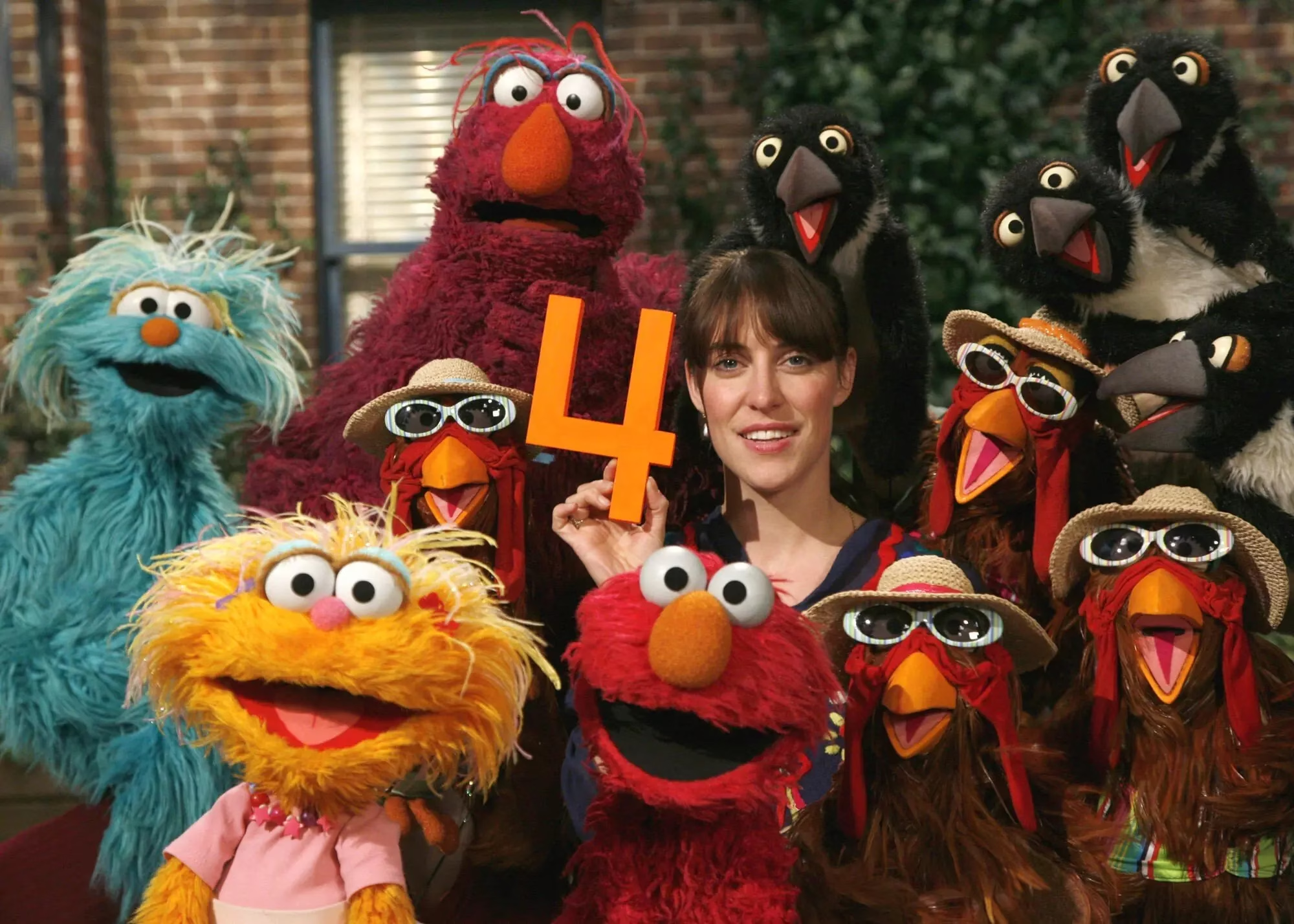
In the Aug. 22, 2019 edition of the New York Times, Leslie Feist spoke at length with writer Melena Ryzik about how her 2007 indie-pop smash "1234" has become more renowned among preschoolers than hipsters in the decade since the tune received its Muppet makeover in 2008 on Episode 4161, the first episode of the show's 39th season that year.
"Do you mind, my 3-year-old has watched it 7,000 times," Feist told the Times in regards to the countless instances she’s been stopped by parents for an autograph. "And I say yes, but I always joke: You notice me because you’re a grown-up—the 3-year-olds are really only interested in the puppets. And without fail, the kids are just sort of looking at me like, who is this weird lady in the airport?’"
But the proof is in the viewer numbers on YouTube. As it stands at press time, the "Sesame" version of "1234" has 281,064,113 views, while the original is capped at 13 million.
"Wrong" by Waylon Jennings
<iframe width="620" height="349" src="https://www.youtube.com/embed/-pOdnRQcsPk" frameborder="0" allow="accelerometer; autoplay; encrypted-media; gyroscope; picture-in-picture" allowfullscreen></iframe>
"Sesame"'s first foray into movie theaters with 1985's "Follow That Bird" indeed teemed with heavyweight cameos by such comedy legends as Chevy Chase, John Candy and Sandra Bernhardt. But for young music heads, it was the appearance of the late, great Waylon Jennings as a truck driver who picks up Big Bird along the way, and the two sing a duet together on a song called "Ain’t No Road Too Long" written by the songwrtiting team of Jeff Pennig, Jeff Harrington, and Steve Pippin with additional vocals by Gordon, Grover, Olivia and the Count.
But it was in 1990 when Jennings made his official debut on the Street, appearing on episode 2850 to perform "Wrong," a song from the country great’s then-new album The Eagle, retooled to encourage Big Bird to build a properly standing block tower. Waylon and Big Bird puppeteer Carroll Spinney became pals, with Spinney going on tour with Jennings in the early '90s, where he'd make a cameo as Oscar the Grouch, the other main character he controlled. "It was more like rock 'n' roll than country," Spinney told the Muppets-based blog Tough Pigs. "And when we were in Nashville, he asked me to have Oscar ask him, 'Hey Waylon, what's the best thing about Garth Brooks?’ And then I’d answer him, 'He ain't here!'"
"Just The Way You Are" by Billy Joel
<iframe width="620" height="349" src="https://www.youtube.com/embed/hHC3M7KL2ns" frameborder="0" allow="accelerometer; autoplay; encrypted-media; gyroscope; picture-in-picture" allowfullscreen></iframe>
"You hear the song and then you get the piano," Billy Joel assures Oscar the Grouch when he guest starred on Episode 2533 alongside actress Marlee Matlin, mere months removed from her role as a member of the cast for Alex Cox's 1987 Joe Strummer-soundtracked masterpiece Walker. That was the deal the Piano Man set for the Grouch in order to let the beloved garbage monster keep the keys, and Oscar then begrudgingly sat through Joel serenading him with a sweet version of his 1977 hit ballad "Just The Way You Are" as Matlin translated the lyrics in American Sign Language.
Joel's appearance in 1988 came at a time when he had installed a bit of a moratorium on "Just The Way You Are," following his 1982 divorce from first wife Elizabeth Weber. But given he had a little three-year-old Alexa Ray Joel was undoubtedly an avid viewer of the show must have surely cajoled him into changing his tune.
"Don’t Know Y" by Norah Jones
<iframe width="620" height="349" src="https://www.youtube.com/embed/FEzxchU4RUY" frameborder="0" allow="accelerometer; autoplay; encrypted-media; gyroscope; picture-in-picture" allowfullscreen></iframe>
“You came!” smiled Norah Jones to the Letter Y after leading a chorus of all the surviving members of the original "Sesame Street" cast through a welcome song that brought in HBO's 50th Anniversary special on Veteran's Day weekend 2019. It was the perfect little cherry on top of an already impossibly endearing segment that lovingly harkens back to her first appearance on the show on Episode 4081 in May 2004 when she serenaded Elmo with a vowel-friendly version of the song rewritten by longtime "Sesame Street" songwriter Christine Ferraro. "I was supposed to meet my friend today, the Letter of the Day," she told Elmo before breaking into the song. "But Y never showed up." Then they start reflecting on all the "Y" words they know until the penultimate letter in the alphabet finally showed up.
"Hold My Hand" by Hootie & The Blowfish
<iframe width="620" height="349" src="https://www.youtube.com/embed/7B3P-WANiQk" frameborder="0" allow="accelerometer; autoplay; encrypted-media; gyroscope; picture-in-picture" allowfullscreen></iframe>
Even the most ardent Hootie hater cannot help but get the feels for this insanely sweet reworking of their biggest hit, effortlessly rewiring it into a song about—what else?—practicing safety when crossing the street. "I don't know how that came together, but it was really fun," recalls guitarist Mark Bryan, speaking to the Recording Academy. "And they re-wrote the lyrics, not us. We were working off of an instrumental track so we had to re-sing everything, backgrounds and all. On set, I got to pop up through Oscar's trash can, and sit in Big Bird's nest. Literally felt like a little kid."
"There was a palpable magic being on the set of 'Sesame Street' that morning, even as an adult," adds Hootie's chief songwriter, multi-instrumentalist Jim Sonefeld. "It was only slightly dulled by the physical state I was in after another late night in Manhattan. This was a big stretch to have someone change our lyrics this drastically, especially after three self-penned platinum albums. The only reason we did it was the special place in our hearts we all still held for 'Sesame Street.' I remember the producers being grateful for our willingness and ability to adjust to the new lyrics so quickly. They did not have the same level of thanks after seeing our acting skills."
"Barn In The U.S.A." by Bruce Stringbean And The S Street Band
<iframe width="620" height="349" src="https://www.youtube.com/embed/YBqI1YrY6v8" frameborder="0" allow="accelerometer; autoplay; encrypted-media; gyroscope; picture-in-picture" allowfullscreen></iframe>
This farm animal singalong from Episode 2991 in 1991 highlights the talents of "Sesame Street"'s longtime in-house lyricist Emily Perl Kingsley, who worked on the show from 1970 to 2015 when she retired having one 21 Emmy Awards for her efforts through the years. As one YouTube viewer commented, this version of the Bruce Springsteen anti-war anthem has a little darkness on the edge of its town in this version led by "Bruce Stringbean And The S Street Band" featuring performances by such Sesame power players as show songwriter Christopher Cerf, the Voice of Elmo himself Kevin Clash, Elmo's World creator Jim Martin and Avenue Q puppeteer Rick Lyons, among others. The song would also be featured on the Children’s Television Workshop album Sesame Street: Born To Add.
"Letter B" By The Beetles
<iframe width="620" height="349" src="https://www.youtube.com/embed/WmVd9F1fW00" frameborder="0" allow="accelerometer; autoplay; encrypted-media; gyroscope; picture-in-picture" allowfullscreen></iframe>
Many "Sesame Street" viewers might not immediately know the name Richard Hunt without Googling. But they will most certainly know many of the beloved Muppets he had voiced in his all-too-short life after succumbing to an AIDS-related illness in 1992. Scooter, Janice, Statler, Beaker and Junior Gorg from "Fraggle Rock" were just some of the characters he portrayed through the years. But one of his truly best works just turned 40 this year when he captained an insect beat group called The Beetles through a rewiring of the title track to the Fabs' 1970 swan song to celebrate everyone's favorite first consonant in the alphabet. You can really hear the Harry Nilsson influence in Hunt’s voice as he sings as well, allowing the song to seamlessly survive ear appeal beyond the visual aspect, giving light to his immense talent taken from us far too soon.
"Don't Take Your Ones To Town" by Johnny Cash
<iframe width="620" height="349" src="https://www.youtube.com/embed/ML686-Dst08" frameborder="0" allow="accelerometer; autoplay; encrypted-media; gyroscope; picture-in-picture" allowfullscreen></iframe>
One of the more harrowing gunfighter ballads in the Johnny Cash canon is the cautionary tale "Don't Take Your Guns To Town" from the Man in Black's 1958 LP The Fabulous Johnny Cash. But in 1991, Cash saw his classic tune retold on Episode 2982 into "Don't Take Your Ones To Town," penned by in-house lyricist Christopher Cerf. The "Sesame Street" version finds Big Bird playing "Birdie-Big," a cowpoke who counts to 1 all over town in lieu of Cash's warning until he meets the Count and the Countess, who teach him to count higher.
Revitalized Sesame Street Records Is Stepping Into The Streaming Age
