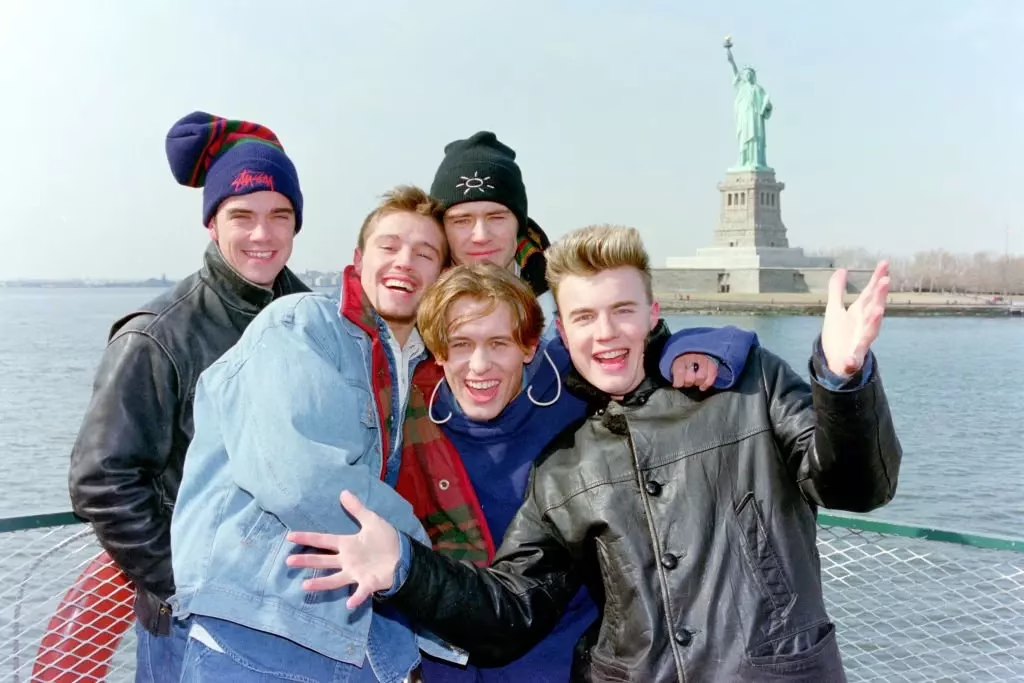
The single mix of "Never Forget," the last track extracted from Take That's third studio album Nobody Else, appropriately begins with "Tuba Mirum" from Verdi's Requiem followed by an intro by the Henllan Boys Choir. Their last LP before disbanding in early 1996, Nobody Else (and "Never Forget" in particular), would mark the departure of Robbie Williams, who left the band precisely during the promotion of this single.
The track's impromptu opening would prove to be weirdly fitting in the short run, not only because a Requiem always presumes some sort of death or loss being publicly mourned, but also due to the choir used as the track's prologue eerily evoking the Rolling Stones' Let It Bleed closer "You Can't Always Get What You Want"—curiously their last album to feature fifth element (and founding member) Brian Jones. Uncannily enough, both albums were released amidst a series of tumultuous events that turned both 1969 and 1995 into anni horribiles for those who had once been considered fundamental and arguably the most charismatic members of their respective bands: Brian Jones would be found dead in his swimming pool before Let It Bleed even hit the shelves; Williams would mercifully have better luck, but for a moment there it certainly didn't seem like it.
Although he had always been the most difficult to "tame" by manager Nigel Martin-Smith, by 1995 Williams' increasingly erratic behavior and public drug usage (just like Jones) had become a nuisance to the band. After a near-overdose in November of the previous year on the eve of the MTV European Music Awards that almost led to the cancelation of the band's performance altogether, Smith, Barrow and Orange confronted Williams, eventually leading to the latter's departure from Take That in July. He would remain virtually idle music-wise, not releasing anything until the following year—this not only due to a clause in his contract that prevented him from dropping any solo material until Take That's disbandment, but also (if not mainly) because of a direction-less, self-destructive attitude that could've easily costed him his life.
<style>.embed-container { position: relative; padding-bottom: 56.25%; height: 0; overflow: hidden; max-width: 100%; } .embed-container iframe, .embed-container object, .embed-container embed { position: absolute; top: 0; left: 0; width: 100%; height: 100%; }</style><div class='embed-container'><iframe src='https://www.youtube.com/embed/N2ICtCO8TCw' frameborder='0' allowfullscreen></iframe></div>
Nobody Else—and "How Deep Is Your Love" as its inevitable epilogue—would probably have been the honorable final opus from one of the greatest boy bands of the 1990s had Barlow succeeded in having the solo career he had always dreamed of, and apart from the occasional reunion whenever royalties' money happened to run low should've been the last we had seen of Take That as an active group. Although the album is by no means of the careless, constant quality of its predecessor—Everything Changes takes itself much less seriously, which arguably makes it superior in the Pop department; it encapsulates a powerful symbolism regarding the self-undoing of a phenomenon that would be impossible to replicate (or even create) on purpose. Where "Sure" and "Back For Good" lead as two of Take That's greatest singles ever, "Never Forget" follows as a prophecy by bringing the band full circle and referencing their roots in the weird, untimely tribute that constitutes the music video, but also by marking the exact time their deterioration would begin: following Williams's departure, the remaining quartet would also go their separate ways in less than a year. The fact that the song features Howard Donald on lead vocals also evokes a replacement, again unpremeditated and prophetic, and a bitter aftertaste is left unresolved until the reprise of the Bee Gees' classic.
<style>.embed-container { position: relative; padding-bottom: 56.25%; height: 0; overflow: hidden; max-width: 100%; } .embed-container iframe, .embed-container object, .embed-container embed { position: absolute; top: 0; left: 0; width: 100%; height: 100%; }</style><div class='embed-container'><iframe src='https://www.youtube.com/embed/CTqabbIPfc0' frameborder='0' allowfullscreen></iframe></div>
Suddenly, they sounded so old. By 1995 it seemed they'd been about it for too long, reaching that critical point between freshness and consecration most acts find increasingly hard to overcome the bigger a phenomenon they are. In Take That's case, this crisis also derived from what is tactfully put as "personal and artistic divergences," with Williams wanting to embark in a new musical direction by growing dissatisfied with the puppy-eyed ballads that seemed to propel the group forward—but how could he even begin to argue with the insane explosion that was "Back For Good"? At the tender age of 21, Williams was given the choice of either get with the program or quit it altogether—the latter being what he ended up doing, not without a grudge against his former band colleagues he'd hold for many years to come, preventing him from rejoining the group or even agreeing to the odd appearance (remember he bluntly refused to meet the gang for the 2005 iTV documentary For The Record). His feud with Barlow in particular would feed a tabloid thirst for blood when, at first, "Forever Love" and "Love Won't Wait" seemed to allow Barlow to hold the upper hand—unsurprisingly so, since he had been Take That's main songwriter. But with "Angels" the tables turned, and the rest is history. The hatchet would nevertheless take a while to bury: the publicly reconciliatory "Shame" wouldn't arrive until 2010.
Nobody Else is a solid album that in spite of lacking the freshness commonly associated with boy bands delivers exactly what Everything Changes had promised two years prior: the maturity of a phenomenon that would implode if forced to remain static. But it is also terribly melancholic and fragmented, not so much in terms of style but in the way it seems to address a lost youth dream when most members were still in their mid-20s. For what it's worth, Take That as we knew them stopped then and there, and the revival over ten years later just felt like a completely different band.
<style>.embed-container { position: relative; padding-bottom: 56.25%; height: 0; overflow: hidden; max-width: 100%; } .embed-container iframe, .embed-container object, .embed-container embed { position: absolute; top: 0; left: 0; width: 100%; height: 100%; }</style><div class='embed-container'><iframe src='https://www.youtube.com/embed/yoO_1FFr56k' frameborder='0' allowfullscreen></iframe></div>
Celebrating Nobody Else as the closing piece of the band's original trinity (Take That & Party and Everything Changes complete the lot) seems easier now that 25 years have gone by and we are granted the appropriate hindsight to appreciate it as more than a frivolous ephemeral fad. An essential bridge to understand the road U.K. Pop music carved between '80s Hi-NRG and '90s Britpop explosion, Take That predictably bowed out as the infamous Oasis/Blur single battle showed both the press and the public had long shifted towards a different focal point: after having filled a very specific gap in time and place, Nobody Else sounded like the proper goodbye. Ideally, with no reprises.
Backstreet Boys Talk GRAMMY Museum "Experience," 'Millennium' Legacy & Touring